Ohio: Right of way & turning — Part 3 Practice Test
Questions in this part include: “Which part of the roadway must you generally drive on?” · “Where should you not attempt to pass?”
Independent educational site · not affiliated with any government agency or DMV
Ready? Test yourself
- Instant feedback with an explanation
- Every answer cites its source in the manual
- Your best score is saved on this device
Questions are original and based on the official manual "Ohio Driver Manual" (HSY 7607 10/25 (October 2025)), Ohio Bureau of Motor Vehicles.
All 17 questions in this practice test
Take the test above first, then use this list to study. Tap “Show answer” to see the correct answer and explanation.
Show the questions and answersHide the questions
-
Which exit of a roundabout do you use to make a U-turn?
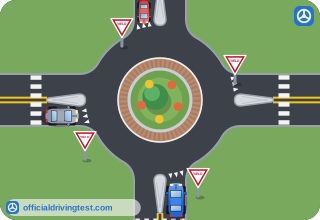
- The 1st exit
- The 4th exit
- The 2nd exit
- The 3rd exit
Show answer
Correct answer: The 4th exit
The manual says to use the 4th exit to make a U-turn.
Source: Ohio Driver Manual (HSY 7607 10/25 (October 2025)), page 18
-
Which part of the roadway must you generally drive on?
- The left half
- The center of the road
- Whichever half has less traffic
- The right half
Show answer
Correct answer: The right half
The manual says to drive on the right half of the roadway except in certain listed situations.
Source: Ohio Driver Manual (HSY 7607 10/25 (October 2025)), page 18
-
Which of these situations allows you to drive on the left half of the roadway?
- The road is wet or icy
- You are driving slower than the other traffic
- The road is divided into three or more marked lanes
- You are following a large truck
Show answer
Correct answer: The road is divided into three or more marked lanes
The manual lists driving on a road divided into three or more marked lanes as an exception to driving on the right half.
Source: Ohio Driver Manual (HSY 7607 10/25 (October 2025)), page 18
-
If an obstruction makes it necessary to drive left-of-center, what must you do?
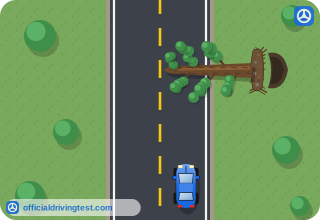
- Yield the right-of-way to oncoming traffic
- Sound your horn and keep moving ahead
- Flash your headlights and then proceed
- Speed up to clear the obstruction quickly
Show answer
Correct answer: Yield the right-of-way to oncoming traffic
The manual says to yield the right-of-way to oncoming traffic when an obstruction forces you left-of-center.
Source: Ohio Driver Manual (HSY 7607 10/25 (October 2025)), page 18
-
On a road with four or more lanes, which lane should you normally drive in?
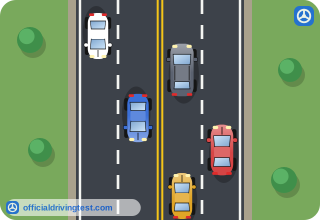
- The lane just right of center
- The left-most lane
- Whichever lane is moving fastest
- The right lane
Show answer
Correct answer: The right lane
The manual says to drive in the right lane on a road with four or more lanes.
Source: Ohio Driver Manual (HSY 7607 10/25 (October 2025)), page 18
-
On a road with four or more lanes, which lane do you use to pass and to make left turns?
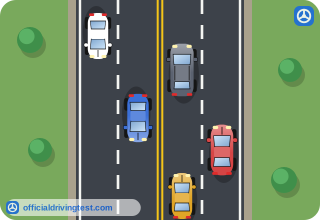
- The right lane next to the curb
- The lane just right of center
- The paved shoulder on the left
- The paved shoulder on the right
Show answer
Correct answer: The lane just right of center
The manual says to use the lane just right of center to pass and make left turns.
Source: Ohio Driver Manual (HSY 7607 10/25 (October 2025)), page 18
-
How should you check your blind spots before changing lanes?
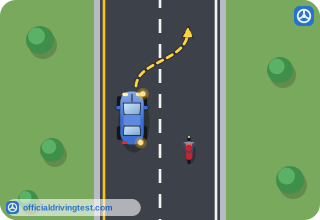
- Turn your head and look over your shoulder in the direction you plan to move
- Glance only at the side-view mirror on the side you will move to
- Adjust both mirrors so they cover the lane you plan to move into
- Check your rear-view mirror twice while holding the wheel steady
Show answer
Correct answer: Turn your head and look over your shoulder in the direction you plan to move
The manual says blind spots are checked by turning your head and looking over your shoulder in the direction you plan to move.
Source: Ohio Driver Manual (HSY 7607 10/25 (October 2025)), page 19
-
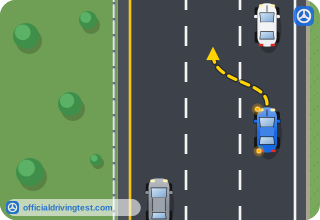
After you identify a gap in traffic and signal, what should you do before changing lanes?
- Sound your horn to let the other drivers know
- Brake firmly to create a larger gap behind you
- Look again in the direction of the lane change
- Change lanes at once because the signal has been given
Show answer
Correct answer: Look again in the direction of the lane change
The manual says to identify a gap, signal, and look again in the direction of the lane change.
Source: Ohio Driver Manual (HSY 7607 10/25 (October 2025)), page 19
-
What is the last step the manual lists for changing lanes?
- Sound your horn
- Cancel your turn signal
- Turn on your hazard lights
- Check your speedometer
Show answer
Correct answer: Cancel your turn signal
After adjusting speed and steering into the lane, the manual says to cancel your turn signal.
Source: Ohio Driver Manual (HSY 7607 10/25 (October 2025)), page 19
-
When you pass another vehicle, how long should you continue to pass before returning to your lane?
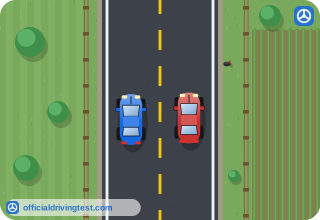
- Until you have gone one full car length beyond the vehicle you passed
- Until the passed vehicle slows down
- Until you see the passed vehicle in your side-view mirror
- Until both headlights of the passed vehicle are visible in your rear-view mirror
Show answer
Correct answer: Until both headlights of the passed vehicle are visible in your rear-view mirror
The manual says to continue to pass until both headlights of the passed vehicle are visible in the rear-view mirror.
Source: Ohio Driver Manual (HSY 7607 10/25 (October 2025)), page 20
-
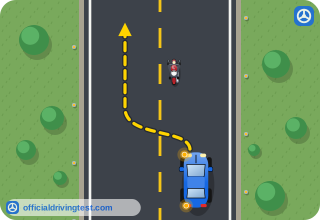
When passing, what should you check in addition to oncoming traffic?
- Only the vehicle directly ahead of the one you are passing
- Only the speedometer to confirm the speed limit
- Your mirrors and over your shoulder for following or passing vehicles
- Only your rear-view mirror for the vehicle behind you
Show answer
Correct answer: Your mirrors and over your shoulder for following or passing vehicles
The manual says to check for oncoming traffic, then check your mirrors and over your shoulder for following or passing vehicles.
Source: Ohio Driver Manual (HSY 7607 10/25 (October 2025)), page 20
-
What should you do when another vehicle is passing you?
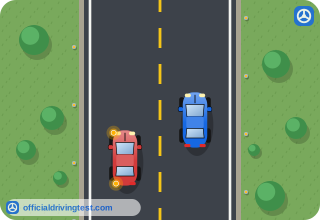
- Stay in your lane and maintain a constant speed
- Speed up to keep the other driver behind you
- Slow down and move partly onto the shoulder
- Drift toward the center line to give the driver room
Show answer
Correct answer: Stay in your lane and maintain a constant speed
The manual says to stay in your lane and maintain a constant speed to allow the driver to pass you.
Source: Ohio Driver Manual (HSY 7607 10/25 (October 2025)), page 20
-
In which situation should you not attempt to pass?
- When you are in a marked passing zone
- When the vehicle ahead is a motorcycle
- When you are traveling below the speed limit
- When your view is blocked by a curve or a hill
Show answer
Correct answer: When your view is blocked by a curve or a hill
The manual says not to pass when your view is blocked by a curve or a hill.
Source: Ohio Driver Manual (HSY 7607 10/25 (October 2025)), page 20
-
Where should you not attempt to pass?
- On a straight road with no traffic
- Before a highway-railroad crossing or bridge
- On a road divided into three or more marked lanes
- On a road designed and posted for one-way traffic
Show answer
Correct answer: Before a highway-railroad crossing or bridge
The manual says not to attempt to pass before a highway-railroad crossing or bridge.
Source: Ohio Driver Manual (HSY 7607 10/25 (October 2025)), page 20
-
Which of these is a place where you should not attempt to pass?
- At intersections
- On a straight road with a broken yellow line in your lane
- On the left-most lane of a multi-lane road
- On a long, straight rural road in daylight
Show answer
Correct answer: At intersections
The manual lists intersections among the places where you should not attempt to pass.
Source: Ohio Driver Manual (HSY 7607 10/25 (October 2025)), page 20
-
On a multi-lane road, what is the left-most lane intended for?
- Driving at the highest speed in the flow of traffic
- Driving in any lane other than the right-most lane
- Passing slower vehicles
- Stopping to let other traffic pass
Show answer
Correct answer: Passing slower vehicles
The manual says the left-most lane on multi-lane roads is intended for passing slower vehicles.
Source: Ohio Driver Manual (HSY 7607 10/25 (October 2025)), page 21
-
Where may you never pass another vehicle?
- In the left-most lane of a multi-lane road
- On the shoulder, whether it is paved or not
- On a road with three or more lanes
- In a zone where the broken yellow line is in your lane
Show answer
Correct answer: On the shoulder, whether it is paved or not
The manual says never to pass on the shoulder, whether it is paved or not.
Source: Ohio Driver Manual (HSY 7607 10/25 (October 2025)), page 21