Ohio: Right of way & turning — Part 1 Practice Test
Questions in this part include: “What does right-of-way describe?” · “When making a turn, which lane should you enter and maintain?”
Independent educational site · not affiliated with any government agency or DMV
Ready? Test yourself
- Instant feedback with an explanation
- Every answer cites its source in the manual
- Your best score is saved on this device
Questions are original and based on the official manual "Ohio Driver Manual" (HSY 7607 10/25 (October 2025)), Ohio Bureau of Motor Vehicles.
All 18 questions in this practice test
Take the test above first, then use this list to study. Tap “Show answer” to see the correct answer and explanation.
Show the questions and answersHide the questions
-
What does right-of-way describe?
- The minimum distance a driver must keep between vehicles on a roadway
- The part of the road reserved for vehicles that are turning left or right
- The priority of traffic flow: who may proceed first in a given situation
- The highest speed at which a driver may travel on a particular road
Show answer
Correct answer: The priority of traffic flow: who may proceed first in a given situation
Right-of-way is the priority of traffic flow, meaning who has the right to proceed with precedence over others in a situation or place.
Source: Ohio Driver Manual (HSY 7607 10/25 (October 2025)), page 10
-
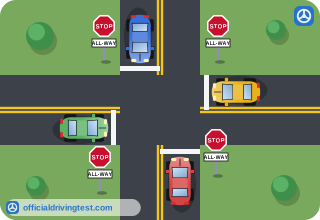
At an intersection, you must yield the right-of-way to which driver?
- The driver who is traveling the fastest
- The driver who is at the intersection or arrives before you
- The driver who arrives at the intersection after you
- The driver of the largest vehicle at the intersection
Show answer
Correct answer: The driver who is at the intersection or arrives before you
The manual lists the driver who is at or arrives before you at an intersection as someone to yield to.
Source: Ohio Driver Manual (HSY 7607 10/25 (October 2025)), page 10
-
When you are making a left turn, to whom must you yield the right-of-way?
- Drivers who are stopped behind you
- Drivers who are parked along the curb
- Only drivers who are in a larger vehicle than yours
- Drivers in the opposing traffic lane
Show answer
Correct answer: Drivers in the opposing traffic lane
The manual says to yield to drivers in the opposing traffic lane when you make a left turn.
Source: Ohio Driver Manual (HSY 7607 10/25 (October 2025)), page 10
-
If you and another driver arrive at a four-way intersection at the same time, which driver must you yield to?
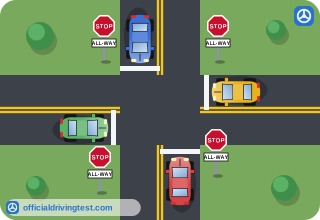
- The driver on your right
- The driver on your left
- The driver directly across from you
- The driver in the larger vehicle
Show answer
Correct answer: The driver on your right
At a four-way intersection, if both drivers arrive at the same time, you yield to the driver on your right.
Source: Ohio Driver Manual (HSY 7607 10/25 (October 2025)), page 10
-
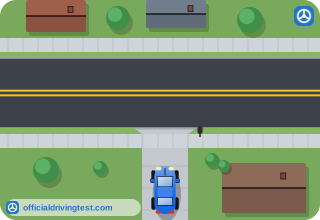
Who must you yield to when you are entering a public highway from a driveway or a private road?
- Drivers who are waiting to enter behind you
- Only bicyclists and pedestrians
- Drivers already on the public highway
- No one, because the highway driver must give way to you
Show answer
Correct answer: Drivers already on the public highway
The manual says to yield to drivers on a public highway if you are entering it from a driveway or private road.
Source: Ohio Driver Manual (HSY 7607 10/25 (October 2025)), page 10
-
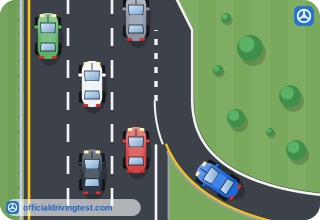
If you are on an entrance or acceleration ramp, to whom must you yield the right-of-way?
- Drivers who are entering the highway from the next ramp ahead
- Drivers already on the limited access or interstate highway
- Drivers who are following you on the entrance ramp behind you
- Drivers traveling in the left lane of the interstate only
Show answer
Correct answer: Drivers already on the limited access or interstate highway
The manual says to yield to drivers already on a limited access or interstate highway when you are on the ramp.
Source: Ohio Driver Manual (HSY 7607 10/25 (October 2025)), page 10
-
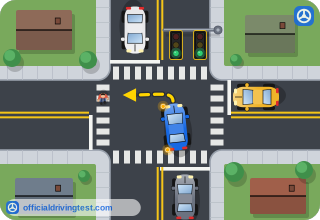
Which of these must you yield the right-of-way to when they are still in the intersection?
- Only pedestrians who are in a marked crosswalk
- Only other drivers who were there before you
- Only bicyclists who are riding in a bike lane
- Pedestrians, bicyclists, and other drivers
Show answer
Correct answer: Pedestrians, bicyclists, and other drivers
The manual says to yield to pedestrians, bicyclists and other drivers who are still in the intersection.
Source: Ohio Driver Manual (HSY 7607 10/25 (October 2025)), page 10
-
Which vehicles does the manual list as public safety vehicles that you must yield the right-of-way to?
- Emergency, police, and fire vehicles
- Only police cars that have their sirens on
- School buses, mail trucks, and utility vehicles
- Only ambulances and fire trucks, but not police vehicles
Show answer
Correct answer: Emergency, police, and fire vehicles
The manual lists public safety vehicles (emergency, police, fire) among those you must yield to.
Source: Ohio Driver Manual (HSY 7607 10/25 (October 2025)), page 10
-
Which of these must you yield the right-of-way to, according to the manual?
- Delivery trucks making a stop
- Vehicles that are towing a trailer
- Funeral processions
- Drivers who are going faster than you
Show answer
Correct answer: Funeral processions
Funeral processions are on the manual’s list of those to whom you yield the right-of-way.
Source: Ohio Driver Manual (HSY 7607 10/25 (October 2025)), page 10
-
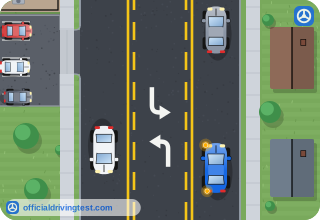
Who may use the center lane of a two-way left turn lane immediately prior to making a left turn?
- Vehicles from either direction
- Only vehicles traveling in the nearest direction
- Only vehicles that are turning into a driveway
- Only vehicles that are passing a slow-moving vehicle
Show answer
Correct answer: Vehicles from either direction
Vehicles from either direction may use the center lane immediately prior to making a left turn.
Source: Ohio Driver Manual (HSY 7607 10/25 (October 2025)), page 14
-
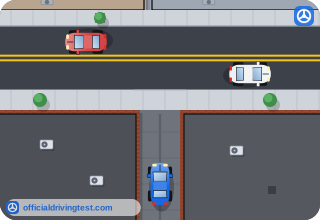
When emerging from an alley, driveway or private road in a business or residential district, where must a driver stop?
- Only after the front of the vehicle has entered the roadway itself
- Only when traffic is approaching, at a point beside the driveway
- At the sidewalk, or before entering the roadway if there is no sidewalk
- At the center of the sidewalk, even if pedestrians are crossing
Show answer
Correct answer: At the sidewalk, or before entering the roadway if there is no sidewalk
The manual says to stop at a sidewalk, or at a point before entering the roadway if there is no sidewalk.
Source: Ohio Driver Manual (HSY 7607 10/25 (October 2025)), page 15
-
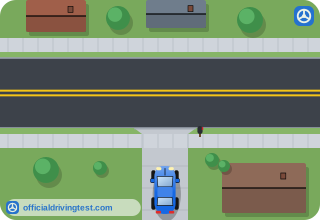
When emerging from an alley, driveway or private road, who must a driver yield the right-of-way to on the sidewalk?
- Only pedestrians in a crosswalk
- Any pedestrian
- Only children
- No one, the driver has the right-of-way
Show answer
Correct answer: Any pedestrian
The manual says drivers must yield the right-of-way to any pedestrian on the sidewalk.
Source: Ohio Driver Manual (HSY 7607 10/25 (October 2025)), page 15
-
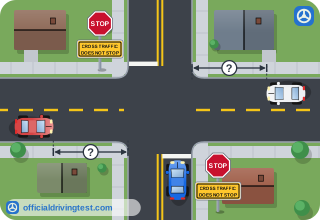
When you approach an intersection and check oncoming and cross traffic, which direction order does the manual give?
- Right, left, then right again
- Left, right, then left again
- Left, then right only
- Straight ahead only
Show answer
Correct answer: Left, right, then left again
The manual says to look left, right, then left again for oncoming and cross traffic.
Source: Ohio Driver Manual (HSY 7607 10/25 (October 2025)), page 16
-
When making a turn, which lane should you enter and maintain?
- The lane closest to the direction you want to go
- The center lane
- The lane with the least traffic
- The lane farthest from the direction you want to go
Show answer
Correct answer: The lane closest to the direction you want to go
The manual says to enter and maintain proper position in the lane that is closest to the direction you want to go.
Source: Ohio Driver Manual (HSY 7607 10/25 (October 2025)), page 16
-
Where should you look while turning?
- At the hood of your own vehicle to see where the wheels point
- At the nearest curb, to keep the vehicle from running over it
- Through the turn to the farthest point possible along your intended path
- At the nearest traffic light or sign until the turn is finished
Show answer
Correct answer: Through the turn to the farthest point possible along your intended path
The manual says to look through the turn to the farthest point possible along the intended path.
Source: Ohio Driver Manual (HSY 7607 10/25 (October 2025)), page 16
-
After completing a turn, what should you do once you accelerate smoothly to an appropriate speed?
- Sound your horn briefly and check the speedometer for speed
- Make sure your turn signal is canceled and check traffic to the rear
- Turn on your hazard lights and then check only the road ahead
- Leave your turn signal on and check only the traffic in front
Show answer
Correct answer: Make sure your turn signal is canceled and check traffic to the rear
The manual says to make sure your turn signal is canceled and check traffic to the rear.
Source: Ohio Driver Manual (HSY 7607 10/25 (October 2025)), page 16
-
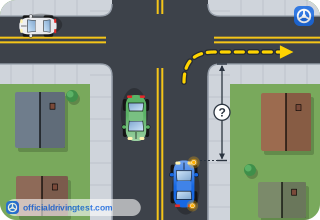
How many feet before an intended turn must a turn signal be given?
- At least 25 feet
- At least 50 feet
- At least 300 feet
- At least 100 feet
Show answer
Correct answer: At least 100 feet
The manual says a turn signal must be given at least 100 feet before the intended turn.
Source: Ohio Driver Manual (HSY 7607 10/25 (October 2025)), page 17
-
How may a turn signal be given?
- Only with a mechanical signal, never with an arm signal
- Only with a hand/arm signal, never with a mechanical one
- By either a mechanical signal or the appropriate hand/arm signal
- By tapping the horn twice and then flashing the headlights
Show answer
Correct answer: By either a mechanical signal or the appropriate hand/arm signal
The manual says the signal may be given using either a mechanical signal or the appropriate hand/arm signal.
Source: Ohio Driver Manual (HSY 7607 10/25 (October 2025)), page 17