Ohio: Parking rules Practice Test
Where you may not stop, park or stand, and how to park on hills.
Independent educational site · not affiliated with any government agency or DMV
Ready? Test yourself
- Instant feedback with an explanation
- Every answer cites its source in the manual
- Your best score is saved on this device
Questions are original and based on the official manual "Ohio Driver Manual" (HSY 7607 10/25 (October 2025)), Ohio Bureau of Motor Vehicles.
All 17 questions in this practice test
Take the test above first, then use this list to study. Tap “Show answer” to see the correct answer and explanation.
Show the questions and answersHide the questions
-
Where should you always park?
- On the shoulder of the road
- Anywhere outside the traveled lanes
- In a designated area
- Wherever the curb is painted
Show answer
Correct answer: In a designated area
The manual says to always park in a designated area.
Source: Ohio Driver Manual (HSY 7607 10/25 (October 2025)), page 23
-
In which direction must a vehicle be parked along the side of the street?
- Facing the direction of traffic on that side of the street
- Facing oncoming traffic
- Either direction, as long as it is parallel to the curb
- At an angle to the curb
Show answer
Correct answer: Facing the direction of traffic on that side of the street
The manual says vehicles must be parked facing the direction of traffic on that side of the street.
Source: Ohio Driver Manual (HSY 7607 10/25 (October 2025)), page 23
-
How far from the right curb must you park, at most, when parking parallel to it?
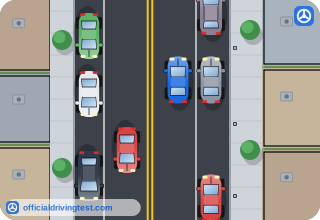
- Not more than 6 inches
- Not more than 24 inches
- Not more than 36 inches
- Not more than 12 inches
Show answer
Correct answer: Not more than 12 inches
The manual says to park parallel to and not more than 12 inches from the right curb.
Source: Ohio Driver Manual (HSY 7607 10/25 (October 2025)), page 23
-
On a one-way street, which curb may you park next to?
- Only the right curb
- Either the right or the left curb
- Only the left curb
- Neither curb, only a marked space
Show answer
Correct answer: Either the right or the left curb
The manual says that on one-way streets vehicles may be parked not more than 12 inches from the right or left curb.
Source: Ohio Driver Manual (HSY 7607 10/25 (October 2025)), page 23
-
How is angled parking marked?
- With lines
- With colored curbs only
- With wheelchair symbols
- With orange cones
Show answer
Correct answer: With lines
The manual says angled parking is marked with lines.
Source: Ohio Driver Manual (HSY 7607 10/25 (October 2025)), page 23
-
How are some parking restrictions indicated?
- By the width of the road
- By the number of lanes
- By colored curb markings
- By the color of the pavement
Show answer
Correct answer: By colored curb markings
The manual says some parking restrictions are indicated by colored curb markings.
Source: Ohio Driver Manual (HSY 7607 10/25 (October 2025)), page 23
-
Who may park in a space marked with a wheelchair symbol?
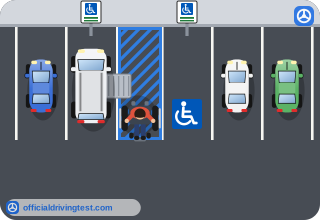
- Any driver who is stopping for only a few minutes
- Only a driver with a disability placard or disability license plate
- Any driver who is picking up or dropping off a passenger briefly
- Any driver who has turned on the hazard lights
Show answer
Correct answer: Only a driver with a disability placard or disability license plate
The manual says not to park in spaces marked by a wheelchair symbol unless you have a disability placard or disability license plate.
Source: Ohio Driver Manual (HSY 7607 10/25 (October 2025)), page 23
-
Within how many feet of a fire hydrant may you NOT stop, park or stand?
- 5 feet
- 15 feet
- 25 feet
- 10 feet
Show answer
Correct answer: 10 feet
The manual lists within 10 feet of a fire hydrant as a prohibited place to stop, park or stand.
Source: Ohio Driver Manual (HSY 7607 10/25 (October 2025)), page 23
-
You may NOT stop, park or stand in or within how many feet of an intersection or crosswalk?
- 5 feet
- 10 feet
- 20 feet
- 30 feet
Show answer
Correct answer: 20 feet
The manual lists in or within 20 feet of an intersection or crosswalk as a prohibited place to stop, park or stand.
Source: Ohio Driver Manual (HSY 7607 10/25 (October 2025)), page 23
-
You may NOT stop, park or stand within how close of another parked vehicle?
- One foot
- Two feet
- Five feet
- Ten feet
Show answer
Correct answer: One foot
The manual lists within one foot of another parked vehicle as a prohibited place to stop, park or stand.
Source: Ohio Driver Manual (HSY 7607 10/25 (October 2025)), page 23
-
Which of these is a place where you may NOT stop, park or stand?
- In an angled space marked with lines
- Parallel to and within 12 inches of the right curb
- In a designated parking area on the street
- In front of a public or private driveway
Show answer
Correct answer: In front of a public or private driveway
The manual lists in front of a public or private driveway as a prohibited place to stop, park or stand.
Source: Ohio Driver Manual (HSY 7607 10/25 (October 2025)), page 23
-
Which of these places is off limits for stopping, parking or standing a vehicle?
- Behind a vehicle that is parked at the curb
- Alongside a vehicle stopped or parked at the edge or curb of a street
- In a space marked with a wheelchair symbol if you have a placard
- In a legal space on a one-way street next to the left curb
Show answer
Correct answer: Alongside a vehicle stopped or parked at the edge or curb of a street
The manual lists alongside a vehicle stopped or parked at the edge or curb of a street as a prohibited place.
Source: Ohio Driver Manual (HSY 7607 10/25 (October 2025)), page 23
-
Where is stopping, parking or standing a vehicle prohibited?
- On a sidewalk
- On a one-way street next to the right curb
- Along the curb 30 feet from the nearest crosswalk
- In a designated parking area
Show answer
Correct answer: On a sidewalk
The manual lists a sidewalk as a prohibited place to stop, park or stand a vehicle.
Source: Ohio Driver Manual (HSY 7607 10/25 (October 2025)), page 23
-
When may you stop, park or stand in a place where doing so is normally prohibited?
- When you are waiting for a passenger and have the engine running
- When you have turned on your hazard lights and stay in the car
- To avoid conflict with other traffic, or as directed by an officer
- When the space is empty and you are in a hurry to get somewhere
Show answer
Correct answer: To avoid conflict with other traffic, or as directed by an officer
The manual gives two exceptions: to avoid conflict with other traffic, or in compliance with directions of an officer or traffic control device.
Source: Ohio Driver Manual (HSY 7607 10/25 (October 2025)), page 23
-
Which of these may be parked on the sidewalk if it does not impede the normal flow of pedestrian traffic?
- A motorcycle of any engine size
- A motor scooter of 150 cc or less
- A full-size passenger car
- A pickup truck or delivery van
Show answer
Correct answer: A motor scooter of 150 cc or less
The manual lists bicycles, electric bicycles, mopeds, motor scooters (150 cc or less) and micro-mobility devices.
Source: Ohio Driver Manual (HSY 7607 10/25 (October 2025)), page 23
-
When you park on a hill or graded surface, which way should you turn the front wheels?
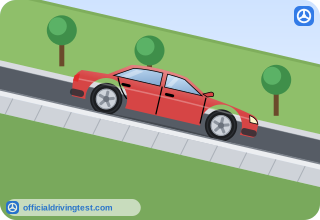
- Away from the curb, toward the road
- Straight ahead
- Parallel to the curb
- Toward the curb-side of the road
Show answer
Correct answer: Toward the curb-side of the road
The manual says to turn the front wheels toward the curb-side of the road to stabilize the vehicle.
Source: Ohio Driver Manual (HSY 7607 10/25 (October 2025)), page 23
-
After turning the front wheels when parking on a hill, which steps does the manual list?
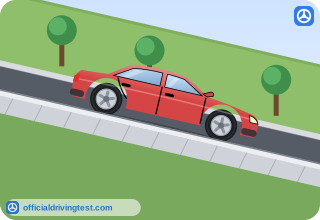
- Leave the gear in drive and set the parking brake only
- Shift to neutral, release the brake and leave the engine running
- Shift from drive to park, set the parking brake and turn the engine off
- Shift to park, then turn the engine off without setting the parking brake
Show answer
Correct answer: Shift from drive to park, set the parking brake and turn the engine off
The manual says to shift from drive to park, set the parking brake and turn the engine off.
Source: Ohio Driver Manual (HSY 7607 10/25 (October 2025)), page 23