Ohio: Emergency vehicles & work zones Practice Test
Emergency vehicles, the Move Over law, police stops and work zones.
Independent educational site · not affiliated with any government agency or DMV
Ready? Test yourself
- Instant feedback with an explanation
- Every answer cites its source in the manual
- Your best score is saved on this device
Questions are original and based on the official manual "Ohio Driver Manual" (HSY 7607 10/25 (October 2025)), Ohio Bureau of Motor Vehicles.
All 31 questions in this practice test
Take the test above first, then use this list to study. Tap “Show answer” to see the correct answer and explanation.
Show the questions and answersHide the questions
-
What should you do when nearing a construction zone?
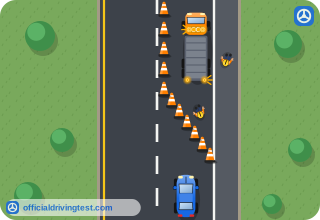
- Be alert, reduce speed, and watch for workers and equipment on the roadway
- Maintain your speed unless a worker personally signals you to slow down
- Speed up to pass through the zone as quickly as you safely can
- Move into the far left lane and wait for a flagger before you continue
Show answer
Correct answer: Be alert, reduce speed, and watch for workers and equipment on the roadway
The manual says to be alert, reduce speed, follow the signs and watch for workers and equipment.
Source: Ohio Driver Manual (HSY 7607 10/25 (October 2025)), page 12
-
In a Work Zone, what must you do when a person with a sign or flag is directing traffic?
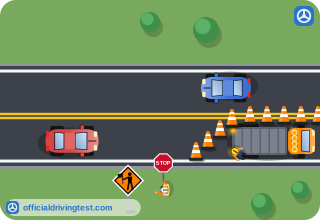
- Follow the posted signs instead of the person
- Continue at the posted speed limit unless stopped
- Follow their instructions
- Wait until the other vehicles have gone first
Show answer
Correct answer: Follow their instructions
Traffic in a Work Zone may be controlled by a person with a sign or flag, and you must follow their instructions.
Source: Ohio Driver Manual (HSY 7607 10/25 (October 2025)), page 12
-
What is the purpose of barriers, such as drums and cones, in a work zone?
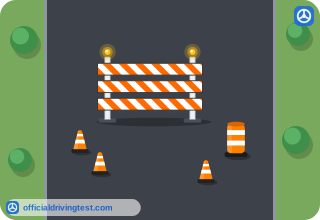
- To mark the speed limit through the work zone for drivers
- To keep traffic from entering closed roads or other dangerous areas
- To show drivers where they may park near a construction site
- To tell drivers to merge onto the shoulder of the roadway
Show answer
Correct answer: To keep traffic from entering closed roads or other dangerous areas
Barriers keep traffic from entering closed roads or other areas where it is dangerous to drive.
Source: Ohio Driver Manual (HSY 7607 10/25 (October 2025)), page 12
-
While approaching or traveling through Work Zones, what should you be prepared to do?
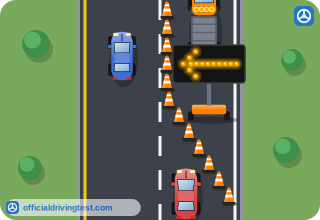
- Change lanes quickly
- Increase your speed
- Pull onto the shoulder
- Stop suddenly
Show answer
Correct answer: Stop suddenly
The manual says to be alert, reduce your speed and be prepared to stop suddenly in Work Zones.
Source: Ohio Driver Manual (HSY 7607 10/25 (October 2025)), page 12
-
What should you yield the right-of-way to and maintain a space cushion for in a Work Zone?
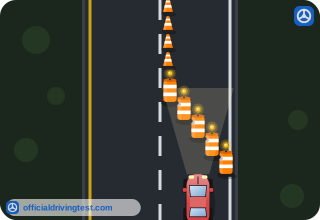
- Workers or equipment on the roadway
- Vehicles that are traveling slower than you
- Drivers who are approaching from behind you
- Vehicles that are parked on the shoulder
Show answer
Correct answer: Workers or equipment on the roadway
The manual says to yield right-of-way to, and keep a space cushion for, workers or equipment on the roadway.
Source: Ohio Driver Manual (HSY 7607 10/25 (October 2025)), page 12
-
What does the manual say about following distance in a Work Zone?
- Following closely is allowed when traffic is slow
- Drivers may close the gap to keep traffic moving
- Maintain a clear distance and do not tailgate
- Only trucks need to leave space ahead of them
Show answer
Correct answer: Maintain a clear distance and do not tailgate
Drivers must maintain a clear distance between their vehicle and the vehicle ahead in a Work Zone and not tailgate.
Source: Ohio Driver Manual (HSY 7607 10/25 (October 2025)), page 12
-
What can the consequences of speeding in a Work Zone include?
- A written warning only, with no fine
- Doubled fines and jail time
- Fines reduced by half for first offenders
- Mandatory replacement of your license plates
Show answer
Correct answer: Doubled fines and jail time
Speeding in a Work Zone can result in doubled fines and jail time.
Source: Ohio Driver Manual (HSY 7607 10/25 (October 2025)), page 12
-
What must you do when a public safety vehicle approaches displaying flashing lights and sounding a warning signal?
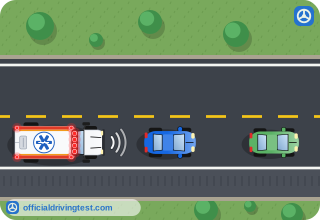
- Speed up and drive well ahead of it until it turns off the road
- Stop in the center of your lane and stay put until it goes past you
- Pull to the left side of the road and wait for it to pass you
- Move as far to the right as possible and stay there until it has passed
Show answer
Correct answer: Move as far to the right as possible and stay there until it has passed
The manual says to move as far as possible to the right of the road and remain there until the emergency vehicle has passed.
Source: Ohio Driver Manual (HSY 7607 10/25 (October 2025)), page 15
-
When are you NOT required to stop for a public safety vehicle with flashing lights and a siren?
- When you are already inside an intersection with a green light
- When the public safety vehicle is a fire engine, not a police car
- When it is traveling in the opposite direction on a divided highway
- When you are driving on a two-lane road with a wide shoulder
Show answer
Correct answer: When it is traveling in the opposite direction on a divided highway
The manual exempts the case where the vehicle is traveling in the opposite direction on a divided highway.
Source: Ohio Driver Manual (HSY 7607 10/25 (October 2025)), page 15
-
What should you do first when you are pulled over by law enforcement?
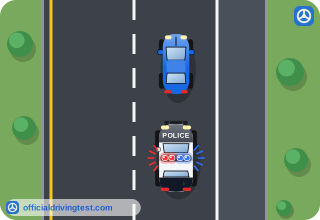
- Stop immediately in the lane you are driving in and stay there
- Speed up until you reach a well-lit area off the road
- Turn off your headlights and pull over in the left lane
- Signal, then pull over on the right side or at the nearest safe location
Show answer
Correct answer: Signal, then pull over on the right side or at the nearest safe location
The manual says to activate your turn signal and, when safe, pull over on the right side of the roadway or at the nearest safe location.
Source: Ohio Driver Manual (HSY 7607 10/25 (October 2025)), page 28
-
When pulled over by law enforcement, what should you do with your vehicle's gear?
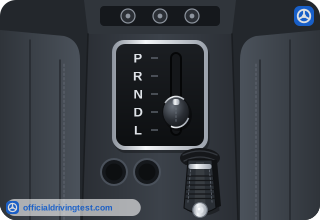
- Leave it in DRIVE with your foot on the brake
- Shift it to NEUTRAL and set the parking brake
- Move it from DRIVE to PARK
- Shift it to REVERSE in case you must move
Show answer
Correct answer: Move it from DRIVE to PARK
The manual says to move your vehicle from DRIVE gear to PARK gear.
Source: Ohio Driver Manual (HSY 7607 10/25 (October 2025)), page 28
-
When pulled over by law enforcement, what should you do with the ignition?
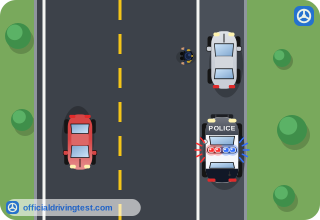
- Turn it to OFF, or press the STOP button
- Leave the engine running at idle
- Turn it to the accessory position only
- Restart the engine when the officer approaches
Show answer
Correct answer: Turn it to OFF, or press the STOP button
The manual says to turn the ignition to OFF (or press the STOP button).
Source: Ohio Driver Manual (HSY 7607 10/25 (October 2025)), page 28
-
During a police or traffic stop, what should you do with the window and where should you stay?
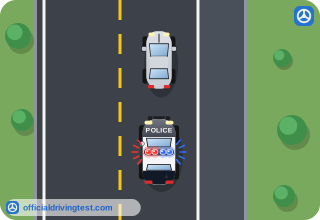
- Keep the window up and step out to meet the officer
- Lower the window and wait outside beside the vehicle
- Keep the window up and lock the doors until backup arrives
- Lower the window and remain in the vehicle
Show answer
Correct answer: Lower the window and remain in the vehicle
The manual says to lower the window and remain in the vehicle unless told otherwise by the officer.
Source: Ohio Driver Manual (HSY 7607 10/25 (October 2025)), page 28
-
What should you do with your safety belt during a police or traffic stop?
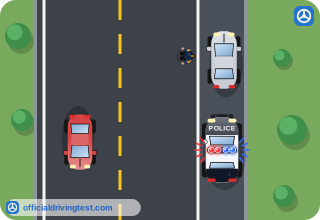
- Unfasten it so you can reach your documents
- Keep it fastened and stay calm
- Unfasten it and step out of the vehicle
- Unfasten it only after the officer asks
Show answer
Correct answer: Keep it fastened and stay calm
The manual says to stay calm and keep your safety belt fastened.
Source: Ohio Driver Manual (HSY 7607 10/25 (October 2025)), page 28
-
Where should you keep your hands during a police or traffic stop?
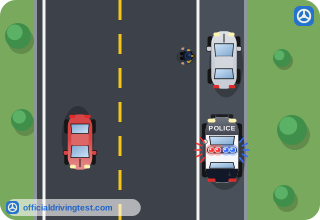
- On the steering wheel, in view of the officer
- In your pockets, out of the officer's view
- On the dashboard, in front of the officer
- Out of the window so the officer can see them
Show answer
Correct answer: On the steering wheel, in view of the officer
The manual says to keep hands on the steering wheel in view of the officer.
Source: Ohio Driver Manual (HSY 7607 10/25 (October 2025)), page 28
-
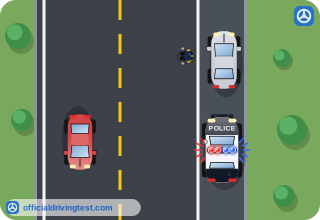
If you have a weapon in the vehicle during a police or traffic stop, what should you do?
- Hide it under the seat before the officer arrives
- Mention it only if the officer asks
- Inform the officer upon first contact
- Place it on the dashboard in plain view
Show answer
Correct answer: Inform the officer upon first contact
The manual says to inform the officer upon first contact if you have a weapon in the vehicle.
Source: Ohio Driver Manual (HSY 7607 10/25 (October 2025)), page 28
-
What must you present when requested by an officer during a police or traffic stop?
- Driver License, vehicle title, and a signed statement
- Driver License, vehicle registration, and insurance information
- Vehicle registration and proof of your current address
- Insurance information and your birth certificate
Show answer
Correct answer: Driver License, vehicle registration, and insurance information
The manual says to present your Driver License, vehicle registration, and insurance information when requested.
Source: Ohio Driver Manual (HSY 7607 10/25 (October 2025)), page 28
-
If you disagree with a traffic ticket, what may you do?
- Argue with the officer at the roadside
- Refuse to sign and drive away
- Ignore the ticket until the BMV contacts you
- Contest the ticket in court
Show answer
Correct answer: Contest the ticket in court
The manual says you may contest a traffic ticket in court.
Source: Ohio Driver Manual (HSY 7607 10/25 (October 2025)), page 28
-
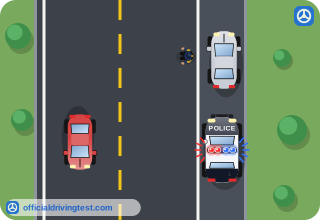
If you have questions during a police or traffic stop, what should you do?
- Argue your point until the officer explains
- Wait until the officer leaves and call the BMV
- Politely ask the officer for clarification
- Get out of the car to discuss the matter
Show answer
Correct answer: Politely ask the officer for clarification
The manual says to be cooperative, not argue, and politely ask for clarification if you have questions.
Source: Ohio Driver Manual (HSY 7607 10/25 (October 2025)), page 28
-
What is a Work Zone?
- An area where roadwork takes place, possibly with lane closures
- An area near a school where many children cross the street
- A section of road where parking is allowed only for road workers
- A rest area with fuel, food and services for truck drivers
Show answer
Correct answer: An area where roadwork takes place, possibly with lane closures
A Work Zone is an area where roadwork takes place and may involve lane closures, detours and moving equipment.
Source: Ohio Driver Manual (HSY 7607 10/25 (October 2025)), page 29
-
What should you watch for when approaching a Work Zone?
- Only workers standing in the road
- Only flashing lights on police vehicles
- Only signs posted by the Department of Transportation
- Signs, cones, barrels, large vehicles, and workers
Show answer
Correct answer: Signs, cones, barrels, large vehicles, and workers
The manual says to watch for signs, cones, barrels, large vehicles and workers.
Source: Ohio Driver Manual (HSY 7607 10/25 (October 2025)), page 29
-
What colors do Work Zone signs have?
- A yellow background with red letters or symbols
- An orange background with black letters or symbols
- A white background with black letters or symbols
- A green background with white letters or symbols
Show answer
Correct answer: An orange background with black letters or symbols
Work Zone signs have an orange background and black letters or symbols.
Source: Ohio Driver Manual (HSY 7607 10/25 (October 2025)), page 29
-
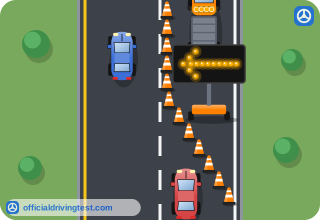
When should you reduce your speed in a Work Zone?
- Always, even if there are no workers
- Only when workers are present
- Only when a flagger is visible
- Only during the daytime
Show answer
Correct answer: Always, even if there are no workers
The manual says to always reduce speed in a Work Zone because narrower lanes and rough pavement can create a hazard.
Source: Ohio Driver Manual (HSY 7607 10/25 (October 2025)), page 29
-
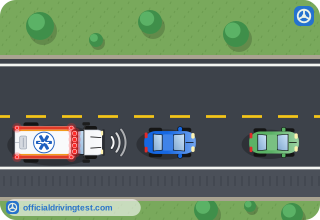
What must you do when an emergency vehicle with flashing lights and audible sirens is approaching through traffic?
- Pull to the nearest shoulder and keep on moving
- Speed up to clear the next intersection quickly
- Stop in the middle of the lane you are in
- Quickly and safely pull to the right side and stop
Show answer
Correct answer: Quickly and safely pull to the right side and stop
The driver must quickly and safely pull to the right side of the road and stop.
Source: Ohio Driver Manual (HSY 7607 10/25 (October 2025)), page 38
-
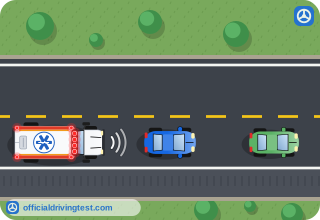
After pulling over for an emergency vehicle, what should you avoid?
- Using your hazard lights
- Checking your mirrors
- Blocking intersections
- Staying in your seat
Show answer
Correct answer: Blocking intersections
When pulling over for an emergency vehicle, you should avoid blocking intersections.
Source: Ohio Driver Manual (HSY 7607 10/25 (October 2025)), page 38
-
How long must you remain in place after pulling over for an emergency vehicle?
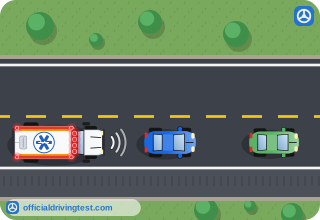
- Until it has passed or an officer directs otherwise
- Until you can no longer hear its siren sound
- Until ten seconds after the vehicle has passed
- Until the next intersection is clear of traffic
Show answer
Correct answer: Until it has passed or an officer directs otherwise
All vehicles must remain in this position until the emergency vehicle has passed or they are otherwise directed by a law enforcement officer.
Source: Ohio Driver Manual (HSY 7607 10/25 (October 2025)), page 38
-
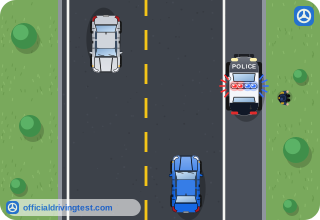
What does Ohio law require when you approach a stopped police vehicle with its warning lights activated?
- Stop at least 100 feet behind the vehicle
- Speed up so you can pass it more quickly
- Honk your horn as you pass it by
- Move to an adjacent lane and/or slow down
Show answer
Correct answer: Move to an adjacent lane and/or slow down
Ohio law requires all drivers to move to an adjacent lane and/or slow down when approaching a stopped police or other listed vehicle with its warning lights activated.
Source: Ohio Driver Manual (HSY 7607 10/25 (October 2025)), page 38
-
Which of these stopped vehicles with activated warning lights is covered by Ohio's Move Over law?
- A taxi picking up a passenger
- A waste collection vehicle
- A rental truck on the shoulder
- A delivery van at a curb
Show answer
Correct answer: A waste collection vehicle
The Move Over law covers police, emergency, road service, waste collection, highway maintenance, and public utility commission vehicles with warning lights activated.
Source: Ohio Driver Manual (HSY 7607 10/25 (October 2025)), page 38
-
How many U.S. states have a Move Over law, according to the manual?
- Every state
- About half of the states
- Only states with heavy traffic
- Only the states near Ohio
Show answer
Correct answer: Every state
The manual says every U.S. state has a Move Over law.
Source: Ohio Driver Manual (HSY 7607 10/25 (October 2025)), page 38
-
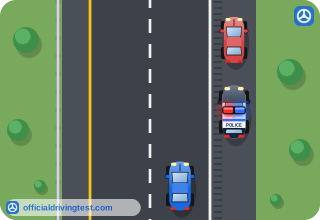
When approaching an authorized vehicle stopped on the roadside, what should you do if safety and traffic conditions permit?
- Stay in your lane and speed up to pass it quickly
- Stop behind the stopped vehicle until it leaves
- Slow down and change into a lane not next to the stopped vehicle
- Change into the lane that is next to the stopped vehicle
Show answer
Correct answer: Slow down and change into a lane not next to the stopped vehicle
If safety and traffic conditions permit, slow down and yield by making a lane change into a lane not next to the stopped vehicle.
Source: Ohio Driver Manual (HSY 7607 10/25 (October 2025)), page 38
-
You approach a stopped authorized vehicle and a lane change is unsafe. What should you do?
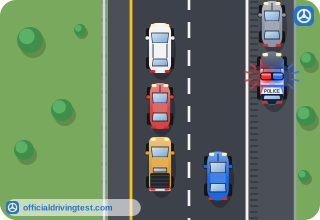
- Stop until its warning lights go off
- Slow down and proceed with caution at a safe speed
- Change lanes anyway, since the law requires it
- Keep your speed and sound your horn to pass
Show answer
Correct answer: Slow down and proceed with caution at a safe speed
If a lane change is unsafe, slow down and proceed with caution while maintaining a safe speed for traffic conditions.
Source: Ohio Driver Manual (HSY 7607 10/25 (October 2025)), page 38