North Dakota: Parking rules Practice Test
Where North Dakota law forbids parking, the distances from hydrants, crosswalks and signals, parallel parking and parking on hills.
Independent educational site · not affiliated with any government agency or DMV
Ready? Test yourself
- Instant feedback with an explanation
- Every answer cites its source in the manual
- Your best score is saved on this device
- Keyboard: press 1 to 4 to answer and Enter for the next question
Questions are original and based on the official manual "North Dakota Noncommercial Driver License Manual" (2025-2027), North Dakota Department of Transportation (NDDOT).
All 20 questions in this practice test
Take the test above first, then use this list to study. Tap “Show answer” to see the correct answer and explanation.
Show the questions and answersHide the questions
-
When parallel parking, where should your wheels be?
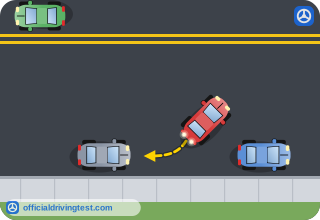
- At a 45-degree angle to the curb
- Parallel to the left-hand curb and within three feet of it
- Parallel to the right-hand curb and within one foot of it
- Within two feet of the right-hand curb
Show answer
Correct answer: Parallel to the right-hand curb and within one foot of it
When parallel parking, your wheels should be parallel to the right-hand curb and within one foot of it.
Source: North Dakota Noncommercial Driver License Manual (2025-2027), page 25 · Open this page in the manual (Manual page 25)
-
When you begin to parallel park, how should you position your vehicle?
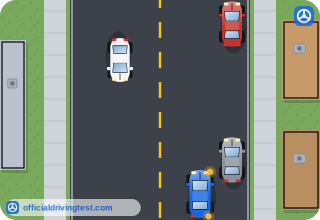
- Even with the vehicle ahead and about two feet away from it
- Directly behind the vehicle ahead, touching its bumper
- Four feet past the vehicle ahead
- Two feet from the curb, ahead of the space
Show answer
Correct answer: Even with the vehicle ahead and about two feet away from it
You signal your movement and stop even with the vehicle ahead and about two feet away from it.
Source: North Dakota Noncommercial Driver License Manual (2025-2027), page 25 · Open this page in the manual (Manual page 25)
-
In parallel parking, what do you do right after stopping even with the vehicle ahead?
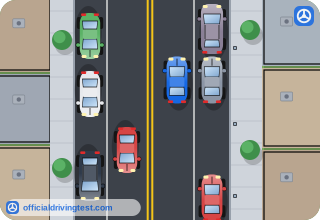
- Turn your wheel to the left and back slowly toward the vehicle ahead
- Pull straight ahead toward the curb and stop beside the vehicle
- Back up in a straight line without turning the wheel at all
- Turn your wheel to the right and back slowly toward the vehicle behind
Show answer
Correct answer: Turn your wheel to the right and back slowly toward the vehicle behind
The second step is to turn your wheel to the right and back slowly toward the vehicle behind.
Source: North Dakota Noncommercial Driver License Manual (2025-2027), page 25 · Open this page in the manual (Manual page 25)
-
In parallel parking, what do you do when you are clear of the vehicle ahead?
- Turn your wheel to the right and back quickly toward the curb
- Turn your wheel to the left and back slowly toward the car behind you
- Stop and put your vehicle in park while still crooked
- Pull straight ahead toward the curb and stop beside the car
Show answer
Correct answer: Turn your wheel to the left and back slowly toward the car behind you
When clear of the vehicle ahead, turn your wheel to the left and back slowly toward the vehicle behind you.
Source: North Dakota Noncommercial Driver License Manual (2025-2027), page 25 · Open this page in the manual (Manual page 25)
-
In the last step of parallel parking, where do you stop?
- In the center of the parking space
- Against the bumper of the vehicle behind
- Two feet from the curb
- Even with the vehicle ahead
Show answer
Correct answer: In the center of the parking space
You turn your wheel to the right, pull ahead toward the curb, stop in the center of the parking space, and put your vehicle in park.
Source: North Dakota Noncommercial Driver License Manual (2025-2027), page 25 · Open this page in the manual (Manual page 25)
-
When parking downhill beside a curb, which way should you turn your wheels?
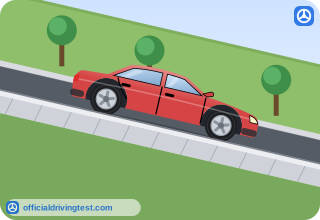
- Away from the curb
- Straight ahead
- Toward the curb
- Toward the center of the road
Show answer
Correct answer: Toward the curb
When parking on a hill facing downhill beside a curb, you turn your wheels toward the curb.
Source: North Dakota Noncommercial Driver License Manual (2025-2027), page 25 · Open this page in the manual (Manual page 25)
-
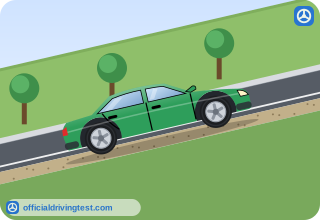
When parking uphill with no curb, which way should you turn your wheels?
- Toward the center of the road
- Toward the shoulder
- Straight ahead
- Away from the shoulder
Show answer
Correct answer: Toward the shoulder
When parked uphill with no curb, you turn your wheels toward the shoulder.
Source: North Dakota Noncommercial Driver License Manual (2025-2027), page 25 · Open this page in the manual (Manual page 25)
-
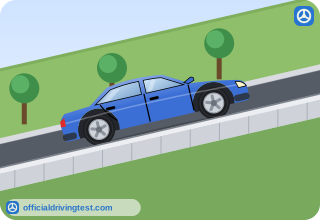
When parking uphill beside a curb, which way should you turn your wheels?
- Toward the curb
- Straight ahead
- Toward the shoulder
- Away from the curb
Show answer
Correct answer: Away from the curb
When parked uphill next to a curb, you turn your wheels away from the curb.
Source: North Dakota Noncommercial Driver License Manual (2025-2027), page 25 · Open this page in the manual (Manual page 25)
-
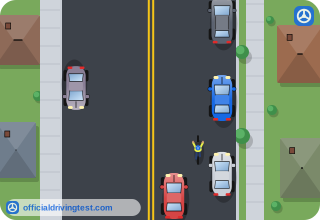
When you leave a parking space, how should you look to the rear?
- Only in the rear-view mirror, without turning your head
- Only in the side mirrors, without turning your head
- Over your shoulder as well as in the rear-view mirror
- Only over your shoulder, without using the mirror
Show answer
Correct answer: Over your shoulder as well as in the rear-view mirror
When leaving a parking space, look to the rear over your shoulder as well as in the rear-view mirror.
Source: North Dakota Noncommercial Driver License Manual (2025-2027), page 26 · Open this page in the manual (Manual page 26)
-
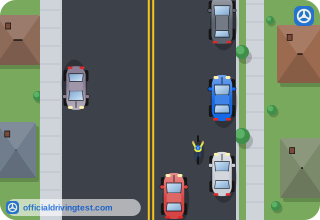
When leaving a parking space, when should you signal?
- Before you start to move
- After you enter the traffic lane
- Only if other vehicles are nearby
- Once you reach the next intersection
Show answer
Correct answer: Before you start to move
The manual says to signal before you start to move when leaving a parking space.
Source: North Dakota Noncommercial Driver License Manual (2025-2027), page 26 · Open this page in the manual (Manual page 26)
-
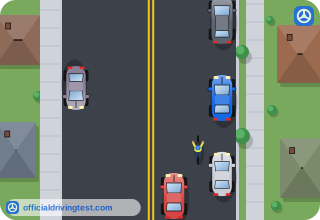
When leaving a parking space, to whom should you yield the right of way?
- Parked vehicles
- Only vehicles larger than yours
- Nobody, since you were parked
- Oncoming vehicles
Show answer
Correct answer: Oncoming vehicles
When you leave a parking space, you should yield the right of way to oncoming vehicles.
Source: North Dakota Noncommercial Driver License Manual (2025-2027), page 26 · Open this page in the manual (Manual page 26)
-
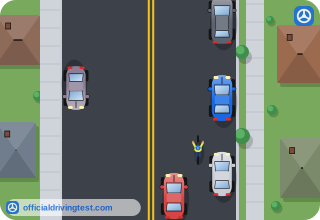
After leaving a parking space, which lane should you enter?
- The farthest lane from the curb, to stay away from traffic
- The nearest lane, and stay in it until it is safe to change
- The center lane, then the nearest lane afterward
- Any lane that is open, with no need to stay in it
Show answer
Correct answer: The nearest lane, and stay in it until it is safe to change
You enter traffic in the nearest lane, and remain in that lane until safe to change to another lane.
Source: North Dakota Noncommercial Driver License Manual (2025-2027), page 26 · Open this page in the manual (Manual page 26)
-
Between one-half hour after sunset and one-half hour before sunrise, what must a vehicle parked on a public highway display?
- A red lamp in front and a white light on the rear
- One amber lamp on the rear and nothing on the front
- A white or amber lamp in front and a red light on the rear
- A flashing red light on the roof of the vehicle
Show answer
Correct answer: A white or amber lamp in front and a red light on the rear
Between one-half hour after sunset and one-half hour before sunrise, a vehicle parked on a public highway must display at least one white or amber lamp in front and a red light on the rear.
Source: North Dakota Noncommercial Driver License Manual (2025-2027), page 26 · Open this page in the manual (Manual page 26)
-
The lamps on a vehicle parked on a public highway at night must be visible for how far?
- 100 feet
- 1,000 feet
- 200 feet
- 500 feet
Show answer
Correct answer: 1,000 feet
The lamps on a vehicle parked on a public highway at night must be visible for a distance of 1,000 feet.
Source: North Dakota Noncommercial Driver License Manual (2025-2027), page 26 · Open this page in the manual (Manual page 26)
-
Within how many feet of a fire hydrant is parking not allowed?
- 5 feet
- 15 feet
- 25 feet
- 10 feet
Show answer
Correct answer: 10 feet
The manual says not to park within 10 feet of a fire hydrant.
Source: North Dakota Noncommercial Driver License Manual (2025-2027), page 26 · Open this page in the manual (Manual page 26)
-
What is the no-parking distance at a crosswalk at an intersection?
- On it or within 5 feet of it
- On it or within 15 feet of it
- On it or within 10 feet of it
- On it or within 25 feet of it
Show answer
Correct answer: On it or within 10 feet of it
The manual says not to park on or within 10 feet of a crosswalk at an intersection.
Source: North Dakota Noncommercial Driver License Manual (2025-2027), page 26 · Open this page in the manual (Manual page 26)
-
Within how many feet of a flashing beacon, stop sign, or traffic control signal placed on the side of the roadway is parking not allowed?
- 15 feet
- 5 feet
- 10 feet
- 50 feet
Show answer
Correct answer: 15 feet
The manual says not to park within 15 feet of a flashing beacon, a stop sign, or a traffic control signal placed on the side of the roadway.
Source: North Dakota Noncommercial Driver License Manual (2025-2027), page 26 · Open this page in the manual (Manual page 26)
-
What is parking on the street side of a parked vehicle called?
- Angle parking
- Reverse parking
- Shoulder parking
- Double parking
Show answer
Correct answer: Double parking
Parking on the street side of a parked vehicle is a violation called double parking.
Source: North Dakota Noncommercial Driver License Manual (2025-2027), page 26 · Open this page in the manual (Manual page 26)
-
What is a safety zone?
- A marked area set aside for emergency vehicles
- A marked area set aside for pedestrians
- A marked area set aside for bicyclists
- A marked area set aside for school buses
Show answer
Correct answer: A marked area set aside for pedestrians
Safety zones are marked areas set aside for pedestrians, and you may not park between a safety zone and the curb next to it.
Source: North Dakota Noncommercial Driver License Manual (2025-2027), page 26 · Open this page in the manual (Manual page 26)
-
You may not park in a designated Accessible Parking space unless you have the appropriate placard or ‘Accessible’ license plate. What else should you not park on?
- The diagonal lines next to the space
- The curb directly ahead of the space
- A regular space two spaces away
- A space at the far end of the same lot
Show answer
Correct answer: The diagonal lines next to the space
You should not park on the diagonal lines next to a designated Accessible Parking space.
Source: North Dakota Noncommercial Driver License Manual (2025-2027), page 26 · Open this page in the manual (Manual page 26)