North Dakota: Emergency vehicles and work zones Practice Test
Yielding to emergency vehicles, moving over for stopped vehicles with flashing lights, flaggers and work zone safety.
Independent educational site · not affiliated with any government agency or DMV
Ready? Test yourself
- Instant feedback with an explanation
- Every answer cites its source in the manual
- Your best score is saved on this device
- Keyboard: press 1 to 4 to answer and Enter for the next question
Questions are original and based on the official manual "North Dakota Noncommercial Driver License Manual" (2025-2027), North Dakota Department of Transportation (NDDOT).
All 23 questions in this practice test
Take the test above first, then use this list to study. Tap “Show answer” to see the correct answer and explanation.
Show the questions and answersHide the questions
-
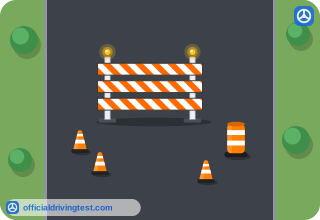
What are barricades, vertical panels, drums, cones, and tubes used for in work areas?
- To mark the places where workers may park their equipment overnight
- To alert drivers of conditions and to guide them safely through the work zone
- To show drivers the speed limit that applies through the whole work zone
- To warn drivers that the road ahead has been closed to traffic permanently
Show answer
Correct answer: To alert drivers of conditions and to guide them safely through the work zone
These channelizing devices are the most commonly used ones to alert drivers of conditions in work areas and guide them safely through the work zone.
Source: North Dakota Noncommercial Driver License Manual (2025-2027), page 13 · Open this page in the manual (Manual page 13)
-
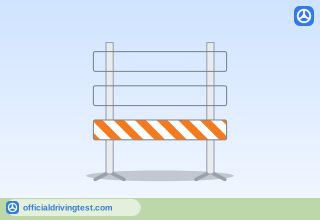
On a work zone barricade or vertical panel, what do diagonal stripes sloping downward to the right mean?
- The driver should keep to the left
- The driver must stop and wait for a flagperson
- The driver should keep to the right
- The road ahead is closed to all traffic
Show answer
Correct answer: The driver should keep to the right
Diagonal stripes sloping downward to the right mean the driver should keep to the right; stripes sloping downward to the left mean keep to the left.
Source: North Dakota Noncommercial Driver License Manual (2025-2027), page 13 · Open this page in the manual (Manual page 13)
-
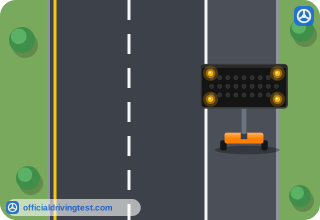
What are large flashing or sequencing arrow panels used for in work zones?
- To direct drivers into certain lanes and tell them part of the road ahead is closed
- To tell drivers that a flagperson is working just ahead and will stop them
- To show drivers the speed limit that applies through the work zone
- To mark the end of the work zone and tell drivers that they may speed up
Show answer
Correct answer: To direct drivers into certain lanes and tell them part of the road ahead is closed
Arrow panels direct drivers into certain traffic lanes and inform them that part of the road or street ahead is closed.
Source: North Dakota Noncommercial Driver License Manual (2025-2027), page 13 · Open this page in the manual (Manual page 13)
-
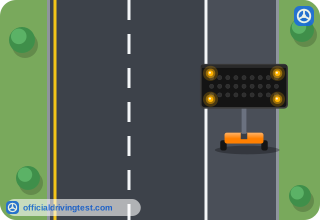
When may large flashing or sequencing arrow panels be used in work zones?
- Both day and night
- Only at night
- Only when workers are present
- Only on freeways
Show answer
Correct answer: Both day and night
Large flashing or sequencing arrow panels may be used in work zones both day and night.
Source: North Dakota Noncommercial Driver License Manual (2025-2027), page 13 · Open this page in the manual (Manual page 13)
-
Besides directing drivers into lanes, in what mode may a work zone arrow panel also be used?
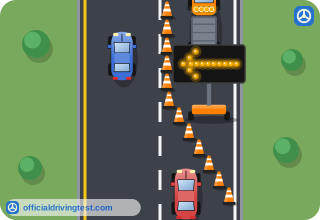
- A detour mode
- A speed-limit mode
- A caution mode
- A stop mode
Show answer
Correct answer: A caution mode
The manual says the arrow panel may also be used in a caution mode.
Source: North Dakota Noncommercial Driver License Manual (2025-2027), page 13 · Open this page in the manual (Manual page 13)
-
What do flagpersons do in highway and street work zones?
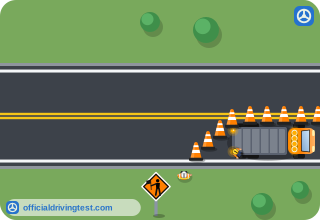
- Issue warnings to drivers who are speeding
- Stop, slow, or guide traffic safely through the area
- Close the road to all traffic until the work is finished
- Report crashes to the police for the work crew
Show answer
Correct answer: Stop, slow, or guide traffic safely through the area
Flagpersons are often provided in work zones to stop, slow, or guide traffic safely through the area.
Source: North Dakota Noncommercial Driver License Manual (2025-2027), page 14 · Open this page in the manual (Manual page 14)
-
What do flagpersons use to direct traffic through work zones?
- Green flags or yield paddles
- White flags or go/stop paddles
- Orange lanterns or whistles
- Red flags or stop/slow paddles
Show answer
Correct answer: Red flags or stop/slow paddles
Flagpersons use red flags or stop/slow paddles to direct traffic through work zones.
Source: North Dakota Noncommercial Driver License Manual (2025-2027), page 14 · Open this page in the manual (Manual page 14)
-
What colors of vests, shirts, or jackets do flagpersons wear?
- Black, charcoal gray, or white with black stripes
- Red, white, blue, or dark navy with gold stripes
- Brown, tan, olive, or dark green camouflage pattern
- Orange, yellow, strong yellow-green, or fluorescent
Show answer
Correct answer: Orange, yellow, strong yellow-green, or fluorescent
Flagpersons wear orange, yellow, strong yellow-green, or fluorescent vests, shirts, or jackets.
Source: North Dakota Noncommercial Driver License Manual (2025-2027), page 14 · Open this page in the manual (Manual page 14)
-
Which of these does the manual list as a hazard in work zones?
- Dense fog
- Loose gravel
- Low bridges
- Falling rocks
Show answer
Correct answer: Loose gravel
The work zone safety tips list uneven pavement, narrow lanes, heavy equipment, and loose gravel as hazards.
Source: North Dakota Noncommercial Driver License Manual (2025-2027), page 14 · Open this page in the manual (Manual page 14)
-
According to the work zone safety tips, how far from traffic are the workers?
- About 10 feet away
- About 3 yards away
- Just inches away
- At least 25 feet away
Show answer
Correct answer: Just inches away
The tips say to slow down because workers are just inches away from traffic.
Source: North Dakota Noncommercial Driver License Manual (2025-2027), page 14 · Open this page in the manual (Manual page 14)
-
When can work zones appear?
- At any time of day, because road crews work both night and day
- Only during daylight hours, on weekdays when crews are working
- Mostly at night, when traffic is light enough to work safely
- Only in the summer months, when road crews are busiest
Show answer
Correct answer: At any time of day, because road crews work both night and day
Work zones can appear at any time of day because road crews work both night and day.
Source: North Dakota Noncommercial Driver License Manual (2025-2027), page 14 · Open this page in the manual (Manual page 14)
-
Which vehicles always have the right of way?
- Vehicles that are the first to reach an intersection
- Vehicles traveling on the Interstate
- Vehicles carrying children
- Emergency vehicles
Show answer
Correct answer: Emergency vehicles
The manual states that emergency vehicles always have the right of way.
Source: North Dakota Noncommercial Driver License Manual (2025-2027), page 20 · Open this page in the manual (Manual page 20)
-
An emergency or law enforcement vehicle is approaching with its red, white, or blue lights flashing or its siren on. What must you do?
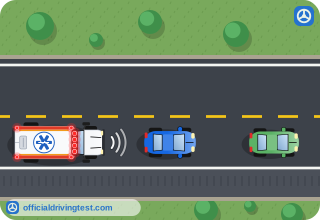
- Speed up and move into the left lane to get clear
- Immediately stop along the right-hand curb or edge of the road
- Slow down but keep moving in your lane at reduced speed
- Stop in the middle of the intersection until it passes
Show answer
Correct answer: Immediately stop along the right-hand curb or edge of the road
You must immediately come to a stop along the right-hand curb or edge of the road and stay stopped until the vehicle has passed.
Source: North Dakota Noncommercial Driver License Manual (2025-2027), page 20 · Open this page in the manual (Manual page 20)
-
How long must you remain stopped for an approaching emergency or law enforcement vehicle that has its lights flashing or siren on?
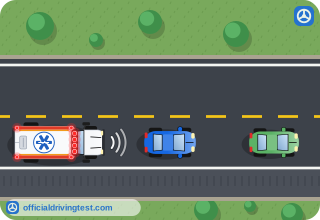
- Until the emergency or law enforcement vehicle has passed
- For at least one full minute after it passes you
- Until the sound of the siren can no longer be heard
- Until another driver in front of you starts moving
Show answer
Correct answer: Until the emergency or law enforcement vehicle has passed
You must remain stopped until the emergency or law enforcement vehicle has passed.
Source: North Dakota Noncommercial Driver License Manual (2025-2027), page 20 · Open this page in the manual (Manual page 20)
-
When stopping for an approaching emergency vehicle, where should you not stop?
- Along the right-hand curb
- At the right edge of the road
- In the middle of the intersection
- Behind the crosswalk
Show answer
Correct answer: In the middle of the intersection
The manual says not to stop in the middle of the intersection when an emergency vehicle approaches.
Source: North Dakota Noncommercial Driver License Manual (2025-2027), page 20 · Open this page in the manual (Manual page 20)
-
An emergency or law enforcement vehicle is parked at the scene of a crash with its emergency lights flashing. What must you do?
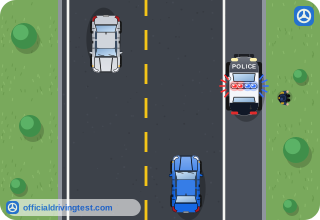
- Continue in your lane at the same speed as before
- Drive to the right-hand side of the roadway and stop
- Speed up to get past the scene quickly
- Stop in the middle of your lane and wait there
Show answer
Correct answer: Drive to the right-hand side of the roadway and stop
You must drive to the right-hand side of the roadway and stop; once stopped, you may pass at your risk when the roadway is clear.
Source: North Dakota Noncommercial Driver License Manual (2025-2027), page 20 · Open this page in the manual (Manual page 20)
-
After you have stopped at the right-hand side of the roadway for an emergency vehicle parked at a crash scene with its lights flashing, when may you pass?
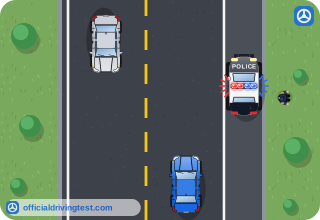
- As soon as the lights stop flashing
- Only after the emergency vehicle leaves
- Only after a tow truck has arrived
- At your risk, when the roadway is clear
Show answer
Correct answer: At your risk, when the roadway is clear
Once stopped, you may pass at your risk when the roadway is clear.
Source: North Dakota Noncommercial Driver License Manual (2025-2027), page 20 · Open this page in the manual (Manual page 20)
-
A police officer is directing traffic at the scene of a crash. What must you do?
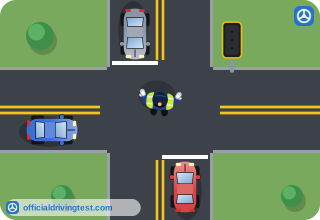
- Follow the signals of the nearest traffic light
- Follow the vehicle ahead of you
- Obey the officer’s instructions
- Treat the intersection as an unsigned one
Show answer
Correct answer: Obey the officer’s instructions
If there is a police officer directing traffic at the scene, you must obey the officer’s instructions.
Source: North Dakota Noncommercial Driver License Manual (2025-2027), page 20 · Open this page in the manual (Manual page 20)
-
An emergency vehicle, law enforcement vehicle, or North Dakota Department of Transportation maintenance vehicle is parked on the Interstate or a multilane highway with its emergency or work lights flashing. What should you do?
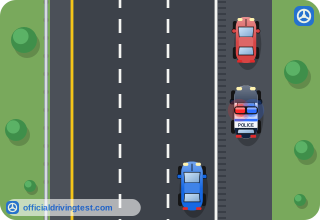
- Move over to the opposite lane and proceed with due caution
- Come to a full stop behind it and wait for it to leave
- Drive past in the same lane at the posted speed limit
- Pull onto the right shoulder and wait for it to leave
Show answer
Correct answer: Move over to the opposite lane and proceed with due caution
You should move over to the opposite lane and proceed with due caution.
Source: North Dakota Noncommercial Driver License Manual (2025-2027), page 20 · Open this page in the manual (Manual page 20)
-
What does a yellow-flashing light on a vehicle warn you to do?
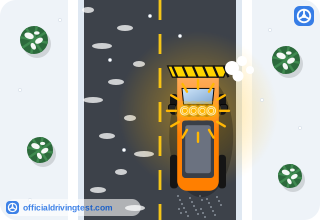
- Stop completely
- Pull to the right and wait
- Move to the left lane
- Slow down
Show answer
Correct answer: Slow down
The yellow-flashing light is used mostly on tow trucks and slow moving vehicles, and it warns you to slow down.
Source: North Dakota Noncommercial Driver License Manual (2025-2027), page 20 · Open this page in the manual (Manual page 20)
-
An emergency vehicle is approaching a roundabout. What should you do?
- Stop inside the roundabout until it has passed you
- Clear the roundabout and do not enter if one is approaching
- Speed up to get through before it reaches the roundabout
- Pass the emergency vehicle inside the roundabout
Show answer
Correct answer: Clear the roundabout and do not enter if one is approaching
You should clear the roundabout to allow emergency vehicles to pass and not enter the roundabout if one is approaching.
Source: North Dakota Noncommercial Driver License Manual (2025-2027), page 23 · Open this page in the manual (Manual page 23)
-
A motor vehicle with flashing hazard lights is stranded along the interstate or a multilane highway outside city limits. What should an approaching driver do?
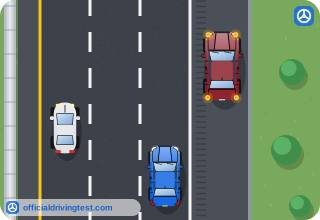
- Stop behind the stranded vehicle until it is able to move away
- Keep the same lane and speed up to pass the stranded vehicle
- Move into the lane next to the stranded vehicle and sound your horn
- Yield and move safely to the lane not adjacent to the stranded vehicle
Show answer
Correct answer: Yield and move safely to the lane not adjacent to the stranded vehicle
Under the move-over rule, a driver approaching a stranded vehicle with flashing hazard lights should yield and move safely to the lane not adjacent to it.
Source: North Dakota Noncommercial Driver License Manual (2025-2027), page 32 · Open this page in the manual (Manual page 32)
-
If the only lane you can safely move to is the lane adjacent to a stranded vehicle with flashing hazard lights, what should you do?
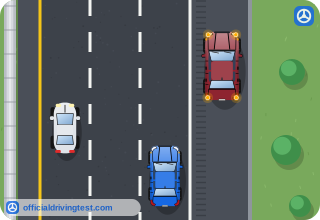
- Proceed with caution and reduce speed
- Stop in your lane until the vehicle leaves
- Maintain your speed and sound your horn
- Pass as fast as the road allows
Show answer
Correct answer: Proceed with caution and reduce speed
When the only safe lane is the one next to the stranded vehicle, the manual says to proceed with caution and reduce speed.
Source: North Dakota Noncommercial Driver License Manual (2025-2027), page 32 · Open this page in the manual (Manual page 32)