New Jersey: Signals & vehicle controls — Part 6 Practice Test
Questions in this part include: “According to the New Jersey Driver Manual, what are parking lights used for?” · “According to the New Jersey Driver Manual, when may spotlights be used?”
Independent educational site · not affiliated with any government agency or DMV
Ready? Test yourself
- Instant feedback with an explanation
- Every answer cites its source in the manual
- Your best score is saved on this device
Questions are original and based on the official manual "New Jersey Driver Manual" (2026), New Jersey Motor Vehicle Commission (MVC).
All 17 questions in this practice test
Take the test above first, then use this list to study. Tap “Show answer” to see the correct answer and explanation.
Show the questions and answersHide the questions
-
According to the New Jersey Driver Manual, what are parking lights used for?
- Showing others, for a short time, where a car is parked
- Driving at dusk before it is fully dark outside
- Warning the drivers behind you that you are about to stop suddenly
- Replacing the headlights in light rain or fog
Show answer
Correct answer: Showing others, for a short time, where a car is parked
Parking lights are used for a short period of time, such as when a vehicle is left in a permitted zone, to show other motorists where it is parked.
Source: New Jersey Driver Manual (2026), page 83 · Open this page in the manual (Manual page 83)
-
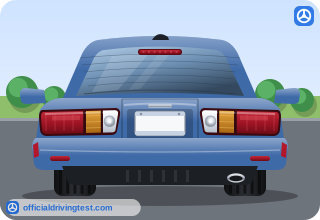
When do a vehicle's taillights turn on?
- Only when the vehicle is shifted into reverse
- Only when the brakes are applied after dark
- At the same time as the headlights and parking lights
- Only when the hazard flashers have been switched on by the driver
Show answer
Correct answer: At the same time as the headlights and parking lights
Taillights turn on at the same time as a vehicle's headlights and parking lights.
Source: New Jersey Driver Manual (2026), page 84 · Open this page in the manual (Manual page 84)
-
During the day, with the headlights off, what happens to a vehicle's taillights when you apply the brakes?
- They stay off
- They turn on
- They flash on and off
- They turn amber
Show answer
Correct answer: They turn on
During the day, without headlights, the taillights also turn on as a motorist applies the brakes.
Source: New Jersey Driver Manual (2026), page 84 · Open this page in the manual (Manual page 84)
-
What do brake lights do when a motorist applies the brakes?
- Change color from red to amber briefly
- Switch off until the vehicle moves again
- Flash rapidly to warn others of a sudden emergency stop
- Get brighter to show you are slowing or stopping
Show answer
Correct answer: Get brighter to show you are slowing or stopping
Brake lights become brighter when a motorist applies the brakes, showing that the vehicle is slowing or stopping.
Source: New Jersey Driver Manual (2026), page 84 · Open this page in the manual (Manual page 84)
-
According to the New Jersey Driver Manual, how should interior (overhead) lights be used while driving?
- Only briefly, when necessary
- Whenever passengers want to read
- Throughout any night drive
- Only when the high beams are on
Show answer
Correct answer: Only briefly, when necessary
Interior (overhead) lights should be used only briefly, when necessary, while driving, or when a police officer asks you to light the inside of the vehicle during a stop.
Source: New Jersey Driver Manual (2026), page 84 · Open this page in the manual (Manual page 84)
-
How bright should your dashboard lights be while driving?
- As bright as they will go at all times
- Switched off completely at night
- Bright only when driving in the city
- Dim, but light enough to read the dials
Show answer
Correct answer: Dim, but light enough to read the dials
Dashboard lights that are too bright can create glare and impede vision, so keep them dim but still light enough to read the dials.
Source: New Jersey Driver Manual (2026), page 84 · Open this page in the manual (Manual page 84)
-
According to the New Jersey Driver Manual, when may spotlights be used?
- Only in emergencies
- To light up dark rural roads while driving
- In place of high beams in the country
- To read house numbers while driving
Show answer
Correct answer: Only in emergencies
Spotlights should be used only in emergencies and may not be used for driving purposes.
Source: New Jersey Driver Manual (2026), page 84 · Open this page in the manual (Manual page 84)
-
According to the New Jersey Driver Manual, when should emergency flashers (hazard lights) be used?
- Whenever you stop briefly in a no-parking zone
- Only in emergencies
- Whenever you drive slower than other traffic
- Whenever you drive in heavy rain
Show answer
Correct answer: Only in emergencies
The manual says spotlights should be used only in emergencies, and that this also applies to emergency flashers (hazard lights).
Source: New Jersey Driver Manual (2026), page 84 · Open this page in the manual (Manual page 84)
-
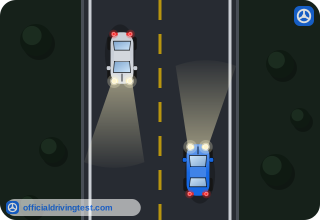
At night, which headlight signal does the New Jersey Driver Manual say might help you communicate with other motorists?
- Turning on your hazard flashers while moving
- A quick flip from low beams to high and back to low
- Turning your headlights off and then on again
- Leaving your high beams on until the other driver notices
Show answer
Correct answer: A quick flip from low beams to high and back to low
At night, a quick flip of the headlights from low to high and back to low might be helpful to communicate with other motorists.
Source: New Jersey Driver Manual (2026), page 93 · Open this page in the manual (Manual page 93)
-
Besides using turn signals, what does the New Jersey Driver Manual call another good method of communicating with other motorists?
- Flashing your high beams during the day
- Waving out the window at every intersection
- Braking suddenly to get their attention
- Catching other motorists' eyes
Show answer
Correct answer: Catching other motorists' eyes
Turn signals tell other motorists what you are going to do, and another good method is catching other motorists' eyes.
Source: New Jersey Driver Manual (2026), page 93 · Open this page in the manual (Manual page 93)
-
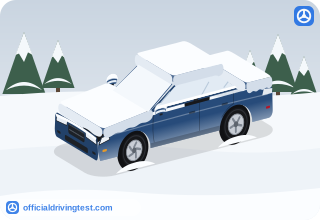
For cold-weather driving, what does the New Jersey Driver Manual say you should always make sure your vehicle has?
- Studded snow tires on all four wheels
- The proper windshield washing fluid
- A spare set of windshield wiper blades
- A full tank of premium-grade fuel
Show answer
Correct answer: The proper windshield washing fluid
In its cold-weather advice, the manual says to always make sure the vehicle has the proper type of windshield washing fluid.
Source: New Jersey Driver Manual (2026), page 98 · Open this page in the manual (Manual page 98)
-
If your brakes lock, what does the New Jersey Driver Manual say to do?
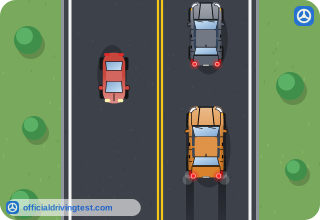
- Release, then reapply with slightly less pressure
- Turn the engine off and let the car coast to a stop
- Push the pedal even harder until you stop
- Keep holding the locked brakes and steer sharply
Show answer
Correct answer: Release, then reapply with slightly less pressure
If the brakes lock, release the brake pedal and immediately reapply with slightly less pressure, repeating with less and less pressure until the vehicle is under control.
Source: New Jersey Driver Manual (2026), page 99 · Open this page in the manual (Manual page 99)
-
What does the New Jersey Driver Manual say about snow tires on ice?
- They grip ice better than tire chains
- They are required by law on icy roads
- They do not provide good traction on ice
- They give the best traction on ice
Show answer
Correct answer: They do not provide good traction on ice
Snow tires give better traction for starting, steering and stopping in winter, but they do not provide good traction on ice.
Source: New Jersey Driver Manual (2026), page 99 · Open this page in the manual (Manual page 99)
-
According to the New Jersey Driver Manual, what gives the best traction on ice and in hard-packed or deep snow?
- All-season tires
- Tire chains
- Snow tires
- Wider tires
Show answer
Correct answer: Tire chains
Tire chains give the best traction on ice and in hard-packed or deep snow.
Source: New Jersey Driver Manual (2026), page 99 · Open this page in the manual (Manual page 99)
-
In New Jersey, during what period may motorists use studded snow tires?
- December 1 to March 1
- October 1 to May 1
- November 1 to April 15
- November 15 to April 1
Show answer
Correct answer: November 15 to April 1
In New Jersey, studded snow tires may be used between November 15 and April 1.
Source: New Jersey Driver Manual (2026), page 99 · Open this page in the manual (Manual page 99)
-
A vehicle's ignition system permits the key to be removed only when the transmission is in:
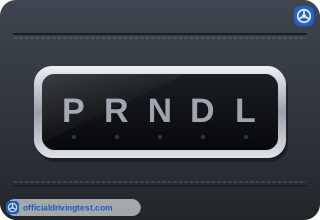
- Reverse
- Neutral
- Park
- Drive
Show answer
Correct answer: Park
To prevent theft and roll-away, an ignition system permits key removal only when the transmission is in the Park position.
Source: New Jersey Driver Manual (2026), page 104 · Open this page in the manual (Manual page 104)
-
When used properly, what are the ignition systems in today's vehicles designed to prevent?
- Air bags going off in minor bumps
- Vehicle theft and roll-away
- Engine overheating and stalling
- Battery drain overnight
Show answer
Correct answer: Vehicle theft and roll-away
Today's ignition systems, used properly, prevent the theft of an automobile and vehicle roll-away.
Source: New Jersey Driver Manual (2026), page 104 · Open this page in the manual (Manual page 104)