New Jersey: Signals & vehicle controls — Part 5 Practice Test
Questions in this part include: “How does the New Jersey Driver Manual describe the horn?” · “In New Jersey, when you are using your windshield wipers because of rain, snow, or ice, what must you also do?”
Independent educational site · not affiliated with any government agency or DMV
Ready? Test yourself
- Instant feedback with an explanation
- Every answer cites its source in the manual
- Your best score is saved on this device
Questions are original and based on the official manual "New Jersey Driver Manual" (2026), New Jersey Motor Vehicle Commission (MVC).
All 17 questions in this practice test
Take the test above first, then use this list to study. Tap “Show answer” to see the correct answer and explanation.
Show the questions and answersHide the questions
-
New Jersey law requires motorists to know the correct hand signals for stopping and turning. What does the manual say about these signals?
- They apply only to bicyclists
- They are standard in all states
- They differ from state to state
- They are needed only for the road test
Show answer
Correct answer: They are standard in all states
The manual says New Jersey law requires you to know the correct hand signals for stopping and turning, and that these signals are standard in all states.
Source: New Jersey Driver Manual (2026), page 54 · Open this page in the manual (Manual page 54)
-
How does the New Jersey Driver Manual describe the horn?
- A warning signal that calls attention to you
- A signal that you are yielding the right of way
- A courtesy signal to greet motorists you know
- A way to tell a slow driver ahead to speed up
Show answer
Correct answer: A warning signal that calls attention to you
The manual calls the horn a warning signal: it calls attention to what the motorist is doing.
Source: New Jersey Driver Manual (2026), page 54 · Open this page in the manual (Manual page 54)
-
To drive in reverse, how should your head and body be turned?
- Facing forward, watching the inside rearview mirror closely
- Toward the driver-side outside mirror
- To the right, until you see clearly through the back window
- To the left, looking back over your left shoulder only
Show answer
Correct answer: To the right, until you see clearly through the back window
To drive in reverse, turn your head and body to the right until you can see clearly through the back window without using the mirrors.
Source: New Jersey Driver Manual (2026), page 55 · Open this page in the manual (Manual page 55)
-
When backing up in a straight line, where should your right hand and arm be?
- Over the back of the front passenger seat
- At the 3 o'clock position on the steering wheel
- At the bottom of the steering wheel
- On the gearshift lever
Show answer
Correct answer: Over the back of the front passenger seat
For backing straight, place your right hand and arm over the back of the front passenger seat, with your left hand at the top of the steering wheel.
Source: New Jersey Driver Manual (2026), page 55 · Open this page in the manual (Manual page 55)
-
When backing up in a straight line, where should your left hand hold the steering wheel?
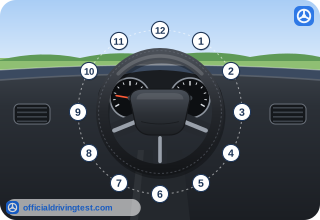
- At the 3 o'clock position
- At the bottom of the wheel
- On the inside of the rim, palm inward
- At the top of the wheel
Show answer
Correct answer: At the top of the wheel
In the straight-line reversing position, the left hand grasps the top of the steering wheel while the right arm rests over the passenger seat.
Source: New Jersey Driver Manual (2026), page 55 · Open this page in the manual (Manual page 55)
-
How fast should a vehicle typically be driven in reverse?
- About 5 to 10 mph, like slow city traffic
- At walking speed, about 2 to 4 mph
- About 10 to 15 mph
- No faster than 1 mph
Show answer
Correct answer: At walking speed, about 2 to 4 mph
A vehicle should be driven slowly in reverse, typically at walking speed (2 to 4 mph).
Source: New Jersey Driver Manual (2026), page 55 · Open this page in the manual (Manual page 55)
-
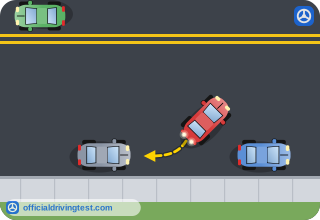
If you must turn the wheel while reversing, such as when parallel parking, how should you steer?
- By watching only the backup camera screen on the dashboard
- With two hands on the wheel, looking out the rear window
- By palming the wheel with one hand
- With only your left hand at the top of the wheel
Show answer
Correct answer: With two hands on the wheel, looking out the rear window
When turning the wheel in reverse, two hands must be on the wheel while your head and body are turned to look out the rear window.
Source: New Jersey Driver Manual (2026), page 55 · Open this page in the manual (Manual page 55)
-
When you turn while backing up, which way does the front of the vehicle swing?
- In the opposite direction of the turn
- In the same direction as the turn
- It stays in line with the rear wheels
- Always toward the nearest curb
Show answer
Correct answer: In the opposite direction of the turn
The manual reminds motorists that the front of the vehicle will swing in the opposite direction of a turn.
Source: New Jersey Driver Manual (2026), page 55 · Open this page in the manual (Manual page 55)
-
In New Jersey, headlights must be used during which period of the day?
- From one-half hour before sunset until sunrise
- From one-half hour after sunset to one-half hour before sunrise
- From sunset until sunrise, and at no other time
- From one full hour after sunset until one full hour before sunrise
Show answer
Correct answer: From one-half hour after sunset to one-half hour before sunrise
New Jersey law requires headlights between one-half hour after sunset and one-half hour before sunrise.
Source: New Jersey Driver Manual (2026), page 83 · Open this page in the manual (Manual page 83)
-
In New Jersey, you must use your headlights when visibility is how many feet or less?
- 1,000 feet
- 300 feet
- 200 feet
- 500 feet
Show answer
Correct answer: 500 feet
Headlights must also be used whenever visibility is 500 feet or less.
Source: New Jersey Driver Manual (2026), page 83 · Open this page in the manual (Manual page 83)
-
In New Jersey, when you are using your windshield wipers because of rain, snow, or ice, what must you also do?
- Turn on your hazard flashers
- Turn on only your parking lights
- Turn on your headlights
- Turn on your high beams
Show answer
Correct answer: Turn on your headlights
New Jersey law requires headlights whenever you are using your windshield wipers, such as during rain, snow, and ice.
Source: New Jersey Driver Manual (2026), page 83 · Open this page in the manual (Manual page 83)
-
In New Jersey, headlights must be used when you encounter which of these conditions, even in daytime?
- Fog, mist, or smoke
- Heavy traffic on a sunny day
- Driving through a school zone
- Driving on a toll road
Show answer
Correct answer: Fog, mist, or smoke
Headlights must be used when encountering fog, mist, smoke, or other factors that reduce visibility.
Source: New Jersey Driver Manual (2026), page 83 · Open this page in the manual (Manual page 83)
-
In New Jersey, can parking lights be used in place of headlights when headlights are required?
- Yes, during light rain only
- Yes, for short trips only
- No, that is not legal
- Yes, on well-lit city streets
Show answer
Correct answer: No, that is not legal
Parking or auxiliary lights cannot legally be used in place of headlights when headlights are required.
Source: New Jersey Driver Manual (2026), page 83 · Open this page in the manual (Manual page 83)
-
According to the New Jersey Driver Manual, when is the bright (high) beam meant to be used?
- When following close behind another vehicle
- In open country when no traffic is in sight
- Whenever another vehicle is approaching
- On city streets that are well lit
Show answer
Correct answer: In open country when no traffic is in sight
The bright beam is for open country driving when there is no traffic in sight.
Source: New Jersey Driver Manual (2026), page 83 · Open this page in the manual (Manual page 83)
-
How does the bright (high) beam help a motorist?
- It lets you see farther ahead and at a wider angle
- It reduces the glare from oncoming headlights
- It lights only the road right in front of the bumper
- It lets other drivers judge your speed better
Show answer
Correct answer: It lets you see farther ahead and at a wider angle
The bright beam helps a motorist see farther ahead and to the sides, at a wider angle.
Source: New Jersey Driver Manual (2026), page 83 · Open this page in the manual (Manual page 83)
-
According to the New Jersey Driver Manual, when are dim (low) beams used?
- Only on roads without streetlights
- Only while parked on a shoulder
- Only in open country with no traffic
- For city driving and driving in traffic
Show answer
Correct answer: For city driving and driving in traffic
Dim beams are used for city driving and driving in traffic, including when traveling behind other vehicles or when another vehicle is approaching.
Source: New Jersey Driver Manual (2026), page 83 · Open this page in the manual (Manual page 83)
-
Where are a vehicle's dim (low) beams focused?
- Out to both sides
- Down on the road
- High and far ahead
- Up toward the road signs
Show answer
Correct answer: Down on the road
Dim beams are focused down on the road; they are the beams to use when traveling behind other vehicles or when another vehicle is approaching.
Source: New Jersey Driver Manual (2026), page 83 · Open this page in the manual (Manual page 83)