New Jersey: Signals & vehicle controls — Part 4 Practice Test
Questions in this part include: “According to the New Jersey Driver Manual, what should you know about your vehicle in order to brake properly?” · “What is the correct hand signal a motorist gives for a right turn?”
Independent educational site · not affiliated with any government agency or DMV
Ready? Test yourself
- Instant feedback with an explanation
- Every answer cites its source in the manual
- Your best score is saved on this device
Questions are original and based on the official manual "New Jersey Driver Manual" (2026), New Jersey Motor Vehicle Commission (MVC).
All 17 questions in this practice test
Take the test above first, then use this list to study. Tap “Show answer” to see the correct answer and explanation.
Show the questions and answersHide the questions
-
According to the New Jersey Driver Manual, what should you know about your vehicle in order to brake properly?
- How many miles the brake pads have been used
- Whether it has conventional brakes or anti-lock brakes (ABS)
- Whether the engine powers the front wheels or the rear wheels
- Whether its tires are all-season or winter tires
Show answer
Correct answer: Whether it has conventional brakes or anti-lock brakes (ABS)
A motorist should know the type of braking system (conventional drum and disc, or ABS); whether the vehicle is front- or rear-wheel drive does not determine proper braking.
Source: New Jersey Driver Manual (2026), page 53 · Open this page in the manual (Manual page 53)
-
What common braking mistake does the New Jersey Driver Manual say many new motorists make?
- Slamming on the brake pedal when there is no emergency
- Starting to brake much too early when approaching a red light
- Shifting into neutral just before stopping
- Braking too gently when approaching a stop sign
Show answer
Correct answer: Slamming on the brake pedal when there is no emergency
Many new motorists slam on the brake pedal even when there is no emergency, which jerks the vehicle to a stop and wears out brakes and tires.
Source: New Jersey Driver Manual (2026), page 53 · Open this page in the manual (Manual page 53)
-
How should you press the brake to bring your vehicle to a controlled stop?
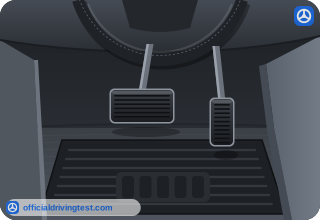
- With your left foot while the right stays on the gas
- By slamming it and then releasing it
- With quick, hard pumps
- With steady, gentle pressure
Show answer
Correct answer: With steady, gentle pressure
Steady, gentle pressure should be applied to the brake to bring the vehicle to a controlled stop.
Source: New Jersey Driver Manual (2026), page 53 · Open this page in the manual (Manual page 53)
-
An ABS-equipped vehicle may lose control at only what speed if the motorist violently jerks the steering wheel and brakes, even on dry pavement?
- 35 mph
- 65 mph
- 15 mph
- 55 mph
Show answer
Correct answer: 35 mph
The manual warns that an ABS-equipped vehicle may lose control at only 35 mph if the motorist violently jerks the wheel and brakes, even on dry pavement.
Source: New Jersey Driver Manual (2026), page 53 · Open this page in the manual (Manual page 53)
-
Where does the New Jersey Driver Manual suggest new motorists practice hard braking and steering until they are used to ABS?
- On a quiet highway late at night
- During the road test, with the examiner
- In an empty parking lot or similar open space
- On a residential street with little traffic
Show answer
Correct answer: In an empty parking lot or similar open space
New motorists should practice hard braking and steering in an empty parking lot or similar open space until they are accustomed to ABS.
Source: New Jersey Driver Manual (2026), page 53 · Open this page in the manual (Manual page 53)
-
Which foot should you use for the brake and the gas pedal?
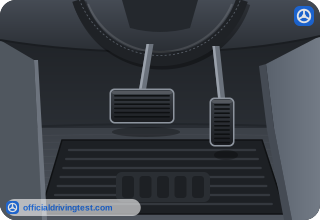
- Whichever foot is more comfortable
- Your right foot for both
- Your left foot for both
- Your left foot for the brake, right for the gas
Show answer
Correct answer: Your right foot for both
The manual says a motorist should always use their right foot for both the brake and the gas pedal.
Source: New Jersey Driver Manual (2026), page 53 · Open this page in the manual (Manual page 53)
-
In a vehicle with a manual transmission, which foot should operate the clutch?
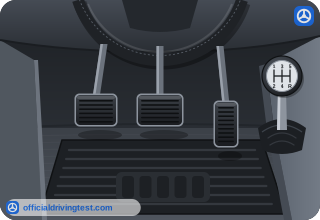
- The right foot, switching from the brake
- The left foot
- Either foot
- The right foot
Show answer
Correct answer: The left foot
With a manual transmission, the left foot should be used for the clutch, while the right foot works the brake and gas.
Source: New Jersey Driver Manual (2026), page 53 · Open this page in the manual (Manual page 53)
-
According to the New Jersey Driver Manual, when should a motorist give a proper signal?
- Only when turning at an intersection
- Only when changing lanes on a multi-lane highway
- When turning, changing lanes, stopping or slowing down
- Only when other vehicles or pedestrians are close enough to see
Show answer
Correct answer: When turning, changing lanes, stopping or slowing down
A motorist should always give a proper signal when turning, changing lanes, stopping or slowing down.
Source: New Jersey Driver Manual (2026), page 54 · Open this page in the manual (Manual page 54)
-
In New Jersey, how far before a turn should you put on your turn signal?
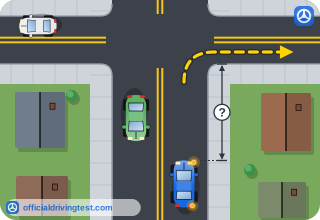
- At least 100 feet
- At least 50 feet
- At least 500 feet
- At least 200 feet
Show answer
Correct answer: At least 100 feet
A motorist should put on the turn signal at least 100 feet before turning (N.J.S.A. 39:4-126).
Source: New Jersey Driver Manual (2026), page 54 · Open this page in the manual (Manual page 54)
-
Why should you cancel your turn signal after making a turn?
- Leaving it on causes the vehicle to fail inspection
- Leaving it on drains the battery and stalls the engine
- Leaving it on makes the signal bulbs overheat
- Leaving it on could mislead other motorists
Show answer
Correct answer: Leaving it on could mislead other motorists
The manual says to cancel the signal after a turn because not doing so could mislead other motorists.
Source: New Jersey Driver Manual (2026), page 54 · Open this page in the manual (Manual page 54)
-
What is the correct hand signal for stopping or slowing down?
- Hand and arm downward, palm facing to the rear
- Hand and arm upward
- Hand and arm straight out
- Hand and arm waving forward, palm facing the front
Show answer
Correct answer: Hand and arm downward, palm facing to the rear
The stop or slow-down signal is the hand and arm pointed downward with the palm facing to the rear.
Source: New Jersey Driver Manual (2026), page 54 · Open this page in the manual (Manual page 54)
-
What is the correct hand signal a motorist gives for a right turn?
- Hand and arm downward
- Hand and arm straight out
- Hand and arm upward
- Hand pointing right across the roof
Show answer
Correct answer: Hand and arm upward
A motorist signals a right turn with the (left) hand and arm pointed upward.
Source: New Jersey Driver Manual (2026), page 54 · Open this page in the manual (Manual page 54)
-
What is the correct hand signal for a left turn?
- Hand circling above the roof
- Hand and arm downward
- Hand and arm upward
- Hand and arm straight out
Show answer
Correct answer: Hand and arm straight out
A left turn is signaled with the hand and arm held straight out.
Source: New Jersey Driver Manual (2026), page 54 · Open this page in the manual (Manual page 54)
-
When giving a hand signal, how should you hold your arm?
- Across your chest toward the passenger side
- Well out of the vehicle so others can see it
- Resting on the window frame, hand inside
- Just inside the window, where it is safe from traffic
Show answer
Correct answer: Well out of the vehicle so others can see it
To give a hand signal, put your arm well out of the vehicle so that it is visible to other motorists.
Source: New Jersey Driver Manual (2026), page 54 · Open this page in the manual (Manual page 54)
-
According to the New Jersey Driver Manual, when may motorists sound the horn when passing another vehicle?
- Only when in a business or residential zone
- Never; the horn is only for emergencies
- When not in a business or residential zone
- Only between sunset and sunrise
Show answer
Correct answer: When not in a business or residential zone
The horn is a warning signal; motorists may sound it when passing another vehicle when not in a business or residential zone.
Source: New Jersey Driver Manual (2026), page 54 · Open this page in the manual (Manual page 54)
-
Under normal conditions, a vehicle's horn should be able to be heard for at least how far?
- 100 feet
- 200 feet
- 500 feet
- 50 feet
Show answer
Correct answer: 200 feet
Under normal conditions, the horn should be able to be heard for at least 200 feet (N.J.S.A. 39:3-69).
Source: New Jersey Driver Manual (2026), page 54 · Open this page in the manual (Manual page 54)
-
While driving in reverse, what happens when you turn the steering wheel to the right?
- The vehicle keeps moving straight back
- The vehicle moves to the left
- The steering does not work in reverse
- The vehicle moves to the right
Show answer
Correct answer: The vehicle moves to the right
In reverse, turning the wheel to the right directs the vehicle to the right, and steering left directs it to the left.
Source: New Jersey Driver Manual (2026), page 54 · Open this page in the manual (Manual page 54)