New Jersey: Sharing the road — Part 5 Practice Test
Questions in this part include: “In New Jersey, which statement about a low-speed vehicle (LSV) is true?” · “In New Jersey, what rights and responsibilities do horseback riders and horse-drawn vehicles have on public roadways?”
Independent educational site · not affiliated with any government agency or DMV
Ready? Test yourself
- Instant feedback with an explanation
- Every answer cites its source in the manual
- Your best score is saved on this device
Questions are original and based on the official manual "New Jersey Driver Manual" (2026), New Jersey Motor Vehicle Commission (MVC).
All 17 questions in this practice test
Take the test above first, then use this list to study. Tap “Show answer” to see the correct answer and explanation.
Show the questions and answersHide the questions
-
In New Jersey, a person with a mobility-related disability may operate certain motorized scooters on any public street with a posted speed limit not exceeding:
- 45 mph
- 25 mph
- 15 mph
- 35 mph
Show answer
Correct answer: 25 mph
State law allows people with a mobility-related disability to operate certain motorized scooters on any public street posted at 25 mph or less.
Source: New Jersey Driver Manual (2026), page 152 · Open this page in the manual (Manual page 152)
-
In New Jersey, when may a person with a mobility-related disability operate a motorized scooter on a street posted above 25 mph but not more than 35 mph?
- Never, under any circumstances
- Only when accompanied by a licensed adult driver at all times
- If local government finds it poses no danger to traffic
- Only between sunrise and sunset
Show answer
Correct answer: If local government finds it poses no danger to traffic
They may use streets posted over 25 mph but not over 35 mph if local government determines the scooter does not pose a danger to safety and the flow of traffic.
Source: New Jersey Driver Manual (2026), page 152 · Open this page in the manual (Manual page 152)
-
In New Jersey, a motorized scooter operated on public streets by a person with a mobility-related disability may have a maximum speed capability of no more than:
- 25 mph
- 10 mph
- 20 mph
- 15 mph
Show answer
Correct answer: 15 mph
The motorized scooter may only have a maximum speed capability of no more than 15 mph.
Source: New Jersey Driver Manual (2026), page 152 · Open this page in the manual (Manual page 152)
-
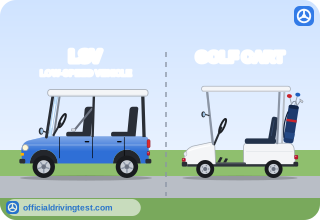
In New Jersey, a low-speed vehicle (LSV) is a four-wheeled vehicle with an attainable speed on a paved surface of:
- More than 35 mph but no more than 45 mph
- More than 20 mph but no more than 25 mph
- More than 25 mph but no more than 35 mph
- No more than 15 mph
Show answer
Correct answer: More than 20 mph but no more than 25 mph
An LSV is a four-wheeled vehicle whose attainable speed is more than 20 mph but no more than 25 mph on a paved surface.
Source: New Jersey Driver Manual (2026), page 153 · Open this page in the manual (Manual page 153)
-
In New Jersey, which statement about a low-speed vehicle (LSV) is true?
- It is exempt from federal safety standards
- It must run on diesel fuel
- It cannot be powered by gas or diesel fuel
- It must be powered by pedals
Show answer
Correct answer: It cannot be powered by gas or diesel fuel
An LSV cannot be powered by gas or diesel fuel and must comply with federal safety standards.
Source: New Jersey Driver Manual (2026), page 153 · Open this page in the manual (Manual page 153)
-
In New Jersey, may snowmobiles, ATVs and dirt bikes ride on public roadways with other vehicles?
- Yes, but only on highway shoulders
- Yes, on any public road
- Yes, but only on roads posted at 25 mph or less
- No, but they may cross certain roads when safe
Show answer
Correct answer: No, but they may cross certain roads when safe
It is illegal for these vehicles to ride on public roadways with other vehicles, but they are permitted to cross certain roadways when safety permits.
Source: New Jersey Driver Manual (2026), page 154 · Open this page in the manual (Manual page 154)
-
In New Jersey, what must operators of snowmobiles, ATVs and dirt bikes maintain and display?
- A slow-moving vehicle emblem and a flashing amber light
- A commercial driver license
- Proof of insurance and the vehicle's registration
- A farm vehicle exemption certificate
Show answer
Correct answer: Proof of insurance and the vehicle's registration
Operators of snowmobiles, ATVs and dirt bikes must maintain proof of insurance and always display the vehicle's registration.
Source: New Jersey Driver Manual (2026), page 154 · Open this page in the manual (Manual page 154)
-
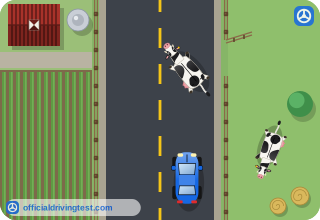
According to the New Jersey Driver Manual, what is the best defense against crashes involving animals?
- Honk your horn steadily in rural areas
- Watch both roadsides and expect sudden moves
- Keep your high beams on at all times
- Swerve sharply away as soon as you see an animal
Show answer
Correct answer: Watch both roadsides and expect sudden moves
Swerving to avoid an animal can make you hit something else or be hit from behind; the best defense is to watch both sides of the road ahead and be prepared for unexpected movement.
Source: New Jersey Driver Manual (2026), page 155 · Open this page in the manual (Manual page 155)
-
In New Jersey, what rights and responsibilities do horseback riders and horse-drawn vehicles have on public roadways?
- None; they may not use public roads
- The right-of-way over all other traffic
- Only those of pedestrians
- The same as drivers of motor vehicles
Show answer
Correct answer: The same as drivers of motor vehicles
Horse-drawn vehicles and horseback riders have the same rights and responsibilities as drivers of motor vehicles on public roadways.
Source: New Jersey Driver Manual (2026), page 155 · Open this page in the manual (Manual page 155)
-
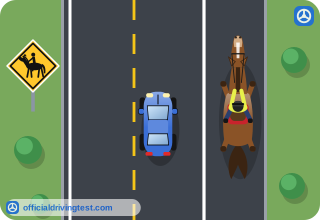
In New Jersey, when approaching or passing a person riding a horse or driving a horse-drawn vehicle, you must reduce your speed to:
- 15 mph or less
- 45 mph or less
- 25 mph or less
- 35 mph or less
Show answer
Correct answer: 25 mph or less
Motorists must reduce their speed to 25 mph or less and proceed with caution when approaching or passing a horse rider or horse-drawn vehicle.
Source: New Jersey Driver Manual (2026), page 155 · Open this page in the manual (Manual page 155)
-
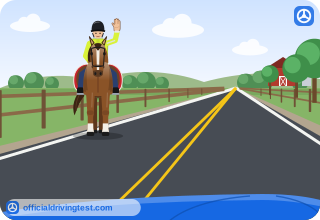
In New Jersey, a person riding a horse toward you from the opposite direction puts up a hand to signal you. What must you do?
- Stop and stay stopped until the horse passes
- Flash your headlights and continue
- Tap the horn lightly to acknowledge the rider
- Slow to 25 mph and keep going
Show answer
Correct answer: Stop and stay stopped until the horse passes
At the request or hand signal of a rider or horse-drawn vehicle driver coming the opposite way, you must stop and remain stationary as long as it takes the horse to pass.
Source: New Jersey Driver Manual (2026), page 155 · Open this page in the manual (Manual page 155)
-
In New Jersey, how must horse-drawn vehicles and horseback riders travel on the road?
- On the sidewalk whenever possible
- In the center of the travel lane
- With traffic, keeping as far right as possible
- Against traffic, on the far left side of the road
Show answer
Correct answer: With traffic, keeping as far right as possible
Horse-drawn vehicles and horseback riders must ride with traffic, keeping as far to the right as possible, and may not use certain limited-access highways.
Source: New Jersey Driver Manual (2026), page 155 · Open this page in the manual (Manual page 155)
-
In New Jersey, a horse-drawn vehicle must display a light on its front during which period?
- 30 minutes after sunset to 30 minutes before sunrise
- Only between midnight and 5 a.m.
- Only during morning and evening rush hours
- From one hour after sunset to one hour before sunrise
Show answer
Correct answer: 30 minutes after sunset to 30 minutes before sunrise
A light must be displayed on the front of a horse-drawn vehicle from 30 minutes after sunset until 30 minutes before sunrise, and in low visibility.
Source: New Jersey Driver Manual (2026), page 155 · Open this page in the manual (Manual page 155)
-
In New Jersey, a horse-drawn vehicle must display a front light whenever visibility is at or below what distance?
- 1,000 feet
- 500 feet
- 250 feet
- 100 feet
Show answer
Correct answer: 500 feet
A light must be displayed on the front of a horse-drawn vehicle if visibility is 500 feet or less, as well as at night and in fog, mist or smoke.
Source: New Jersey Driver Manual (2026), page 155 · Open this page in the manual (Manual page 155)
-
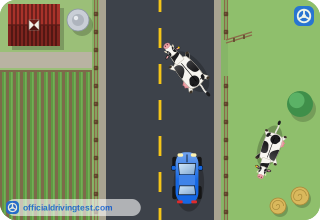
According to the New Jersey Driver Manual, why can swerving to avoid an animal on the road be dangerous?
- Swerving is illegal on all New Jersey roads
- It switches off your car's anti-lock brakes
- It uses up more fuel than braking hard
- You may hit something else or be hit from behind
Show answer
Correct answer: You may hit something else or be hit from behind
Trying to avoid animals often causes crashes: by swerving, the vehicle may hit something else or be hit by another vehicle from behind.
Source: New Jersey Driver Manual (2026), page 155 · Open this page in the manual (Manual page 155)
-
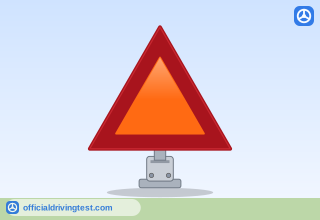
What does a fluorescent, reflective orange triangular sign on a vehicle indicate?
- It is carrying hazardous materials
- It is driven by a student driver
- It is an emergency vehicle
- It is a slow-moving vehicle
Show answer
Correct answer: It is a slow-moving vehicle
A fluorescent and reflective orange triangular sign indicates a slow-moving vehicle, such as farm and construction equipment on public highways.
Source: New Jersey Driver Manual (2026), page 217 · Open this page in the manual (Manual page 217)
-
Operators of slow-moving vehicles, such as farm equipment on public highways, must place a slow-moving vehicle sign where?
- On the roof of the cab
- On the back of the vehicle
- On the driver's side door
- On the front bumper
Show answer
Correct answer: On the back of the vehicle
Slow-moving vehicle operators must obey all traffic rules and place a slow-moving vehicle sign on the back of their vehicles to warn approaching motorists.
Source: New Jersey Driver Manual (2026), page 217 · Open this page in the manual (Manual page 217)