New Jersey: Sharing the road — Part 4 Practice Test
Questions in this part include: “In New Jersey, what is the penalty for a driver who violates the Safe Passing Law and causes bodily injury?” · “According to the New Jersey Driver Manual, how should you check around your vehicle for bicyclists and skaters?”
Independent educational site · not affiliated with any government agency or DMV
Ready? Test yourself
- Instant feedback with an explanation
- Every answer cites its source in the manual
- Your best score is saved on this device
Questions are original and based on the official manual "New Jersey Driver Manual" (2026), New Jersey Motor Vehicle Commission (MVC).
All 17 questions in this practice test
Take the test above first, then use this list to study. Tap “Show answer” to see the correct answer and explanation.
Show the questions and answersHide the questions
-
In New Jersey, what is the penalty for a driver who violates the Safe Passing Law and causes bodily injury?
- $250 fine and one point
- $100 fine and no points
- $500 fine and two penalty points
- $1,000 fine and four penalty points
Show answer
Correct answer: $500 fine and two penalty points
Drivers who do not follow the Safe Passing Law and cause bodily injury are fined $500 and assessed two motor vehicle penalty points.
Source: New Jersey Driver Manual (2026), page 151 · Open this page in the manual (Manual page 151)
-
In New Jersey, what is the penalty for violating the Safe Passing Law when no bodily injury results?
- $100 fine and no penalty points
- $100 fine and two penalty points
- $500 fine and two penalty points
- No fine, only a written warning
Show answer
Correct answer: $100 fine and no penalty points
If no bodily injury results, the violator is fined $100 and is not assessed any penalty points.
Source: New Jersey Driver Manual (2026), page 151 · Open this page in the manual (Manual page 151)
-
In New Jersey, what must a bicycle ridden after dark have?
- Flashing lights on both wheels
- Front and rear lights plus a rear reflector
- Only a red rear light
- Only a white reflector on the front of the bicycle
Show answer
Correct answer: Front and rear lights plus a rear reflector
Bicycles ridden after dark must have front and rear lights and a rear reflector, but these may still be hard for motorists to see.
Source: New Jersey Driver Manual (2026), page 151 · Open this page in the manual (Manual page 151)
-
In New Jersey, a motorist signaling a right turn must yield to which of these moving through the intersection?
- No one, as long as your right turn signal is on
- Bicyclists, skateboarders and inline skaters
- Only vehicles turning left
- Only other motor vehicles
Show answer
Correct answer: Bicyclists, skateboarders and inline skaters
Motorists signaling a right turn must yield to bicyclists, skateboarders or inline skaters moving through an intersection, and should wait until the intersection clears.
Source: New Jersey Driver Manual (2026), page 151 · Open this page in the manual (Manual page 151)
-
According to the New Jersey Driver Manual, how may a bicyclist, skateboarder or inline skater make a left turn?
- Use the traffic lanes to turn like a vehicle
- By riding on the left side, against traffic
- Only by walking across in the crosswalk
- Only from the right-hand shoulder
Show answer
Correct answer: Use the traffic lanes to turn like a vehicle
To turn left, a bicyclist, skateboarder or inline skater may choose to use traffic lanes to turn as a vehicle would.
Source: New Jersey Driver Manual (2026), page 151 · Open this page in the manual (Manual page 151)
-
According to the New Jersey Driver Manual, where in a turn lane may a bicyclist, skateboarder or inline skater ride?
- Only behind all the cars
- Straddling the lane line
- On the left edge of the turn lane
- On the right edge of the turn lane
Show answer
Correct answer: On the right edge of the turn lane
Motorists should be aware that a bicyclist, skateboarder or inline skater may ride on the right edge of the turn lane.
Source: New Jersey Driver Manual (2026), page 151 · Open this page in the manual (Manual page 151)
-
According to the New Jersey Driver Manual, how should you check around your vehicle for bicyclists and skaters?
- By using only your side mirrors
- By using only your rearview mirror before you move
- By turning your head, not relying only on mirrors
- By honking before you move
Show answer
Correct answer: By turning your head, not relying only on mirrors
Check around your vehicle by turning your head instead of relying only on your mirrors.
Source: New Jersey Driver Manual (2026), page 151 · Open this page in the manual (Manual page 151)
-
According to the New Jersey Driver Manual, which of these is a time to check your blind spots for bicyclists and skaters?
- Only when backing out of a driveway
- Before opening your car door
- Only after dark
- Only when changing lanes on highways
Show answer
Correct answer: Before opening your car door
Check your blind spots before turning, parallel parking, opening a door or pulling away from a curb.
Source: New Jersey Driver Manual (2026), page 151 · Open this page in the manual (Manual page 151)
-
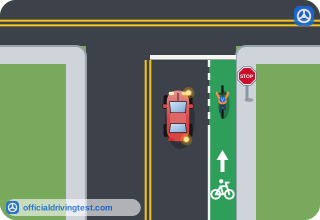
When turning right, why should you avoid turning in front of bicyclists, skateboarders and inline skaters?
- They must yield to all turning cars
- They must stop at every corner
- They may not be able to stop quickly
- They always ride on the sidewalk
Show answer
Correct answer: They may not be able to stop quickly
When turning right, check for bicyclists, skateboarders and inline skaters and avoid turning in front of them, because they may not be able to stop quickly.
Source: New Jersey Driver Manual (2026), page 151 · Open this page in the manual (Manual page 151)
-
When you turn left in New Jersey, whom must you yield to?
- All oncoming traffic, including bicyclists and skaters
- No one, if you have a green light
- Only oncoming buses
- Only oncoming cars and trucks, never bicycles or skaters
Show answer
Correct answer: All oncoming traffic, including bicyclists and skaters
When turning left, yield to all oncoming traffic, including bicyclists, skateboarders and inline skaters.
Source: New Jersey Driver Manual (2026), page 151 · Open this page in the manual (Manual page 151)
-
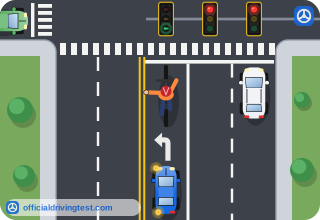
You are in a left-turn lane and a bicyclist is ahead of you in the same lane. What should you do?
- Turn alongside the rider
- Honk so the rider moves aside
- Pass the rider on the right side of the lane
- Wait until the rider finishes turning
Show answer
Correct answer: Wait until the rider finishes turning
If a bicyclist, skateboarder or inline skater is in front of you in a left turn lane, wait for them to complete their turn before you proceed.
Source: New Jersey Driver Manual (2026), page 151 · Open this page in the manual (Manual page 151)
-
In New Jersey, where may motorized scooters such as pocket bikes and mini choppers be driven?
- On highway shoulders
- Only on designated municipal or county property
- On public sidewalks, as long as they yield to pedestrians
- On any public road
Show answer
Correct answer: Only on designated municipal or county property
It is illegal to drive motorized scooters on any public road or sidewalk, except on designated municipal or county property.
Source: New Jersey Driver Manual (2026), page 151 · Open this page in the manual (Manual page 151)
-
In New Jersey, where must a motorized scooter be registered?
- In the owner's home municipality or county
- With the MVC, the same way a car is registered
- With the New Jersey State Police
- Nowhere; registration isn't required
Show answer
Correct answer: In the owner's home municipality or county
Motorized scooters must be registered in the municipality or county where the owner resides, and must be insured.
Source: New Jersey Driver Manual (2026), page 152 · Open this page in the manual (Manual page 152)
-
In New Jersey, must a motorized scooter be insured?
- No, insurance is never required
- Only if the rider is under 18
- Yes, it must be insured
- Only if it can go over 25 mph
Show answer
Correct answer: Yes, it must be insured
The manual states that motorized scooters must be registered locally and must be insured.
Source: New Jersey Driver Manual (2026), page 152 · Open this page in the manual (Manual page 152)
-
In New Jersey, unless the municipality or county sets a different age, no one under what age may operate a motorized scooter?
- 10
- 14
- 16
- 12
Show answer
Correct answer: 12
No one under age 12 (or the age set by the municipality or county where it is operated) may operate a motorized scooter.
Source: New Jersey Driver Manual (2026), page 152 · Open this page in the manual (Manual page 152)
-
Which of these is NOT considered a motorized scooter in New Jersey?
- A motorized wheelchair
- A pocket bike
- A motorized skateboard
- A mini chopper
Show answer
Correct answer: A motorized wheelchair
Pocket bikes, mini choppers and motorized skateboards are listed as motorized scooters; motorized wheelchairs are listed as not being motorized scooters.
Source: New Jersey Driver Manual (2026), page 152 · Open this page in the manual (Manual page 152)
-
Which of these IS an example of a motorized scooter under New Jersey law?
- An e-bike
- A mobility scooter for a person with a disability
- A low-speed vehicle
- A mini motorcycle
Show answer
Correct answer: A mini motorcycle
Mini motorcycles are listed as motorized scooters; e-bikes, low-speed vehicles and mobility scooters for people with disabilities are not motorized scooters.
Source: New Jersey Driver Manual (2026), page 152 · Open this page in the manual (Manual page 152)