New Jersey: Sharing the road — Part 3 Practice Test
Questions in this part include: “What does the New Jersey Driver Manual say about passing a truck on the right?” · “According to the New Jersey Driver Manual, what is a moped (motorized bicycle)?”
Independent educational site · not affiliated with any government agency or DMV
Ready? Test yourself
- Instant feedback with an explanation
- Every answer cites its source in the manual
- Your best score is saved on this device
Questions are original and based on the official manual "New Jersey Driver Manual" (2026), New Jersey Motor Vehicle Commission (MVC).
All 17 questions in this practice test
Take the test above first, then use this list to study. Tap “Show answer” to see the correct answer and explanation.
Show the questions and answersHide the questions
-
When passing a truck, when may you pull back in front of it?
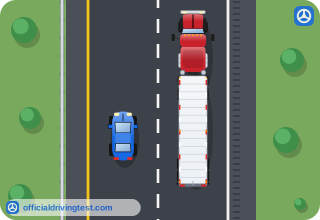
- When its whole front shows in your rearview mirror
- Once you are a few feet past its cab
- As soon as your rear bumper clears the truck's front bumper
- When the truck driver flashes the headlights
Show answer
Correct answer: When its whole front shows in your rearview mirror
Do not pull in front of a truck when passing until you can see the whole front of the truck in your rearview mirror.
Source: New Jersey Driver Manual (2026), page 149 · Open this page in the manual (Manual page 149)
-
What does the New Jersey Driver Manual say about passing a truck on the right?
- Pass on the right if the truck is slow
- Never pass a truck on the right
- Always pass a truck on the right
- Pass on whichever side is open
Show answer
Correct answer: Never pass a truck on the right
The manual says to always signal before changing lanes and never pass a truck on the right.
Source: New Jersey Driver Manual (2026), page 149 · Open this page in the manual (Manual page 149)
-
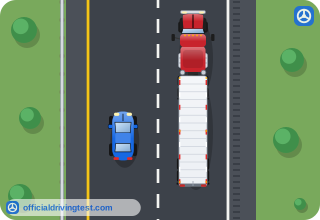
According to the New Jersey Driver Manual, how should you control your speed while passing a truck?
- Slow down beside its cab
- Vary your speed so it notices you
- Match its speed alongside it
- Keep a consistent speed
Show answer
Correct answer: Keep a consistent speed
The manual says to maintain a consistent speed when passing a truck.
Source: New Jersey Driver Manual (2026), page 149 · Open this page in the manual (Manual page 149)
-
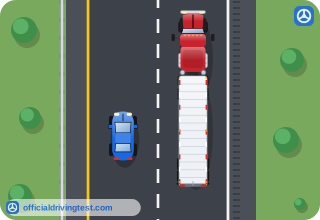
According to the New Jersey Driver Manual, why should you not linger alongside a truck when passing?
- Its tires give off too much heat
- Driving next to any truck on a highway is always illegal
- You would be in the way if it had to change lanes fast
- It forces the truck to slow down
Show answer
Correct answer: You would be in the way if it had to change lanes fast
The sides of trucks have long blind spots; if the driver must quickly change lanes or make an emergency maneuver, a vehicle there will be in the way.
Source: New Jersey Driver Manual (2026), page 150 · Open this page in the manual (Manual page 150)
-
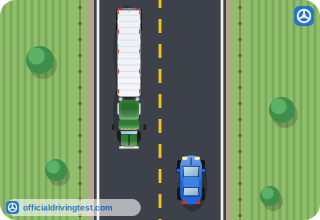
What should you do when a large vehicle is traveling toward you from the opposite direction?
- Bear to the right
- Flash your high beams
- Move toward the center line
- Speed up to pass it quickly
Show answer
Correct answer: Bear to the right
Bear right when a large vehicle approaches from the opposite direction; this reduces wind turbulence and may prevent a sideswipe.
Source: New Jersey Driver Manual (2026), page 150 · Open this page in the manual (Manual page 150)
-
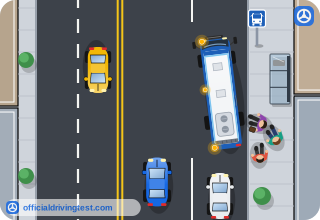
In New Jersey, what must non-emergency vehicles do when a bus is re-entering traffic after dropping off or picking up passengers?
- Sound the horn to warn the bus
- Speed up to pass the bus first
- Yield the right-of-way to the bus
- Yield only if it is a school bus
Show answer
Correct answer: Yield the right-of-way to the bus
State law requires all non-emergency vehicles to yield the right-of-way to buses re-entering traffic after dropping off or picking up passengers.
Source: New Jersey Driver Manual (2026), page 150 · Open this page in the manual (Manual page 150)
-
In New Jersey, once a bus is back in the normal flow of traffic, must motorists yield to it when it changes lanes?
- Yes, buses always have the right-of-way in New Jersey
- Only on roads that have a bus lane
- Only if the bus signals for 5 seconds
- No, not once it is back in the traffic flow
Show answer
Correct answer: No, not once it is back in the traffic flow
Once the bus is back in the normal flow of traffic, motorists are not required to yield the right-of-way to buses changing lanes.
Source: New Jersey Driver Manual (2026), page 150 · Open this page in the manual (Manual page 150)
-
In New Jersey, what is the penalty for violating the law requiring motorists to yield to buses re-entering traffic?
- A $1,000 to $2,000 fine and up to 90 days in jail
- $50 to $200 fine, up to 15 days in jail, or both
- $100 fine with no jail possible
- $500 fine and two penalty points
Show answer
Correct answer: $50 to $200 fine, up to 15 days in jail, or both
Violating the bus yield law (N.J.S.A. 39:4-87.1) carries a fine of $50 to $200, up to 15 days in jail, or both.
Source: New Jersey Driver Manual (2026), page 150 · Open this page in the manual (Manual page 150)
-
In New Jersey, what is the maximum speed at which a moped driver may travel?
- 35 mph
- 45 mph
- 15 mph
- 25 mph
Show answer
Correct answer: 25 mph
Moped drivers may not exceed 25 mph and must follow all traffic signs and signals.
Source: New Jersey Driver Manual (2026), page 150 · Open this page in the manual (Manual page 150)
-
In New Jersey, where on the road must a moped be driven?
- On the left side, facing traffic
- In the center of the travel lane
- On the right side, with the flow of traffic
- On the sidewalk whenever a sidewalk is available
Show answer
Correct answer: On the right side, with the flow of traffic
Moped drivers must drive on the right side of the road with the flow of traffic.
Source: New Jersey Driver Manual (2026), page 150 · Open this page in the manual (Manual page 150)
-
According to the New Jersey Driver Manual, what is a moped (motorized bicycle)?
- A low-speed, two-wheeled vehicle with pedals
- A miniature motorcycle with no pedals
- A four-wheeled vehicle limited to 25 mph
- A three-wheeled scooter for highway use
Show answer
Correct answer: A low-speed, two-wheeled vehicle with pedals
Motorized bicycles, or mopeds, are low-speed, two-wheeled vehicles with pedals, intended for limited use on public roadways.
Source: New Jersey Driver Manual (2026), page 150 · Open this page in the manual (Manual page 150)
-
According to the New Jersey Driver Manual, why should motorists always be alert for mopeds?
- They travel faster than most cars
- They are smaller than motorcycles and harder to see
- They are allowed to ignore traffic signs and signals
- They must ride against traffic
Show answer
Correct answer: They are smaller than motorcycles and harder to see
Mopeds are smaller than motorcycles and may be harder to see; their drivers have the same rights and responsibilities as other motor vehicle drivers.
Source: New Jersey Driver Manual (2026), page 150 · Open this page in the manual (Manual page 150)
-
Under New Jersey law, what rights and responsibilities do bicyclists, skateboarders and inline skaters have on the road?
- The same as motor vehicles
- Only the rights of pedestrians
- None; they may not use the road
- Rights, but no duty to obey signals
Show answer
Correct answer: The same as motor vehicles
Under New Jersey law, bicyclists, skateboarders and inline skaters have the same rights and responsibilities as motor vehicles.
Source: New Jersey Driver Manual (2026), page 150 · Open this page in the manual (Manual page 150)
-
In New Jersey, how are bicyclists, skateboarders and inline skaters classified?
- As slow-moving vehicles
- As pedestrians
- As vulnerable road users
- As motor vehicle operators
Show answer
Correct answer: As vulnerable road users
Although they have the same rights and responsibilities as motor vehicles, bicyclists, skateboarders and inline skaters are classified as vulnerable road users.
Source: New Jersey Driver Manual (2026), page 150 · Open this page in the manual (Manual page 150)
-
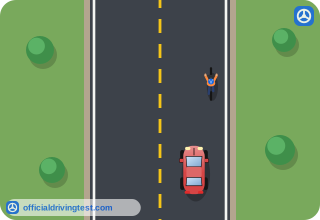
Under New Jersey's Safe Passing Law, what does passing a bicyclist with "due caution" mean?
- Flashing your headlights as you pass to warn the rider
- Slowing down and giving the rider plenty of space
- Honking twice before you pass
- Passing at the posted speed limit
Show answer
Correct answer: Slowing down and giving the rider plenty of space
The Safe Passing Law defines due caution as both slowing down and giving the other user plenty of space when passing.
Source: New Jersey Driver Manual (2026), page 150 · Open this page in the manual (Manual page 150)
-
In New Jersey, what rights and responsibilities do moped drivers have?
- None; mopeds may not use public roads
- Only the rights of pedestrians
- Fewer duties, because mopeds are slow
- The same as other motor vehicle drivers
Show answer
Correct answer: The same as other motor vehicle drivers
The manual says moped drivers have the same rights and responsibilities as those driving other motor vehicles.
Source: New Jersey Driver Manual (2026), page 150 · Open this page in the manual (Manual page 150)
-
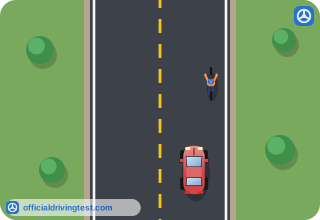
Under New Jersey's Safe Passing Law, when you pass a bicyclist traveling in your direction, do no-passing and speed laws still apply?
- No, you may cross a no-passing line to give room
- No, you may briefly speed up past the limit
- Only on roads that have more than one lane
- Yes, you must follow all no-passing and speed laws
Show answer
Correct answer: Yes, you must follow all no-passing and speed laws
Due caution under the Safe Passing Law includes following all current no-passing and no-speeding laws, and moving over a lane if there is one to move into.
Source: New Jersey Driver Manual (2026), page 150 · Open this page in the manual (Manual page 150)