New Jersey: Sharing the road — Part 1 Practice Test
Questions in this part include: “Besides the standard hand signals, how else may a bicyclist, skateboarder or inline skater signal a right turn?” · “Before turning, which less visible vehicles does the New Jersey Driver Manual tell you to check for?”
Independent educational site · not affiliated with any government agency or DMV
Ready? Test yourself
- Instant feedback with an explanation
- Every answer cites its source in the manual
- Your best score is saved on this device
Questions are original and based on the official manual "New Jersey Driver Manual" (2026), New Jersey Motor Vehicle Commission (MVC).
All 18 questions in this practice test
Take the test above first, then use this list to study. Tap “Show answer” to see the correct answer and explanation.
Show the questions and answersHide the questions
-
Besides the standard hand signals, how else may a bicyclist, skateboarder or inline skater signal a right turn?
- By extending the right hand and arm straight out
- By extending the left hand and arm straight downward
- By waving the right hand and arm above the head
- By extending the left hand and arm straight out
Show answer
Correct answer: By extending the right hand and arm straight out
Instead of raising the left hand and arm upward for a right turn, bicyclists, skateboarders and inline skaters may extend the right hand and arm straight out.
Source: New Jersey Driver Manual (2026), page 54 · Open this page in the manual (Manual page 54)
-
Before turning, which less visible vehicles does the New Jersey Driver Manual tell you to check for?
- Motorcycles, bicycles and mopeds
- Police cars and ambulances
- Tow trucks and snowplows
- Tractor-trailers and large city buses
Show answer
Correct answer: Motorcycles, bicycles and mopeds
Before turning, check for less visible vehicles, such as motorcycles, bicycles and mopeds.
Source: New Jersey Driver Manual (2026), page 56 · Open this page in the manual (Manual page 56)
-
When should you yield the right-of-way to a postal vehicle?
- When it re-enters the flow of traffic
- Only in residential districts
- Only when its hazard lights are off
- Never; it has no special right-of-way
Show answer
Correct answer: When it re-enters the flow of traffic
The basic right-of-way rules include yielding to postal vehicles when they re-enter the flow of traffic.
Source: New Jersey Driver Manual (2026), page 65 · Open this page in the manual (Manual page 65)
-
Why should you watch for bicycles and mopeds when turning right on red?
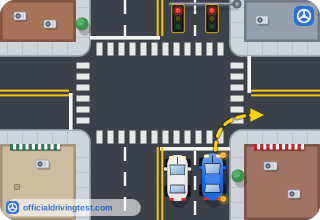
- They may have a green light and are hard to see
- They are not allowed to use intersections
- They must always stop for vehicles that are turning
- They always ride on the sidewalk instead
Show answer
Correct answer: They may have a green light and are hard to see
Difficult-to-see vehicles such as bicycles and mopeds may have a green light, so you must be aware of them.
Source: New Jersey Driver Manual (2026), page 72 · Open this page in the manual (Manual page 72)
-
On a two-lane road in New Jersey, how far away must you stop from a school bus with flashing red lights?
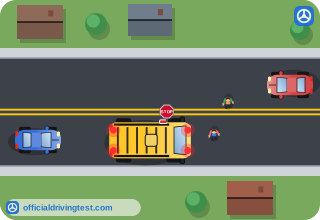
- At least 25 feet
- At least 50 feet
- At least 15 feet
- At least 10 feet
Show answer
Correct answer: At least 25 feet
State law requires a motorist to stop at least 25 feet away from a school bus with flashing red lights on a two-lane road.
Source: New Jersey Driver Manual (2026), page 77 · Open this page in the manual (Manual page 77)
-
Besides two-lane roads and multi-lane highways whose lanes are separated only by lines, where else does New Jersey's rule to stop 25 feet from a school bus with flashing red lights apply?
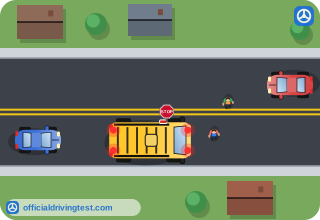
- On the far side of a safety island on a dual-lane highway
- On a privately maintained road
- Nowhere else; it covers only public roads
- On the far side of a raised median on a dual-lane highway
Show answer
Correct answer: On a privately maintained road
The 25-foot stopping rule applies on two-lane roads, multi-lane highways where lanes are only separated by lines, and privately maintained roads.
Source: New Jersey Driver Manual (2026), page 77 · Open this page in the manual (Manual page 77)
-
On a dual-lane highway in New Jersey, if you are on the other side of a safety island or raised median from a school bus with flashing red lights, what should you do?
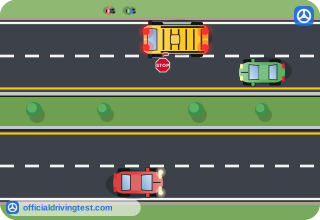
- Stop at least 25 feet away
- Slow to 25 mph
- Slow to 10 mph
- Keep going at the posted speed limit
Show answer
Correct answer: Slow to 10 mph
On a dual-lane highway, a motorist on the other side of a safety island or raised median should slow to 10 mph.
Source: New Jersey Driver Manual (2026), page 77 · Open this page in the manual (Manual page 77)
-
On a school bus, when do the yellow (or amber) flashing lights go on?
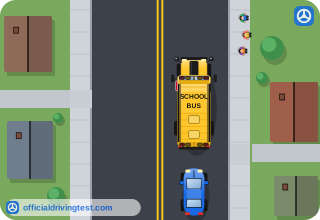
- After the bus has stopped
- When the bus is about to pull away
- When the bus door opens
- Before the bus stops
Show answer
Correct answer: Before the bus stops
The yellow (or amber) lights go on before the bus stops, and the red lights go on when the bus has stopped.
Source: New Jersey Driver Manual (2026), page 77 · Open this page in the manual (Manual page 77)
-
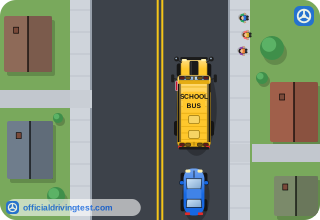
Why does the New Jersey Driver Manual say you should not depend on a school bus's warning lights when driving behind it?
- The lights are hard to see in daylight
- The lights could be malfunctioning
- The lights are used only for older students
- The lights are used only on rural roads
Show answer
Correct answer: The lights could be malfunctioning
A motorist driving behind a school bus should not depend on its warning lights, because they could be malfunctioning.
Source: New Jersey Driver Manual (2026), page 77 · Open this page in the manual (Manual page 77)
-
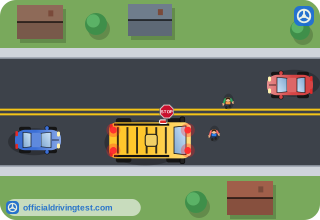
After stopping for a school bus in New Jersey, when may you proceed?
- As soon as all the children are on board, even with the red lights flashing
- After waiting 30 seconds, whether or not the lights are on
- After the bus signals are turned off, while still watching for children
- When the bus driver waves you on, even with red lights flashing
Show answer
Correct answer: After the bus signals are turned off, while still watching for children
A motorist should proceed only after the bus signals have been turned off, and even then must watch for children or persons with developmental disabilities.
Source: New Jersey Driver Manual (2026), page 77 · Open this page in the manual (Manual page 77)
-
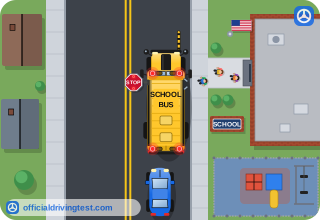
If a school bus has stopped directly in front of a school to pick up or let off children, how may New Jersey motorists pass it?
- From either direction at no more than 10 mph
- Only from the opposite direction, at 25 mph
- From either direction at no more than 25 mph
- Not at all until the bus moves away
Show answer
Correct answer: From either direction at no more than 10 mph
When a school bus is stopped directly in front of a school to pick up or let off children, a motorist may pass from either direction at no more than 10 mph.
Source: New Jersey Driver Manual (2026), page 77 · Open this page in the manual (Manual page 77)
-
In New Jersey, after stopping for an ice cream truck that is flashing red lights and showing a stop signal arm, how fast may you drive past it?
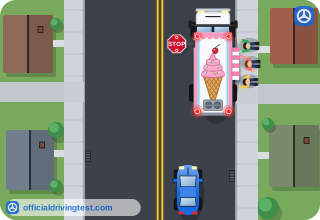
- No more than 15 mph
- No more than 10 mph
- No more than 5 mph
- No more than 25 mph
Show answer
Correct answer: No more than 15 mph
A motorist must stop and then drive past the frozen dessert truck at no more than 15 mph.
Source: New Jersey Driver Manual (2026), page 78 · Open this page in the manual (Manual page 78)
-
In New Jersey, when do you NOT need to stop for a frozen dessert truck that is flashing red lights and showing a stop signal arm?
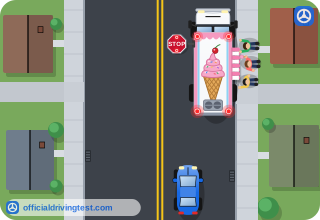
- When you cannot see any children anywhere near the truck or road
- On a dual highway, across a safety island or raised median
- When you are overtaking the truck from behind
- When the truck is parked on a residential street
Show answer
Correct answer: On a dual highway, across a safety island or raised median
A motorist need not stop on a dual highway if they are on the other side of a safety island or raised median from the truck.
Source: New Jersey Driver Manual (2026), page 78 · Open this page in the manual (Manual page 78)
-
New Jersey's rules for frozen dessert trucks with flashing red lights and a stop signal arm apply when you approach or overtake the truck from which direction?
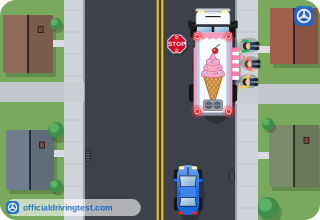
- Only from behind the truck
- Only on the side where its window is
- From either direction
- Only from the opposite direction
Show answer
Correct answer: From either direction
The rules apply when approaching or overtaking an ice cream or frozen dessert truck from either direction.
Source: New Jersey Driver Manual (2026), page 78 · Open this page in the manual (Manual page 78)
-
If you encounter an animal on the road in farm country or open land, you should:
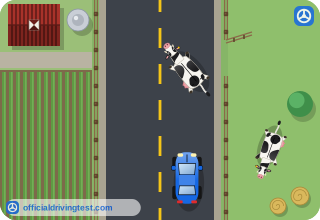
- Swerve into the opposite lane around it
- Sound your horn and keep going at speed
- Speed up to get past it before it moves
- Slow down until the animal has passed
Show answer
Correct answer: Slow down until the animal has passed
Animals make unexpected moves, so if you encounter one you should slow down until it has passed.
Source: New Jersey Driver Manual (2026), page 102 · Open this page in the manual (Manual page 102)
-
Under New Jersey's Safe Passing Law, what should you do when possible when passing a bicyclist or other vulnerable road user?
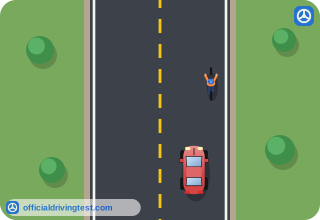
- Pass within two feet
- Speed up to pass quickly
- Honk before you pass
- Move over one lane
Show answer
Correct answer: Move over one lane
The Safe Passing Law requires due caution: move over one lane when possible, or allow at least four feet on a single-lane road.
Source: New Jersey Driver Manual (2026), page 146 · Open this page in the manual (Manual page 146)
-
Under New Jersey's Safe Passing Law, how much space must you allow when passing a vulnerable road user on a single-lane road?
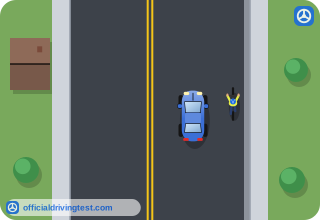
- At least 4 feet
- At least 6 feet
- At least 3 feet
- At least 2 feet
Show answer
Correct answer: At least 4 feet
On a single-lane road, drivers must allow at least four feet of space when passing a vulnerable road user.
Source: New Jersey Driver Manual (2026), page 146 · Open this page in the manual (Manual page 146)
-
Under New Jersey's Safe Passing Law, what must you do if it is not possible to give a bicyclist 4 feet of space?
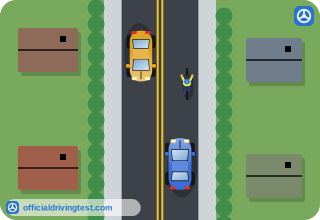
- Slow to 35 mph and pass
- Slow to 25 mph, ready to stop until it is safe
- Pass quickly at the posted speed limit to get by sooner
- Honk so the rider moves over
Show answer
Correct answer: Slow to 25 mph, ready to stop until it is safe
If four feet is not possible, drivers must slow to 25 mph and be prepared to stop until it is safe to pass.
Source: New Jersey Driver Manual (2026), page 146 · Open this page in the manual (Manual page 146)