New Jersey: Seat belts & child safety — Part 2 Practice Test
Questions in this part include: “In most new vehicles, where can the shoulder belt be adjusted to improve its fit?” · “According to the New Jersey Driver Manual, what is the best protection a motorist can offer a child passenger?”
Independent educational site · not affiliated with any government agency or DMV
Ready? Test yourself
- Instant feedback with an explanation
- Every answer cites its source in the manual
- Your best score is saved on this device
Questions are original and based on the official manual "New Jersey Driver Manual" (2026), New Jersey Motor Vehicle Commission (MVC).
All 20 questions in this practice test
Take the test above first, then use this list to study. Tap “Show answer” to see the correct answer and explanation.
Show the questions and answersHide the questions
-
Where should the shoulder portion of a seat belt cross your body?
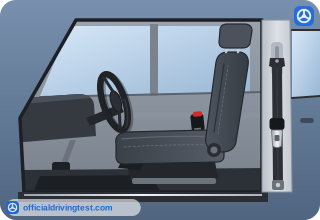
- Over the collar bone and across the breastbone
- Behind the back, below the shoulder blades
- Across the side of the neck, close to the chin
- Under your arm, across the lower part of the ribs
Show answer
Correct answer: Over the collar bone and across the breastbone
The shoulder belt should come over the collar bone, away from the neck, and cross over the breastbone.
Source: New Jersey Driver Manual (2026), page 41 · Open this page in the manual (Manual page 41)
-
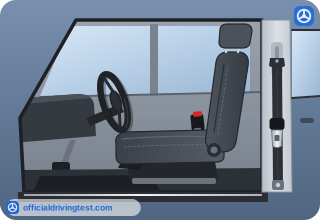
In most new vehicles, where can the shoulder belt be adjusted to improve its fit?
- On the steering column
- On the side pillar
- On the headrest
- At the floor buckle
Show answer
Correct answer: On the side pillar
The shoulder belt in most new vehicles can be adjusted on the side pillar to improve fit.
Source: New Jersey Driver Manual (2026), page 41 · Open this page in the manual (Manual page 41)
-
According to the New Jersey Driver Manual's seat belt tips, why should you know how to release your seat belt?
- So an officer can inspect it at a traffic stop
- So you can take it off during short trips
- In case you must get out of the vehicle quickly
- So you can loosen it while driving on a highway
Show answer
Correct answer: In case you must get out of the vehicle quickly
The manual says to know how to adjust seat belts and how to release them in case motorists or passengers have to get out of the vehicle quickly.
Source: New Jersey Driver Manual (2026), page 41 · Open this page in the manual (Manual page 41)
-
How many people may share one seat belt?
- Two small children
- Two people if both are under age 8
- Any number of children if it is a lap belt
- Only one person
Show answer
Correct answer: Only one person
The manual says never put more than one person in one belt.
Source: New Jersey Driver Manual (2026), page 41 · Open this page in the manual (Manual page 41)
-
Why should passengers in the back seat buckle up?
- Only to avoid a fine; a belt adds no safety in the back seat
- They can be thrown into others with deadly force or ejected
- Back-seat air bags will not work unless they buckle up
- It keeps the rear doors from opening while driving
Show answer
Correct answer: They can be thrown into others with deadly force or ejected
Without a seat belt, occupants can be thrown throughout the vehicle, into other occupants with deadly force, or ejected through the windshield or a window.
Source: New Jersey Driver Manual (2026), page 41 · Open this page in the manual (Manual page 41)
-
All child restraint systems built since what date must be designed to pass tough safety tests?
- January 1, 1981
- January 1, 1995
- January 1, 1998
- July 1, 1966
Show answer
Correct answer: January 1, 1981
All child restraint systems built since January 1, 1981 must be designed to pass tough safety tests.
Source: New Jersey Driver Manual (2026), page 41 · Open this page in the manual (Manual page 41)
-
What does the label on a child car seat that meets federal standards show?
- The only vehicle model it may be installed in
- An MVC approval stamp and its expiration date
- Its date of manufacture and federal safety compliance
- The name of the store where it was bought and its price
Show answer
Correct answer: Its date of manufacture and federal safety compliance
Approved seats carry a label giving the date of manufacture and stating that the seat conforms to all applicable Federal Motor Vehicle Safety Standards.
Source: New Jersey Driver Manual (2026), page 41 · Open this page in the manual (Manual page 41)
-
Which statement about infant car seats is correct, according to the New Jersey Driver Manual?
- An infant seat must never be faced forward
- An infant seat should face forward in the front seat
- An infant seat may face forward once the baby can sit up
- An infant seat may face either way if it has a federal label
Show answer
Correct answer: An infant seat must never be faced forward
Some seats can face forward once a child reaches the right weight, but an infant seat must never be faced forward; doing so would be extremely dangerous.
Source: New Jersey Driver Manual (2026), page 41 · Open this page in the manual (Manual page 41)
-
How can you find out the size and weight of the child a car seat is designed to protect?
- Look at your insurance ID card
- Ask at an MVC agency
- Check the label on the car seat
- Check the vehicle's registration card
Show answer
Correct answer: Check the label on the car seat
The manual says to always check the label on a car seat for the size and weight of the child it is designed to protect.
Source: New Jersey Driver Manual (2026), page 41 · Open this page in the manual (Manual page 41)
-
According to the New Jersey Driver Manual, what is the best protection a motorist can offer a child passenger?
- Seating the child directly in front of an air bag
- Using the adult seat belt alone
- Holding the child on an adult's lap
- Correct use of the car seat
Show answer
Correct answer: Correct use of the car seat
Using the car seat every time, and correctly each time, is the best protection a motorist can offer a child.
Source: New Jersey Driver Manual (2026), page 42 · Open this page in the manual (Manual page 42)
-
Under New Jersey law, how must a child under age 8 who is less than 57 inches tall ride?
- On an adult's lap, wearing the adult's seat belt
- In a forward-facing harness or booster seat, in the back
- In an adult lap and shoulder belt, in any seat of the car
- In a rear-facing seat, in the front passenger seat
Show answer
Correct answer: In a forward-facing harness or booster seat, in the back
Children under 8 who are under 57 inches tall must ride in a federally approved forward-facing restraint with a five-point harness, or a federally approved booster seat, in a rear seat.
Source: New Jersey Driver Manual (2026), page 42 · Open this page in the manual (Manual page 42)
-
New Jersey's child passenger safety law requires a child under age 8 who is shorter than how many inches to ride in a child restraint or booster seat in a rear seat?
- 57 inches (4 feet, 9 inches)
- 60 inches (5 feet)
- 48 inches (4 feet)
- 52 inches (4 feet, 4 inches)
Show answer
Correct answer: 57 inches (4 feet, 9 inches)
The rule covers children under age 8 who are less than 57 inches (4 feet, 9 inches) tall.
Source: New Jersey Driver Manual (2026), page 42 · Open this page in the manual (Manual page 42)
-
Under New Jersey law, how must a child under age 4 who weighs less than 40 pounds ride?
- In a federally approved booster seat in a rear seat
- In a booster seat in the front seat
- In an adult lap and shoulder belt in a rear seat
- In a five-point harness seat in a rear seat
Show answer
Correct answer: In a five-point harness seat in a rear seat
Children under 4 who weigh less than 40 pounds must ride in a rear seat in a car seat with a five-point harness: either rear-facing (then forward-facing once they outgrow it) or forward-facing.
Source: New Jersey Driver Manual (2026), page 42 · Open this page in the manual (Manual page 42)
-
Under New Jersey law, a child under age 4 who weighs less than how many pounds must ride in a five-point harness seat in a rear seat?
- 20 pounds
- 65 pounds
- 40 pounds
- 50 pounds
Show answer
Correct answer: 40 pounds
The harness-seat rule applies to children under age 4 who weigh less than 40 pounds.
Source: New Jersey Driver Manual (2026), page 42 · Open this page in the manual (Manual page 42)
-
Under New Jersey law, how must a child under age 2 who weighs less than 30 pounds ride?
- In an adult lap and shoulder belt
- In a booster seat
- In a forward-facing seat with a five-point harness
- In a rear-facing seat with a five-point harness
Show answer
Correct answer: In a rear-facing seat with a five-point harness
Children under age 2 and those under 30 pounds must ride in a federally approved rear-facing child restraint equipped with a five-point harness.
Source: New Jersey Driver Manual (2026), page 42 · Open this page in the manual (Manual page 42)
-
Under New Jersey law, all children under what age must be seated in a rear seat when the vehicle has one?
- 8
- 6
- 4
- 16
Show answer
Correct answer: 8
All children under age eight must be seated in a rear seat.
Source: New Jersey Driver Manual (2026), page 43 · Open this page in the manual (Manual page 43)
-
Under New Jersey law, if a vehicle has no rear seats, where may a child under age 8 ride?
- In the front seat with only the adult seat belt
- In a front seat, in an approved child seat or booster
- Nowhere; the child may not ride in that vehicle at all
- On an adult passenger's lap in the front seat
Show answer
Correct answer: In a front seat, in an approved child seat or booster
If the vehicle has no rear seats, children under 8 must be secured in a federally approved child restraint or booster seat in a front seat.
Source: New Jersey Driver Manual (2026), page 43 · Open this page in the manual (Manual page 43)
-
Under New Jersey law, a rear-facing child restraint may NOT be placed in the front seat of a vehicle that:
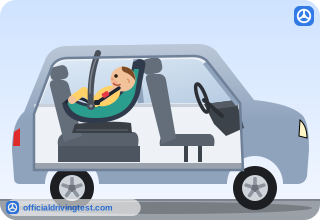
- Has a manual transmission instead of an automatic
- Is more than ten years old
- Has a passenger-side air bag that is switched on
- Has tinted windows on the rear side doors
Show answer
Correct answer: Has a passenger-side air bag that is switched on
A rear-facing child restraint cannot be used in the front seat of any vehicle with a passenger-side air bag that is not disabled or turned off.
Source: New Jersey Driver Manual (2026), page 43 · Open this page in the manual (Manual page 43)
-
What fine can a person face for violating New Jersey's child passenger safety law?
- $50 to $75, plus fees and court costs
- $100 to $250, plus fees and court costs
- $500 to $1,000, plus fees and court costs
- $20 to $40, plus fees and court costs
Show answer
Correct answer: $50 to $75, plus fees and court costs
Failure to comply with the child passenger safety law can bring a fine of not less than $50 nor more than $75, plus fees and court costs.
Source: New Jersey Driver Manual (2026), page 43 · Open this page in the manual (Manual page 43)
-
Under New Jersey law, may a child who would be required to use a child passenger restraint system ride as a passenger in an autocycle?
- Yes, on trips shorter than five miles from home
- No, the autocycle operator may not permit it
- Yes, if the child wears a helmet
- Yes, if a booster seat is installed
Show answer
Correct answer: No, the autocycle operator may not permit it
A person operating an autocycle must not let a child ride as a passenger if the child would be required to be secured in a child passenger restraint system.
Source: New Jersey Driver Manual (2026), page 43 · Open this page in the manual (Manual page 43)