New Jersey: Right of way & turning — Part 1 Practice Test
Questions in this part include: “How does the speed of traffic affect when you should plan a turn?” · “How does the New Jersey manual define an intersection?”
Independent educational site · not affiliated with any government agency or DMV
Ready? Test yourself
- Instant feedback with an explanation
- Every answer cites its source in the manual
- Your best score is saved on this device
Questions are original and based on the official manual "New Jersey Driver Manual" (2026), New Jersey Motor Vehicle Commission (MVC).
All 18 questions in this practice test
Take the test above first, then use this list to study. Tap “Show answer” to see the correct answer and explanation.
Show the questions and answersHide the questions
-
If you miss the turn you wanted to make, what should you do?
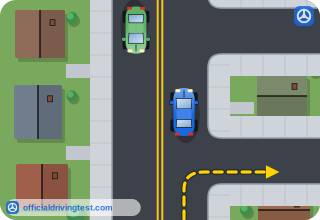
- Turn sharply at the last moment
- Back up carefully to the missed turn
- Stop in the lane and wait to reverse
- Take the next turn; never back up
Show answer
Correct answer: Take the next turn; never back up
If a turn is missed, never back up; it is better to take the next turn than to risk a crash.
Source: New Jersey Driver Manual (2026), page 55 · Open this page in the manual (Manual page 55)
-
How does the speed of traffic affect when you should plan a turn?
- Plan turns only once you reach the intersection
- The faster traffic moves, the later you should decide
- The faster traffic moves, the sooner you should plan
- Speed does not matter; always plan 50 feet ahead
Show answer
Correct answer: The faster traffic moves, the sooner you should plan
Decide well in advance where you want to turn; the faster the traffic is moving, the sooner you should plan your turn.
Source: New Jersey Driver Manual (2026), page 55 · Open this page in the manual (Manual page 55)
-
Before turning, in what order should you signal and move into the proper lane?
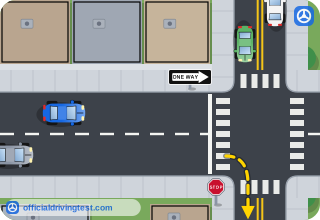
- Signal first, then move into the proper lane
- Signal only after entering the intersection
- Move into the lane first, then signal
- Move over and turn; signal only if cars are behind
Show answer
Correct answer: Signal first, then move into the proper lane
Before turning, signal first (with turn signals or hand signals) and then move into the proper lane.
Source: New Jersey Driver Manual (2026), page 56 · Open this page in the manual (Manual page 56)
-
When making a turn, when should you slow down?
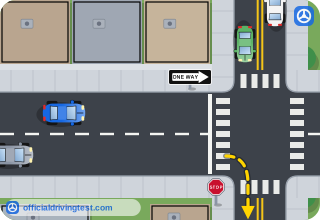
- Only if a vehicle is ahead of you
- Before reaching the intersection
- After you complete the turn
- In the middle of the intersection
Show answer
Correct answer: Before reaching the intersection
Before turning, a motorist should slow down before reaching the intersection and then keep a steady speed.
Source: New Jersey Driver Manual (2026), page 56 · Open this page in the manual (Manual page 56)
-
Which lane should you stay in while making a turn?
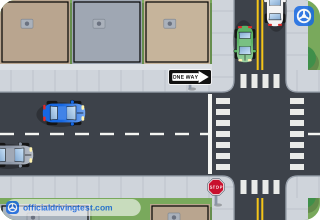
- Whichever lane is clearer halfway through
- The far lane, to make the turn wider
- The shoulder, if traffic is heavy
- The same lane until the turn is finished
Show answer
Correct answer: The same lane until the turn is finished
The manual says to always stay in the same lane until the turn is finished.
Source: New Jersey Driver Manual (2026), page 56 · Open this page in the manual (Manual page 56)
-
Where should you start a 3-point turn (K-turn)?
- From the left edge of the road
- From the middle of an intersection
- From the right edge of the road
- From the center of the road
Show answer
Correct answer: From the right edge of the road
When turning a vehicle around, start from the right edge of the road at a safe spot.
Source: New Jersey Driver Manual (2026), page 56 · Open this page in the manual (Manual page 56)
-
When choosing a place to make a 3-point turn (K-turn), what should you look for?
- A curve, where traffic has to slow down
- The narrowest part of the road
- A busy intersection controlled by a traffic signal
- A safe spot with good visibility in both directions
Show answer
Correct answer: A safe spot with good visibility in both directions
The manual says to choose a safe spot with good visibility in both directions.
Source: New Jersey Driver Manual (2026), page 56 · Open this page in the manual (Manual page 56)
-
If there is no other traffic, what is the first move in a 3-point turn (K-turn)?
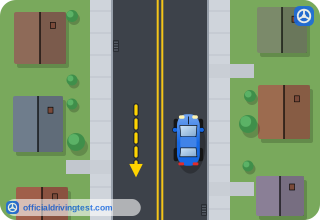
- Back up slowly with the wheel turned to the left
- Signal left and move forward slowly, turning the wheel left
- Signal right and back up, turning the wheel right
- Move forward slowly with the steering wheel turned to the right
Show answer
Correct answer: Signal left and move forward slowly, turning the wheel left
If there is no other traffic, signal left and move forward slowly while turning the steering wheel to the left.
Source: New Jersey Driver Manual (2026), page 56 · Open this page in the manual (Manual page 56)
-
During the first step of a 3-point turn, where should you stop the vehicle?
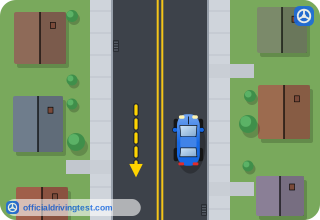
- Several inches from the left curb
- Touching the left curb with the front tires
- In the middle of the opposite lane
- Several feet from the left curb
Show answer
Correct answer: Several inches from the left curb
After moving forward and turning left, the vehicle should be stopped several inches from the left curb or street edge.
Source: New Jersey Driver Manual (2026), page 56 · Open this page in the manual (Manual page 56)
-
In a 3-point turn, after stopping near the left curb, what should you do next?
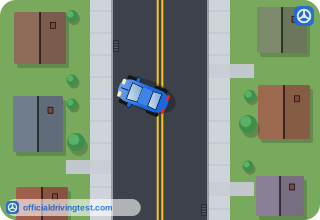
- Back up straight across the road to the right curb
- Move forward, turning the wheel to the right
- Back up slowly, turning the wheel to the right
- Back up slowly, turning the wheel to the left
Show answer
Correct answer: Back up slowly, turning the wheel to the right
The second step is to back up slowly while turning the steering wheel to the right, stopping several inches from the right curb or street edge.
Source: New Jersey Driver Manual (2026), page 56 · Open this page in the manual (Manual page 56)
-
In a 3-point turn (K-turn), after backing up and stopping near the right curb, what is the next move?
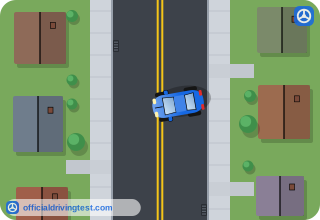
- Move forward while turning the wheel to the right
- Back up again while turning the wheel to the left
- Back up straight until you reach the left curb
- Move forward while turning the wheel to the left
Show answer
Correct answer: Move forward while turning the wheel to the left
After backing up to the right curb, move the vehicle forward while turning the steering wheel to the left, then straighten the wheels as the vehicle faces the way you want to go.
Source: New Jersey Driver Manual (2026), page 56 · Open this page in the manual (Manual page 56)
-
Under the basic right-of-way rules, which other vehicles must you yield to?
- Vehicles parked along the curb nearby
- Only vehicles larger than yours
- Vehicles traveling behind you
- Vehicles already in the intersection
Show answer
Correct answer: Vehicles already in the intersection
You must yield to other vehicles that are already in the intersection.
Source: New Jersey Driver Manual (2026), page 66 · Open this page in the manual (Manual page 66)
-
How does the New Jersey manual define an intersection?
- Any stretch of road that has a traffic signal on it
- Where two or more roads cross or merge at angles
- Any place where a road crosses a railroad
- Any part of a divided highway with ramps
Show answer
Correct answer: Where two or more roads cross or merge at angles
An intersection is where two or more roads cross or merge at angles.
Source: New Jersey Driver Manual (2026), page 67 · Open this page in the manual (Manual page 67)
-
According to the New Jersey manual, where do most crashes occur?
- On highway ramps
- In parking lots
- At intersections
- On rural curves
Show answer
Correct answer: At intersections
Most crashes occur at intersections, so drivers should know how to navigate them safely.
Source: New Jersey Driver Manual (2026), page 67 · Open this page in the manual (Manual page 67)
-
How many types of intersections does the New Jersey manual say a motorist should be aware of?
- Six
- Three
- Two
- Four
Show answer
Correct answer: Four
The manual says a motorist should be aware of the four types of intersections and how to navigate them safely.
Source: New Jersey Driver Manual (2026), page 67 · Open this page in the manual (Manual page 67)
-
What makes an intersection "controlled"?
- It lies inside a city or town limit
- Lane lines are painted on every one of its approaches
- A speed limit sign is posted just before it
- Signals, signs, or a police officer regulate it
Show answer
Correct answer: Signals, signs, or a police officer regulate it
A controlled intersection is one regulated by traffic signals, signs, or a police officer.
Source: New Jersey Driver Manual (2026), page 67 · Open this page in the manual (Manual page 67)
-
At a multi-way stop, you and another driver arrive at the same time. Who must yield?
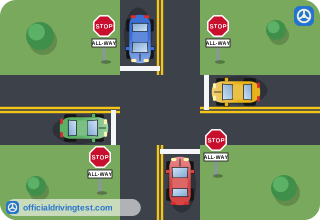
- The driver on your right yields to you
- You yield to the driver on your right
- The smaller vehicle yields to the larger
- The driver going straight yields
Show answer
Correct answer: You yield to the driver on your right
At a multi-way stop, a driver must yield to the motorist on the right if both arrive at the same time.
Source: New Jersey Driver Manual (2026), page 67 · Open this page in the manual (Manual page 67)
-
You arrive at a multi-way stop where another vehicle has already stopped. What must you do?
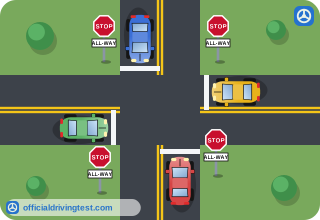
- Yield to that vehicle
- Go first, since you are moving
- Honk and proceed at the same time
- Go first if you are turning right
Show answer
Correct answer: Yield to that vehicle
At a multi-way stop, you must yield to any vehicle already stopped at the intersection.
Source: New Jersey Driver Manual (2026), page 67 · Open this page in the manual (Manual page 67)