New Jersey: Railroad crossings Practice Test
Crossing signs, signals and gates, and when you must stop.
Independent educational site · not affiliated with any government agency or DMV
Ready? Test yourself
- Instant feedback with an explanation
- Every answer cites its source in the manual
- Your best score is saved on this device
Questions are original and based on the official manual "New Jersey Driver Manual" (2026), New Jersey Motor Vehicle Commission (MVC).
All 25 questions in this practice test
Take the test above first, then use this list to study. Tap “Show answer” to see the correct answer and explanation.
Show the questions and answersHide the questions
-
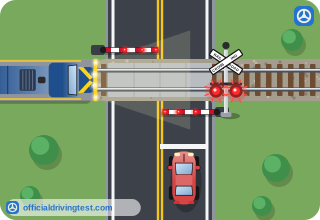
In New Jersey, how far from a railroad crossing must you stop when there are flashing red lights, ringing bells, lowered gates, or flag signals?
- At least 50 feet
- At least 100 feet
- At least 5 feet
- At least 15 feet
Show answer
Correct answer: At least 15 feet
A motorist must stop at least 15 feet from a railroad crossing when there are flashing red lights, ringing bells, descending or lowered gates, or flag signals.
Source: New Jersey Driver Manual (2026), page 76 · Open this page in the manual (Manual page 76)
-
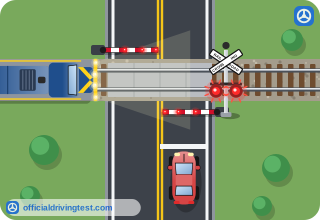
At a railroad crossing with gates, bells, and flashing red lights, when may you cross after stopping?
- When the gates are up, the bells are silent and the lights are off
- As soon as the gates begin to rise, even while the lights still flash
- After waiting about 15 seconds with no train in sight
- As soon as the last car of the train has passed
Show answer
Correct answer: When the gates are up, the bells are silent and the lights are off
A motorist should never cross until the gates have been raised, the bells have stopped ringing, and the red lights have stopped flashing.
Source: New Jersey Driver Manual (2026), page 76 · Open this page in the manual (Manual page 76)
-
According to the New Jersey Driver Manual, how much distance do most trains need to stop when traveling at 60 mph or more?
- About the length of a football field
- More than a mile
- About a quarter of a mile
- About 100 feet
Show answer
Correct answer: More than a mile
Most trains need more than a mile to stop if they are traveling at 60 mph or more.
Source: New Jersey Driver Manual (2026), page 76 · Open this page in the manual (Manual page 76)
-
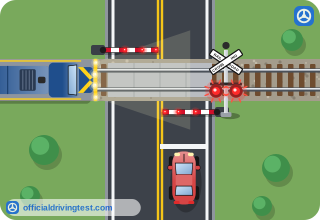
Why does the New Jersey Driver Manual warn you never to race a train to a crossing?
- Motorists can underestimate the speed and distance of trains
- Trains are required to stop for vehicles at every crossing
- Crossing gates only come down after a train has passed
- Trains in New Jersey never go faster than 20 mph
Show answer
Correct answer: Motorists can underestimate the speed and distance of trains
The manual says never race a train, because a motorist can underestimate the speed and distance of trains.
Source: New Jersey Driver Manual (2026), page 76 · Open this page in the manual (Manual page 76)
-
Which of these is one of the warning devices used to mark railroad crossings in New Jersey?
- Flashing green lights
- Flag signals
- Blue strobe lights
- Orange traffic cones
Show answer
Correct answer: Flag signals
Railroad crossing warning devices include advance-warning signs, pavement markings, flashing red lights, gates, ringing bells, and flag signals.
Source: New Jersey Driver Manual (2026), page 76 · Open this page in the manual (Manual page 76)
-
Which vehicles must always stop at railroad crossings, so you should be ready to stop when driving behind them?
- Motorcycles, mopeds, and bicycles on the roadway
- Taxis, limousines, and ride-share vehicles
- School buses, buses, and vehicles carrying hazardous materials
- Pickup trucks, delivery vans, and any vehicles that are towing trailers
Show answer
Correct answer: School buses, buses, and vehicles carrying hazardous materials
School buses, buses, and vehicles carrying hazardous materials must always stop at railroad crossings, so a motorist behind them must be prepared to stop even if no train is signaled.
Source: New Jersey Driver Manual (2026), page 76 · Open this page in the manual (Manual page 76)
-
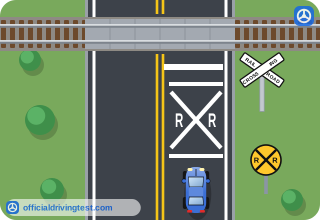
Before you drive across railroad tracks, what should you make sure of?
- That your hazard flashers are turned on
- That you have shifted into the highest gear
- That your radio is turned up loud enough to hear the train horn
- That there is room on the other side to get completely across
Show answer
Correct answer: That there is room on the other side to get completely across
A motorist should never stop on railroad tracks, so before crossing make sure there is room on the other side to get completely across.
Source: New Jersey Driver Manual (2026), page 76 · Open this page in the manual (Manual page 76)
-
If the warning devices at a crossing activate while you are already crossing the railroad tracks, what should you do?
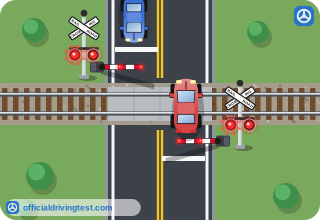
- Stop on the tracks and wait for the gates to rise
- Get out of the vehicle and walk away from it
- Back up off the tracks the way you came
- Immediately proceed to the other side
Show answer
Correct answer: Immediately proceed to the other side
If warning devices activate while a motorist is crossing railroad tracks, the motorist should immediately proceed to the other side.
Source: New Jersey Driver Manual (2026), page 76 · Open this page in the manual (Manual page 76)
-
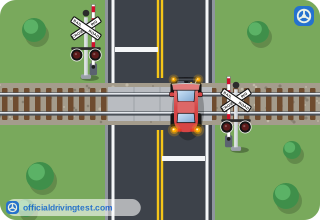
If your vehicle stalls on railroad tracks and no train is coming, what should you and your passengers do?
- Get out and push the vehicle off the tracks together
- Stay inside the vehicle with the emergency flashers on
- Get out and move far away from the vehicle and tracks
- Stay inside and keep trying to restart the engine
Show answer
Correct answer: Get out and move far away from the vehicle and tracks
Everyone should get out and move far away from the vehicle and tracks, even if a train is not approaching.
Source: New Jersey Driver Manual (2026), page 106 · Open this page in the manual (Manual page 106)
-
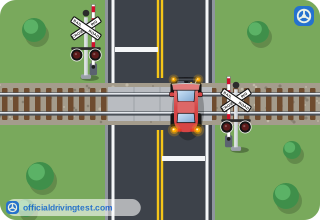
After getting clear of a vehicle stalled on railroad tracks, whom should you call?
- A private towing company to pull the vehicle off
- The crossing's Emergency Notification sign number, or 911
- The Motor Vehicle Commission's customer service line
- Your insurance company, to report the stalled vehicle first
Show answer
Correct answer: The crossing's Emergency Notification sign number, or 911
Once clear of the vehicle and tracks, call the number on the Emergency Notification sign posted at the crossing or 911.
Source: New Jersey Driver Manual (2026), page 106 · Open this page in the manual (Manual page 106)
-
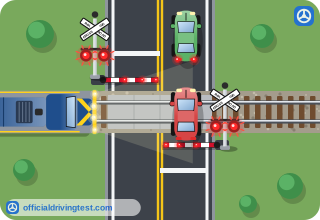
If a train is approaching your stalled vehicle, which way should you run?
- 45 degrees away from the tracks, in the direction of the train
- Straight along the tracks, in the direction away from the train
- At a 90-degree angle, straight away from the tracks and the vehicle
- Back toward your vehicle so you can try to push it off the tracks
Show answer
Correct answer: 45 degrees away from the tracks, in the direction of the train
Run at a 45-degree angle away from the vehicle and tracks but in the direction of the train, to avoid being hit by flying debris.
Source: New Jersey Driver Manual (2026), page 106 · Open this page in the manual (Manual page 106)
-
In New Jersey, how many points are assessed for improperly crossing a railroad grade crossing?
- 3 points
- 8 points
- 2 points
- 5 points
Show answer
Correct answer: 2 points
Improper crossing of a railroad grade crossing carries 2 points.
Source: New Jersey Driver Manual (2026), page 140 · Open this page in the manual (Manual page 140)
-
According to the New Jersey Driver Manual, when can trains travel on a track?
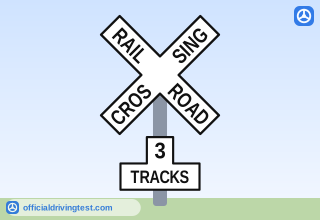
- Any track, either direction, any time
- Only one direction on each track
- Only in daylight at rural crossings
- Only at their scheduled times
Show answer
Correct answer: Any track, either direction, any time
Trains can travel on any track, in either direction, at any time, so always expect a train at a crossing.
Source: New Jersey Driver Manual (2026), page 153 · Open this page in the manual (Manual page 153)
-
According to the New Jersey Driver Manual, what must you never do at a railroad crossing?
- Obey the warning devices
- Listen for an approaching train
- Drive around descending or lowered gates
- Look both ways before crossing the tracks
Show answer
Correct answer: Drive around descending or lowered gates
Always remain alert at railroad crossings and never drive through flashing red lights or around descending or lowered gates.
Source: New Jersey Driver Manual (2026), page 153 · Open this page in the manual (Manual page 153)
-
According to the New Jersey Driver Manual, how much wider than the tracks can a train be on each side?
- About six inches
- It is no wider than the tracks
- Three or more feet
- About one foot
Show answer
Correct answer: Three or more feet
Trains can be three or more feet wider than the tracks on both sides, so never get boxed in on the tracks: cross only when there is room to get completely across.
Source: New Jersey Driver Manual (2026), page 153 · Open this page in the manual (Manual page 153)
-
According to the New Jersey Driver Manual, you should not pass other vehicles within how many feet of a railroad crossing?
- 100 feet
- 200 feet
- 500 feet
- 50 feet
Show answer
Correct answer: 100 feet
Do not pass other vehicles within 100 feet of a railroad crossing.
Source: New Jersey Driver Manual (2026), page 153 · Open this page in the manual (Manual page 153)
-
If you are driving a vehicle with a standard (manual) transmission, what should you not do while crossing railroad tracks?
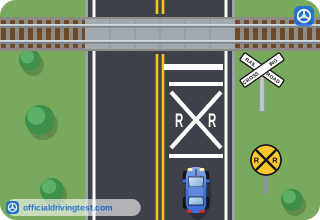
- Look both ways
- Keep your headlights on
- Keep both hands on the wheel
- Shift gears
Show answer
Correct answer: Shift gears
If you drive a standard transmission vehicle, do not shift gears while crossing railroad tracks.
Source: New Jersey Driver Manual (2026), page 153 · Open this page in the manual (Manual page 153)
-
According to the New Jersey Driver Manual, where is it legal to cross railroad tracks?
- Anywhere the tracks are clearly visible in both directions
- Only at designated crossings with warning devices
- At any point on railroad property
- Anywhere, if no train is in sight
Show answer
Correct answer: Only at designated crossings with warning devices
Cross only at designated railroad crossings; railroad property is private property, and crossing anywhere other than a marked crossing is dangerous and illegal.
Source: New Jersey Driver Manual (2026), page 153 · Open this page in the manual (Manual page 153)
-
According to the New Jersey Driver Manual, who has the right-of-way at a railroad crossing?
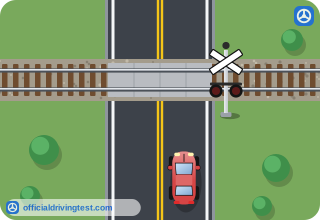
- The vehicle that arrives first
- Vehicles, whenever the gates are up
- The train, always
- Whichever is moving faster
Show answer
Correct answer: The train, always
Trains always have the right of way, and motorists must yield to approaching trains.
Source: New Jersey Driver Manual (2026), page 153 · Open this page in the manual (Manual page 153)
-
After obeying the warning devices, looking both ways and listening for a train at a railroad crossing, how should you cross?
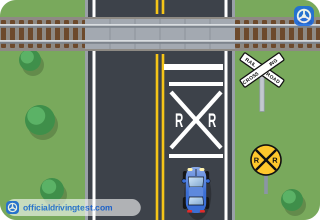
- Pull onto the tracks and wait for the gate
- Proceed quickly across and never stop on the tracks
- Cross slowly, shifting to a lower gear
- Stop on the tracks to look both ways and listen once more
Show answer
Correct answer: Proceed quickly across and never stop on the tracks
At a designated crossing, obey warning devices, eliminate distractions, look both ways, listen for a train and proceed quickly across; never stop on the tracks.
Source: New Jersey Driver Manual (2026), page 153 · Open this page in the manual (Manual page 153)
-
According to the New Jersey Driver Manual, what should you never do when a train is approaching a railroad crossing?
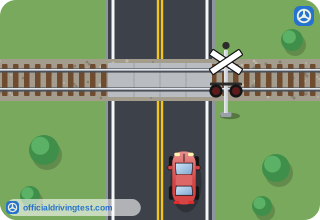
- Race the train to the crossing
- Stop and wait at the crossing
- Wait until the gates go back up
- Yield the right-of-way to the train
Show answer
Correct answer: Race the train to the crossing
Among the railroad-crossing tips, the manual says never race a train to a crossing; the train is closer and faster than you think.
Source: New Jersey Driver Manual (2026), page 153 · Open this page in the manual (Manual page 153)
-
What do flashing red lights at a railroad crossing indicate?
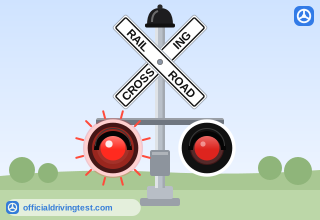
- You may cross after slowing down
- The crossing is closed for repairs
- A train is approaching
- The tracks are no longer in use
Show answer
Correct answer: A train is approaching
Flashing red lights at railroad crossings indicate an approaching train, and motorists must yield to the train.
Source: New Jersey Driver Manual (2026), page 212 · Open this page in the manual (Manual page 212)
-
What does the X-shaped crossbuck sign at a railroad crossing mean?
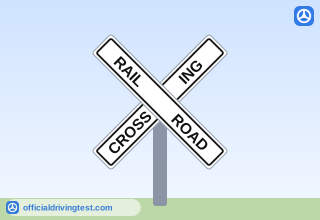
- The tracks are no longer used
- The same as a Yield sign
- Trains must yield to vehicles
- The same as a STOP sign
Show answer
Correct answer: The same as a Yield sign
The crossbuck, an X-shaped railroad crossing sign with black wording on a white background, means the same as a Yield sign.
Source: New Jersey Driver Manual (2026), page 216 · Open this page in the manual (Manual page 216)
-
Why must motorists always yield the right-of-way to trains?
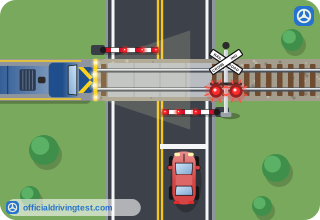
- Trains are not allowed to brake at crossings
- Trains always travel faster than 60 mph
- Railroad crossings are private property
- Trains cannot swerve to avoid motorists
Show answer
Correct answer: Trains cannot swerve to avoid motorists
Motorists must always yield the right-of-way to trains because trains cannot swerve to avoid motorists.
Source: New Jersey Driver Manual (2026), page 216 · Open this page in the manual (Manual page 216)
-
Which of these is an active warning device at a railroad crossing?
- A crossbuck sign
- An advance warning sign
- Pavement markings
- Lowered gates
Show answer
Correct answer: Lowered gates
Pavement markings, signs and crossbucks are passive warning devices; flashing red lights, ringing bells and lowered gates are active warning devices.
Source: New Jersey Driver Manual (2026), page 217 · Open this page in the manual (Manual page 217)