New Jersey: Pedestrian rights — Part 2 Practice Test
Questions in this part include: “In New Jersey, who always has the right of way in a crosswalk?” · “Under New Jersey law, which of these may a pedestrian NOT do?”
Independent educational site · not affiliated with any government agency or DMV
Ready? Test yourself
- Instant feedback with an explanation
- Every answer cites its source in the manual
- Your best score is saved on this device
Questions are original and based on the official manual "New Jersey Driver Manual" (2026), New Jersey Motor Vehicle Commission (MVC).
All 19 questions in this practice test
Take the test above first, then use this list to study. Tap “Show answer” to see the correct answer and explanation.
Show the questions and answersHide the questions
-
In New Jersey, who always has the right of way in a crosswalk?
- Only children, seniors and people with visible disabilities crossing
- Only pedestrians who are crossing with a WALK signal showing at that corner
- Pedestrians and people in wheelchairs or mobility-assistance vehicles
- Drivers who have already started to turn through the crosswalk area
Show answer
Correct answer: Pedestrians and people in wheelchairs or mobility-assistance vehicles
The manual says pedestrians and individuals in wheelchairs or mobility-assistance vehicles always have the right of way in a crosswalk.
Source: New Jersey Driver Manual (2026), page 101 · Open this page in the manual (Manual page 101)
-
On city streets, how fast should your vehicle be going when you are at a crosswalk?
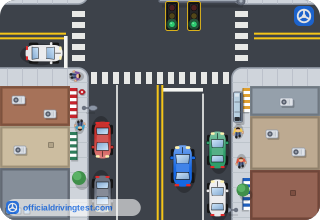
- At its lowest speed
- About 5 mph below the speed limit
- Fast enough to clear the crosswalk quickly
- At the posted speed limit
Show answer
Correct answer: At its lowest speed
At a crosswalk your vehicle should be at its lowest speed while you decide whether to stop or go across.
Source: New Jersey Driver Manual (2026), page 101 · Open this page in the manual (Manual page 101)
-
According to the New Jersey Driver Manual, what is the fatality rate of vehicle-pedestrian crashes when the car is going 20 mph?
- 5 percent
- 85 percent
- 50 percent
- 25 percent
Show answer
Correct answer: 5 percent
Vehicle-pedestrian crashes have a five percent fatality rate at 20 mph; the rate jumps to 85 percent at 40 mph.
Source: New Jersey Driver Manual (2026), page 144 · Open this page in the manual (Manual page 144)
-
According to the New Jersey Driver Manual, the fatality rate of vehicle-pedestrian crashes jumps to what when the car is going 40 mph?
- 50 percent
- 85 percent
- 65 percent
- 35 percent
Show answer
Correct answer: 85 percent
The fatality rate is five percent at 20 mph but jumps to 85 percent at 40 mph, so speed greatly affects pedestrian survival.
Source: New Jersey Driver Manual (2026), page 144 · Open this page in the manual (Manual page 144)
-
According to the New Jersey Driver Manual, which road features designed to make roads safer for motorists can make roads more dangerous for pedestrians?
- Speed humps and raised crosswalks
- Stop signs and yield signs
- Large medians and wide shoulders
- Countdown pedestrian signals
Show answer
Correct answer: Large medians and wide shoulders
The manual notes that measures such as large medians and wide shoulders, meant to make roads safer for motorists, can make roads more dangerous for pedestrians.
Source: New Jersey Driver Manual (2026), page 144 · Open this page in the manual (Manual page 144)
-
According to the New Jersey Driver Manual, which pedestrians are more susceptible to serious injuries?
- Joggers wearing headphones
- Teenagers and young adults
- People walking in groups
- Children and older adults
Show answer
Correct answer: Children and older adults
The manual states that children and older adults are more susceptible to serious injuries.
Source: New Jersey Driver Manual (2026), page 144 · Open this page in the manual (Manual page 144)
-
According to the New Jersey Driver Manual, who has the right-of-way at intersections in most cases?
- Vehicles already turning
- Vehicles going straight through
- Whichever vehicle arrives first
- Pedestrians
Show answer
Correct answer: Pedestrians
The manual states that in most cases, pedestrians have the right-of-way at intersections, where every corner has a crosswalk even if it is not marked.
Source: New Jersey Driver Manual (2026), page 144 · Open this page in the manual (Manual page 144)
-
When you stop for a crosswalk on a multi-lane roadway, where should you stop?
- As close to the crosswalk as you can
- Far enough back not to block other lanes' view
- Just past the crosswalk, out of the way
- With your front bumper resting on the crosswalk lines
Show answer
Correct answer: Far enough back not to block other lanes' view
On a multi-lane road, stop far enough in advance of the crosswalk that you do not block the view of drivers in the adjacent lanes.
Source: New Jersey Driver Manual (2026), page 145 · Open this page in the manual (Manual page 145)
-
Under New Jersey law, which of these may a pedestrian NOT do?
- Walk facing traffic where there is no sidewalk
- Start crossing on a WALK signal
- Start crossing at an unmarked crosswalk at an intersection
- Step suddenly into the path of a car too close to yield
Show answer
Correct answer: Step suddenly into the path of a car too close to yield
Pedestrians must obey pedestrian signals and may not suddenly leave a curb or place of safety into the path of a vehicle so close that the driver cannot yield.
Source: New Jersey Driver Manual (2026), page 145 · Open this page in the manual (Manual page 145)
-
According to the New Jersey Driver Manual, if a pedestrian makes an error, what happens to the driver's responsibility?
- The driver automatically gets the right-of-way
- The driver no longer has to use care
- The driver must still exercise due care
- The driver may honk and continue at speed
Show answer
Correct answer: The driver must still exercise due care
Pedestrian errors do not relieve motorists of their continuing responsibility to exercise due care.
Source: New Jersey Driver Manual (2026), page 145 · Open this page in the manual (Manual page 145)
-
According to the New Jersey Driver Manual, why should drivers use caution near parked vehicles?
- Pedestrians may emerge unexpectedly
- Parked cars are often left in gear
- Their alarms may distract you
- Parked cars may be ticketed at any time
Show answer
Correct answer: Pedestrians may emerge unexpectedly
Use caution near parked vehicles where pedestrians may emerge unexpectedly; children are unpredictable and hard to see, so watch for movement around parked vehicles.
Source: New Jersey Driver Manual (2026), page 145 · Open this page in the manual (Manual page 145)
-
According to the New Jersey Driver Manual, drivers must be alert for pedestrians when entering or exiting which of these?
- Highway on-ramps and off-ramps
- Toll plazas and weigh stations
- Tunnels and bridges
- Driveways, parking lots and alleys
Show answer
Correct answer: Driveways, parking lots and alleys
The manual tells drivers to be alert for pedestrians when entering or exiting driveways, parking lots and alleys.
Source: New Jersey Driver Manual (2026), page 145 · Open this page in the manual (Manual page 145)
-
According to the New Jersey Driver Manual, what must drivers do after dark or in low-visibility conditions, when pedestrians are harder to see?
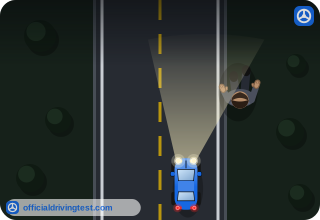
- Drive in the far-left lane
- Keep the same speed you would drive in daylight
- Reduce speed and increase alertness
- Use high beams at all times
Show answer
Correct answer: Reduce speed and increase alertness
Pedestrians are harder to see at night or in poor weather, so drivers must reduce speed and increase alertness.
Source: New Jersey Driver Manual (2026), page 146 · Open this page in the manual (Manual page 146)
-
According to the New Jersey Driver Manual, how should pedestrians walk along a roadway that has no sidewalk?
- In the center of the lane
- On whichever side has more shade
- Facing traffic
- With their backs to traffic
Show answer
Correct answer: Facing traffic
Pedestrians should face traffic when walking along roadways without sidewalks.
Source: New Jersey Driver Manual (2026), page 146 · Open this page in the manual (Manual page 146)
-
According to the New Jersey Driver Manual, what should pedestrians wear when walking along a roadway at night?
- Clothing that matches the color of the pavement
- Reflective or light-colored clothing
- Any clothing; color does not matter
- Dark or black clothing
Show answer
Correct answer: Reflective or light-colored clothing
Pedestrians should use reflective or light-colored clothing at night, though this does not relieve motorists of their duty to stay vigilant.
Source: New Jersey Driver Manual (2026), page 146 · Open this page in the manual (Manual page 146)
-
A pedestrian signal shows a steady orange raised-palm symbol. What does it mean for pedestrians still on the sidewalk?
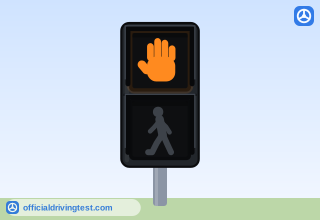
- They may cross if no cars are turning
- They may start crossing if they hurry
- They must not enter the roadway
- They may cross only inside the crosswalk
Show answer
Correct answer: They must not enter the roadway
Facing the steady orange raised-palm symbol, pedestrians must not leave the sidewalk or enter the roadway.
Source: New Jersey Driver Manual (2026), page 213 · Open this page in the manual (Manual page 213)
-
The steady raised-palm pedestrian signal comes on while a pedestrian is already crossing within the crosswalk. According to the manual, what happens?
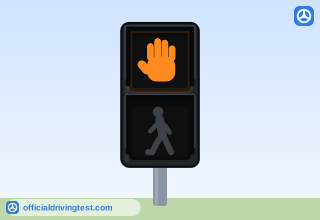
- Drivers may go, since the pedestrian lost the right of way
- They must use the push button to get more time
- They must stop and wait in the middle of the road
- They will have time to finish crossing
Show answer
Correct answer: They will have time to finish crossing
Pedestrians already within the crosswalk will have time to cross the intersection before the signal changes.
Source: New Jersey Driver Manual (2026), page 213 · Open this page in the manual (Manual page 213)
-
In New Jersey, when a white, steady pedestrian silhouette (walking person) signal is lit, what does the law require of turning motorists?
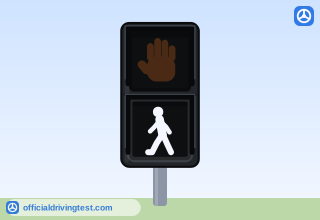
- Yield to pedestrians on this signal and in the crosswalk
- Yield only to pedestrians who are crossing from the right side
- Sound the horn so pedestrians know that a car is turning
- Finish the turn quickly before pedestrians step off the curb
Show answer
Correct answer: Yield to pedestrians on this signal and in the crosswalk
New Jersey law requires turning motorists to yield to pedestrians crossing on this signal and to pedestrians in the crosswalk.
Source: New Jersey Driver Manual (2026), page 213 · Open this page in the manual (Manual page 213)
-
What does a white, steady pedestrian silhouette (walking person) signal tell the pedestrians facing it?
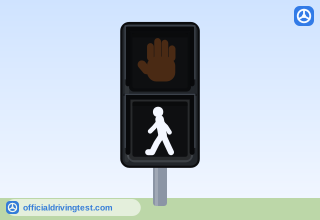
- They must wait for turning cars to go first
- They may cross only after pushing the button
- They must stay on the sidewalk
- They may cross in the direction of the signal
Show answer
Correct answer: They may cross in the direction of the signal
Pedestrians facing the white, steady pedestrian silhouette may cross the roadway in the direction of the signal.
Source: New Jersey Driver Manual (2026), page 213 · Open this page in the manual (Manual page 213)