New Jersey: Pedestrian rights — Part 1 Practice Test
Questions in this part include: “According to the New Jersey manual, how do lower driving speeds affect pedestrians?” · “In New Jersey, failing to stop for a pedestrian can bring a fine of up to how much?”
Independent educational site · not affiliated with any government agency or DMV
Ready? Test yourself
- Instant feedback with an explanation
- Every answer cites its source in the manual
- Your best score is saved on this device
Questions are original and based on the official manual "New Jersey Driver Manual" (2026), New Jersey Motor Vehicle Commission (MVC).
All 20 questions in this practice test
Take the test above first, then use this list to study. Tap “Show answer” to see the correct answer and explanation.
Show the questions and answersHide the questions
-
According to the New Jersey manual, how do lower driving speeds affect pedestrians?
- They raise risk as drivers get less alert
- They greatly improve pedestrian survival
- They make little difference to injuries
- They matter only inside school zones
Show answer
Correct answer: They greatly improve pedestrian survival
Even small increases in speed raise the risk of severe injury or death; lower speeds give drivers more time to react and greatly improve pedestrian survival.
Source: New Jersey Driver Manual (2026), page 63 · Open this page in the manual (Manual page 63)
-
When must you yield the right-of-way to a person using a motorized or mobility-assistance device?
- Only when they are on the sidewalk
- When in a crosswalk or trying to cross
- Only when they wave you to stop
- Only when the pedestrian signal shows Walk
Show answer
Correct answer: When in a crosswalk or trying to cross
You must yield to motorized or mobility-assistance devices when they are in a crosswalk or seeking to cross a road.
Source: New Jersey Driver Manual (2026), page 66 · Open this page in the manual (Manual page 66)
-
How does New Jersey's number of pedestrian injury crashes and deaths compare with the national average?
- It is well below the national average
- It is almost exactly equal to the national average
- It is the lowest of any state
- It is high compared with the national average
Show answer
Correct answer: It is high compared with the national average
New Jersey continues to have a high number of pedestrian injury crashes and fatalities compared to the national average.
Source: New Jersey Driver Manual (2026), page 66 · Open this page in the manual (Manual page 66)
-
According to the New Jersey manual, who bears the primary duty to prevent vehicle-pedestrian crashes?
- Crossing guards
- Local police
- Drivers
- Pedestrians
Show answer
Correct answer: Drivers
Pedestrian safety is shared, but drivers bear the primary duty to prevent vehicle-pedestrian crashes.
Source: New Jersey Driver Manual (2026), page 66 · Open this page in the manual (Manual page 66)
-
According to the New Jersey manual, who are the most vulnerable roadway users?
- Bus passengers
- Pedestrians
- Truck drivers
- Drivers of large SUVs
Show answer
Correct answer: Pedestrians
Pedestrians are the most vulnerable roadway users and especially susceptible to serious injury or death.
Source: New Jersey Driver Manual (2026), page 66 · Open this page in the manual (Manual page 66)
-
In New Jersey, where do crosswalks exist even if no lines are painted?
- At all intersection corners, unless signs bar it
- Only where a pedestrian Walk signal is installed
- Only in school zones and busy business districts
- Only in the middle of long blocks, near bus stops
Show answer
Correct answer: At all intersection corners, unless signs bar it
Crosswalks can be marked or unmarked, and they exist at all corners of intersections unless signs prohibit pedestrian crossing.
Source: New Jersey Driver Manual (2026), page 66 · Open this page in the manual (Manual page 66)
-
In New Jersey, what must you do when a pedestrian is within a marked crosswalk?
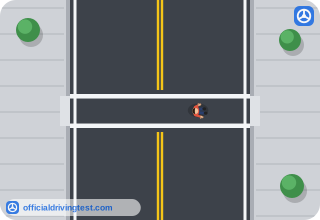
- Steer around the pedestrian
- Come to a complete stop
- Sound your horn and proceed
- Slow down and yield
Show answer
Correct answer: Come to a complete stop
You must stop for the pedestrian, which means a complete stop, not just slowing down or yielding.
Source: New Jersey Driver Manual (2026), page 66 · Open this page in the manual (Manual page 66)
-
After stopping for a pedestrian in a crosswalk, how long must you remain stopped?
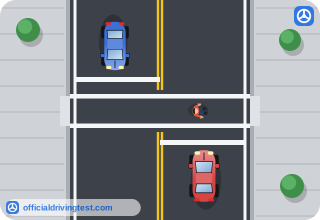
- Until they are out of your own lane only
- Until your traffic signal turns green again
- Until they have walked beyond the center line of the road
- Until they clear your lane and the next lane on your side
Show answer
Correct answer: Until they clear your lane and the next lane on your side
You must remain stopped until the pedestrian has safely cleared your lane and the adjacent lane in the same direction.
Source: New Jersey Driver Manual (2026), page 66 · Open this page in the manual (Manual page 66)
-
A pedestrian is still in the crosswalk when the signal changes to "Don't Walk." What must you do?
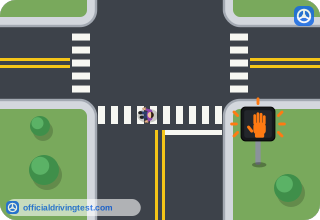
- Stay stopped and let them finish crossing
- Honk so they hurry across
- Go ahead, since the signal has now changed
- Drive carefully around them
Show answer
Correct answer: Stay stopped and let them finish crossing
You must stop for all pedestrians in a crosswalk, even if they are still in it when the signal changes to "Don't Walk."
Source: New Jersey Driver Manual (2026), page 66 · Open this page in the manual (Manual page 66)
-
The vehicle ahead of you has stopped for a pedestrian at a crosswalk. What should you do?
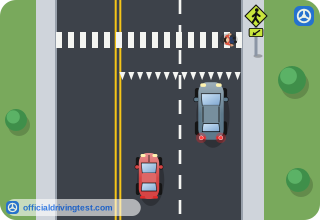
- Pass it on the left with care
- Pass it on the right if clear
- Stop too; never pass it
- Sound your horn, then pass
Show answer
Correct answer: Stop too; never pass it
Never pass another vehicle that has stopped for a pedestrian at a crosswalk.
Source: New Jersey Driver Manual (2026), page 66 · Open this page in the manual (Manual page 66)
-
What does the New Jersey manual say about stopping or parking in a crosswalk?
- You may block one while waiting in traffic
- Never block or park in a crosswalk
- You may stop in one while the light is red
- You may park in one for up to 5 minutes
Show answer
Correct answer: Never block or park in a crosswalk
Drivers must never block or park in a crosswalk.
Source: New Jersey Driver Manual (2026), page 66 · Open this page in the manual (Manual page 66)
-
In New Jersey, failing to stop for a pedestrian can bring a fine of up to how much?
- $500
- $100
- $250
- $1,000
Show answer
Correct answer: $500
Failure to stop for a pedestrian may result in fines of up to $500, plus other penalties.
Source: New Jersey Driver Manual (2026), page 66 · Open this page in the manual (Manual page 66)
-
In New Jersey, failing to stop for a pedestrian can bring up to how many days in jail?
- 5 days
- 90 days
- 25 days
- 10 days
Show answer
Correct answer: 25 days
Failure to stop for a pedestrian may result in up to 25 days in jail, among other penalties.
Source: New Jersey Driver Manual (2026), page 66 · Open this page in the manual (Manual page 66)
-
In New Jersey, failing to stop for a pedestrian can bring a driving privilege suspension of up to how long?
- One year
- One month
- Two years
- Six months
Show answer
Correct answer: Six months
Failure to stop for a pedestrian may result in a driving privilege suspension of up to six months.
Source: New Jersey Driver Manual (2026), page 66 · Open this page in the manual (Manual page 66)
-
How many motor vehicle points can a New Jersey driver receive for failing to stop for a pedestrian?
- 1 point
- 4 points
- 6 points
- 2 points
Show answer
Correct answer: 2 points
Failure to stop for a pedestrian may result in two motor vehicle points, along with fines, jail, community service and suspension.
Source: New Jersey Driver Manual (2026), page 66 · Open this page in the manual (Manual page 66)
-
Which areas does the New Jersey manual name as places to reduce speed because pedestrians are likely to appear?
- Freeway entrance ramps and exit ramps
- School zones, bus stops, parks, and playgrounds
- Toll plazas with high-speed EZ Pass lanes
- Highway acceleration lanes and deceleration lanes
Show answer
Correct answer: School zones, bus stops, parks, and playgrounds
Drivers must reduce speed where pedestrians are likely, including school zones and bus stops, residential neighborhoods, parks and playgrounds, and business districts.
Source: New Jersey Driver Manual (2026), page 66 · Open this page in the manual (Manual page 66)
-
To help keep pedestrians safe, what does the New Jersey manual say drivers must do with their windshield?
- Keep it clean for clear visibility
- Tint it to cut glare at night
- Keep a sun shade over part of it
- Clean it only before you take long trips
Show answer
Correct answer: Keep it clean for clear visibility
Drivers must keep the windshield clean and maintain clear visibility so they can see pedestrians.
Source: New Jersey Driver Manual (2026), page 67 · Open this page in the manual (Manual page 67)
-
In New Jersey, a motorist must stop for a blind pedestrian who is using which of these?
- A red-tipped umbrella or a flashing hand light
- A white or metallic cane, or a trained guide dog
- An orange flag or a reflective orange vest
- A yellow cane or a loud whistle
Show answer
Correct answer: A white or metallic cane, or a trained guide dog
Motorists must stop for a blind pedestrian using a white or metallic walking cane or a trained guide dog.
Source: New Jersey Driver Manual (2026), page 75 · Open this page in the manual (Manual page 75)
-
In New Jersey, a motorist must stop for a guide dog instructor who is doing what?
- Walking a pet dog on a leash
- Standing on the sidewalk
- Instructing a guide dog
- Waiting at a bus stop
Show answer
Correct answer: Instructing a guide dog
The stopping rules include a guide dog instructor engaged in instructing a guide dog, in addition to blind pedestrians with a cane or guide dog.
Source: New Jersey Driver Manual (2026), page 75 · Open this page in the manual (Manual page 75)
-
When approaching a frozen dessert truck that is flashing red lights and showing a stop signal arm, who must you yield the right-of-way to?
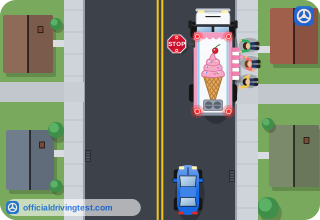
- Only children under 12 who are crossing toward the truck
- No one, as long as you slow down
- Only the truck driver when pulling away
- Any person crossing the road to or from the truck
Show answer
Correct answer: Any person crossing the road to or from the truck
Motorists must yield the right-of-way to any person who is crossing the roadway to or from the truck, and watch out for children.
Source: New Jersey Driver Manual (2026), page 78 · Open this page in the manual (Manual page 78)