New Jersey: Pavement markings Practice Test
White and yellow lines, stop lines, crosswalks and other pavement markings.
Independent educational site · not affiliated with any government agency or DMV
Ready? Test yourself
- Instant feedback with an explanation
- Every answer cites its source in the manual
- Your best score is saved on this device
Questions are original and based on the official manual "New Jersey Driver Manual" (2026), New Jersey Motor Vehicle Commission (MVC).
All 16 questions in this practice test
Take the test above first, then use this list to study. Tap “Show answer” to see the correct answer and explanation.
Show the questions and answersHide the questions
-
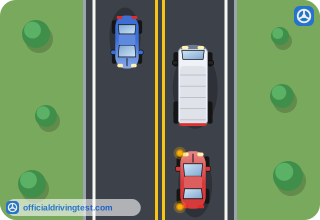
On a two-way road, what do two solid center lines mean?
- Passing is allowed only at night
- Passing is allowed on both sides
- Passing is allowed with caution
- No passing is allowed
Show answer
Correct answer: No passing is allowed
When both center lines are solid, no passing is allowed.
Source: New Jersey Driver Manual (2026), page 64 · Open this page in the manual (Manual page 64)
-
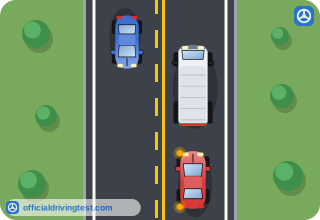
The center of the road has one broken line and one solid line. Who may pass?
- Drivers on both sides of the road
- Only drivers on the side with the broken line
- No drivers on either side of the road
- Only drivers on the side with the solid line
Show answer
Correct answer: Only drivers on the side with the broken line
When one center line is broken, passing is allowed only on the side with the broken line.
Source: New Jersey Driver Manual (2026), page 64 · Open this page in the manual (Manual page 64)
-
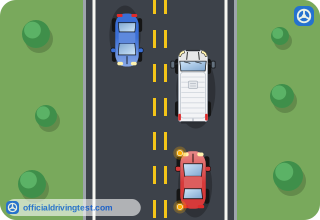
On a two-way road, what do two broken center lines mean?
- No passing is allowed on either side
- Passing is allowed only in daylight
- Passing is allowed on both sides
- Passing is allowed on one side only
Show answer
Correct answer: Passing is allowed on both sides
When both center lines are broken, passing is allowed on both sides.
Source: New Jersey Driver Manual (2026), page 64 · Open this page in the manual (Manual page 64)
-
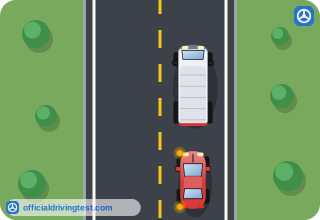
When passing on a two-way road, by when must you complete the pass?
- Before the center lines are solid again
- Within 10 seconds of starting the pass
- As soon as the other driver waves you by
- Within 100 feet after the lines turn solid
Show answer
Correct answer: Before the center lines are solid again
All passing must be completed before the center lines become solid again.
Source: New Jersey Driver Manual (2026), page 64 · Open this page in the manual (Manual page 64)
-
What does a single solid white line across the road at an intersection mean?
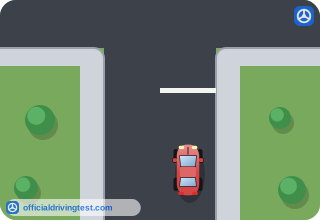
- Stop behind the line for a signal or sign
- A pedestrian crosswalk begins at this line
- Your lane ends and you must merge
- Passing is not allowed beyond this point
Show answer
Correct answer: Stop behind the line for a signal or sign
A single solid white line across the road at an intersection means you must stop behind it for a traffic signal or sign.
Source: New Jersey Driver Manual (2026), page 67 · Open this page in the manual (Manual page 67)
-
Between intersections, when may you cross a solid line, with care?
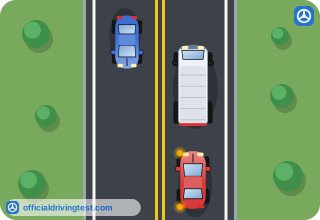
- When passing a slow-moving vehicle
- When entering or leaving a driveway
- Whenever traffic is light
- When the car ahead is turning right
Show answer
Correct answer: When entering or leaving a driveway
Solid lines between intersections show where not to pass, but they may be crossed with care when entering or leaving driveways in business or residential areas.
Source: New Jersey Driver Manual (2026), page 73 · Open this page in the manual (Manual page 73)
-
How do road markings compare legally with signs and traffic signals?
- They are only advice, unlike signs
- They apply only on state highways
- They apply only when police are present
- They have the same force of law
Show answer
Correct answer: They have the same force of law
Road markings have the same force of law as signs or traffic signals.
Source: New Jersey Driver Manual (2026), page 216 · Open this page in the manual (Manual page 216)
-
What do yellow center lines separate?
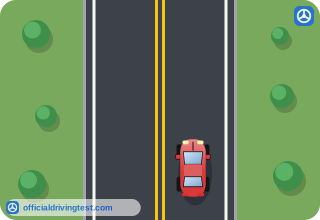
- Bus and car pool lanes from regular lanes
- Traffic moving in opposite directions
- Traffic moving in the same direction
- The shoulder from the travel lane
Show answer
Correct answer: Traffic moving in opposite directions
Yellow center lines separate traffic flow going in opposite directions.
Source: New Jersey Driver Manual (2026), page 216 · Open this page in the manual (Manual page 216)
-
What do white lines on the road do?
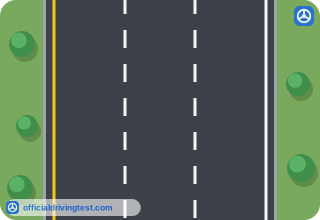
- Separate same-direction lanes and show road edges
- Tell you the speed limit for each lane
- Show where pedestrians may not cross
- Separate traffic that is moving in opposite directions
Show answer
Correct answer: Separate same-direction lanes and show road edges
White lines separate traffic going the same way when there is more than one lane, and show the edges of roads; white dashed lines separate lanes on multi-lane highways.
Source: New Jersey Driver Manual (2026), page 216 · Open this page in the manual (Manual page 216)
-
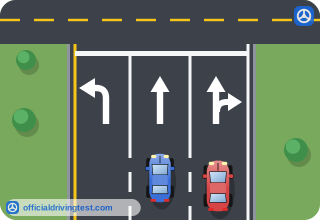
When used with other signs, what do arrows painted in a lane show?
- The direction of the nearest exit ramp
- Where parking is allowed along the curb
- Where to pass slower vehicles on the left
- The direction you must take in that lane
Show answer
Correct answer: The direction you must take in that lane
Road arrows, when used with other signs, show the correct direction a motorist must take in that lane.
Source: New Jersey Driver Manual (2026), page 216 · Open this page in the manual (Manual page 216)
-
In New Jersey, where should you keep when you are driving slowly?
- Straddle the center line
- Use the left lane
- Drive on the shoulder
- Keep to the right
Show answer
Correct answer: Keep to the right
The manual says to stay in your lane and keep to the right when driving slowly.
Source: New Jersey Driver Manual (2026), page 216 · Open this page in the manual (Manual page 216)
-
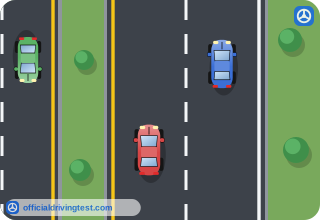
What do edge lines on a highway do?
- Mark where passing is not allowed
- Separate the shoulder from the travel lane
- Separate lanes of traffic moving opposite ways
- Show where to stop at a signal
Show answer
Correct answer: Separate the shoulder from the travel lane
Edge lines separate the shoulder from the travel lane and show the edges of highways.
Source: New Jersey Driver Manual (2026), page 217 · Open this page in the manual (Manual page 217)
-
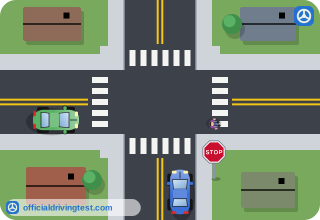
You must stop for a sign, a signal or pedestrians at an intersection that has no stop line. Where should you stop?
- Just past the crosswalk
- At the edge of the cross street
- Before the crosswalk
- In the middle of the crosswalk
Show answer
Correct answer: Before the crosswalk
At intersections where stop lines are missing, stop before the crosswalk when required to stop by traffic signs or signals or for pedestrians.
Source: New Jersey Driver Manual (2026), page 217 · Open this page in the manual (Manual page 217)
-
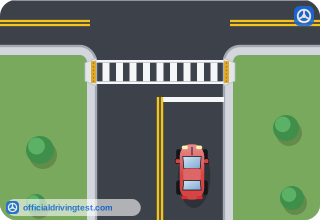
What do white crosswalk markings indicate?
- Areas where parking is banned
- School bus loading zones
- Pedestrian crossing areas
- Bicycle lanes
Show answer
Correct answer: Pedestrian crossing areas
White crosswalks indicate pedestrian crossing areas, which pedestrians should use when crossing the road.
Source: New Jersey Driver Manual (2026), page 217 · Open this page in the manual (Manual page 217)
-
Which of these are examples of white special pavement markings that alert motorists to special conditions?
- STOP AHEAD, SCHOOL and R X R
- Speed limits and route numbers
- Parking space numbers
- Mile markers and exit numbers
Show answer
Correct answer: STOP AHEAD, SCHOOL and R X R
White special markings show special conditions, such as STOP AHEAD, SCHOOL and R X R, as a motorist alert.
Source: New Jersey Driver Manual (2026), page 217 · Open this page in the manual (Manual page 217)
-
What do white diamonds painted on the pavement of a lane indicate?
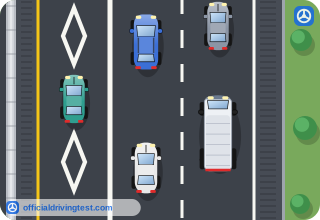
- A railroad crossing ahead of the lane
- A lane reserved for bicycles only
- A high occupancy vehicle (HOV) lane
- A lane that is about to end
Show answer
Correct answer: A high occupancy vehicle (HOV) lane
White diamonds indicate high occupancy vehicle (HOV) lanes, reserved for a particular vehicle type or vehicles carrying multiple riders.
Source: New Jersey Driver Manual (2026), page 217 · Open this page in the manual (Manual page 217)