New Jersey: Emergency vehicles & work zones — Part 2 Practice Test
Questions in this part include: “How can you tell you have reached the end of a work area and may resume normal driving?” · “According to the manual's work zone safety basics, what saves lives?”
Independent educational site · not affiliated with any government agency or DMV
Ready? Test yourself
- Instant feedback with an explanation
- Every answer cites its source in the manual
- Your best score is saved on this device
Questions are original and based on the official manual "New Jersey Driver Manual" (2026), New Jersey Motor Vehicle Commission (MVC).
All 17 questions in this practice test
Take the test above first, then use this list to study. Tap “Show answer” to see the correct answer and explanation.
Show the questions and answersHide the questions
-
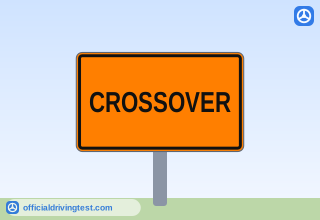
When traffic is redirected around a work zone, a median crossover or a lane shift is an example of:
- A flagger-controlled stop-and-go area
- A diversion onto a temporary roadway
- A detour onto another roadway
- An End Road Work transition area
Show answer
Correct answer: A diversion onto a temporary roadway
The manual distinguishes a detour onto another roadway from a diversion onto a temporary roadway, such as a median crossover or a lane shift.
Source: New Jersey Driver Manual (2026), page 103 · Open this page in the manual (Manual page 103)
-
How can you tell you have reached the end of a work area and may resume normal driving?
- A new speed limit sign posted about one mile past the work area
- A flashing green light placed at the end of the lane closure
- An End Road Work sign or the last temporary traffic control device
- A flagger holding up a green flag at the exit
Show answer
Correct answer: An End Road Work sign or the last temporary traffic control device
At the end of the work area there will be an End Road Work sign or the last temporary traffic control device, so motorists can resume normal driving.
Source: New Jersey Driver Manual (2026), page 103 · Open this page in the manual (Manual page 103)
-
If traffic is permitted through or next to a work area, how will it be guided?
- With temporary traffic control devices
- By a posted detour map
- Only by the existing permanent lane lines
- Only by police officers
Show answer
Correct answer: With temporary traffic control devices
When traffic is allowed through or adjacent to the work area, it is guided with temporary traffic control devices.
Source: New Jersey Driver Manual (2026), page 103 · Open this page in the manual (Manual page 103)
-
According to the manual, about how many fatal crashes happen in work zones nationwide each year?
- Nearly 8,000
- Nearly 800
- Nearly 80
- Over 37,000
Show answer
Correct answer: Nearly 800
The manual says there are nearly 800 fatal and over 37,000 serious injury crashes in work zones nationwide each year.
Source: New Jersey Driver Manual (2026), page 103 · Open this page in the manual (Manual page 103)
-
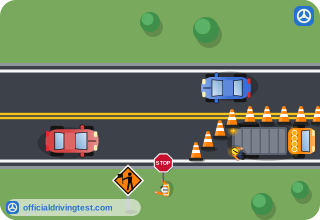
Why should you turn on your headlights when driving through a work zone?
- So you can read all of the temporary work zone signs
- Because it tells the flagger that you want to pass through
- So workers and other motorists can see your vehicle
- Because work zones are always poorly lit
Show answer
Correct answer: So workers and other motorists can see your vehicle
One of the work zone basics is to turn on headlights, because workers and other motorists must be able to see your vehicle.
Source: New Jersey Driver Manual (2026), page 103 · Open this page in the manual (Manual page 103)
-
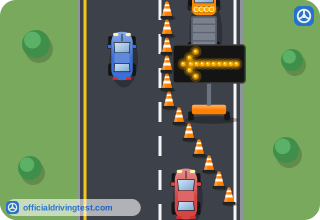
Why does the manual tell you not to tailgate in a work zone?
- Flaggers need a 10-second gap between cars
- Following closely damages temporary pavement
- Work zone lanes are wider than normal lanes
- Unexpected stops or slowing may occur
Show answer
Correct answer: Unexpected stops or slowing may occur
In a work zone, unexpected stops or slowing may occur, so you should not tailgate.
Source: New Jersey Driver Manual (2026), page 103 · Open this page in the manual (Manual page 103)
-
According to the manual's work zone safety basics, what saves lives?
- Signs and work zone flaggers
- Following the vehicle ahead closely
- Changing lanes often to avoid delays
- Driving faster to get through quickly
Show answer
Correct answer: Signs and work zone flaggers
The work zone basics say to pay close attention, because signs and work zone flaggers save lives.
Source: New Jersey Driver Manual (2026), page 103 · Open this page in the manual (Manual page 103)
-
To minimize distractions when traveling through a work zone, the manual says you should avoid:
- Changing radio stations or talking on hands-free devices
- Checking your mirrors before the lanes shift or merge
- Reading the temporary work zone signs posted along the road
- Using your turn signals before lane shifts or merges
Show answer
Correct answer: Changing radio stations or talking on hands-free devices
The manual advises minimizing distractions in work zones by avoiding changing radio stations or talking on hands-free devices.
Source: New Jersey Driver Manual (2026), page 104 · Open this page in the manual (Manual page 104)
-
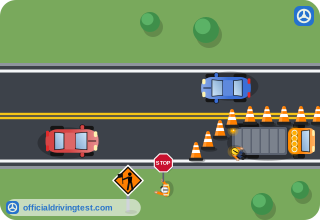
Delays in work zones can make drivers frustrated. Why does the manual tell you to be patient there?
- Crews are working to improve the ride for all
- Patient drivers do not have to obey the signs
- Honking tells the flaggers to speed traffic up
- Delays in work zones never last over 5 minutes
Show answer
Correct answer: Crews are working to improve the ride for all
The manual says to be patient and remember that work zone crew members are working to improve the ride for all motorists.
Source: New Jersey Driver Manual (2026), page 104 · Open this page in the manual (Manual page 104)
-
Which of these is among the offenses the New Jersey Driver Manual lists as carrying doubled fines in a highway construction zone?
- An expired vehicle registration
- Tailgating
- A dirty license plate
- An expired inspection sticker
Show answer
Correct answer: Tailgating
Offenses with doubled fines in construction zones include reckless and careless driving, speeding, improper passing, tailgating, improper turns and failure to obey signals, signs or an officer.
Source: New Jersey Driver Manual (2026), page 129 · Open this page in the manual (Manual page 129)
-
In New Jersey, how many points are assessed for failing to yield to an emergency vehicle?
- 2 points
- 3 points
- 5 points
- 8 points
Show answer
Correct answer: 2 points
Failure to yield to an emergency vehicle carries 2 points.
Source: New Jersey Driver Manual (2026), page 139 · Open this page in the manual (Manual page 139)
-
In New Jersey, how many points are assessed for violating the "Move Over Law" (the procedure for approaching certain stationary vehicles)?
- 3 points
- 2 points
- 4 points
- 5 points
Show answer
Correct answer: 2 points
The point chart assigns 2 points for failing to follow the procedure for approaching certain stationary vehicles, the Move Over Law.
Source: New Jersey Driver Manual (2026), page 140 · Open this page in the manual (Manual page 140)
-
Road work signs that warn of lane closings, lane shifts, flaggers, uneven pavement and detours are:
- Orange and diamond-shaped
- Blue and square
- White and rectangular
- Yellow and pennant-shaped
Show answer
Correct answer: Orange and diamond-shaped
Road work signs are orange, diamond-shaped signs that warn of lane closing, lane shifts, flaggers, uneven pavement and detours.
Source: New Jersey Driver Manual (2026), page 215 · Open this page in the manual (Manual page 215)
-
In a road work area, where are reduced speed limit signs posted?
- On the back of the flaggers' vests
- Only at the end of the work zone
- Alongside the orange work zone signs
- Only on overhead electronic message boards
Show answer
Correct answer: Alongside the orange work zone signs
Motorists should look for reduced speed limit signs posted alongside orange work zone signs.
Source: New Jersey Driver Manual (2026), page 215 · Open this page in the manual (Manual page 215)
-
How should a motorist react to road work signs?
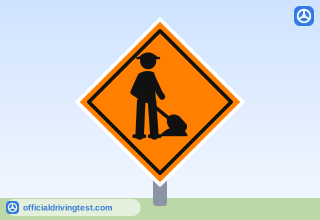
- Ignore them unless workers can be seen
- Control your distance and be ready to stop
- Speed up to get through the work zone quickly
- Change lanes often to find the fastest lane
Show answer
Correct answer: Control your distance and be ready to stop
React to road work signs by controlling the distance to the vehicle in front and your reaction time, reading the signs, following directions, and preparing to slow down or stop.
Source: New Jersey Driver Manual (2026), page 215 · Open this page in the manual (Manual page 215)
-
In New Jersey, how much authority do a flagger's directions in a work zone have?
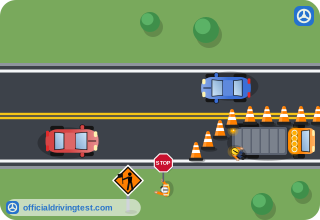
- Authority only when police are present
- The same authority as a regulatory sign
- Less authority than any posted warning sign
- None; their directions are only advice
Show answer
Correct answer: The same authority as a regulatory sign
Flaggers have the same authority as a regulatory sign, so a motorist may be cited for disobeying their directions.
Source: New Jersey Driver Manual (2026), page 215 · Open this page in the manual (Manual page 215)
-
When reacting to road work signs, besides watching for workers on the road, what should a motorist stay alert to in the work zone?
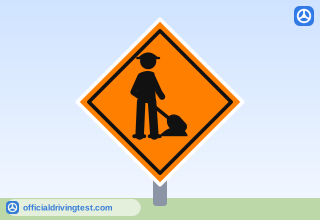
- Roadside advertising signs
- Radio traffic reports
- Toll rates posted ahead
- Moving construction machinery
Show answer
Correct answer: Moving construction machinery
A motorist should react to road work signs by, among other things, staying alert to the moving construction machinery in the work zone.
Source: New Jersey Driver Manual (2026), page 215 · Open this page in the manual (Manual page 215)