New Jersey: Emergency vehicles & work zones — Part 1 Practice Test
Questions in this part include: “Which vehicles may use sirens, whistles or bells?” · “Besides emergency and service vehicles, New Jersey's Move Over law also applies when you approach which of these?”
Independent educational site · not affiliated with any government agency or DMV
Ready? Test yourself
- Instant feedback with an explanation
- Every answer cites its source in the manual
- Your best score is saved on this device
Questions are original and based on the official manual "New Jersey Driver Manual" (2026), New Jersey Motor Vehicle Commission (MVC).
All 17 questions in this practice test
Take the test above first, then use this list to study. Tap “Show answer” to see the correct answer and explanation.
Show the questions and answersHide the questions
-
Which vehicles may use sirens, whistles or bells?
- School buses and tow trucks
- Any vehicle passing another vehicle
- Any vehicle in a residential zone
- Only emergency vehicles
Show answer
Correct answer: Only emergency vehicles
The manual states that only emergency vehicles may use sirens, whistles or bells.
Source: New Jersey Driver Manual (2026), page 54 · Open this page in the manual (Manual page 54)
-
When must you yield the right-of-way to police cars, fire engines, and ambulances?
- Only when an officer waves you over
- Only at intersections with traffic lights
- Only when they are right behind you on a highway
- When they are using sirens or flashing lights
Show answer
Correct answer: When they are using sirens or flashing lights
You must yield to emergency vehicles when they are giving warning signals such as sirens or flashing lights.
Source: New Jersey Driver Manual (2026), page 65 · Open this page in the manual (Manual page 65)
-
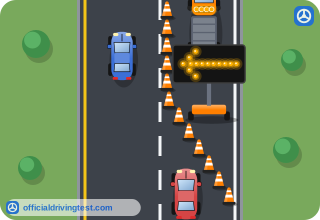
When you come across a construction area, what should you do?
- Follow closely behind the vehicle ahead
- Keep your usual speed and stay in your current lane
- Speed up so that you spend less time in the area
- Adjust speed and position to keep space around you
Show answer
Correct answer: Adjust speed and position to keep space around you
Stay alert for construction-area warning signs, and adjust speed and position to maintain space around your vehicle.
Source: New Jersey Driver Manual (2026), page 71 · Open this page in the manual (Manual page 71)
-
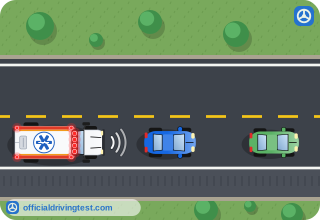
In New Jersey, what should you do when an emergency vehicle approaches with its siren sounding and emergency lights flashing?
- Move into the left lane and keep driving at speed
- Steer to the extreme right, stop, and wait for it to pass
- Stop right away in your current lane and wait there
- Speed up so you stay well ahead of the approaching emergency vehicle
Show answer
Correct answer: Steer to the extreme right, stop, and wait for it to pass
A motorist should steer to the extreme right of the roadway, stop, and wait for the emergency vehicle to pass.
Source: New Jersey Driver Manual (2026), page 78 · Open this page in the manual (Manual page 78)
-
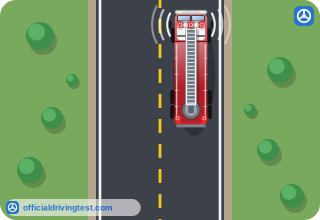
In New Jersey, how far behind a signaling emergency vehicle should you stay?
- At least 500 feet
- At least 100 feet
- At least 200 feet
- At least 300 feet
Show answer
Correct answer: At least 300 feet
After an emergency vehicle passes, a motorist should keep at least 300 feet behind a signaling emergency vehicle.
Source: New Jersey Driver Manual (2026), page 78 · Open this page in the manual (Manual page 78)
-
New Jersey law requires you to yield to emergency vehicles that sound sirens and/or show flashing emergency lights of which colors?
- Red and/or blue
- Amber only
- White only
- Green and/or white
Show answer
Correct answer: Red and/or blue
All motorists must yield to emergency vehicles that sound sirens and/or show flashing red and/or blue emergency lights.
Source: New Jersey Driver Manual (2026), page 78 · Open this page in the manual (Manual page 78)
-
In New Jersey, what color lights do private vehicles of volunteer fire and rescue squad members use when responding to an emergency call?
- Red
- Green
- Blue
- Amber
Show answer
Correct answer: Blue
Private vehicles driven by volunteer fire and rescue squad members, with emergency vehicle identification, use blue lights when responding to an emergency call.
Source: New Jersey Driver Manual (2026), page 78 · Open this page in the manual (Manual page 78)
-
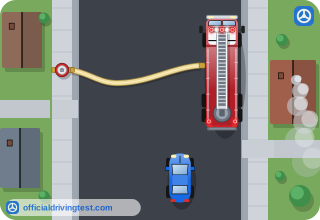
In New Jersey, you should never park within how many feet of a fire department vehicle that is in service?
- 200 feet
- 500 feet
- 100 feet
- 50 feet
Show answer
Correct answer: 200 feet
A motorist should never park within 200 feet of a fire department vehicle in service unless directed to by a fire, emergency rescue or police official.
Source: New Jersey Driver Manual (2026), page 78 · Open this page in the manual (Manual page 78)
-
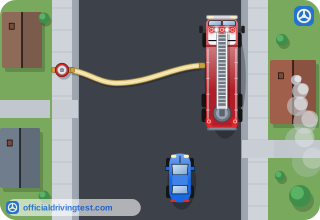
When may you drive over a fire hose in New Jersey?
- Only when the hose is not carrying any water
- Only when a fire, rescue or police official directs you to
- Whenever you drive over it slowly and carefully, without stopping
- Only when your hazard lights are switched on
Show answer
Correct answer: Only when a fire, rescue or police official directs you to
A motorist should never drive over a fire hose unless directed to do so by a fire, emergency rescue or police official.
Source: New Jersey Driver Manual (2026), page 78 · Open this page in the manual (Manual page 78)
-
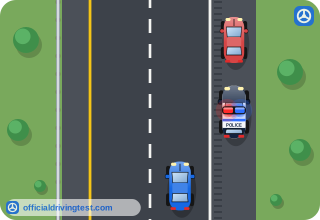
Under New Jersey's Move Over law, what must you do when approaching a stationary emergency vehicle with flashing lights, if safety and traffic allow?
- Stay in your lane and keep the same speed
- Stop behind the vehicle until it drives away
- Change into a lane that is not next to the stopped vehicle
- Sound your horn to warn the emergency workers standing at the scene
Show answer
Correct answer: Change into a lane that is not next to the stopped vehicle
The Move Over law requires motorists, when safety and traffic permit, to change into a lane not adjacent to the stationary emergency or disabled vehicle.
Source: New Jersey Driver Manual (2026), page 78 · Open this page in the manual (Manual page 78)
-
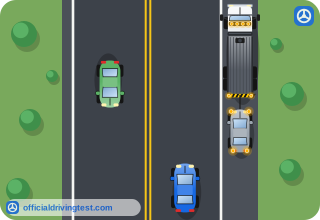
Under New Jersey's Move Over law, what must you do if changing lanes is impossible, prohibited, or unsafe?
- Turn on your hazard lights and keep your current speed
- Stop completely in your lane until the vehicle leaves
- Keep your current speed but drive along the far edge of your own lane
- Slow to a proper speed below the posted limit and be ready to stop
Show answer
Correct answer: Slow to a proper speed below the posted limit and be ready to stop
If a lane change is impossible, prohibited or unsafe, the motorist must reduce speed to a reasonable and proper speed lower than the posted limit and be prepared to stop.
Source: New Jersey Driver Manual (2026), page 78 · Open this page in the manual (Manual page 78)
-
New Jersey's Move Over law applies to emergency, tow, and highway maintenance vehicles displaying flashing lights of which colors?
- Red only
- Amber or yellow only, never red or blue
- Red, blue, amber or yellow
- Red or blue only
Show answer
Correct answer: Red, blue, amber or yellow
The law covers vehicles displaying a flashing, blinking or alternating red, blue, amber or yellow light, or a set of lights containing one of these colors.
Source: New Jersey Driver Manual (2026), page 78 · Open this page in the manual (Manual page 78)
-
Besides emergency and service vehicles, New Jersey's Move Over law also applies when you approach which of these?
- A slow-moving farm vehicle traveling in the right lane
- A stopped car with hazard lights, flares or reflective triangles
- Any vehicle signaling to turn right at the next corner
- A car parked legally at the curb in a business or residential district
Show answer
Correct answer: A stopped car with hazard lights, flares or reflective triangles
The Move Over law also covers any stationary or disabled vehicle that is flashing hazard warning lights or using road flares or reflective triangles.
Source: New Jersey Driver Manual (2026), page 78 · Open this page in the manual (Manual page 78)
-
What fine do motorists face for violating New Jersey's Move Over law?
- $1,000 to $2,500
- $500 to $1,000
- $50 to $200
- $100 to $500
Show answer
Correct answer: $100 to $500
Motorists who violate the Move Over law face a fine of not less than $100 and not more than $500.
Source: New Jersey Driver Manual (2026), page 78 · Open this page in the manual (Manual page 78)
-
In New Jersey, traffic fines for motor vehicle violations committed in roadway construction zones are:
- Doubled
- Tripled
- The same as anywhere else
- Increased by a flat $50
Show answer
Correct answer: Doubled
New Jersey doubles traffic fines for motor vehicle violations committed in roadway construction zones (N.J.S.A. 39:4-203.5).
Source: New Jersey Driver Manual (2026), page 103 · Open this page in the manual (Manual page 103)
-
A work zone may be identified by an advance warning sign or by flashing lights on a vehicle up to how far before the work area?
- Two miles
- One-half mile
- 500 feet
- One mile
Show answer
Correct answer: One-half mile
The manual says work zones are identified by an advance warning sign or flashing lights on a vehicle up to one-half mile before the work area.
Source: New Jersey Driver Manual (2026), page 103 · Open this page in the manual (Manual page 103)
-
In a work area, who may control traffic and protect the project personnel?
- Private security guards
- School crossing guards
- Tow truck operators
- Flaggers
Show answer
Correct answer: Flaggers
The manual says flaggers may control traffic and protect project personnel in the work area.
Source: New Jersey Driver Manual (2026), page 103 · Open this page in the manual (Manual page 103)