New Jersey: Emergencies and special situations — Part 2 Practice Test
Skids, breakdowns, crashes, bad weather, night driving and traffic stops. — Part 2
Independent educational site · not affiliated with any government agency or DMV
Ready? Test yourself
- Instant feedback with an explanation
- Every answer cites its source in the manual
- Your best score is saved on this device
Questions are original and based on the official manual "New Jersey Driver Manual" (2026), New Jersey Motor Vehicle Commission (MVC).
All 36 questions in this practice test
Take the test above first, then use this list to study. Tap “Show answer” to see the correct answer and explanation.
Show the questions and answersHide the questions
-
In the crash-prevention formula, what does "be alert" mean?
- Focus only on the vehicle directly in front of you
- Never think the other motorist will not make a driving mistake
- Expect other drivers to warn you before they make a mistake
- Assume other motorists will always obey the traffic rules
Show answer
Correct answer: Never think the other motorist will not make a driving mistake
Being alert means never assuming that the other motorist will not make a driving mistake.
Source: New Jersey Driver Manual (2026), page 90 · Open this page in the manual (Manual page 90)
-
In the crash-prevention formula, what does "act in time" advise a motorist to do?
- Try not to panic, and know what to do if trouble strikes
- Wait to see how other motorists react before doing anything
- Brake as hard as possible at the first sign of danger
- Speed up to get away from any problem that develops
Show answer
Correct answer: Try not to panic, and know what to do if trouble strikes
Acting in time means trying not to panic and knowing what to do if something happens suddenly.
Source: New Jersey Driver Manual (2026), page 90 · Open this page in the manual (Manual page 90)
-
According to the New Jersey Driver Manual, what should a motorist do if they are angry or excited?
- Drive faster to get the trip over with
- Use the horn to release tension
- Open the windows and keep driving
- Take time to cool off
Show answer
Correct answer: Take time to cool off
Emotions can greatly affect driving ability, so an angry or excited motorist should take time to cool off.
Source: New Jersey Driver Manual (2026), page 90 · Open this page in the manual (Manual page 90)
-
Which of the following does the New Jersey Driver Manual list as an aggressive driving action?
- Driving in the center lane during a heavy rainstorm
- Turning on hazard lights when pulling off the road
- Following another vehicle too closely
- Keeping up with the flow of traffic
Show answer
Correct answer: Following another vehicle too closely
The manual defines aggressive driving as unlawful actions such as unexpectedly changing speed, erratic lane changes, disregarding traffic control devices, failing to yield and following too closely.
Source: New Jersey Driver Manual (2026), page 90 · Open this page in the manual (Manual page 90)
-
According to the New Jersey Driver Manual, when does road rage occur?
- When motorists lose their tempers over a traffic disturbance
- When a vehicle's brakes suddenly fail in heavy traffic
- When a driver becomes drowsy after many hours of driving
- When a driver is distracted by a talkative passenger
Show answer
Correct answer: When motorists lose their tempers over a traffic disturbance
Road rage occurs when motorists lose their tempers or become frustrated because of a traffic disturbance.
Source: New Jersey Driver Manual (2026), page 91 · Open this page in the manual (Manual page 91)
-
Which of these is a behavior of aggressive motorists described in the New Jersey Driver Manual's section on road rage?
- Leaving three or more seconds of following distance
- Turning on hazard lights on the shoulder
- Slowing down to let another vehicle pass
- Passing illegally on the right
Show answer
Correct answer: Passing illegally on the right
Aggressive motorists may run stop signs and red lights, speed, tailgate, weave through traffic, pass illegally on the right, make unsafe lane changes, gesture, scream, honk or flash high beams.
Source: New Jersey Driver Manual (2026), page 91 · Open this page in the manual (Manual page 91)
-
As part of its campaign against road rage, what has New Jersey done?
- Required anger classes for every new license holder
- Banned the use of car horns in all city centers
- Trained special patrols to stop aggressive motorists
- Lowered the speed limit on every state highway
Show answer
Correct answer: Trained special patrols to stop aggressive motorists
New Jersey is waging a campaign against road rage and has specifically trained enforcement patrols to help stop aggressive motorists.
Source: New Jersey Driver Manual (2026), page 91 · Open this page in the manual (Manual page 91)
-
According to the New Jersey Driver Manual, what may extreme cases of aggressive driving lead to?
- Highway hypnosis
- Hydroplaning
- Drowsy driving
- Road rage
Show answer
Correct answer: Road rage
Aggressive drivers fail to consider how their actions affect other motorists, and extreme cases of aggressive driving may lead to road rage.
Source: New Jersey Driver Manual (2026), page 91 · Open this page in the manual (Manual page 91)
-
What does the New Jersey Driver Manual advise when driving in town or city traffic?
- Change lanes often to find the fastest lane
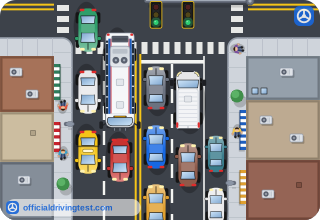
- Be patient and avoid quick turns or lane changes
- Follow closely so other drivers cannot cut in
- Use the horn often to keep traffic moving along
Show answer
Correct answer: Be patient and avoid quick turns or lane changes
A motorist should always be patient in town or city traffic, try not to make quick turns or lane changes, and not let rush hour traffic become irritating.
Source: New Jersey Driver Manual (2026), page 93 · Open this page in the manual (Manual page 93)
-
According to the New Jersey Driver Manual, wet road surfaces can cause tires to hydroplane starting at about what speed?
- 35 mph
- 20 mph
- 65 mph
- 45 mph
Show answer
Correct answer: 35 mph
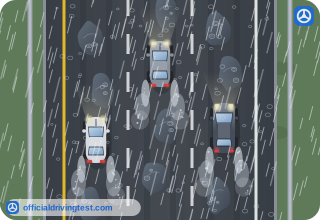
Tires can hydroplane, or ride up on a film of water, starting at about 35 mph, which could cause a loss of control.
Source: New Jersey Driver Manual (2026), page 97 · Open this page in the manual (Manual page 97)
-
According to the New Jersey Driver Manual, after what speed may tires totally leave the road surface on a wet road?
- 45 mph
- 25 mph
- 55 mph
- 35 mph
Show answer
Correct answer: 55 mph
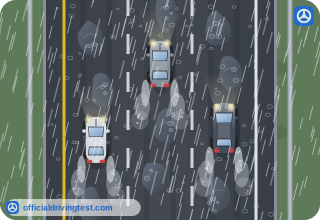
Chances of hydroplaning increase with speed, and after 55 mph tires may totally leave the road surface.
Source: New Jersey Driver Manual (2026), page 97 · Open this page in the manual (Manual page 97)
-
If a hydroplaning vehicle's tires totally leave the road surface, what happens?
- Anti-lock brakes restore full braking and turning control
- Braking still works normally, but turning is not possible
- Turning still works normally, but braking is not possible
- Braking is virtually impossible and turning is not possible
Show answer
Correct answer: Braking is virtually impossible and turning is not possible
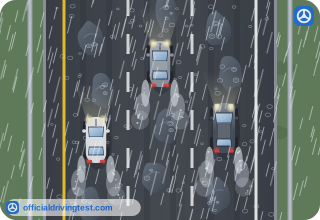
If tires totally leave the road surface, braking is virtually impossible and turning is not possible.
Source: New Jersey Driver Manual (2026), page 97 · Open this page in the manual (Manual page 97)
-
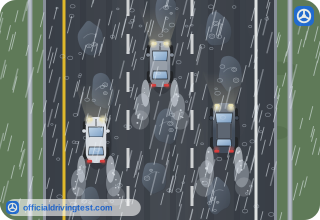
If a vehicle is hydroplaning, what does the New Jersey Driver Manual say can create a skid?
- Only a sharp turn made at a high rate of speed
- A gust of wind, a change in road level or a slight turn
- Nothing at all, as long as the tires are brand new
- Only hard braking while traveling above 55 mph
Show answer
Correct answer: A gust of wind, a change in road level or a slight turn
While hydroplaning, even a gust of wind, a change in road level or a slight turn can create a skid.
Source: New Jersey Driver Manual (2026), page 97 · Open this page in the manual (Manual page 97)
-
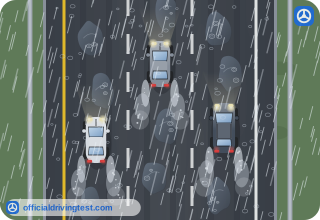
Which of these does the New Jersey Driver Manual recommend to avoid hydroplaning?
- Stay in the lane closest to the curb
- Drive through standing water quickly
- Use cruise control to keep a steady speed
- Avoid driving on bald or badly worn tires
Show answer
Correct answer: Avoid driving on bald or badly worn tires
To avoid hydroplaning, do not drive on bald or badly worn tires, and slow down when heavy rain, standing water or slush is present.
Source: New Jersey Driver Manual (2026), page 97 · Open this page in the manual (Manual page 97)
-
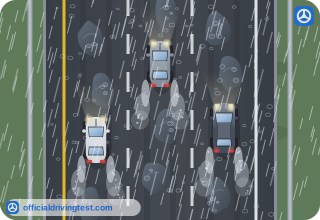
In a heavy rainstorm on a multiple-lane highway, which lane does the New Jersey Driver Manual suggest using when available?
- The paved shoulder
- The far right lane next to the shoulder
- The center lane
- The far left lane next to the median
Show answer
Correct answer: The center lane
In a heavy rainstorm, try to drive on the highest point of the road, for example the center lane of a multiple-lane highway when available.
Source: New Jersey Driver Manual (2026), page 97 · Open this page in the manual (Manual page 97)
-
Under New Jersey law, who is responsible when ice flies from a vehicle and causes death, injury or property damage?
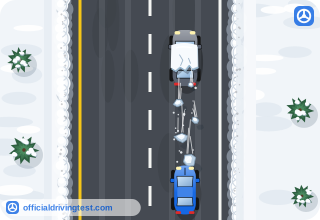
- The motorist of the vehicle the ice came from
- The state highway department
- No one, because it is caused by the weather
- The driver of the vehicle that was hit
Show answer
Correct answer: The motorist of the vehicle the ice came from
New Jersey law makes a motorist responsible for any ice that flies from their vehicle and causes death, injury or property damage (N.J.S.A. 39:4-77.1).
Source: New Jersey Driver Manual (2026), page 98 · Open this page in the manual (Manual page 98)
-
Before driving in cold weather, what does the New Jersey Driver Manual say to do with the engine?
- Let it idle for at least 15 minutes first
- Let it warm up according to manufacturer directions
- Drive off at once so that it warms up faster
- Rev it hard for several minutes to heat it up
Show answer
Correct answer: Let it warm up according to manufacturer directions
Before driving in cold weather, start the engine and let it warm up according to the manufacturer's directions.
Source: New Jersey Driver Manual (2026), page 98 · Open this page in the manual (Manual page 98)
-
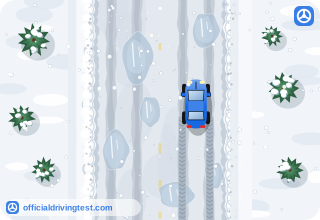
In snow and ice conditions, how does the New Jersey Driver Manual suggest you find out how slippery the road is?
- Make a quick turn to test the grip
- Brake hard at high speed on an empty road
- Spin the wheels when starting from a stop
- Gently apply the brakes while driving slowly
Show answer
Correct answer: Gently apply the brakes while driving slowly
Gently applying the brakes while driving slowly shows how slippery the road is and how fast you can go and still stop safely.
Source: New Jersey Driver Manual (2026), page 98 · Open this page in the manual (Manual page 98)
-
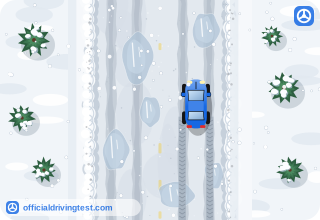
Which of these does the New Jersey Driver Manual list among the special dangers of winter driving?
- More road construction zones
- Heavier holiday truck traffic
- Brighter sun at midday
- Longer hours of darkness
Show answer
Correct answer: Longer hours of darkness
Winter driving has special dangers, including longer hours of darkness, fog, rain, snow, sleet and ice, each of which increases the possibility of a crash.
Source: New Jersey Driver Manual (2026), page 98 · Open this page in the manual (Manual page 98)
-
To start moving on snow and ice, what does the New Jersey Driver Manual recommend?

- Race the engine to build momentum
- Start in the highest gear
- Keep the engine speed low
- Spin the wheels to clear the snow
Show answer
Correct answer: Keep the engine speed low
To start on snow and ice, keep the engine speed low.
Source: New Jersey Driver Manual (2026), page 99 · Open this page in the manual (Manual page 99)
-
When starting on snow and ice, what should you do if the wheels spin?

- Press the gas pedal harder
- Turn the steering wheel sharply
- Shift into a higher gear
- Use a lower gear
Show answer
Correct answer: Use a lower gear
If the wheels spin when starting on snow and ice, a lower gear should be used.
Source: New Jersey Driver Manual (2026), page 99 · Open this page in the manual (Manual page 99)
-
If your vehicle is stuck in snow, how does the New Jersey Driver Manual say to get it free?

- Rock it by shifting between forward and reverse
- Hold the gas pedal down firmly while in drive
- Let most of the air out of all four tires
- Turn the wheel fully and accelerate hard
Show answer
Correct answer: Rock it by shifting between forward and reverse
When stuck, rock the vehicle back and forth by shifting between forward and reverse to escape.
Source: New Jersey Driver Manual (2026), page 99 · Open this page in the manual (Manual page 99)
-
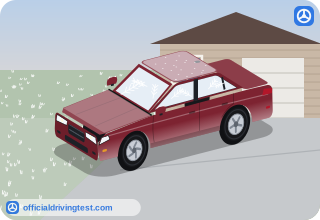
In frost or ice, what should you always do with the vehicle's windows before starting out?
- Scrape and wipe them
- Wait for them to clear while you drive
- Clear only a small spot on the windshield
- Clear only the driver's side window
Show answer
Correct answer: Scrape and wipe them
In frost or ice, always scrape and wipe the vehicle's windows before starting, and turn on the defroster.
Source: New Jersey Driver Manual (2026), page 99 · Open this page in the manual (Manual page 99)
-
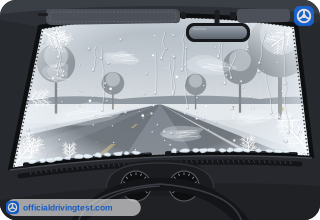
If the defroster stops working while you are driving in freezing rain or snow, what does the New Jersey Driver Manual say to do?
- Turn on the high beams so you can see better
- Safely stop and let the heater warm the windows
- Keep driving and wipe the glass clear by hand
- Open all the windows and keep driving slowly
Show answer
Correct answer: Safely stop and let the heater warm the windows
If the defroster does not work in freezing rain or snow, safely stop the vehicle, close the windows and let the heater warm up the windows.
Source: New Jersey Driver Manual (2026), page 99 · Open this page in the manual (Manual page 99)
-
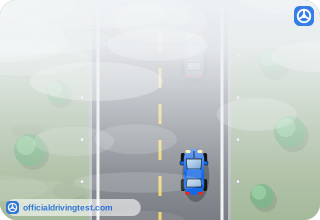
When driving in fog, how should your lights be set?
- High beams, so you can see farther ahead
- Low beams, plus fog lights if you have them
- Parking lights only, to reduce the glare
- Alternating between high and low beams
Show answer
Correct answer: Low beams, plus fog lights if you have them
Always slow down in fog; keep the headlights on low beam and turn on fog lights if the vehicle has them.
Source: New Jersey Driver Manual (2026), page 99 · Open this page in the manual (Manual page 99)
-
When driving in fog, what does the New Jersey Driver Manual say can serve as a motorist's guide?

- Pavement markings and other vehicles' lights
- The painted curbs along the side streets
- The sound of other vehicles' horns nearby
- The position of the sun in the sky
Show answer
Correct answer: Pavement markings and other vehicles' lights
In fog, pavement markings and other vehicle lights can serve as a motorist's guide.
Source: New Jersey Driver Manual (2026), page 99 · Open this page in the manual (Manual page 99)
-
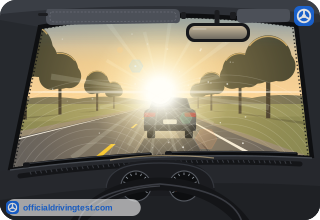
How does the New Jersey Driver Manual say to deal with sun glare?
- Switch on your high beams so you can see better
- Speed up so you get past the glare more quickly
- Follow the vehicle ahead of you more closely
- Adjust the visor, grip the wheel firmly, slow down
Show answer
Correct answer: Adjust the visor, grip the wheel firmly, slow down
Adjust the sun visors to shield your eyes without blocking your view of the road, hold the steering wheel firmly, slow down and watch for lane markings.
Source: New Jersey Driver Manual (2026), page 99 · Open this page in the manual (Manual page 99)
-
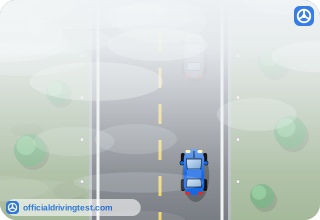
If visibility is greatly reduced, what does the New Jersey Driver Manual say a motorist should do?
- Keep going at the same speed with high beams on
- Stop in the travel lane and turn on the flashers
- Pull onto the shoulder and turn on the flashers
- Closely follow the taillights of the car ahead
Show answer
Correct answer: Pull onto the shoulder and turn on the flashers
In all cases, if visibility is greatly reduced, stop alongside the road or on the shoulder, out of the way of traffic, and turn on the emergency flashers.
Source: New Jersey Driver Manual (2026), page 99 · Open this page in the manual (Manual page 99)
-
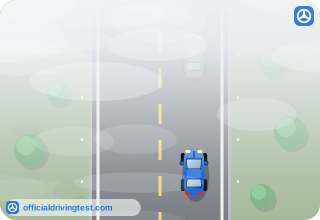
What does the New Jersey Driver Manual say you should always do when driving in fog?
- Speed up to get out of it sooner
- Keep your normal speed
- Slow down
- Follow the car ahead more closely
Show answer
Correct answer: Slow down
The manual says to always slow down when driving in fog, with the headlights on low beam.
Source: New Jersey Driver Manual (2026), page 99 · Open this page in the manual (Manual page 99)
-
According to the New Jersey Driver Manual, about what share of driving decisions are based on what a motorist sees while driving?
- About 50 percent
- About 70 percent
- Nearly 100 percent
- Nearly 90 percent
Show answer
Correct answer: Nearly 90 percent
The manual says nearly 90 percent of driving decisions are based on what a motorist sees, which is why reduced vision at night matters so much.
Source: New Jersey Driver Manual (2026), page 100 · Open this page in the manual (Manual page 100)
-
To drive safely at night, what does the manual tell you to do?
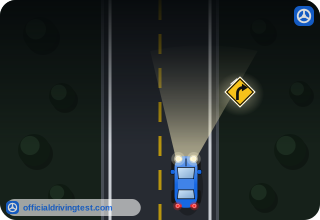
- Slow down and drive within the range of your headlights
- Stay close to the taillights of the vehicle driving ahead
- Use your high beams on every road, at all times of night
- Keep your dashboard and interior lights at full brightness
Show answer
Correct answer: Slow down and drive within the range of your headlights
Vision is reduced at night, so you should slow down and drive within the range of your vehicle's headlights.
Source: New Jersey Driver Manual (2026), page 100 · Open this page in the manual (Manual page 100)
-
Besides road signs, what does the New Jersey Driver Manual tell you to watch for when driving at night?
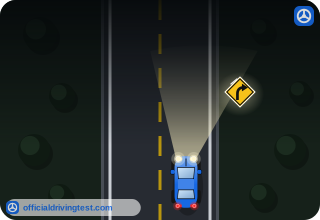
- Only oncoming vehicles that use high beams
- Only large trucks and buses with lights on
- Only the vehicles in your own lane ahead
- Unlit or slow vehicles, bicycles and animals
Show answer
Correct answer: Unlit or slow vehicles, bicycles and animals
The night driving rules say to watch for road signs, slow-moving or unlit vehicles, bicycles, pedestrians, and animals.
Source: New Jersey Driver Manual (2026), page 101 · Open this page in the manual (Manual page 101)
-
Why should you never turn a steering-wheel ignition to the lock position while the vehicle is moving?
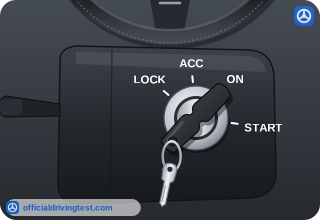
- The headlights and brake lights will all go out
- The front air bags will deploy at once
- The engine will restart by itself and then speed up
- The steering will lock and you will lose control
Show answer
Correct answer: The steering will lock and you will lose control
Never turn the ignition to lock while moving: the steering will lock as the vehicle turns and you will lose control.
Source: New Jersey Driver Manual (2026), page 104 · Open this page in the manual (Manual page 104)
-
According to the manual, what can throw a vehicle into a skid, often on wet or icy roads?
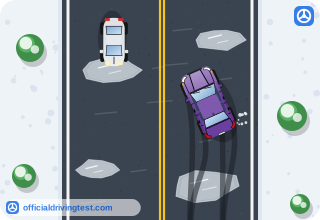
- Driving with your low beams on at night
- Sudden turns, lane changes or hard braking
- Keeping a steady, moderate speed in your lane
- Driving in a lower gear on slippery roads
Show answer
Correct answer: Sudden turns, lane changes or hard braking
Sudden turns, lane changes or hard braking can throw a vehicle into a skid, which often happens on wet or icy roads.
Source: New Jersey Driver Manual (2026), page 104 · Open this page in the manual (Manual page 104)
-
How should you handle a skid in a front-wheel drive vehicle compared with a rear-wheel drive vehicle?
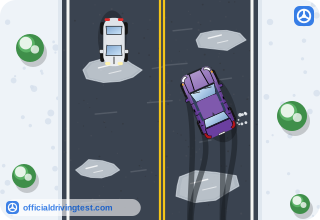
- Accelerate only in a rear-wheel drive vehicle
- Steer away from the skid only in front-wheel drive
- The same way in both
- Brake hard only in a front-wheel drive vehicle
Show answer
Correct answer: The same way in both
The manual says a skid should be handled in the same way in both front-wheel and rear-wheel drive vehicles.
Source: New Jersey Driver Manual (2026), page 104 · Open this page in the manual (Manual page 104)
-
If the rear end of your vehicle starts to slide, what should you do?
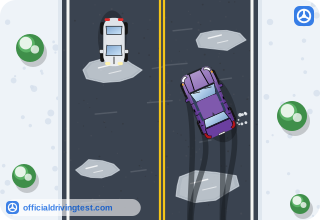
- Take your foot off the gas pedal
- Quickly turn the wheel away from the skid
- Press the brake pedal hard
- Press harder on the gas pedal
Show answer
Correct answer: Take your foot off the gas pedal
If the rear end starts to slide, take your foot off the gas pedal; turning quickly away from the skid can make the vehicle spin.
Source: New Jersey Driver Manual (2026), page 104 · Open this page in the manual (Manual page 104)