New Jersey: Emergencies and special situations — Part 1 Practice Test
Skids, breakdowns, crashes, bad weather, night driving and traffic stops. — Part 1
Independent educational site · not affiliated with any government agency or DMV
Ready? Test yourself
- Instant feedback with an explanation
- Every answer cites its source in the manual
- Your best score is saved on this device
Questions are original and based on the official manual "New Jersey Driver Manual" (2026), New Jersey Motor Vehicle Commission (MVC).
All 36 questions in this practice test
Take the test above first, then use this list to study. Tap “Show answer” to see the correct answer and explanation.
Show the questions and answersHide the questions
-
Which New Jersey law requires the MVC to educate motorists about the dangers of carbon monoxide poisoning from vehicles?
- Kyleigh's Law
- The Rosa-Bonilla Family Act
- The Graduated Driver License Act
- Maggie's Law
Show answer
Correct answer: The Rosa-Bonilla Family Act
The Rosa-Bonilla Family Act requires the Motor Vehicle Commission to educate motorists about carbon monoxide poisoning from motor vehicles.
Source: New Jersey Driver Manual (2026), page 47 · Open this page in the manual (Manual page 47)
-
What is carbon monoxide (CO)?
- An odorless, colorless gas in vehicle exhaust
- A harmless vapor from the air conditioner
- A strong-smelling gas that you will notice right away
- Blue smoke from overheated brakes
Show answer
Correct answer: An odorless, colorless gas in vehicle exhaust
Carbon monoxide is an odorless, colorless gas present in a vehicle's exhaust.
Source: New Jersey Driver Manual (2026), page 47 · Open this page in the manual (Manual page 47)
-
According to the New Jersey Driver Manual, what do the pollution controls on modern vehicles do about carbon monoxide (CO)?
- Greatly reduce the CO emitted from the tailpipe
- Make the CO in exhaust completely harmless
- Give CO a smell so you can notice it
- Make it safe to idle in a closed garage
Show answer
Correct answer: Greatly reduce the CO emitted from the tailpipe
Modern pollution controls greatly reduce the CO emitted from the tailpipe, but certain conditions can still let dangerous, even fatal, levels of CO build up in or around a vehicle.
Source: New Jersey Driver Manual (2026), page 47 · Open this page in the manual (Manual page 47)
-
Which condition can cause dangerous levels of carbon monoxide to build up in or around a vehicle?
- Using non-freezing spray on the windshield
- An exhaust leak or a poorly tuned engine
- Keeping the windows and mirrors clean
- Tires inflated to the proper pressure
Show answer
Correct answer: An exhaust leak or a poorly tuned engine
Operating a vehicle with an exhaust leak or poorly tuned engine is one of the conditions that can let dangerous CO levels build up.
Source: New Jersey Driver Manual (2026), page 47 · Open this page in the manual (Manual page 47)
-
According to the New Jersey Driver Manual, which of these can let dangerous carbon monoxide build up in or around a vehicle?
- Driving with freshly inflated tires
- Driving with the headlights switched to low beam
- Driving with the rear defroster on
- Driving with the trunk or rear tailgate open
Show answer
Correct answer: Driving with the trunk or rear tailgate open
Operating a vehicle with the trunk or rear tailgate open is listed as a condition that can cause dangerous CO levels.
Source: New Jersey Driver Manual (2026), page 47 · Open this page in the manual (Manual page 47)
-
Is it safe to let a vehicle idle in a garage if the outside garage door is open?
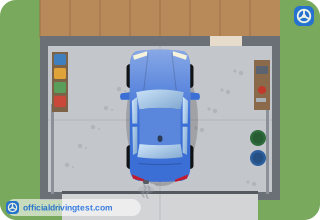
- Yes, the open door lets all the exhaust escape
- Yes, as long as the engine is less than 10 years old
- No, dangerous carbon monoxide can still build up
- Yes, if it idles for less than 30 minutes
Show answer
Correct answer: No, dangerous carbon monoxide can still build up
Idling a vehicle in a garage or confined space, even with the outside garage door open, can let dangerous CO levels build up.
Source: New Jersey Driver Manual (2026), page 48 · Open this page in the manual (Manual page 48)
-
Which of these can cause dangerous carbon monoxide levels in or around a vehicle?
- A tailpipe blocked by snow, leaves or water
- A horn that is rarely used
- Tires that were checked while cold
- A windshield treated with non-freezing spray
Show answer
Correct answer: A tailpipe blocked by snow, leaves or water
Operating a vehicle with a tailpipe blocked by debris such as snow, leaves or water can cause dangerous CO buildup.
Source: New Jersey Driver Manual (2026), page 48 · Open this page in the manual (Manual page 48)
-
According to the New Jersey Driver Manual, which vehicle condition can lead to carbon monoxide building up?
- A brand-new cabin air filter in the dashboard
- Worn windshield wiper blades
- Low windshield washer fluid
- Holes in the body of the vehicle
Show answer
Correct answer: Holes in the body of the vehicle
Operating a vehicle with holes in its body is one of the conditions that can let dangerous CO accumulate.
Source: New Jersey Driver Manual (2026), page 48 · Open this page in the manual (Manual page 48)
-
According to the New Jersey Driver Manual, which is true about carbon monoxide poisoning?
- Only children show symptoms of CO poisoning
- CO can kill even before any symptoms are noticed
- CO always has a strong smell that warns you
- Symptoms always appear well before CO becomes dangerous
Show answer
Correct answer: CO can kill even before any symptoms are noticed
The manual warns that CO can kill even before any of its symptoms are noticed.
Source: New Jersey Driver Manual (2026), page 48 · Open this page in the manual (Manual page 48)
-
Which are common symptoms of carbon monoxide poisoning?
- Itchy skin and a rash
- Hiccups and a sore throat
- Headache and dizziness
- Sneezing and a runny nose
Show answer
Correct answer: Headache and dizziness
Common CO poisoning symptoms include headache, dizziness, loss of consciousness, nausea/vomiting, chest pain and confusion.
Source: New Jersey Driver Manual (2026), page 48 · Open this page in the manual (Manual page 48)
-
If you are in a vehicle and suspect someone is suffering from carbon monoxide poisoning, what should you do?
- Close the windows and keep the engine running for heat
- Drive into a closed garage to get out of the cold
- Let the person sleep in the back seat until they feel better
- Turn off the engine, get out, get them fresh air and call 911
Show answer
Correct answer: Turn off the engine, get out, get them fresh air and call 911
Remove the person from the CO source and call 911; in a vehicle, turn off the engine, get out when it is safe and help the victim breathe fresh air while waiting for help.
Source: New Jersey Driver Manual (2026), page 48 · Open this page in the manual (Manual page 48)
-
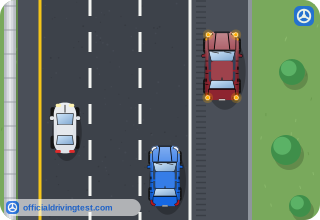
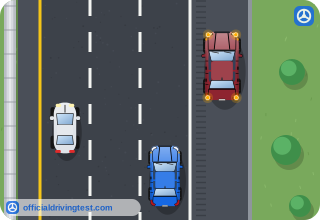
You see a disabled vehicle ahead on the highway. What should you do?
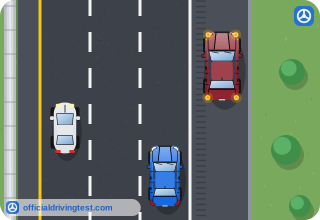
- Reduce speed and add space between you and it
- Keep exactly the same speed and lane position as before
- Stop right behind it in your lane
- Speed up so you get past it quickly
Show answer
Correct answer: Reduce speed and add space between you and it
When you see a disabled vehicle ahead, reduce speed and increase the space between your vehicle and it, which may mean changing lanes.
Source: New Jersey Driver Manual (2026), page 71 · Open this page in the manual (Manual page 71)
-
If your vehicle becomes disabled on the highway, where should you move it?
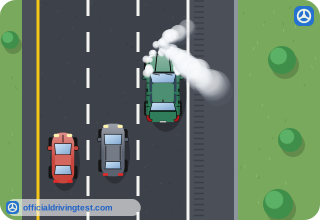
- Into the right-hand travel lane
- Onto the nearest exit ramp and stop in its middle
- As far as possible onto the shoulder or median
- Nowhere; leave it where it stopped
Show answer
Correct answer: As far as possible onto the shoulder or median
If your vehicle becomes disabled, pull off as far as possible onto the shoulder or median.
Source: New Jersey Driver Manual (2026), page 71 · Open this page in the manual (Manual page 71)
-
How does the New Jersey manual say you can signal for assistance when your vehicle is disabled?
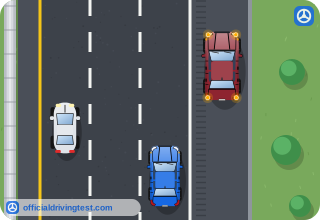
- Open the trunk
- Raise the hood
- Leave the driver door open
- Wave from the travel lane
Show answer
Correct answer: Raise the hood
Raise the hood of a disabled vehicle to signal for assistance.
Source: New Jersey Driver Manual (2026), page 71 · Open this page in the manual (Manual page 71)
-
While waiting for help in a disabled vehicle, what does the New Jersey manual advise?
- Stay inside with your seat belt on and doors locked
- Walk along the highway to the nearest exit
- Wait outside next to the open driver door
- Stand behind the vehicle and wave down the passing drivers
Show answer
Correct answer: Stay inside with your seat belt on and doors locked
Stay in the vehicle, keep your seat belt on, and lock the doors.
Source: New Jersey Driver Manual (2026), page 71 · Open this page in the manual (Manual page 71)
-
Someone stops to help while your vehicle is disabled. What does the New Jersey manual advise?
- Ask them to park in the lane behind you
- Accept a ride in their vehicle
- Ask them to go to a phone and call for help
- Ask them to push your car to the next exit ramp
Show answer
Correct answer: Ask them to go to a phone and call for help
Ask anyone who stops to go to a phone and call for assistance, and do not get into a stranger's vehicle.
Source: New Jersey Driver Manual (2026), page 71 · Open this page in the manual (Manual page 71)
-
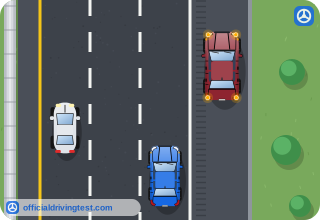
When you approach a disabled vehicle on the highway, what does the New Jersey manual tell you to be alert for?
- Toll booth signs and EZ Pass lanes
- Only the flashers of the disabled car
- Mile markers and route number signs
- Pedestrians, tow trucks, and police vehicles
Show answer
Correct answer: Pedestrians, tow trucks, and police vehicles
Near a disabled vehicle, reduce speed, add space, and be alert for pedestrians, tow trucks, and police vehicles.
Source: New Jersey Driver Manual (2026), page 71 · Open this page in the manual (Manual page 71)
-
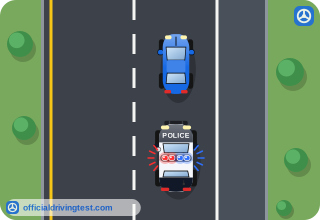
According to the New Jersey Driver Manual, what should you do when you see police emergency lights behind you?
- Speed up to find an exit ramp before you stop
- Stop at once in your lane, wherever you happen to be
- Signal, slow down, and move to the right shoulder or a safe spot
- Keep driving until you reach your home or another destination you choose
Show answer
Correct answer: Signal, slow down, and move to the right shoulder or a safe spot
Pull over safely and promptly: use your turn signal, reduce your speed, and move to the right shoulder or another safe location as soon as it is practical.
Source: New Jersey Driver Manual (2026), page 81 · Open this page in the manual (Manual page 81)
-
After pulling over for a police officer in New Jersey, what does the manual advise?
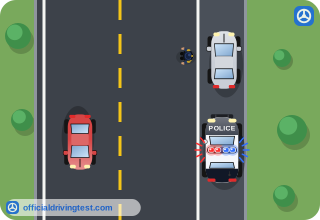
- Put the vehicle in park and stay inside unless told otherwise
- Turn off the engine, get out, and walk back to the officer's police car
- Step out of the vehicle and wait beside it
- Leave it in drive with your foot on the brake
Show answer
Correct answer: Put the vehicle in park and stay inside unless told otherwise
Put the vehicle in park and remain inside the vehicle unless the officer instructs otherwise.
Source: New Jersey Driver Manual (2026), page 81 · Open this page in the manual (Manual page 81)
-
If you are pulled over by police at night, what does the New Jersey Driver Manual advise you to do?
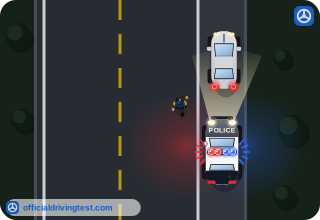
- Turn off all of your vehicle's lights
- Turn on your interior light
- Shine a flashlight toward the officer
- Turn on your high beams
Show answer
Correct answer: Turn on your interior light
At night, turn on your interior light; increased visibility helps the officer see inside the vehicle and reduces uncertainty.
Source: New Jersey Driver Manual (2026), page 81 · Open this page in the manual (Manual page 81)
-
During a traffic stop, where does the New Jersey Driver Manual suggest you keep your hands?
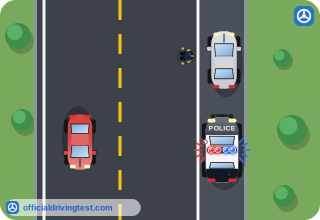
- In your lap, below the window line
- On the gear shift, ready to drive away
- Holding your license out the window
- Visible, preferably on the steering wheel
Show answer
Correct answer: Visible, preferably on the steering wheel
Keep your hands visible at all times, preferably by placing them on the steering wheel.
Source: New Jersey Driver Manual (2026), page 81 · Open this page in the manual (Manual page 81)
-
During a traffic stop, what should you do before reaching for your documents or into the glove compartment?
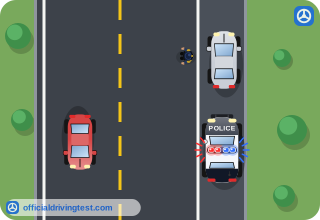
- Wait until instructed, and tell the officer what you are about to do
- Reach for them quickly so the stop takes less time
- Get them out of the glove compartment while the officer walks up to your car
- Hand the officer your whole wallet or bag instead
Show answer
Correct answer: Wait until instructed, and tell the officer what you are about to do
Do not reach for documents, the glove compartment, center console, or under a seat unless instructed, and tell the officer what you are about to do before reaching.
Source: New Jersey Driver Manual (2026), page 81 · Open this page in the manual (Manual page 81)
-
Which documents are New Jersey drivers required to present when a police officer requests them during a traffic stop?
- A Social Security card and the vehicle purchase receipt
- A passport, the vehicle title, and an inspection receipt
- A driver's license, a certified birth certificate, and the vehicle title
- A valid driver's license, vehicle registration, and proof of insurance
Show answer
Correct answer: A valid driver's license, vehicle registration, and proof of insurance
New Jersey drivers are required to present a valid driver's license, a vehicle registration, and proof of insurance when requested.
Source: New Jersey Driver Manual (2026), page 81 · Open this page in the manual (Manual page 81)
-
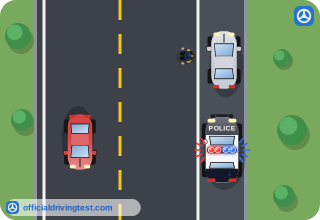
Why does the New Jersey Driver Manual suggest turning down your music during a traffic stop?
- Because the stop is being recorded on video
- So the officer can hear your engine running
- So you can hear the officer's instructions clearly
- Because playing loud music during a stop is always a separate ticket
Show answer
Correct answer: So you can hear the officer's instructions clearly
The manual advises turning down your music so you can hear the officer's instructions clearly.
Source: New Jersey Driver Manual (2026), page 81 · Open this page in the manual (Manual page 81)
-
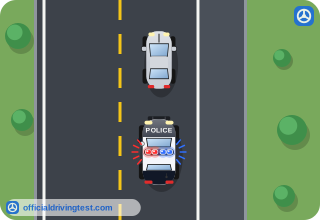
Which of these does the New Jersey Driver Manual recommend when you are stopped by a police officer?
- Keep your windows fully closed
- Roll down your window
- Search under the seat for your papers
- Step out to meet the officer
Show answer
Correct answer: Roll down your window
The manual's traffic stop guidelines include rolling down your window, keeping your hands visible, and avoiding sudden movements.
Source: New Jersey Driver Manual (2026), page 81 · Open this page in the manual (Manual page 81)
-
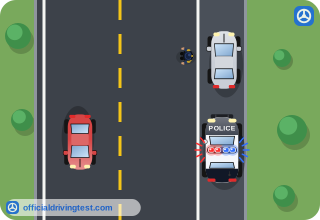
If a police officer asks you to get out of your vehicle during a traffic stop in New Jersey, what does the manual say to do?
- Refuse until a lawyer arrives at the scene
- Stay inside and lock all of the doors
- Follow the instruction and exit the vehicle
- Ask the officer to put the request in writing
Show answer
Correct answer: Follow the instruction and exit the vehicle
The manual says to follow instructions: if asked to exit the vehicle, do so.
Source: New Jersey Driver Manual (2026), page 82 · Open this page in the manual (Manual page 82)
-
If you disagree with a ticket you receive during a New Jersey traffic stop, what does the manual advise?
- Drive away and mail the ticket back to the police department
- Do not argue at the roadside; you may contest it later in court
- Argue your case with the officer before accepting anything
- Refuse to take the ticket from the officer at the roadside
Show answer
Correct answer: Do not argue at the roadside; you may contest it later in court
If you disagree with the stop, do not argue at the roadside; you may contest a ticket later in court.
Source: New Jersey Driver Manual (2026), page 82 · Open this page in the manual (Manual page 82)
-
If you believe a traffic stop was improper or unprofessional, what may you do according to the New Jersey Driver Manual?
- Note the officer's badge number and drive away
- Demand that a second officer come to the scene
- Refuse to hand the officer your documents
- File a complaint with the law enforcement agency
Show answer
Correct answer: File a complaint with the law enforcement agency
If you believe the stop was improper or unprofessional, you may file a complaint with the law enforcement agency.
Source: New Jersey Driver Manual (2026), page 82 · Open this page in the manual (Manual page 82)
-
During a traffic stop, what should you do if you do not understand an officer's instruction?
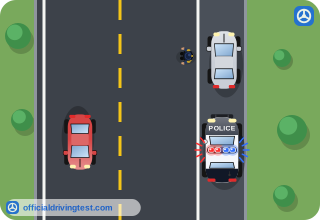
- Politely ask the officer to repeat or explain it
- Call someone on your phone to ask them
- Do whatever you think the officer probably meant
- Ignore it until the officer says it again
Show answer
Correct answer: Politely ask the officer to repeat or explain it
Communicate clearly: if you need clarification, politely ask the officer to repeat or explain the instruction.
Source: New Jersey Driver Manual (2026), page 82 · Open this page in the manual (Manual page 82)
-
According to the New Jersey Driver Manual, why can bright (high) beams momentarily blind other motorists at night?
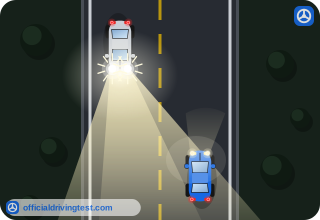
- They flicker too quickly for the eye to adjust to
- They make the other drivers' pupils dilate even more
- They bounce off the road surface into the mirrors
- They make the other drivers' dilated pupils constrict
Show answer
Correct answer: They make the other drivers' dilated pupils constrict
At night a motorist's pupils are dilated; bright beams can momentarily blind other motorists by constricting their pupils.
Source: New Jersey Driver Manual (2026), page 83 · Open this page in the manual (Manual page 83)
-
According to the New Jersey Driver Manual, how long can it take to recover from the glare of approaching high-beam headlights?
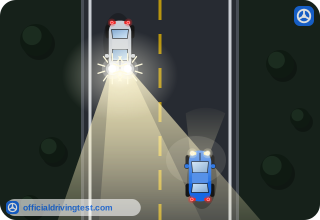
- Three to five seconds
- About one minute
- Less than one second
- 10 to 15 seconds
Show answer
Correct answer: Three to five seconds
It can take three to five seconds for a motorist to recover from the glare of approaching high-beam headlights.
Source: New Jersey Driver Manual (2026), page 83 · Open this page in the manual (Manual page 83)
-
At 50 mph, how far can you travel while unable to see after being blinded by the glare of high beams?
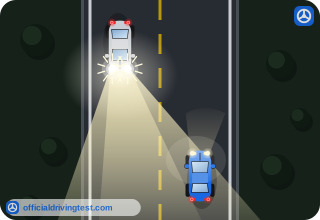
- About half a mile
- About one car length
- The length of a football field
- About the length of two parked cars
Show answer
Correct answer: The length of a football field
At 50 mph, a motorist will have traveled the length of a football field while unable to see during the three to five seconds of glare recovery.
Source: New Jersey Driver Manual (2026), page 83 · Open this page in the manual (Manual page 83)
-
If an approaching vehicle has its high beams on, what should you do?
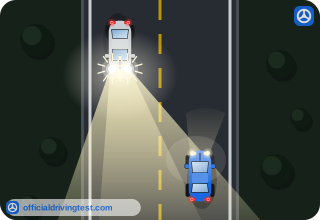
- Flash your own high beams at the driver
- Look to the right side of the road until it passes
- Switch your own high beams on and leave them on
- Look straight at its headlights until it passes
Show answer
Correct answer: Look to the right side of the road until it passes
Look to the right of the road until the vehicle passes, and never flash your high beams at an approaching motorist.
Source: New Jersey Driver Manual (2026), page 83 · Open this page in the manual (Manual page 83)
-
In case of mechanical trouble or another emergency on the highway, what should you do?
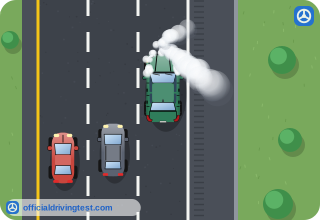
- Pull onto the right shoulder and turn on your flashers
- Pull onto the left shoulder and turn off all your lights
- Stop in your travel lane and turn on your parking lights
- Keep driving slowly in the left lane until you find help
Show answer
Correct answer: Pull onto the right shoulder and turn on your flashers
In case of mechanical trouble or other emergency, a motorist should stop on the right highway shoulder and turn on the emergency flashers.
Source: New Jersey Driver Manual (2026), page 85 · Open this page in the manual (Manual page 85)
-
According to the New Jersey Driver Manual, what causes most crashes?
- Motorist error
- Bad weather conditions
- Mechanical failure of the vehicle
- Poorly designed roads
Show answer
Correct answer: Motorist error
The manual states that most crashes are caused by motorist error, which a motorist can reduce by driving defensively.
Source: New Jersey Driver Manual (2026), page 90 · Open this page in the manual (Manual page 90)
-
What are the three parts of the standard crash-prevention formula in the New Jersey Driver Manual?
- Slow down, signal early, stay right
- Plan ahead, brake hard, steer away
- Look ahead, look behind, look aside
- Be alert, be prepared, act in time
Show answer
Correct answer: Be alert, be prepared, act in time
The standard crash-prevention formula is: be alert, be prepared, and act in time.
Source: New Jersey Driver Manual (2026), page 90 · Open this page in the manual (Manual page 90)