Nevada: Freeway driving
Entering and leaving the freeway, ramp meters, lane-use signals over the freeway and HOV lanes. Split into 2 shorter tests so you're not stuck in one long quiz.
Independent educational site · not affiliated with any government agency or DMV
All 37 Freeway driving questions with answers
Choose a part above to take a practice test, or study every question and answer here.
Show the questions and answersHide the questions
-
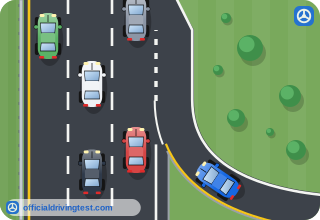
Under what condition may you enter a freeway?
- Only when traffic on the freeway has stopped
- Only when you have first come to a complete stop on the ramp
- Only when you are driving below the posted speed limit
- Only when it is safe to do so
Show answer
Correct answer: Only when it is safe to do so
When entering a freeway, you may enter only when it is safe to do so.
Source: Nevada Driver's Handbook (March 2024 (DMV 700)), page 34 · Open this page in the manual (Manual page 34)
-
Why are freeways usually the safest roads, according to the handbook?
- Speed limits are always lower than on other roads, so crashes are rare
- Access is limited and traffic moves in the same direction without stops
- They have traffic signals that control the flow of vehicles
- Their intersections are controlled by trained traffic officers
Show answer
Correct answer: Access is limited and traffic moves in the same direction without stops
Freeways are usually the safest roads because access is limited and traffic moves in the same direction without stops.
Source: Nevada Driver's Handbook (March 2024 (DMV 700)), page 36 · Open this page in the manual (Manual page 36)
-
Which of these does the handbook say a freeway does NOT have?
- On-ramps
- Merge or acceleration lanes
- Ramp meters at some entrances
- Railroad crossings
Show answer
Correct answer: Railroad crossings
The handbook says there are no intersections, sharp curves, traffic signals, or railroad crossings on a freeway.
Source: Nevada Driver's Handbook (March 2024 (DMV 700)), page 36 · Open this page in the manual (Manual page 36)
-
What does the handbook say drivers should do before they start a freeway trip?
- Plan the route and check the gas gauge
- Drive the route once at low speed to test it
- Ask another driver to lead the way
- Turn on the hazard flashers before entering
Show answer
Correct answer: Plan the route and check the gas gauge
Before drivers start, they should plan their route, know the entrances and exits and check the gas gauge.
Source: Nevada Driver's Handbook (March 2024 (DMV 700)), page 36 · Open this page in the manual (Manual page 36)
-
What do signs say if a driver has entered a freeway the wrong way?
- “Merge Left” and “Yield”
- “Exit Only” and “Keep Right”
- “Do Not Enter” and “Wrong Way”
- “Stop Ahead” and “Detour”
Show answer
Correct answer: “Do Not Enter” and “Wrong Way”
Drivers should use the on-ramp to enter a freeway; signs say “Do Not Enter” and “Wrong Way” if they have made a mistake.
Source: Nevada Driver's Handbook (March 2024 (DMV 700)), page 36 · Open this page in the manual (Manual page 36)
-
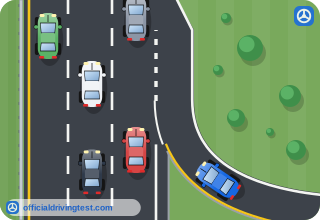
While using the merge or acceleration lane to enter a freeway, what should a driver do?
- Slow to a stop at the end of the lane and wait for a gap
- Use the turn signal and accelerate to or near the speed of freeway traffic
- Drive at the speed of the slowest traffic on the ramp until the lane ends
- Keep the turn signal off so other drivers are not confused
Show answer
Correct answer: Use the turn signal and accelerate to or near the speed of freeway traffic
In the merge or acceleration lane, drivers look for an opening, use their turn signal and accelerate to or near the speed of freeway traffic.
Source: Nevada Driver's Handbook (March 2024 (DMV 700)), page 36 · Open this page in the manual (Manual page 36)
-
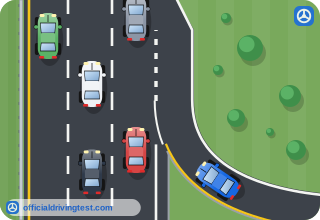
Why should a driver not stop before merging onto a freeway unless necessary?
- It uses more fuel than driving through the merge lane
- Freeway traffic is required to stop for a vehicle on the ramp
- Freeway entrance ramps are too short to allow a stop
- A stop can mean a slow and dangerous start into fast-moving traffic
Show answer
Correct answer: A stop can mean a slow and dangerous start into fast-moving traffic
A stop before merging can mean a slow and dangerous start into fast-moving traffic and can affect traffic behind the driver.
Source: Nevada Driver's Handbook (March 2024 (DMV 700)), page 36 · Open this page in the manual (Manual page 36)
-
As you enter a freeway from a merging lane, what must you do?
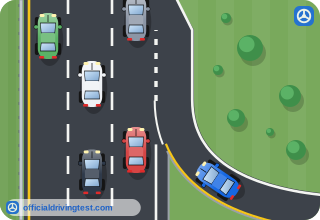
- Yield to traffic already on the freeway
- Expect traffic already on the freeway to yield to you
- Stay in the same lane until freeway traffic stops
- Use your horn to claim the lane
Show answer
Correct answer: Yield to traffic already on the freeway
As you enter from a merging lane, you must yield to traffic already on the freeway.
Source: Nevada Driver's Handbook (March 2024 (DMV 700)), page 36 · Open this page in the manual (Manual page 36)
-
If you are already traveling on the freeway, what should you do when you see merging traffic?
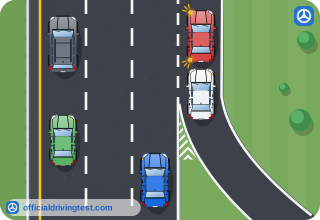
- Maintain your speed so merging drivers know what to expect
- Sound your horn to warn the merging drivers
- Adjust your speed to allow for safe and smooth merges
- Move to the extreme left lane and hold your speed
Show answer
Correct answer: Adjust your speed to allow for safe and smooth merges
Drivers already on the freeway should watch for merging traffic and adjust their speed to allow for safe and smooth merges.
Source: Nevada Driver's Handbook (March 2024 (DMV 700)), page 36 · Open this page in the manual (Manual page 36)
-
Why are driving speeds frequently faster on freeways than on other highways with the same posted speed limits?
- The posted speed limits are not enforced on freeways
- There are fewer stop-and-go situations
- The lanes are wider than lanes on other highways
- Freeway drivers have shorter stopping distances
Show answer
Correct answer: There are fewer stop-and-go situations
Speeds are frequently faster on freeways because there are fewer stop-and-go situations.
Source: Nevada Driver's Handbook (March 2024 (DMV 700)), page 36 · Open this page in the manual (Manual page 36)
-
On freeways with several lanes in each direction, which lane should drivers leave for faster traffic?
- The extreme right lane
- The center lane
- The merge or acceleration lane
- The extreme left lane
Show answer
Correct answer: The extreme left lane
Drivers should leave the extreme left lane for faster traffic.
Source: Nevada Driver's Handbook (March 2024 (DMV 700)), page 36 · Open this page in the manual (Manual page 36)
-
What does the handbook say about lane hopping on a freeway?
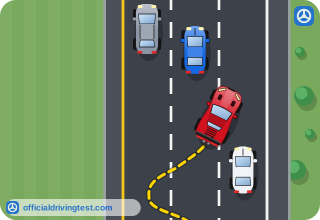
- It is always dangerous and seldom saves time
- It is a safe way to save time when traffic is heavy
- It is safe only when you use your turn signal
- It is allowed only in the extreme left lane
Show answer
Correct answer: It is always dangerous and seldom saves time
Lane hopping is always dangerous, annoys other drivers, increases the risk of a crash, and seldom saves time.
Source: Nevada Driver's Handbook (March 2024 (DMV 700)), page 36 · Open this page in the manual (Manual page 36)
-
How far ahead should a driver look down the road on a freeway?
- About 5 to 10 seconds
- At least 1 minute
- At least 20 to 30 seconds
- Only as far as the next vehicle
Show answer
Correct answer: At least 20 to 30 seconds
On a freeway, drivers should look ahead much farther down the road, at least 20 to 30 seconds.
Source: Nevada Driver's Handbook (March 2024 (DMV 700)), page 36 · Open this page in the manual (Manual page 36)
-
On a freeway, which traffic should a driver watch?
- Only the vehicle directly ahead
- Traffic all around the vehicle
- Only traffic coming from behind
- Only the traffic in the next lane
Show answer
Correct answer: Traffic all around the vehicle
Drivers should watch traffic all around the vehicle and be aware of other drivers who are changing lanes, passing, or slowing down.
Source: Nevada Driver's Handbook (March 2024 (DMV 700)), page 36 · Open this page in the manual (Manual page 36)
-
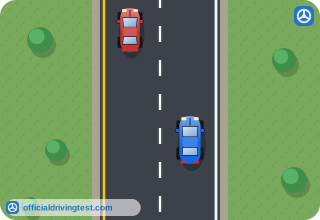
How should a driver check the vehicle's blind spot before changing lanes on a freeway?
- Use only the side mirrors and keep your eyes forward
- Slow down and wait for another driver to flash headlights
- Sound the horn and then move over
- Use mirrors and quickly look over your shoulder
Show answer
Correct answer: Use mirrors and quickly look over your shoulder
Before changing lanes, use mirrors and quickly look over your shoulder to check your vehicle's blind spot.
Source: Nevada Driver's Handbook (March 2024 (DMV 700)), page 36 · Open this page in the manual (Manual page 36)
-
A freeway entrance has ramp meters that are switched on. What must you do at a red light?
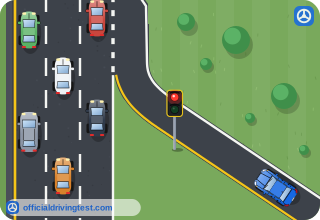
- Pull up to the stop line and stop
- Slow down and enter the freeway when there is a gap
- Stop only if another vehicle is waiting ahead of you
- Stop before the merge lane and wait for a horn signal
Show answer
Correct answer: Pull up to the stop line and stop
If ramp meters are switched on, you must pull up to the stop line and stop at a red light.
Source: Nevada Driver's Handbook (March 2024 (DMV 700)), page 36 · Open this page in the manual (Manual page 36)
-
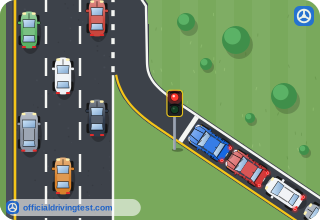
How does a ramp meter signal change compared with a signal at an intersection?
- More slowly
- At exactly the same speed
- More rapidly
- Only when freeway traffic stops
Show answer
Correct answer: More rapidly
At a ramp meter, you should be alert because the signal will change more rapidly than a signal at an intersection.
Source: Nevada Driver's Handbook (March 2024 (DMV 700)), page 36 · Open this page in the manual (Manual page 36)
-
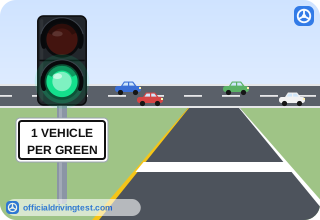
What should you do when a ramp meter light turns green?
- Wait for the signal to turn red again before moving
- Proceed along the ramp and merge onto the freeway safely
- Speed up and merge without checking traffic
- Stop and wait for the signal to flash
Show answer
Correct answer: Proceed along the ramp and merge onto the freeway safely
When the light turns green, proceed along the ramp and merge onto the freeway safely.
Source: Nevada Driver's Handbook (March 2024 (DMV 700)), page 36 · Open this page in the manual (Manual page 36)
-
A freeway entrance ramp has more than one travel lane, and each lane has its own ramp meter. What are motorists encouraged to do?
- Use only the right lane and follow its signal
- Follow only the signal that turns green first, in either lane
- Use the lane with the shortest line, ignoring the other signals
- Use both lanes and abide by the signal controlling their lane of travel
Show answer
Correct answer: Use both lanes and abide by the signal controlling their lane of travel
Motorists are encouraged to use both lanes and abide by the ramp meter signal controlling their lane of travel.
Source: Nevada Driver's Handbook (March 2024 (DMV 700)), page 37 · Open this page in the manual (Manual page 37)
-
On a metered freeway ramp, how are High Occupancy Vehicle (HOV) bypass lanes marked?
- With a diamond on the pavement
- With a solid red stripe
- With a white arrow on a green background
- With a double yellow line
Show answer
Correct answer: With a diamond on the pavement
HOV bypass lanes, also known as carpool lanes, are marked with a diamond on the pavement and are not metered.
Source: Nevada Driver's Handbook (March 2024 (DMV 700)), page 37 · Open this page in the manual (Manual page 37)
-
Who may use the HOV ramp meter bypass lane without stopping?
- Only vehicles carrying three or more people
- Only buses and commercial vehicles
- Drivers in a carpool of two or more people
- Any driver who signals before entering the lane
Show answer
Correct answer: Drivers in a carpool of two or more people
If you are in a carpool of two or more people, you may use the HOV ramp meter bypass lane without stopping.
Source: Nevada Driver's Handbook (March 2024 (DMV 700)), page 37 · Open this page in the manual (Manual page 37)
-
When will overhead freeway signals be used?
- Anytime there are lane closures or reduced speed limits
- Only when a crash has blocked every lane of the freeway
- Only during weekday rush hours on busy urban freeways
- Only when construction crews are working in a marked work zone
Show answer
Correct answer: Anytime there are lane closures or reduced speed limits
These signals are used anytime there are lane closures or reduced speed limits due to construction, debris, a crash or any other reason that becomes necessary.
Source: Nevada Driver's Handbook (March 2024 (DMV 700)), page 37 · Open this page in the manual (Manual page 37)
-
As a driver gets closer to a crash, what do the overhead freeway signals provide?
- The names of the exits that remain open past the crash
- A warning to stop and wait for emergency crews
- Updated information about lane closures and reduced speed limits
- A countdown of the minutes until the lanes will reopen
Show answer
Correct answer: Updated information about lane closures and reduced speed limits
As a driver gets closer to the crash, the signals provide updated information regarding lane closures and reduced speed limits.
Source: Nevada Driver's Handbook (March 2024 (DMV 700)), page 37 · Open this page in the manual (Manual page 37)
-
What do the overhead freeway signals indicate once drivers pass a crash?
- That the left lane stays closed for the next mile
- That all lanes are once again open
- That the speed limit stays reduced for the next mile
- That only the carpool lane is open
Show answer
Correct answer: That all lanes are once again open
Once drivers pass the crash, the signals indicate all lanes are once again open.
Source: Nevada Driver's Handbook (March 2024 (DMV 700)), page 37 · Open this page in the manual (Manual page 37)
-
What is a stated goal of high-occupancy vehicle (HOV) lanes?
- To encourage ridesharing and public transportation
- To give faster travel to drivers who drive alone
- To provide extra parking space for buses and carpools
- To keep trucks off the other lanes of the roadway
Show answer
Correct answer: To encourage ridesharing and public transportation
HOV lanes exist to give drivers an incentive to use ridesharing and public transportation, which also removes congestion from the normal lanes.
Source: Nevada Driver's Handbook (March 2024 (DMV 700)), page 39 · Open this page in the manual (Manual page 39)
-
How many persons must be in a car to use an HOV lane?
- One or more
- Three or more
- Two or more
- Four or more
Show answer
Correct answer: Two or more
The rules of HOV lanes require 2 or more persons per vehicle.
Source: Nevada Driver's Handbook (March 2024 (DMV 700)), page 39 · Open this page in the manual (Manual page 39)
-
When do HOV lane restrictions apply?
- At all hours of every day in every segment
- The hours vary and are posted on regulatory signs
- Only during the morning commute on weekdays
- Only when a lighted sign above the lane is on
Show answer
Correct answer: The hours vary and are posted on regulatory signs
HOV hours vary, so you must read the regulatory signs for each segment of the lane.
Source: Nevada Driver's Handbook (March 2024 (DMV 700)), page 39 · Open this page in the manual (Manual page 39)
-
Which of these may use an HOV lane even though only one person is aboard?
- An electric car with only the driver
- A taxi or rideshare car with only the driver
- A passenger car carrying the driver and a pet
- A motorcycle
Show answer
Correct answer: A motorcycle
Motorcycles are eligible to use HOV lanes, even with only one person aboard.
Source: Nevada Driver's Handbook (March 2024 (DMV 700)), page 39 · Open this page in the manual (Manual page 39)
-
Which of these vehicles is eligible to use an HOV lane regardless of how many persons are aboard?
- An emergency vehicle responding to an emergency
- An electric car carrying only the driver
- A taxi or rideshare car with only the driver
- A passenger car carrying the driver and a pet
Show answer
Correct answer: An emergency vehicle responding to an emergency
Emergency vehicles responding to an emergency are eligible to use HOV lanes.
Source: Nevada Driver's Handbook (March 2024 (DMV 700)), page 39 · Open this page in the manual (Manual page 39)
-
In the HOV lane rules, what must the two or more persons in a vehicle be?
- Licensed drivers; babies do not count
- Adults only; children do not count
- Human beings; pets do not count
- Anyone aboard, including pets
Show answer
Correct answer: Human beings; pets do not count
The HOV rules say the 2 or more persons must be human, not pets, and babies count as persons.
Source: Nevada Driver's Handbook (March 2024 (DMV 700)), page 39 · Open this page in the manual (Manual page 39)
-
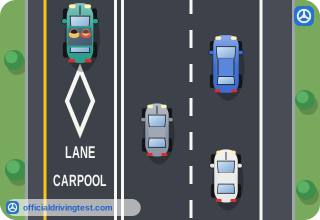
What does a double solid white line beside a carpool lane mean?
- You may cross it only to pass slower traffic
- You may cross it only when the lane is empty
- The carpool lane is closed to all vehicles
- You cannot cross it to enter or exit the lane
Show answer
Correct answer: You cannot cross it to enter or exit the lane
A double solid white line means you cannot cross the lines to enter or exit the car pool lane.
Source: Nevada Driver's Handbook (March 2024 (DMV 700)), page 39 · Open this page in the manual (Manual page 39)
-
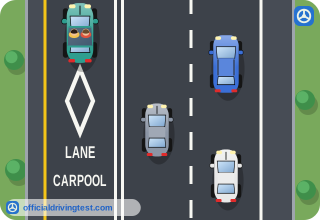
Where may you enter or exit a carpool lane?
- Where there is a broken white line
- Anywhere there is a double solid white line
- Anywhere you can safely signal and merge
- Only at the beginning and end of the freeway
Show answer
Correct answer: Where there is a broken white line
Carpool lanes have specific entry and exit locations, and you can enter or exit where there is a broken white line.
Source: Nevada Driver's Handbook (March 2024 (DMV 700)), page 39 · Open this page in the manual (Manual page 39)
-
Where should you start slowing down when leaving a freeway?
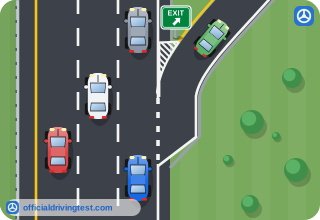
- As soon as you see the exit sign on the freeway
- Just after you pass the exit number sign
- Once you are in the deceleration lane
- Right after you signal, in the lane you are in
Show answer
Correct answer: Once you are in the deceleration lane
Avoid slowing down on the freeway itself; wait until you are in the deceleration lane.
Source: Nevada Driver's Handbook (March 2024 (DMV 700)), page 40 · Open this page in the manual (Manual page 40)
-
In the deceleration lane, how should you slow down?
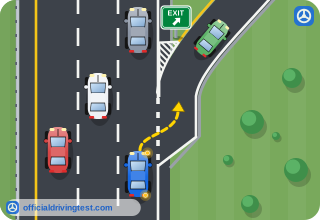
- Quickly, to a stop before entering the exit ramp
- Gradually, until your speed matches the posted exit ramp speed
- Gradually, until you reach the speed of freeway traffic
- By braking hard just before the exit sign
Show answer
Correct answer: Gradually, until your speed matches the posted exit ramp speed
In the deceleration lane you slow down gradually until your speed matches the posted exit ramp speed.
Source: Nevada Driver's Handbook (March 2024 (DMV 700)), page 40 · Open this page in the manual (Manual page 40)
-
How far before a freeway exit should you signal and move into the proper lane?
- Half a mile
- A quarter mile
- 1,000 feet
- A mile or more
Show answer
Correct answer: A mile or more
Signal and move into the proper lane a mile or more before the exit.
Source: Nevada Driver's Handbook (March 2024 (DMV 700)), page 40 · Open this page in the manual (Manual page 40)
-
How are most freeway exits identified to help you spot the one you want?
- They are numbered
- They are lettered
- They are color-coded
- They are named only
Show answer
Correct answer: They are numbered
Most exits are numbered to help you quickly spot the one you want, and the numbers are usually listed on major freeway signs.
Source: Nevada Driver's Handbook (March 2024 (DMV 700)), page 40 · Open this page in the manual (Manual page 40)
-
What should you do if you miss your freeway exit ramp?
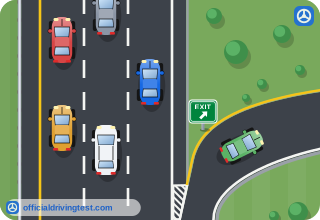
- Stop on the shoulder and back up to the exit ramp
- Turn around at the next opening in the median
- Take the next exit and return in the opposite direction
- Slow down and cut across the lanes to the ramp
Show answer
Correct answer: Take the next exit and return in the opposite direction
Never turn around or back up; go to the next exit, get back on the freeway in the opposite direction, and return to the exit.
Source: Nevada Driver's Handbook (March 2024 (DMV 700)), page 40 · Open this page in the manual (Manual page 40)