Nebraska: Railroad crossings
Crossbucks, advance warning signs, flashing lights and gates, the stopping distance, vehicles that must stop and a stalled vehicle on the tracks. Split into 2 shorter tests so you're not stuck in one long quiz.
Independent educational site · not affiliated with any government agency or DMV
All 36 Railroad crossings questions with answers
Choose a part above to take a practice test, or study every question and answer here.
Show the questions and answersHide the questions
-
A flashing red light is at a railroad crossing and no train is visible. What must a driver do?
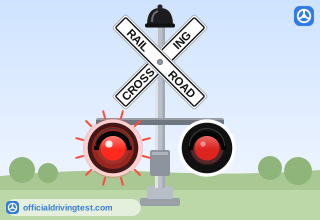
- Slow down and cross if no train is in sight
- Stop only if a train is visible
- Make a complete stop
- Stop only if the gate is lowered
Show answer
Correct answer: Make a complete stop
A flashing red light at a railroad crossing requires a complete stop even if a train is not visible.
Source: Nebraska Driver's Manual (January 2025), page 31 · Open this page in the manual (Manual page 31)
-
What does a crossbuck sign advise a driver of?
- A railroad crossing ahead
- A school crossing ahead
- A divided highway ahead
- A no passing zone
Show answer
Correct answer: A railroad crossing ahead
A crossbuck and circle advise the operator of a railroad crossing ahead.
Source: Nebraska Driver's Manual (January 2025), page 35 · Open this page in the manual (Manual page 35)
-
What does a railroad crossbuck and circle sign mean a driver should do?
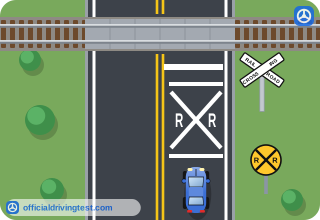
- Wait for a flagger at every crossing before crossing the tracks
- Slow down and cross whenever no gate is down across the road
- Look both ways, listen for and yield to trains, and be ready to stop
- Sound the horn and cross the tracks as quickly as possible
Show answer
Correct answer: Look both ways, listen for and yield to trains, and be ready to stop
The railroad crossing sign means look both ways, listen for and yield to trains and be prepared to stop if a train is approaching.
Source: Nebraska Driver's Manual (January 2025), page 35 · Open this page in the manual (Manual page 35)
-
What does a number under a railroad crossbuck indicate?
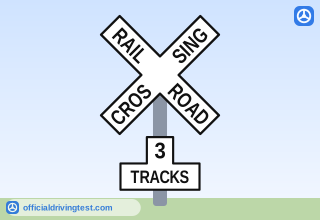
- The speed limit for the crossing
- More than one set of tracks
- The number of trains per day
- The distance to the crossing in hundreds of feet
Show answer
Correct answer: More than one set of tracks
The number under the crossbuck indicates there is more than one set of tracks following the sign.
Source: Nebraska Driver's Manual (January 2025), page 35 · Open this page in the manual (Manual page 35)
-
What must a driver do when the flashing light signals at a railroad crossing are flashing?
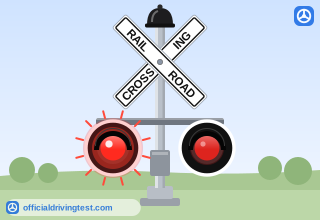
- Slow down and cross if no train is visible
- Stop for 10 seconds and then cross
- Cross if the gate is still up
- Stop and not cross until it can be done safely
Show answer
Correct answer: Stop and not cross until it can be done safely
Drivers must stop when the lights are flashing and not cross until they can do it safely.
Source: Nebraska Driver's Manual (January 2025), page 35 · Open this page in the manual (Manual page 35)
-
What should a driver do at a crossing with more than one track?
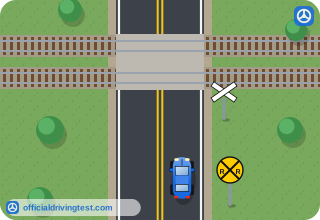
- Watch for trains from either the same or opposite direction
- Watch only for trains from the right
- Watch only for trains that are on the nearest track
- Expect that only one train can be there at a time
Show answer
Correct answer: Watch for trains from either the same or opposite direction
At a crossing with more than one track, a driver should be careful to watch for trains from the same or opposite direction.
Source: Nebraska Driver's Manual (January 2025), page 35 · Open this page in the manual (Manual page 35)
-
How long must a driver remain stopped at a railroad crossing with gates?
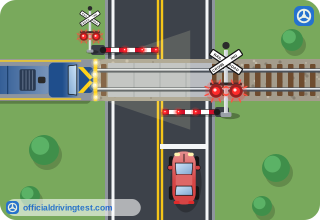
- Until the gate begins to rise
- Until the train is out of sight
- Until the gates go up and the lights stop flashing
- Until the lights stop flashing, even if the gates are down
Show answer
Correct answer: Until the gates go up and the lights stop flashing
The driver remains stopped until the gates go up and the lights stop flashing.
Source: Nebraska Driver's Manual (January 2025), page 35 · Open this page in the manual (Manual page 35)
-
When must a driver stop at a railroad crossing with gates?
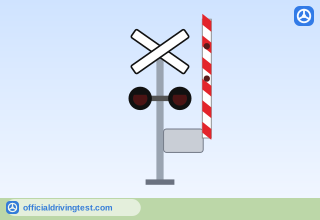
- Only after the gate goes down
- When the lights start to flash, before the gate goes down
- Only if a train is visible
- Only when the gate is down and a train is in sight
Show answer
Correct answer: When the lights start to flash, before the gate goes down
A driver must stop when the lights start to flash before the gate goes down.
Source: Nebraska Driver's Manual (January 2025), page 35 · Open this page in the manual (Manual page 35)
-
What does the manual say about driving around railroad gates?
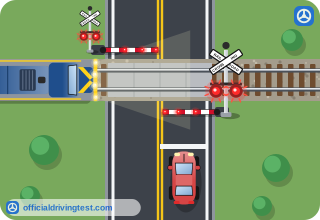
- It is allowed when no train is in sight
- It is allowed after stopping and looking
- It is allowed if the lights are not flashing
- It is dangerous and against the law
Show answer
Correct answer: It is dangerous and against the law
The manual says never to drive around the gates, because it is dangerous and against the law.
Source: Nebraska Driver's Manual (January 2025), page 35 · Open this page in the manual (Manual page 35)
-
What are railroad gates and warning lights meant to alert you to?
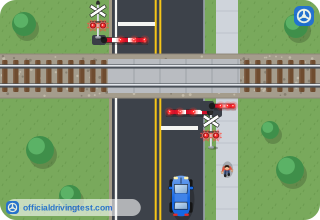
- That a train is in the area
- That a train has already gone by
- That the road is closed for the day
- That the speed limit has changed
Show answer
Correct answer: That a train is in the area
Railroad gates and warning lights alert you that a train is in the area, and you may collide with a train if you go onto the tracks.
Source: Nebraska Driver's Manual (January 2025), page 35 · Open this page in the manual (Manual page 35)
-
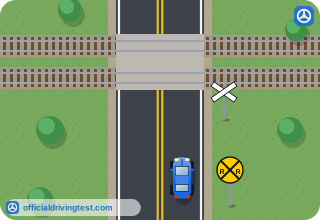
A round sign shows a large X with the letters R and R. What does it mean?
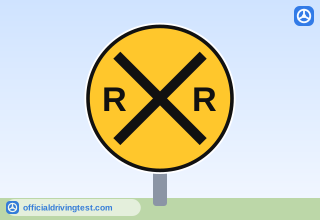
- Stop at every railroad crossing, even if no train is near
- Yield and be prepared to stop if a train is approaching
- The railroad crossing is closed
- Slow to 15 MPH in all cases
Show answer
Correct answer: Yield and be prepared to stop if a train is approaching
The Railroad Crossing sign means yield and be prepared to stop if a train is approaching.
Source: Nebraska Driver's Manual (January 2025), page 41 · Open this page in the manual (Manual page 41)
-
A diamond-shaped sign reading NO TRAIN HORN is installed under a Railroad Crossing sign. What does it indicate?
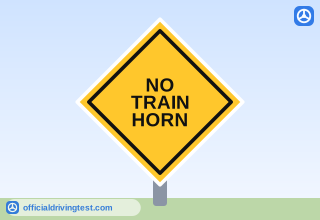
- The railroad crossing is no longer in use.
- Trains must stop before the crossing.
- Drivers may not use their horns near the crossing.
- A quiet zone has been established there.
Show answer
Correct answer: A quiet zone has been established there.
The No Train Horn sign is installed under Railroad Crossing signs where a quiet zone has been established, and trains do not blow the horn there.
Source: Nebraska Driver's Manual (January 2025), page 41 · Open this page in the manual (Manual page 41)
-
Which white letters are set into or applied to the pavement in advance of a railroad crossing?
- RRX
- TRN
- RWY
- RxR
Show answer
Correct answer: RxR
In advance of a railroad crossing, the white letters RxR are set into or applied to the pavement to advise, warn or guide traffic.
Source: Nebraska Driver's Manual (January 2025), page 46 · Open this page in the manual (Manual page 46)
-
At railroad crossings, why may a yellow line be placed on the right side of the center line?
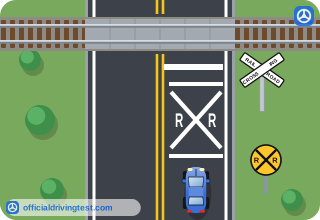
- To prevent passing
- To mark the stopping position
- To show the edge of the shoulder
- To mark a bike lane
Show answer
Correct answer: To prevent passing
At railroad crossings, a yellow line may be placed on the right side of the center line to prevent passing.
Source: Nebraska Driver's Manual (January 2025), page 46 · Open this page in the manual (Manual page 46)
-
Which of these may be painted on the pavement at a railroad crossing?
- A large red triangle
- A green arrow
- A large white X
- A blue square
Show answer
Correct answer: A large white X
Crossings may have a large white X, the letters RR, a no passing zone and/or a stop line painted on the pavement.
Source: Nebraska Driver's Manual (January 2025), page 58 · Open this page in the manual (Manual page 58)
-
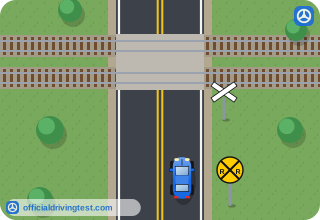
The manual says to approach a railroad crossing at a speed fast enough to coast across the tracks if your engine stalls and what else?
- Slow enough to shift gears on the tracks
- Slow enough to stop if necessary
- Slow enough to creep across in first gear
- Fast enough to cross before a gate lowers
Show answer
Correct answer: Slow enough to stop if necessary
You approach at a constant controlled speed, fast enough to coast across if the engine stalls and slow enough to stop if necessary.
Source: Nebraska Driver's Manual (January 2025), page 58 · Open this page in the manual (Manual page 58)
-
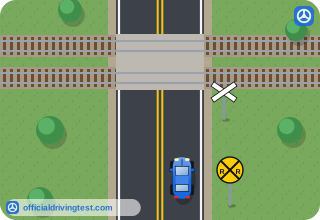
At a railroad crossing, on which track and when should you expect a train?
- Only on the track nearest you
- Only when the lights are flashing
- Only at times printed on the crossing sign
- On any track at any time
Show answer
Correct answer: On any track at any time
The manual says to expect a train on any track at any time.
Source: Nebraska Driver's Manual (January 2025), page 58 · Open this page in the manual (Manual page 58)
-
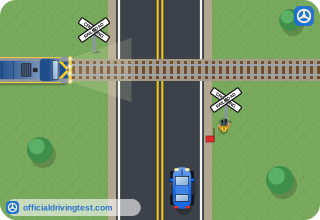
A flagman signals that a train or on-track equipment is approaching a crossing. What must you do?
- Stop
- Slow down and cross if no train is visible
- Cross quickly before it arrives
- Honk and proceed with caution
Show answer
Correct answer: Stop
You must stop when a flagman signals that a train or on-track equipment is approaching.
Source: Nebraska Driver's Manual (January 2025), page 58 · Open this page in the manual (Manual page 58)
-
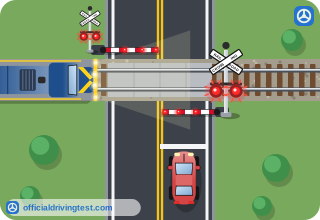
What does the manual say about driving through, around or under a railroad crossing gate or barrier?
- You may drive around it if you can see no train coming
- You may drive under it if it is raised only part way
- Never drive through, around or under any gate or barrier
- You may drive through it if the lights stopped flashing
Show answer
Correct answer: Never drive through, around or under any gate or barrier
Drivers must never drive any vehicle through, around or under any gate or barrier.
Source: Nebraska Driver's Manual (January 2025), page 58 · Open this page in the manual (Manual page 58)
-
If there is no stop line, how far from the nearest rail must you stop when required to stop at a railroad crossing?
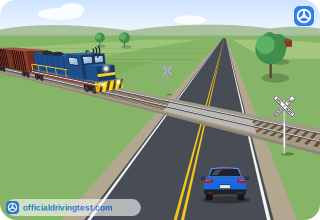
- Not less than 5 feet nor more than 10 feet
- Not less than 15 feet nor more than 50 feet
- Not less than 25 feet nor more than 100 feet
- Not less than 30 feet nor more than 75 feet
Show answer
Correct answer: Not less than 15 feet nor more than 50 feet
When required to stop with no stop line, you stop not less than 15 feet nor more than 50 feet from the nearest rail.
Source: Nebraska Driver's Manual (January 2025), page 58 · Open this page in the manual (Manual page 58)
-
When must you stop for a train or on-track equipment that is clearly visible or whose whistle is heard?
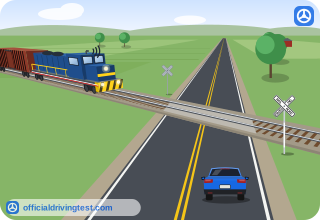
- Only when the crossing gates are lowered
- Only when the warning lights are flashing
- Only when a stop sign is posted there
- When it would be hazardous for you to cross
Show answer
Correct answer: When it would be hazardous for you to cross
You must stop when a train or on-track equipment is clearly visible or its whistle is heard and it would be hazardous for you to cross.
Source: Nebraska Driver's Manual (January 2025), page 58 · Open this page in the manual (Manual page 58)
-
After stopping at a railroad crossing, what else must you make sure of before crossing the tracks?
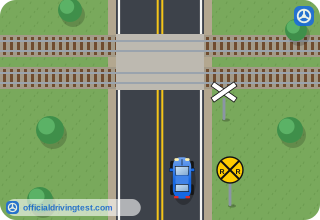
- There is room for your car on the other side
- Your windows are rolled down to listen
- Your headlights are switched to high beam
- Your engine is turned off while you wait
Show answer
Correct answer: There is room for your car on the other side
After stopping, you make sure all tracks are clear and that there is room for your car on the other side of the tracks.
Source: Nebraska Driver's Manual (January 2025), page 58 · Open this page in the manual (Manual page 58)
-
Which vehicles must stop at railroad crossings, so you should watch for them?
- Motorcycles and other two-wheeled vehicles
- Ambulances and police cars responding to calls
- Buses and trucks carrying hazardous materials
- Taxis and vans making deliveries or pickups
Show answer
Correct answer: Buses and trucks carrying hazardous materials
The manual says to watch for vehicles that must stop at railroad crossings, such as buses and trucks carrying hazardous materials.
Source: Nebraska Driver's Manual (January 2025), page 58 · Open this page in the manual (Manual page 58)
-
After stopping at a railroad crossing, what should you watch out for?
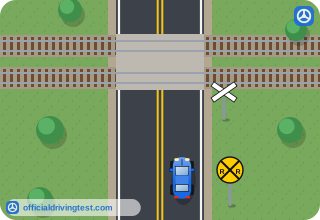
- Only trains coming from the left
- Multiple trains or on-track equipment
- Only the first train to arrive
- Only trains with their headlights on
Show answer
Correct answer: Multiple trains or on-track equipment
The manual says to watch out for multiple trains or on-track equipment.
Source: Nebraska Driver's Manual (January 2025), page 58 · Open this page in the manual (Manual page 58)
-
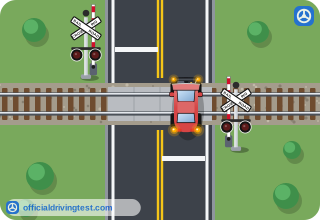
If your vehicle stalls on a railroad crossing, what should you do?
- Stay inside and keep trying to restart the engine
- Wait on the tracks beside the vehicle for help
- Stay inside with seat belts fastened until help arrives
- Get everyone out and off the tracks immediately
Show answer
Correct answer: Get everyone out and off the tracks immediately
If the vehicle stalls on a crossing, you get everyone out and off the tracks immediately.
Source: Nebraska Driver's Manual (January 2025), page 58 · Open this page in the manual (Manual page 58)
-
If your vehicle stalls on a crossing and no train is seen immediately, how can you try to stop a train?
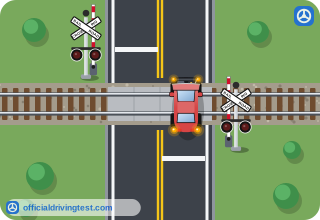
- Call the 1-800 number on the crossing sign
- Wave a flag from beside the tracks
- Flash your headlights from the roadside
- Call the nearest train station
Show answer
Correct answer: Call the 1-800 number on the crossing sign
The manual says to call the 1-800 number on the crossing sign to try to stop the train or on-track equipment.
Source: Nebraska Driver's Manual (January 2025), page 58 · Open this page in the manual (Manual page 58)
-
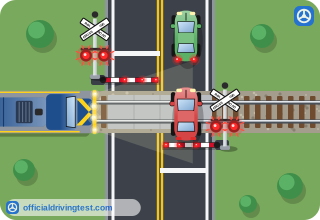
If a train or on-track equipment is coming after your vehicle has stalled on a crossing, what should you do?
- Stay beside the vehicle on the tracks
- Try to start the engine again
- Stay clear of the tracks
- Move the vehicle along the tracks
Show answer
Correct answer: Stay clear of the tracks
If a train or on-track equipment is coming, you stay clear of the tracks.
Source: Nebraska Driver's Manual (January 2025), page 58 · Open this page in the manual (Manual page 58)
-
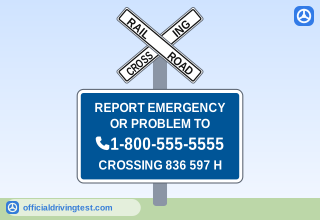
What color is the Railroad Emergency Notification System (ENS) sign typically?
- Green
- Blue
- Red
- Yellow
Show answer
Correct answer: Blue
The manual describes the ENS sign at highway-rail grade crossings as typically blue.
Source: Nebraska Driver's Manual (January 2025), page 58 · Open this page in the manual (Manual page 58)
-
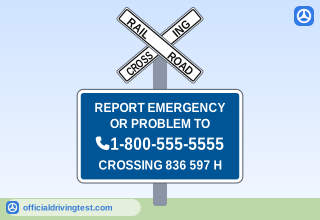
What does the Railroad Emergency Notification System (ENS) sign provide to the public?
- A map of nearby crossings and train schedules
- A radio frequency for contacting train engineers
- A telephone number answered only during business hours
- A 24/7/365 telephone number to report problems or emergencies
Show answer
Correct answer: A 24/7/365 telephone number to report problems or emergencies
The ENS sign gives a 24/7/365 telephone number for reporting problems or emergencies at railroad crossings.
Source: Nebraska Driver's Manual (January 2025), page 58 · Open this page in the manual (Manual page 58)
-
Who answers the toll-free number on a Railroad Emergency Notification System (ENS) sign?
- Railroad dispatchers
- State Patrol dispatchers
- Local fire department staff
- County 911 operators
Show answer
Correct answer: Railroad dispatchers
The toll-free ENS number is answered by railroad dispatchers.
Source: Nebraska Driver's Manual (January 2025), page 58 · Open this page in the manual (Manual page 58)
-
Where is the Railroad Emergency Notification System (ENS) sign located?
- Only on the pavement in front of the crossing gates
- On the wall of the nearest railroad company office
- On the black and white crossbuck or near the crossing
- On a separate sign a mile before the crossing starts
Show answer
Correct answer: On the black and white crossbuck or near the crossing
The ENS sign is either on the black and white crossbuck or near the actual crossing.
Source: Nebraska Driver's Manual (January 2025), page 58 · Open this page in the manual (Manual page 58)
-
What does the Department of Transportation number below the dispatch number on a Railroad Emergency Notification System (ENS) sign identify?
- The railroad company that owns the track
- The exact location of the crossing
- The arrival time of the next train
- The number of tracks at the crossing
Show answer
Correct answer: The exact location of the crossing
The Department of Transportation number identifies the exact location of the crossing in question.
Source: Nebraska Driver's Manual (January 2025), page 59 · Open this page in the manual (Manual page 59)
-
An average 150-car freight train traveling 30 MPH requires what stopping distance?
- 1,200 feet
- 2,000 feet
- 5,000 feet
- 3,150 feet
Show answer
Correct answer: 3,150 feet
An average 150-car freight train traveling 30 MPH needs 3150 feet, or three-fifths of a mile, to stop.
Source: Nebraska Driver's Manual (January 2025), page 59 · Open this page in the manual (Manual page 59)
-
An average 150-car freight train traveling 60 MPH requires what stopping distance?
- 8,500 feet
- 4,000 feet
- 6,300 feet
- 10,500 feet
Show answer
Correct answer: 8,500 feet
The same train traveling 60 MPH needs 8500 feet, or one and three-fifths miles, to stop.
Source: Nebraska Driver's Manual (January 2025), page 59 · Open this page in the manual (Manual page 59)
-
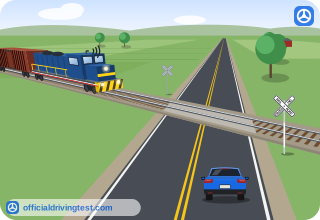
What does the manual say about trying to beat a train across the tracks?
- It is safe if the train is far away
- It is safe if the gates are still up
- Never try it; even a tie means you lose
- It is safe if you see only one train
Show answer
Correct answer: Never try it; even a tie means you lose
The manual says never to try to beat a train or on-track equipment across the tracks, because even a tie means you will be the loser.
Source: Nebraska Driver's Manual (January 2025), page 59 · Open this page in the manual (Manual page 59)
-
Why does the manual say not to shift gears when crossing railroad tracks?
- You might lose steering
- You might stall
- The tracks may be slippery
- You might damage the rails
Show answer
Correct answer: You might stall
The manual says not to shift gears when crossing railroad tracks because you might stall.
Source: Nebraska Driver's Manual (January 2025), page 59 · Open this page in the manual (Manual page 59)