Nebraska: Emergencies and bad weather — Part 1 Practice Test
Questions in this part include: “During which hours does the manual say to watch for deer?” · “Which lights should you activate when making an emergency roadside stop?”
Independent educational site · not affiliated with any government agency or DMV
Ready? Test yourself
- Instant feedback with an explanation
- Every answer cites its source in the manual
- Your best score is saved on this device
- Keyboard: press 1 to 4 to answer and Enter for the next question
Questions are original and based on the official manual "Nebraska Driver's Manual" (January 2025), Nebraska Department of Motor Vehicles.
All 24 questions in this practice test
Take the test above first, then use this list to study. Tap “Show answer” to see the correct answer and explanation.
Show the questions and answersHide the questions
-
If you are about to hit a deer in a passenger vehicle, what is your safest action?
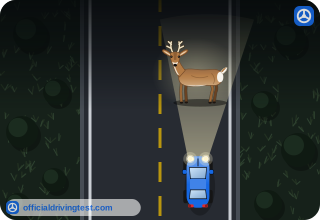
- Swerve off the roadway to avoid the deer
- Swerve into the oncoming lane to avoid the deer
- Speed up and pass the deer quickly
- Brake firmly, steer to keep control, and stop
Show answer
Correct answer: Brake firmly, steer to keep control, and stop
The manual says the safest action is to brake firmly, steer to maintain control and stop as safely as possible, and not to veer off the roadway or into oncoming traffic.
Source: Nebraska Driver's Manual (January 2025), page 26 · Open this page in the manual (Manual page 26)
-
Which action does the manual say reduces your risk for deer crashes?
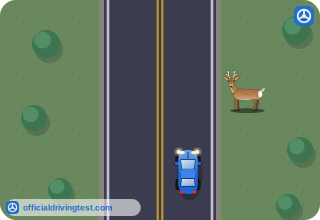
- Driving beyond the range of your headlights
- Driving faster at dusk to leave the area sooner
- Slowing down in marked deer caution zones
- Staying close to wooded areas at night
Show answer
Correct answer: Slowing down in marked deer caution zones
The manual says to reduce your risk by improving your vision, slowing down in marked deer caution zones and driving within the range of your headlights.
Source: Nebraska Driver's Manual (January 2025), page 26 · Open this page in the manual (Manual page 26)
-
During which hours does the manual say to watch for deer?
- From dusk to dawn
- Only at midday
- Only in winter
- Only when raining
Show answer
Correct answer: From dusk to dawn
The manual says to watch for deer from dusk to dawn and in spring and fall.
Source: Nebraska Driver's Manual (January 2025), page 26 · Open this page in the manual (Manual page 26)
-
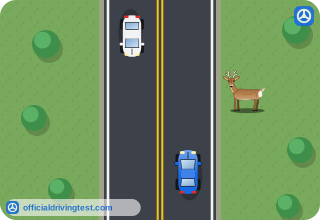
According to the manual, near what kinds of places should you watch for deer?
- Parking lots and shopping centers
- Railroad crossings
- Construction zones
- Waterways and wooded areas
Show answer
Correct answer: Waterways and wooded areas
The manual says to watch for deer near waterways and near wooded areas.
Source: Nebraska Driver's Manual (January 2025), page 26 · Open this page in the manual (Manual page 26)
-
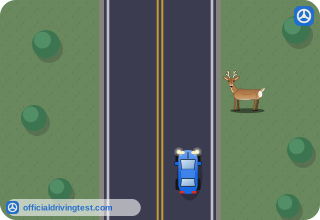
Why should you watch for more than one deer?
- Deer always cross a road in single file
- Deer are unpredictable and travel in groups
- Deer stay on the roadway until a vehicle stops
- Deer never travel in groups
Show answer
Correct answer: Deer are unpredictable and travel in groups
The manual says deer are unpredictable and travel in groups, so watch for more than one.
Source: Nebraska Driver's Manual (January 2025), page 26 · Open this page in the manual (Manual page 26)
-
In which seasons does the manual say to watch for deer?
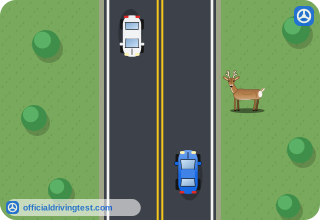
- Spring and fall
- Summer and winter
- Only summer
- Only winter
Show answer
Correct answer: Spring and fall
The manual says to watch for deer from dusk to dawn and in spring and fall.
Source: Nebraska Driver's Manual (January 2025), page 26 · Open this page in the manual (Manual page 26)
-
After a minor crash on the interstate or freeway system with no injuries and drivable vehicles, what should the drivers do?
- Stay in the travel lane and wait for the police to arrive
- Stop where they are in the lanes and turn on the hazard flashers
- Drive to the next exit before stopping to exchange information
- Drive the vehicles to the nearest shoulder, out of the travel lanes
Show answer
Correct answer: Drive the vehicles to the nearest shoulder, out of the travel lanes
Drivers in minor, injury-free crashes on the interstate or freeway system should drive drivable vehicles to the nearest shoulder out of the travel lanes.
Source: Nebraska Driver's Manual (January 2025), page 51 · Open this page in the manual (Manual page 51)
-
On the interstate or freeway system, what may happen to a crash vehicle that cannot be moved to the shoulder?
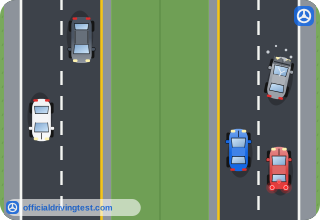
- Law enforcement may push it to the shoulder, or others may remove it
- It must stay in the travel lane until the driver repairs it
- The drivers must push it across the lanes themselves
- It must be left in place until a court orders it moved
Show answer
Correct answer: Law enforcement may push it to the shoulder, or others may remove it
Vehicles that cannot be moved to the shoulder may be pushed there by law enforcement or removed by others.
Source: Nebraska Driver's Manual (January 2025), page 51 · Open this page in the manual (Manual page 51)
-
When making an emergency roadside stop, where should you move your vehicle?
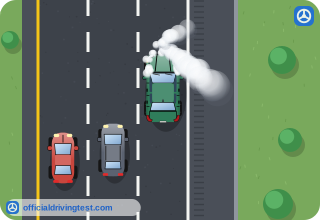
- To the center of the road, so other drivers see you
- Onto the roadside shoulder, as far off the road as possible
- Into the nearest traffic lane, with your flashers on
- Onto the shoulder, but stay as close to the lane as you can
Show answer
Correct answer: Onto the roadside shoulder, as far off the road as possible
For an emergency roadside stop you signal and move onto the roadside shoulder as far off the road as possible.
Source: Nebraska Driver's Manual (January 2025), page 56 · Open this page in the manual (Manual page 56)
-
At an emergency roadside stop, how close to the curb or road’s edge, and in what position, should you park?
- Within 6 inches, at an angle
- Within 24 inches, parallel to it
- Within 36 inches, at an angle
- Within 12 inches, parallel to it
Show answer
Correct answer: Within 12 inches, parallel to it
The manual says to park within 12 inches of and parallel to the curb or road’s edge.
Source: Nebraska Driver's Manual (January 2025), page 56 · Open this page in the manual (Manual page 56)
-
At an emergency roadside stop, on which side of the roadway should you always park, unless it is a one-way street?
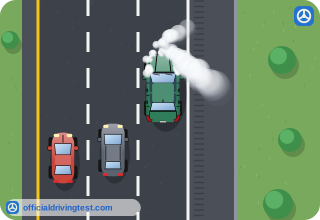
- The right side
- The left side
- The side facing traffic
- The side with the widest shoulder
Show answer
Correct answer: The right side
You always park on the right side of the roadway, unless it is a one-way street.
Source: Nebraska Driver's Manual (January 2025), page 56 · Open this page in the manual (Manual page 56)
-
At an emergency roadside stop, what should you do to make sure the vehicle cannot move?
- Leave it in drive and keep your foot on the brake pedal
- Shift to neutral and leave the parking brake released
- Shift to the proper parking gear and set the parking brake
- Leave it in reverse with the wheels turned to the left
Show answer
Correct answer: Shift to the proper parking gear and set the parking brake
You make sure the vehicle cannot move by shifting the transmission to the proper parking gear and setting the parking brake.
Source: Nebraska Driver's Manual (January 2025), page 56 · Open this page in the manual (Manual page 56)
-
Which lights should you activate when making an emergency roadside stop?
- Your high beams
- Your 4-way flashers
- Your left turn signal
- Your windshield wipers
Show answer
Correct answer: Your 4-way flashers
The manual tells drivers to activate 4-way flashers at an emergency roadside stop.
Source: Nebraska Driver's Manual (January 2025), page 57 · Open this page in the manual (Manual page 57)
-
At an emergency roadside stop, what should you do with the engine?
- Leave it running with the keys in the ignition
- Leave it idling so the heater can run
- Turn it off but leave the keys in the ignition
- Turn it off and remove the keys
Show answer
Correct answer: Turn it off and remove the keys
The steps for an emergency roadside stop include turning off the engine and removing the keys.
Source: Nebraska Driver's Manual (January 2025), page 57 · Open this page in the manual (Manual page 57)
-
What should you do before getting out of your vehicle after an emergency roadside stop?
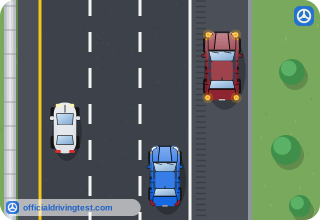
- Check traffic
- Lock all the doors
- Raise the hood
- Turn on your high beams
Show answer
Correct answer: Check traffic
You should check traffic before getting out of the vehicle.
Source: Nebraska Driver's Manual (January 2025), page 57 · Open this page in the manual (Manual page 57)
-
You see a flooded roadway ahead. What should you do?
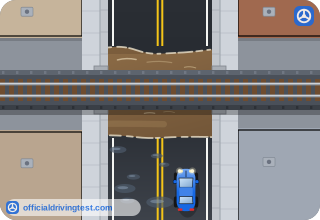
- Drive through slowly in a low gear
- Follow another vehicle across
- Turn around and find another route
- Cross where the water looks shallow
Show answer
Correct answer: Turn around and find another route
The manual says not to drive through flooded areas but to turn around and find another route.
Source: Nebraska Driver's Manual (January 2025), page 62 · Open this page in the manual (Manual page 62)
-
As little as how much water will reach the bottom of most passenger cars, causing loss of control or possible stalling?
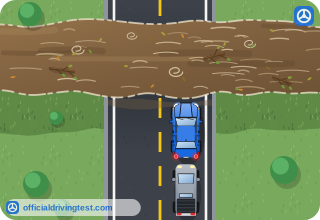
- Six inches
- Two inches
- Three inches
- Four inches
Show answer
Correct answer: Six inches
Six inches of water reaches the bottom of most passenger cars and can cause loss of control or stalling.
Source: Nebraska Driver's Manual (January 2025), page 62 · Open this page in the manual (Manual page 62)
-
How much moving water can carry away most vehicles, including sport utility vehicles and pick-up trucks?
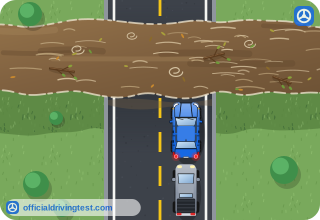
- Four inches
- Eight inches
- Ten inches
- Two feet
Show answer
Correct answer: Two feet
Two feet of moving water can carry away most vehicles, including SUVs and pick-up trucks.
Source: Nebraska Driver's Manual (January 2025), page 62 · Open this page in the manual (Manual page 62)
-
Why should you not try to cross a flooded road even if the water looks shallow?
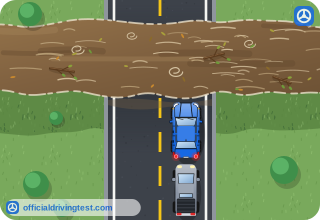
- Shallow water always stalls the engine of a passenger car
- Water can hide dips, and floodwaters can wash away the road beneath
- Shallow water ruins the brake pads on contact
- Crossing floodwater is always a traffic violation
Show answer
Correct answer: Water can hide dips, and floodwaters can wash away the road beneath
Water can hide dips, and floodwaters can damage a roadway by washing away the underlying road surface.
Source: Nebraska Driver's Manual (January 2025), page 62 · Open this page in the manual (Manual page 62)
-
If there is no other route around a flooded road, what should you do?
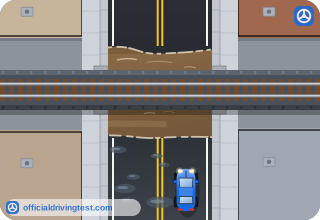
- Proceed to higher ground and wait for the waters to subside
- Drive across the flooded road at a very low speed
- Wait in the roadway for the flood water to drain off
- Turn on your emergency flashers and cross the water
Show answer
Correct answer: Proceed to higher ground and wait for the waters to subside
With no other route, you go to higher ground and wait for the water to subside.
Source: Nebraska Driver's Manual (January 2025), page 62 · Open this page in the manual (Manual page 62)
-
Travel on a roadway with a posted speed of 40 MPH or more is not recommended when fog cuts visibility to less than what?
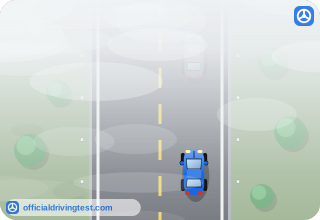
- 1/2 of a mile
- 1/4 of a mile
- 1/8 of a mile
- 1 mile
Show answer
Correct answer: 1/4 of a mile
Travel on roadways with posted speeds of 40 MPH or more is not recommended when visibility is under 1/4 of a mile.
Source: Nebraska Driver's Manual (January 2025), page 62 · Open this page in the manual (Manual page 62)
-
High wind can be a problem for all vehicles. Which does the manual say it is especially a problem for?
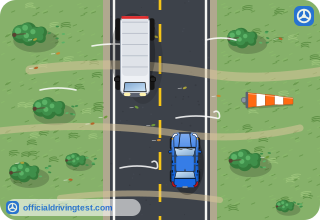
- Heavy trucks only
- Vehicles without antilock brakes
- Vehicles traveling uphill
- Small and high profile vehicles
Show answer
Correct answer: Small and high profile vehicles
Wind can be a problem for all vehicles, especially small and high profile vehicles.
Source: Nebraska Driver's Manual (January 2025), page 62 · Open this page in the manual (Manual page 62)
-
In high wind, what should you watch for after driving in a protected area?
- Narrow bridges, where the road is slick
- Hills, where the wind slows your vehicle
- Open spaces, where the wind may change suddenly
- Intersections, where the wind hides signals
Show answer
Correct answer: Open spaces, where the wind may change suddenly
After a protected area, open spaces expose you to wind, so be ready to make steering corrections.
Source: Nebraska Driver's Manual (January 2025), page 62 · Open this page in the manual (Manual page 62)
-
In high wind, what should you be alert for when meeting large trucks and buses?
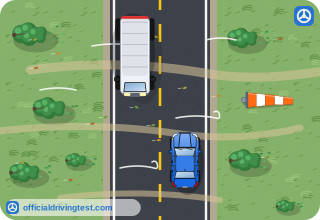
- Possible steering corrections from sudden wind
- A drop in the speed of the large vehicle
- The need to pull onto the shoulder
- The need to turn on your high beams
Show answer
Correct answer: Possible steering corrections from sudden wind
Meeting large trucks and buses can cause sudden wind changes, so be alert for possible steering corrections.
Source: Nebraska Driver's Manual (January 2025), page 62 · Open this page in the manual (Manual page 62)