Montana: Pedestrians — Part 1 Practice Test
Questions in this part include: “What should you do about school zones when you plan a route?” · “Where does a school zone begin?”
Independent educational site · not affiliated with any government agency or DMV
Ready? Test yourself
- Instant feedback with an explanation
- Every answer cites its source in the manual
- Your best score is saved on this device
- Keyboard: press 1 to 4 to answer and Enter for the next question
Questions are original and based on the official manual "Montana Driver Manual" (Revised April 2024), Montana Department of Justice, Motor Vehicle Division.
All 19 questions in this practice test
Take the test above first, then use this list to study. Tap “Show answer” to see the correct answer and explanation.
Show the questions and answersHide the questions
-
What should you do about school zones when you plan a route?
- Plan to pass through them at pick-up time
- Plan a route that avoids them when you can
- Use them as shortcuts to save time
- Plan to pass through them at the lowest speed limit
Show answer
Correct answer: Plan a route that avoids them when you can
The manual says to plan a route that avoids school zones when you can.
Source: Montana Driver Manual (Revised April 2024), page 29
-
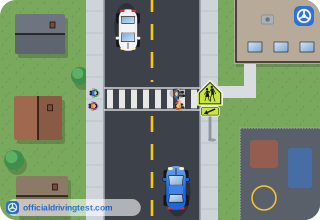
Why is mixing speeding or distracted driving with child pedestrians and bicyclists dangerous?
- Children always cross only at marked crosswalks and only on a green signal
- Children are able to judge the speed and distance of cars accurately
- Children walking to school are accompanied by adults
- Children are difficult to see due to their size and unpredictable behavior
Show answer
Correct answer: Children are difficult to see due to their size and unpredictable behavior
Children are difficult to see due to their size and tendency toward unpredictable behavior.
Source: Montana Driver Manual (Revised April 2024), page 29
-
Why do children walking or bicycling to school often cross streets and parking lots wherever it is convenient?
- They are required to cross away from crosswalks
- School crossing guards tell them to cross there
- They often ignore or do not understand traffic control
- They cannot see the parking lot signs
Show answer
Correct answer: They often ignore or do not understand traffic control
Children walking or bicycling to school often ignore or do not understand traffic control, so they cross wherever it is convenient.
Source: Montana Driver Manual (Revised April 2024), page 29
-
What may young children wrongly think about cars?
- That a car is able to stop when in fact it cannot
- That a car always yields to anyone walking
- That a car is slower than a bicycle
- That a car can only drive in the center lane
Show answer
Correct answer: That a car is able to stop when in fact it cannot
Young children may think that a car is able to stop when in fact it can’t.
Source: Montana Driver Manual (Revised April 2024), page 29
-
What may children think if they can see a driver?
- That the driver will honk
- That the driver is about to turn
- That the driver is going too fast
- That the driver can see them
Show answer
Correct answer: That the driver can see them
Children may think that if they can see a driver, the driver can see them.
Source: Montana Driver Manual (Revised April 2024), page 29
-
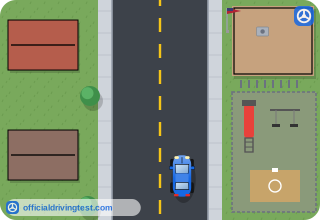
When should you watch out for children near schools and parks?
- Only during school hours
- Day and night
- Only at pick-up and drop-off times
- Only when school is in session
Show answer
Correct answer: Day and night
The manual says to watch out for children near schools and parks day and night.
Source: Montana Driver Manual (Revised April 2024), page 29
-
What must you do for pedestrians in crosswalks and at intersections?
- Slow down and honk
- Slow down and pass on the left
- Stop only if they are children
- Stop and stay stopped
Show answer
Correct answer: Stop and stay stopped
The manual says to stop and stay stopped for pedestrians in crosswalks and at intersections.
Source: Montana Driver Manual (Revised April 2024), page 29
-
Where does a school zone begin?
- At the school’s front door
- At the edge of the school parking lot
- At the nearest traffic signal
- At the first school crossing sign
Show answer
Correct answer: At the school’s front door
A school zone is an area near a school beginning at the school’s front door.
Source: Montana Driver Manual (Revised April 2024), page 29
-
How many blocks surrounding a school does a school zone include?
- Exactly one block in each direction
- Exactly two blocks in each direction
- As many as the local authority determines
- Only the school’s own property
Show answer
Correct answer: As many as the local authority determines
The school zone includes as many surrounding blocks as determined by the local authority establishing a special speed limit.
Source: Montana Driver Manual (Revised April 2024), page 29
-
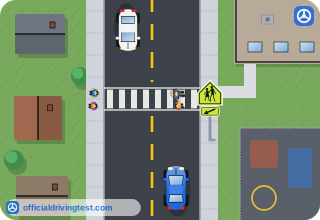
When must drivers yield to pedestrians in school crosswalks?
- Only when a crossing guard is present
- Only when children are in the crosswalk
- Only at pick-up and drop-off times
- Always
Show answer
Correct answer: Always
Drivers must always yield to pedestrians in school crosswalks, whether or not crossing guards are present.
Source: Montana Driver Manual (Revised April 2024), page 29
-
Why should drivers stop before school crosswalks?
- So children can read the school sign
- So other drivers can also see pedestrians
- So the crossing guard can collect fees
- So buses can park in the crosswalk
Show answer
Correct answer: So other drivers can also see pedestrians
Drivers should stop before crosswalks so other drivers can also see pedestrians.
Source: Montana Driver Manual (Revised April 2024), page 29
-
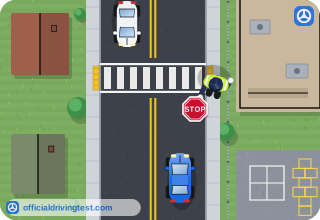
Which of these are drivers not allowed to do?
- Stop before the crosswalk so others can see them
- Wait until the whole column of children has crossed
- Drive through a column of school children crossing a roadway
- Slow down when you approach the school building
Show answer
Correct answer: Drive through a column of school children crossing a roadway
Drivers can’t drive through a column of school children crossing a roadway.
Source: Montana Driver Manual (Revised April 2024), page 29
-
What may a driver not do while a school crossing guard is directing children and holding a sign in the stop position?
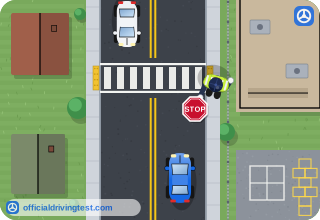
- Drive past the crossing guard
- Wait at the crosswalk
- Yield to the children
- Stop before the crosswalk
Show answer
Correct answer: Drive past the crossing guard
Drivers can’t drive past a school crossing guard who is directing children across a roadway while holding a sign in the stop position.
Source: Montana Driver Manual (Revised April 2024), page 29
-
Where a pedestrian signal is used, which signals must pedestrians obey?
- The red-yellow-green traffic lights, rather than the pedestrian signals
- Whichever signal shows first, pedestrian or traffic light
- The pedestrian signals, rather than the red-yellow-green traffic lights
- Neither one, as long as no vehicles are close
Show answer
Correct answer: The pedestrian signals, rather than the red-yellow-green traffic lights
Where pedestrian signals are used, pedestrians must obey them rather than the red-yellow-green traffic lights.
Source: Montana Driver Manual (Revised April 2024), page 30
-
When may a pedestrian start crossing the street from the curb or sidewalk at a pedestrian signal?
- When the DON’T WALK signal is flashing
- When facing a WALK signal
- When the upheld orange hand is steady
- When no vehicles are in sight, whatever the signal shows
Show answer
Correct answer: When facing a WALK signal
Pedestrians facing a WALK signal may start from the curb or sidewalk to cross the street.
Source: Montana Driver Manual (Revised April 2024), page 30
-
A pedestrian is at the curb and the pedestrian signal shows DON’T WALK, either steady or flashing. What must the pedestrian do?
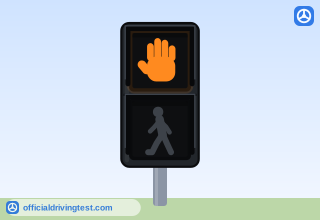
- Start crossing if no vehicles are approaching
- Start crossing, but hurry to the far curb
- Cross only after the traffic light for cars turns yellow
- Wait until a WALK signal appears before starting to cross
Show answer
Correct answer: Wait until a WALK signal appears before starting to cross
If a DON’T WALK signal is showing or flashing, pedestrians must wait until a WALK signal appears before starting to cross the intersection.
Source: Montana Driver Manual (Revised April 2024), page 30
-
A pedestrian is already in the crosswalk when the DON’T WALK signal begins flashing. What should the pedestrian do?
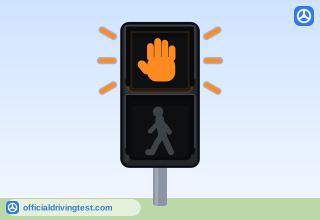
- Continue crossing the street
- Stop and wait in the crosswalk until the WALK signal returns
- Go back to the curb that was just left
- Stand still until traffic stops
Show answer
Correct answer: Continue crossing the street
Pedestrians who are in the crosswalk when the DON’T WALK signal begins flashing should continue crossing the street.
Source: Montana Driver Manual (Revised April 2024), page 30
-
On a pedestrian signal, what does an upheld orange hand mean?
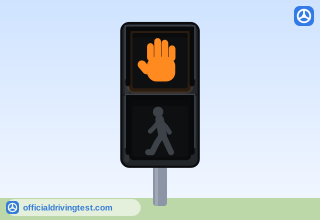
- WALK
- Cross with caution
- DON’T WALK
- Cross if no cars come
Show answer
Correct answer: DON’T WALK
An upheld orange hand on a pedestrian signal means DON’T WALK.
Source: Montana Driver Manual (Revised April 2024), page 30
-
On a pedestrian signal, what does a white pedestrian figure mean?
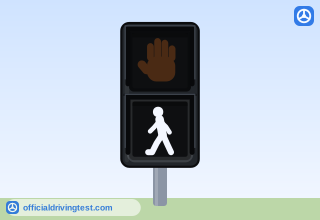
- DON’T WALK
- WALK
- Wait for the light
- Cross with caution
Show answer
Correct answer: WALK
A white pedestrian figure on a pedestrian signal means WALK.
Source: Montana Driver Manual (Revised April 2024), page 30