Montana: Parking rules
Where Montana forbids parking, parallel parking, parking on a hill, curb colors and spaces for people with disabilities. Split into 2 shorter tests so you're not stuck in one long quiz.
Independent educational site · not affiliated with any government agency or DMV
All 40 Parking rules questions with answers
Choose a part above to take a practice test, or study every question and answer here.
Show the questions and answersHide the questions
-
Which is one purpose of signs about parking and stopping near schools?
- Reserving the closest spaces for parents
- Keeping school bus loading zones clear
- Marking where drivers may double-park
- Allowing vehicles to wait in travel lanes
Show answer
Correct answer: Keeping school bus loading zones clear
Signs may be used to keep school bus loading zones clear, and to prevent parked or waiting vehicles from blocking lanes and views.
Source: Montana Driver Manual (Revised April 2024), page 29
-
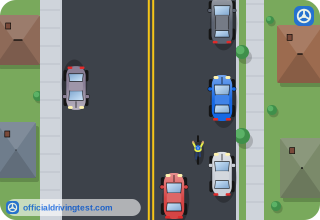
Whenever you park, the place must be far enough from any travel lane to avoid interfering with traffic. What else should it be?
- Hidden from the view of passing traffic
- On the left side of the street, facing traffic
- Next to a crosswalk so passengers can cross
- Visible to cars approaching from either direction
Show answer
Correct answer: Visible to cars approaching from either direction
Drivers must make sure a parked vehicle does not become a hazard: park far enough from any travel lane and where the vehicle is visible to cars approaching from either direction.
Source: Montana Driver Manual (Revised April 2024), page 44
-
Where should you always park if possible?
- On the shoulder of the road
- In a designated area
- Next to a fire station driveway
- On the road-side of a parked car
Show answer
Correct answer: In a designated area
The manual says to always park in a designated area if possible.
Source: Montana Driver Manual (Revised April 2024), page 44
-
You park a vehicle that has a manual transmission. How should you leave it?
- In neutral, with the parking brake set
- In gear, with the parking brake set
- In neutral, with the parking brake off
- In gear, with the parking brake off
Show answer
Correct answer: In gear, with the parking brake set
Always set your parking brake when you park, and leave a vehicle with a manual transmission in gear.
Source: Montana Driver Manual (Revised April 2024), page 44
-
You park a vehicle that has an automatic transmission. How should you leave it?
- In neutral, with the parking brake set
- In park, with the parking brake off
- In drive, with the parking brake set
- In park, with the parking brake set
Show answer
Correct answer: In park, with the parking brake set
Always set your parking brake when you park, and leave a vehicle with an automatic transmission in park.
Source: Montana Driver Manual (Revised April 2024), page 44
-
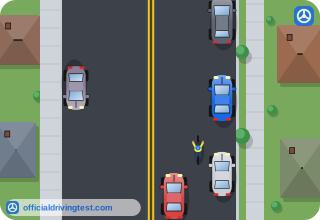
After parking, which side of the vehicle does the manual say to get out on if you can?
- The curbside
- The street side
- The driver's side
- The side facing traffic
Show answer
Correct answer: The curbside
Check traffic before you open the door, and get out of the vehicle on the curbside if you can.
Source: Montana Driver Manual (Revised April 2024), page 44
-
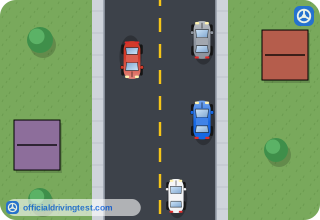
If you must get out of your parked vehicle on the street side, what should you do?
- Open the door slowly and leave it open until traffic passes
- Turn on the hazard lights and then step out quickly
- Check for vehicles, bicyclists, and pedestrians first
- Signal with your arm out the window, then open the door
Show answer
Correct answer: Check for vehicles, bicyclists, and pedestrians first
If you must use the street side, check for vehicles, bicyclists, and pedestrians before you get out, and shut the door as soon as you can.
Source: Montana Driver Manual (Revised April 2024), page 44
-
What does the manual say about keys and doors when you leave your vehicle?
- Leave the keys hidden inside and lock the doors
- Take the keys, but leave the doors unlocked
- Leave the keys only if you will be back soon
- Never leave keys in it, and lock the doors
Show answer
Correct answer: Never leave keys in it, and lock the doors
Never leave keys in a parked car, and lock the doors whenever you leave your vehicle.
Source: Montana Driver Manual (Revised April 2024), page 44
-
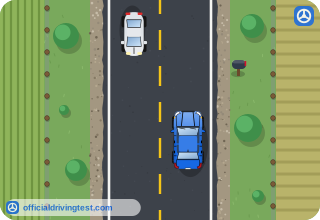
You must park on a roadway where there is no curb. Where should you pull over?
- As close as practicable to the center line
- As close as practicable to the edge of the shoulder
- Halfway onto the shoulder, half in the lane
- Anywhere, as long as your hazard lights are on
Show answer
Correct answer: As close as practicable to the edge of the shoulder
Park as far away from traffic as possible; if there is no curb, pull over as close as practicable to the edge of the shoulder.
Source: Montana Driver Manual (Revised April 2024), page 44
-
How close to the curb or shoulder must your parked vehicle be?
- Within 6 inches
- Within 3 feet
- Within 18 inches
- Within 5 feet
Show answer
Correct answer: Within 18 inches
Your vehicle must be within 18 inches (1.5 feet) of the curb or shoulder.
Source: Montana Driver Manual (Revised April 2024), page 44
-
Your vehicle is parked on a roadway in the dark with its headlights on. What must be done with the headlights?
- They must be dimmed
- They must be on high beam
- They must be set to flash
- They must be aimed at the curb
Show answer
Correct answer: They must be dimmed
If the headlights of a vehicle parked on a roadway or shoulder in darkness are on, they must be dimmed.
Source: Montana Driver Manual (Revised April 2024), page 45
-
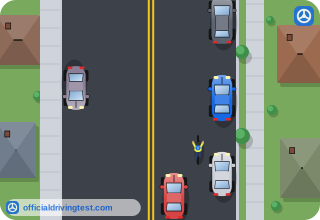
What should you use when entering traffic from a parking space?
- Your hazard lights
- Your high beams
- Your turn signal
- Your parking lights
Show answer
Correct answer: Your turn signal
Use your turn signal when entering traffic from a parking space.
Source: Montana Driver Manual (Revised April 2024), page 45
-
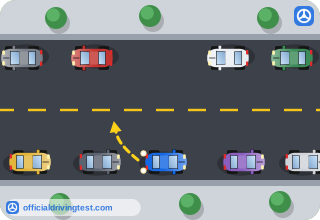
What does the manual tell you to do when backing out of a parking space?
- Back out quickly, so that you block traffic for a shorter time
- Look both ways and double-check for vehicles, bicycles, and pedestrians
- Look only toward the lane that you plan to enter as you back
- Rely on your rearview mirror alone while you back out slowly
Show answer
Correct answer: Look both ways and double-check for vehicles, bicycles, and pedestrians
Be sure to look in both directions and double-check for vehicles, bicycles, and pedestrians when backing out of a parking space.
Source: Montana Driver Manual (Revised April 2024), page 45
-
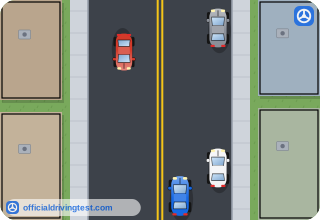
What is the first step when you parallel park in an empty space between two parked vehicles?
- Stop beside the vehicle parked behind the empty space
- Turn the steering wheel sharply to the right
- Set the parking brake and shift into reverse
- Signal your intention to park with the turn indicator
Show answer
Correct answer: Signal your intention to park with the turn indicator
The first step in parallel parking is to use the turn indicator to signal your intention to park.
Source: Montana Driver Manual (Revised April 2024), page 45
-
When starting to parallel park, how far should you stay from the vehicle parked in front of the empty space?
- At least six inches
- At least five feet
- At least two feet
- At least eight feet
Show answer
Correct answer: At least two feet
Position your vehicle parallel with the vehicle parked in front of the empty space and keep at least two feet from it.
Source: Montana Driver Manual (Revised April 2024), page 45
-
When starting to parallel park, what should your rear bumper line up with?
- The rear bumper of the vehicle in front of the space
- The front bumper of the vehicle behind the space
- The front door of the vehicle in front of the space
- The middle of the empty space at the curb
Show answer
Correct answer: The rear bumper of the vehicle in front of the space
Align your rear bumper with the rear bumper of the vehicle parked in front of the empty space.
Source: Montana Driver Manual (Revised April 2024), page 45
-
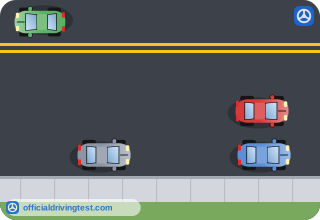
While parallel parking, you back slowly until the front of your vehicle is even with the front door of the parallel car. What do you do next?
- Turn the wheel sharply left and pull forward into the space
- Straighten the wheels and pull forward in the space
- Stop and set the parking brake before turning the wheel
- Turn the wheel sharply right and back to a 45-degree angle
Show answer
Correct answer: Turn the wheel sharply right and back to a 45-degree angle
Reverse slowly until the front of the vehicle is even with the front door of the parallel car, then turn the wheel sharply to the right and reverse slowly until the vehicle is at a 45-degree angle.
Source: Montana Driver Manual (Revised April 2024), page 45
-
While parallel parking, the front of your vehicle passes the rear of the parallel car. How should you steer?
- Turn the wheel right sharply, then gradually, while backing in
- Turn the wheel left sharply, then gradually, while backing in
- Keep the wheel straight and back in until you reach the curb
- Turn the wheel left and pull forward out of the space again
Show answer
Correct answer: Turn the wheel left sharply, then gradually, while backing in
When the front of your vehicle passes the rear of the parallel car, turn the steering wheel to the left sharply, then gradually, while backing into the space.
Source: Montana Driver Manual (Revised April 2024), page 45
-
What is the last step of parallel parking described in the manual?
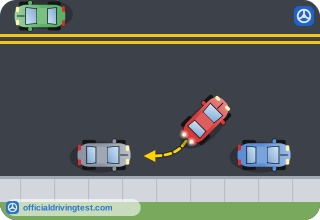
- Back up until your bumper touches the car behind
- Straighten the wheels and pull forward in the space
- Turn the wheels sharply to the right and stop
- Signal left and wait for traffic to pass by
Show answer
Correct answer: Straighten the wheels and pull forward in the space
The last step is to straighten your vehicle's wheels and pull forward in the space.
Source: Montana Driver Manual (Revised April 2024), page 45
-
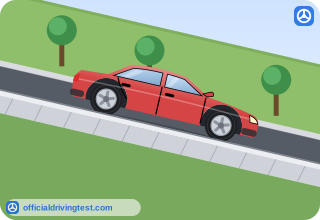
Why should you turn your wheels sharply when you park on a hill?
- So that the parking brake does not need to be set
- So the car can pull out more quickly when you leave
- So other drivers can see the car from farther away
- So that if the car starts to roll, it rolls away from traffic
Show answer
Correct answer: So that if the car starts to roll, it rolls away from traffic
When you park on a hill, turn your wheels sharply so that if your car starts to roll downhill, it will roll away from traffic.
Source: Montana Driver Manual (Revised April 2024), page 45
-
You park facing downhill next to a curb. Which way should you turn your wheels?
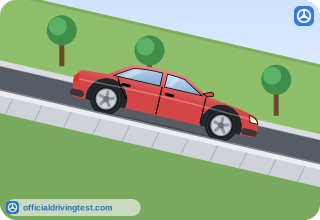
- Toward the curb
- Away from the curb
- Straight ahead
- Either way, if the parking brake is set
Show answer
Correct answer: Toward the curb
When you park facing downhill, turn your wheels toward the curb.
Source: Montana Driver Manual (Revised April 2024), page 45
-
You park facing uphill next to a curb. Which way should you turn your wheels?
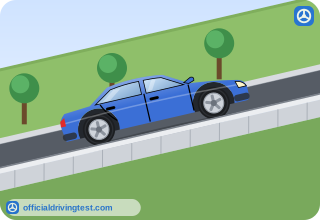
- Toward the curb
- Straight ahead
- Away from the curb
- Either way, if the parking brake is set
Show answer
Correct answer: Away from the curb
When you park facing uphill, turn your wheels away from the curb.
Source: Montana Driver Manual (Revised April 2024), page 45
-
You park facing uphill on a road with no curb. Which way should you turn your wheels?
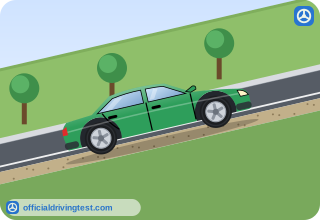
- Toward the street
- Straight ahead
- Either way, if the parking brake is set
- Away from the street
Show answer
Correct answer: Away from the street
When you park facing uphill and there is no curb, turn your wheels away from the street.
Source: Montana Driver Manual (Revised April 2024), page 45
-
What does a white curb marking mean?
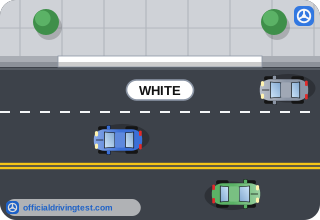
- Stopping only to load or unload, staying with the car
- Stopping only to pick up or unload passengers
- Do not stop, stand, or park at any time
- Parking for up to two hours at any time of day
Show answer
Correct answer: Stopping only to pick up or unload passengers
A white curb means stopping only to pick up or unload passengers.
Source: Montana Driver Manual (Revised April 2024), page 46
-
What does a yellow curb marking mean?
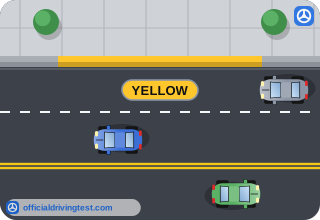
- Parking for up to fifteen minutes at any time
- Do not stop, stand, or park there at any time of day
- Stop only long enough to load or unload, and stay with the car
- Parking for up to two hours, with no need to stay with the car
Show answer
Correct answer: Stop only long enough to load or unload, and stay with the car
A yellow curb means stopping only long enough to load or unload, and you must stay with the car.
Source: Montana Driver Manual (Revised April 2024), page 46
-
What does a red curb marking mean?
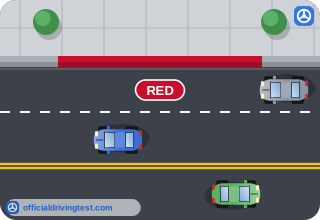
- Do not stop, stand, or park
- Stopping only to pick up or unload passengers
- Loading only, and you must stay with the car
- Parking for up to fifteen minutes
Show answer
Correct answer: Do not stop, stand, or park
A red curb means do not stop, stand, or park.
Source: Montana Driver Manual (Revised April 2024), page 46
-
Within how many feet of a crosswalk or sidewalk at an intersection is parking not allowed?
- 20 feet
- 5 feet
- 10 feet
- 100 feet
Show answer
Correct answer: 20 feet
Do not park within 20 feet of a crosswalk or sidewalk at an intersection.
Source: Montana Driver Manual (Revised April 2024), page 46
-
Within how many feet of a traffic signal, stop sign, or yield sign is parking not allowed?
- 10 feet
- 60 feet
- 30 feet
- 100 feet
Show answer
Correct answer: 30 feet
Do not park within 30 feet of a traffic signal, stop sign, or yield sign.
Source: Montana Driver Manual (Revised April 2024), page 46
-
Within how many feet of a fire hydrant is parking not allowed?
- 5 feet
- 15 feet
- 8 feet
- 40 feet
Show answer
Correct answer: 15 feet
Do not park within 15 feet of a fire hydrant.
Source: Montana Driver Manual (Revised April 2024), page 46
-
Within how many feet of a railroad crossing is parking not allowed?
- 10 feet
- 25 feet
- 200 feet
- 50 feet
Show answer
Correct answer: 50 feet
Do not park within 50 feet of a railroad crossing.
Source: Montana Driver Manual (Revised April 2024), page 46
-
Within how many feet of a fire station driveway on the same side of the street is parking not allowed?
- 5 feet
- 10 feet
- 20 feet
- 100 feet
Show answer
Correct answer: 20 feet
Do not park within 20 feet of a fire station driveway on the same side of the street.
Source: Montana Driver Manual (Revised April 2024), page 46
-
A fire station driveway is on the other side of the street. Within how many feet of it is parking not allowed?
- 75 feet
- 10 feet
- 25 feet
- 150 feet
Show answer
Correct answer: 75 feet
Do not park within 75 feet of a fire station driveway on the other side of the street.
Source: Montana Driver Manual (Revised April 2024), page 46
-
When are you not allowed to park in a construction area?
- Only while workers are present
- Only between sunset and sunrise
- Only if no flagger is on duty
- If your vehicle will block traffic
Show answer
Correct answer: If your vehicle will block traffic
Do not park in a construction area if your vehicle will block traffic.
Source: Montana Driver Manual (Revised April 2024), page 46
-
Which of these places is on the manual's list of places where you must not park?
- At a curb 25 feet from a fire hydrant
- On a bridge or in a tunnel or underpass
- At a curb 40 feet from a stop sign
- At a curb 60 feet from a railroad crossing
Show answer
Correct answer: On a bridge or in a tunnel or underpass
Do not park on a bridge or elevated structure or in a tunnel or underpass.
Source: Montana Driver Manual (Revised April 2024), page 46
-
Which of these places is on the manual's list of places where you must not park?
- At a curb 40 feet past a yield sign
- In an intersection
- At a curb 20 feet beyond a fire hydrant
- In a parking lane 100 feet from a crosswalk
Show answer
Correct answer: In an intersection
An intersection is one of the places where the manual says not to park.
Source: Montana Driver Manual (Revised April 2024), page 46
-
May you park so that your vehicle blocks an alley or a private road?
- Yes, as long as you stay inside the vehicle the whole time
- Yes, for up to 15 minutes if your hazard lights are on
- Yes, if there is no sign there that prohibits parking
- No, blocking a driveway, alley, or private road is not allowed
Show answer
Correct answer: No, blocking a driveway, alley, or private road is not allowed
Do not park blocking a driveway, alley, private road, or an area of the curb removed or lowered for access to the sidewalk.
Source: Montana Driver Manual (Revised April 2024), page 46
-
May you park on the wrong side of the street?
- No, it is a place where you must not park
- Yes, on a quiet residential street
- Yes, at night if your parking lights are on
- Yes, if you stay within 18 inches of the curb
Show answer
Correct answer: No, it is a place where you must not park
The manual lists the wrong side of the street among the places where you must not park.
Source: Montana Driver Manual (Revised April 2024), page 46
-
What is double parking?
- Parking two vehicles in one marked space
- Parking on both sides of a one-way street
- Parking on the road-side of a parked vehicle
- Parking for twice the posted time limit
Show answer
Correct answer: Parking on the road-side of a parked vehicle
Double parking means parking on the road-side of a parked vehicle, which is not allowed.
Source: Montana Driver Manual (Revised April 2024), page 46
-
When may you park in a space marked for the handicapped?
- When you stay with the vehicle the whole time you are parked
- For a few minutes while you load or unload your passengers
- When no other parking space is open anywhere nearby
- Only if you have a handicap license plate, tag, or sticker
Show answer
Correct answer: Only if you have a handicap license plate, tag, or sticker
Do not park in a space marked for the handicapped unless you have a handicap license plate, tag, or sticker; you can be fined for improper parking there.
Source: Montana Driver Manual (Revised April 2024), page 46
-
You want to parallel park and traffic is coming behind you. What should you do?
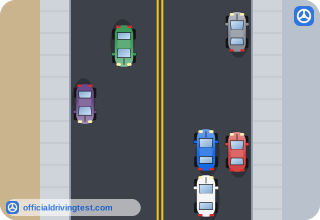
- Use your turn signal, pull next to the space, and let following vehicles pass
- Stop in the lane and back into the space at once with your flashers on
- Slow down quickly and back into the space as soon as you can stop
- Speed up past the space so that following vehicles pass you first
Show answer
Correct answer: Use your turn signal, pull next to the space, and let following vehicles pass
With traffic coming behind you, you put on your turn signal, pull next to the space, and allow following vehicles to pass before you park.
Source: Montana Driver Manual (Revised April 2024), page 65