Missouri: Sharing the road — Part 2 Practice Test
School buses, motorcycles, large trucks and their no-zones, bicycles and electric bicycles, farm vehicles and commercial vehicle size limits. — Part 2
Independent educational site · not affiliated with any government agency or DMV
Ready? Test yourself
- Instant feedback with an explanation
- Every answer cites its source in the manual
- Your best score is saved on this device
Questions are original and based on the official manual "Missouri Driver Guide" (Revised August 2026), Missouri Department of Revenue.
All 34 questions in this practice test
Take the test above first, then use this list to study. Tap “Show answer” to see the correct answer and explanation.
Show the questions and answersHide the questions
-
When traveling up or down steep grades, how must large vehicles drive?
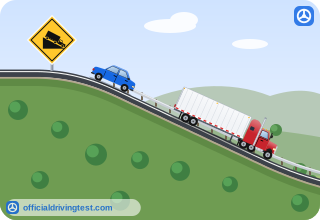
- Slowly in the left lane
- At highway speed in the left lane
- Slowly in the right lane
- At the posted speed in the center lane
Show answer
Correct answer: Slowly in the right lane
The manual says large vehicles must drive slowly in the right lane on steep grades.
Source: Missouri Driver Guide (Revised August 2026), page 29 · Open this page in the manual (Manual page 29)
-
Why does the manual advise you to avoid the right lane when you are near truck weigh stations?
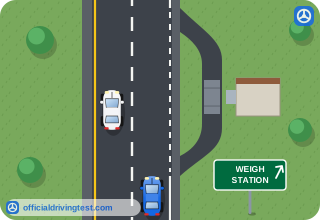
- Because the right lane is closed near weigh stations
- So slow-moving trucks can easily merge back onto the roadway
- Because trucks must stop in the right lane
- Because weigh stations require all vehicles to stop
Show answer
Correct answer: So slow-moving trucks can easily merge back onto the roadway
The manual says to avoid the right lane near weigh stations so slow-moving trucks can easily merge back onto the roadway.
Source: Missouri Driver Guide (Revised August 2026), page 29 · Open this page in the manual (Manual page 29)
-
What must vehicles carrying hazardous materials do at railroad crossings?
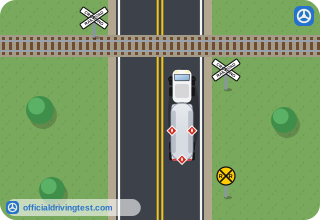
- Slow down and cross if no train is in sight
- Stop only when the signals are flashing
- Stop only at crossings without gates
- Stop at all railroad crossings
Show answer
Correct answer: Stop at all railroad crossings
The manual says vehicles carrying hazardous materials must stop at all railroad crossings.
Source: Missouri Driver Guide (Revised August 2026), page 29 · Open this page in the manual (Manual page 29)
-
What is the first step a large truck may take when making a right turn?
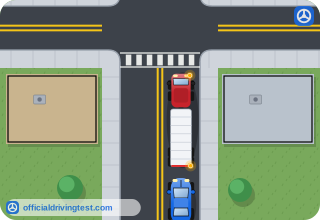
- Swing out to the left
- Swing out to the right
- Stop and sound its horn
- Drive onto the shoulder
Show answer
Correct answer: Swing out to the left
The manual says large trucks may swing out to the left as the first step in making a right turn, so you should observe turn signals before passing.
Source: Missouri Driver Guide (Revised August 2026), page 29 · Open this page in the manual (Manual page 29)
-
When following a tractor-trailer, what should you observe before trying to pass?
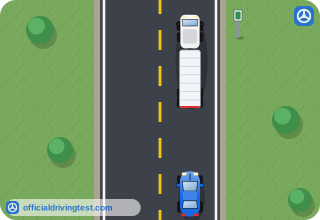
- Its brake lights only
- Its license plate
- Its turn signals
- Its trailer length
Show answer
Correct answer: Its turn signals
The manual says to observe a tractor-trailer's turn signals before trying to pass.
Source: Missouri Driver Guide (Revised August 2026), page 29 · Open this page in the manual (Manual page 29)
-
If you need to make a turn or lane change near a truck, what does the manual advise?
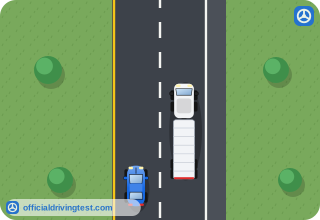
- Speed up and turn in front of the truck
- Sound your horn and turn in front of the truck
- Stay alongside the truck until the lane is clear
- Slow down and turn behind the truck
Show answer
Correct answer: Slow down and turn behind the truck
The manual says cutting off a truck is particularly dangerous; take a moment to slow down and turn behind the truck.
Source: Missouri Driver Guide (Revised August 2026), page 29 · Open this page in the manual (Manual page 29)
-
A tractor-trailer often appears to be traveling more slowly than its actual speed. Why?
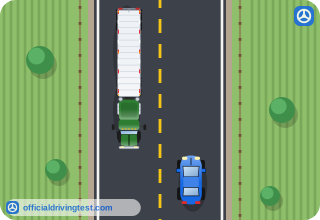
- Because of its large size
- Because its engine is quiet
- Because its lights are dim
- Because it has many gears
Show answer
Correct answer: Because of its large size
The manual says that because of its large size, a tractor-trailer often appears to be traveling more slowly than its actual speed.
Source: Missouri Driver Guide (Revised August 2026), page 30 · Open this page in the manual (Manual page 30)
-
Where do most collisions with bicycles and mopeds happen?
- On long rural highways
- In parking lots
- At intersections
- In bicycle lanes
Show answer
Correct answer: At intersections
The manual says most collisions with bicycles and mopeds happen at intersections, where they are especially easy to overlook.
Source: Missouri Driver Guide (Revised August 2026), page 31 · Open this page in the manual (Manual page 31)
-
What should you do before turning right onto a main road to avoid crashes with wrong-way bicyclists?
- Look only to the left for approaching traffic on the road
- Look right for wrong-way bicyclists on the road or sidewalk
- Look only at the crosswalk ahead of you
- Sound your horn as you enter the road
Show answer
Correct answer: Look right for wrong-way bicyclists on the road or sidewalk
The manual says crashes with wrong-way bicyclists happen when a motorist looks only left, so look right and check the road and sidewalk before proceeding.
Source: Missouri Driver Guide (Revised August 2026), page 31 · Open this page in the manual (Manual page 31)
-
You are following a bicyclist and need to make a right turn. What should you do?
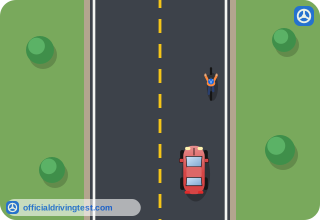
- Pass the cyclist and then turn right in front of him
- Sound your horn and turn beside the cyclist
- Move into the bicycle lane beside the cyclist
- Slow down and stay behind the cyclist until you can turn
Show answer
Correct answer: Slow down and stay behind the cyclist until you can turn
The manual says to slow down and remain behind the cyclist until you can turn.
Source: Missouri Driver Guide (Revised August 2026), page 31 · Open this page in the manual (Manual page 31)
-
When may you turn left in front of an oncoming bicyclist?
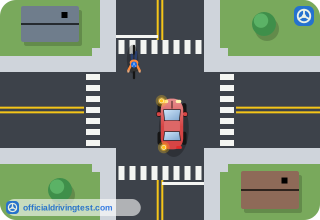
- Only when absolutely sure you can turn before the cyclist arrives
- Whenever the bicyclist is traveling slower than the traffic
- Whenever you have signaled your left turn in advance
- Whenever the bicyclist is riding in a bicycle lane
Show answer
Correct answer: Only when absolutely sure you can turn before the cyclist arrives
The manual says to yield to oncoming bicyclists unless you are absolutely sure you can make the turn before the cyclist reaches the intersection.
Source: Missouri Driver Guide (Revised August 2026), page 31 · Open this page in the manual (Manual page 31)
-
What should you check for before opening your car door into a traffic lane or bicycle lane?
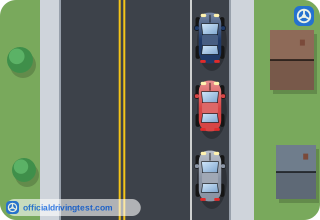
- Parked trucks
- Pedestrian signals
- Passing bicyclists
- Oncoming left-turning vehicles
Show answer
Correct answer: Passing bicyclists
The manual says to check for passing bicyclists before opening your car door into a traffic lane or bicycle lane.
Source: Missouri Driver Guide (Revised August 2026), page 31 · Open this page in the manual (Manual page 31)
-
How does the manual define a bicycle lane?
- A paved shoulder where parking is permitted at all times
- A part of the roadway designated by striping for bicycles
- A sidewalk section set aside for bicycle riders
- Any road that is closed to motor vehicles
Show answer
Correct answer: A part of the roadway designated by striping for bicycles
The manual defines a bicycle lane as a portion of a roadway designated by striping to be used by bicycles.
Source: Missouri Driver Guide (Revised August 2026), page 31 · Open this page in the manual (Manual page 31)
-
When may a driver cross a bicycle lane?
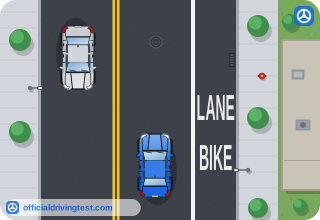
- Never, because bicycle lanes may not be crossed
- Only to pass slower traffic ahead of you
- Only when it is dark and no cyclist is near
- When turning, or when entering or leaving the roadway
Show answer
Correct answer: When turning, or when entering or leaving the roadway
The manual says you may cross a bicycle lane when turning or when entering or leaving the roadway.
Source: Missouri Driver Guide (Revised August 2026), page 31 · Open this page in the manual (Manual page 31)
-
What must a driver do for bicyclists in a bicycle lane?
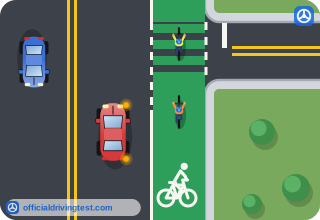
- Yield to them
- Pass them quickly
- Sound the horn
- Stop only if they signal
Show answer
Correct answer: Yield to them
The manual says you must yield to bicyclists in a bicycle lane.
Source: Missouri Driver Guide (Revised August 2026), page 31 · Open this page in the manual (Manual page 31)
-
What are the rights and responsibilities of a moped or bicycle rider on public streets and highways?
- Fewer than those of a motor vehicle operator
- Those of a pedestrian
- The same as those of a motor vehicle operator
- None, because they are not motor vehicles
Show answer
Correct answer: The same as those of a motor vehicle operator
The manual says that on public streets and highways, moped and bicycle riders have the same rights and responsibilities as a motor vehicle operator.
Source: Missouri Driver Guide (Revised August 2026), page 31 · Open this page in the manual (Manual page 31)
-
In which direction should a moped or bicycle rider always ride?
- Against traffic, to see oncoming vehicles
- With traffic, never against it
- Either way on the shoulder
- Against traffic on one-way streets
Show answer
Correct answer: With traffic, never against it
The manual says to always ride with traffic, never against it.
Source: Missouri Driver Guide (Revised August 2026), page 31 · Open this page in the manual (Manual page 31)
-
When a moped or bicycle is operating at less than the posted speed or traffic flow, where should it generally ride?
- In the center of the lane when traffic is light
- On the left side of the roadway near the median
- On the sidewalk next to the roadway
- As near to the right side of the roadway as is safe
Show answer
Correct answer: As near to the right side of the roadway as is safe
The manual says to generally ride as near to the right side of the roadway as is safe when operating at less than the posted speed or traffic flow.
Source: Missouri Driver Guide (Revised August 2026), page 32 · Open this page in the manual (Manual page 32)
-
When may a moped or bicycle rider move more toward the middle or left of the lane or roadway?
- When making a left turn
- Whenever a vehicle follows closely behind
- Whenever the right edge is smooth and paved
- Whenever the rider travels below the posted speed
Show answer
Correct answer: When making a left turn
The manual lists making a left turn, avoiding hazards, a lane too narrow to share, and going straight in a right-turn-only lane as times a rider may move toward the middle or left.
Source: Missouri Driver Guide (Revised August 2026), page 32 · Open this page in the manual (Manual page 32)
-
A bicyclist is on a one-way street. What may the bicyclist choose to do?
- Ride against the flow of traffic
- Ride only on the sidewalk
- Ride as far left as is safe
- Ride in the middle of the street
Show answer
Correct answer: Ride as far left as is safe
The manual says that on a one-way street bicyclists may also choose to ride as far left as is safe.
Source: Missouri Driver Guide (Revised August 2026), page 32 · Open this page in the manual (Manual page 32)
-
Before changing lanes or changing position within a lane, what should a moped or bicycle rider do?
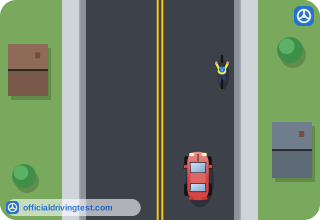
- Sound the horn and then move
- Check traffic and signal
- Stop and get off the bicycle
- Speed up to clear the lane
Show answer
Correct answer: Check traffic and signal
The manual says to always check traffic and signal before changing lanes or changing your position within a lane.
Source: Missouri Driver Guide (Revised August 2026), page 32 · Open this page in the manual (Manual page 32)
-
Where does the law not allow you to ride a moped?
- On any street with a speed limit above 25 mph
- On any road with a bicycle lane
- On any road without a shoulder
- On any part of the federal interstate highway system
Show answer
Correct answer: On any part of the federal interstate highway system
The manual says the law does not allow you to ride a moped on any part of the federal interstate highway system.
Source: Missouri Driver Guide (Revised August 2026), page 32 · Open this page in the manual (Manual page 32)
-
Does state law require moped and bicycle riders to wear a helmet?
- No, but a safety-certified helmet can prevent serious head injury
- Yes, at all times when riding on any public street or highway
- Yes, but only for riders who are under 18 years of age
- Yes, but only when riding after dark on a public road
Show answer
Correct answer: No, but a safety-certified helmet can prevent serious head injury
The manual says state law does not require a helmet for moped and bicycle riders, but a safety-certified helmet can prevent serious head injuries or death.
Source: Missouri Driver Guide (Revised August 2026), page 32 · Open this page in the manual (Manual page 32)
-
In conditions of heavy traffic, what may less proficient bicyclists find it easier to do?
- Ride on the sidewalk beside the street
- Ride in the center of the traffic lane
- Wait near the curb for a safe gap to appear
- Ride against traffic near the curb
Show answer
Correct answer: Wait near the curb for a safe gap to appear
The manual says less proficient bicyclists may find it easier to wait near the curb for a safe gap in heavy traffic.
Source: Missouri Driver Guide (Revised August 2026), page 32 · Open this page in the manual (Manual page 32)
-
For teen and adult bicyclists, what do studies show is far safer?
- Riding on the sidewalk instead of the street
- Riding on the street with traffic, not against it
- Riding against traffic on the right side of the street
- Riding only at night on lighted streets
Show answer
Correct answer: Riding on the street with traffic, not against it
The manual says studies show riding on the street with traffic, following the same rules as other vehicles, is far safer than riding on the sidewalk.
Source: Missouri Driver Guide (Revised August 2026), page 32 · Open this page in the manual (Manual page 32)
-
A motorized bicycle has how many wheels and what kind of transmission, in the manual's definition?
- Two or three wheels and an automatic transmission
- Two wheels and a manual transmission
- Three or four wheels and an automatic transmission
- Two wheels and any kind of transmission
Show answer
Correct answer: Two or three wheels and an automatic transmission
The manual defines a motorized bicycle as a two-wheeled or three-wheeled device having an automatic transmission and a motor.
Source: Missouri Driver Guide (Revised August 2026), page 32 · Open this page in the manual (Manual page 32)
-
A motorized bicycle has a motor with a cylinder capacity of not more than how many cubic centimeters?
- 25
- 100
- 50
- 150
Show answer
Correct answer: 50
The manual says a motorized bicycle's motor has a cylinder capacity of not more than 50 cubic centimeters.
Source: Missouri Driver Guide (Revised August 2026), page 32 · Open this page in the manual (Manual page 32)
-
A motorized bicycle's motor produces less than how much power, according to the manual?
- One gross brake horsepower
- Three gross brake horsepower
- Five gross brake horsepower
- Ten gross brake horsepower
Show answer
Correct answer: Three gross brake horsepower
The manual says a motorized bicycle's motor produces less than three gross brake horsepower.
Source: Missouri Driver Guide (Revised August 2026), page 32 · Open this page in the manual (Manual page 32)
-
A motorized bicycle must be capable of propelling the device at what maximum speed on level ground?
- Not more than 20 miles per hour
- Not more than 45 miles per hour
- Not more than 55 miles per hour
- Not more than 30 miles per hour
Show answer
Correct answer: Not more than 30 miles per hour
The manual says a motorized bicycle's maximum speed on level ground is not more than 30 miles per hour.
Source: Missouri Driver Guide (Revised August 2026), page 33 · Open this page in the manual (Manual page 33)
-
What does the manual say about registering and inspecting a moped or bicycle?
- Neither is required
- Both are required each year
- Only registration is required
- Only inspection is required
Show answer
Correct answer: Neither is required
The manual says you do not have to register your moped or bicycle and it does not have to be inspected.
Source: Missouri Driver Guide (Revised August 2026), page 33 · Open this page in the manual (Manual page 33)
-
Your moped or bicycle brakes must be able to stop you within how many feet when traveling ten mph?
- 10 feet
- 40 feet
- 25 feet
- 60 feet
Show answer
Correct answer: 25 feet
The manual says brakes must be able to stop you within 25 feet when traveling ten mph.
Source: Missouri Driver Guide (Revised August 2026), page 33 · Open this page in the manual (Manual page 33)
-
During which hours must a bicycle have the required lights and reflectors?
- From one hour before sunset until one hour after sunrise
- From ½ hour after sunset until ½ hour before sunrise
- From one hour after sunset until one hour before sunrise
- Only when riding in rain, fog or snow
Show answer
Correct answer: From ½ hour after sunset until ½ hour before sunrise
The manual says to have the required lights and reflectors from ½ hour after sunset until ½ hour before sunrise.
Source: Missouri Driver Guide (Revised August 2026), page 33 · Open this page in the manual (Manual page 33)
-
The white light on the front of your bicycle, or carried by you, must be visible to other drivers from how far?
- 100 feet
- 200 feet
- 1,000 feet
- 500 feet
Show answer
Correct answer: 500 feet
The manual says the white light must be visible to other drivers from 500 feet.
Source: Missouri Driver Guide (Revised August 2026), page 33 · Open this page in the manual (Manual page 33)
-
A rear red light or rear red reflector on a bicycle must be seen when reflected by the low beam headlights of a vehicle from how far?
- 600 feet
- 200 feet
- 300 feet
- 1,000 feet
Show answer
Correct answer: 600 feet
The manual says the rear red reflector or rear red light must be visible when reflected by low beam headlights at 600 feet.
Source: Missouri Driver Guide (Revised August 2026), page 33 · Open this page in the manual (Manual page 33)