Missouri: Sharing the road — Part 1 Practice Test
School buses, motorcycles, large trucks and their no-zones, bicycles and electric bicycles, farm vehicles and commercial vehicle size limits. — Part 1
Independent educational site · not affiliated with any government agency or DMV
Ready? Test yourself
- Instant feedback with an explanation
- Every answer cites its source in the manual
- Your best score is saved on this device
Questions are original and based on the official manual "Missouri Driver Guide" (Revised August 2026), Missouri Department of Revenue.
All 34 questions in this practice test
Take the test above first, then use this list to study. Tap “Show answer” to see the correct answer and explanation.
Show the questions and answersHide the questions
-
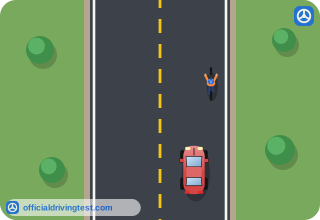
How should you pass a pedestrian or cyclist?
- Speed up so that you pass them as quickly as possible
- Pass as close to them as you can to save time
- Use the same care as when passing a motor vehicle
- Stay behind them until they leave the road
Show answer
Correct answer: Use the same care as when passing a motor vehicle
The manual says to use the same care when passing a pedestrian or cyclist as when passing a motor vehicle, slowing down and waiting for a safe opportunity if needed.
Source: Missouri Driver Guide (Revised August 2026), page 22 · Open this page in the manual (Manual page 22)
-
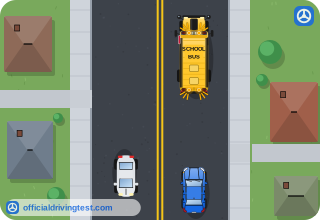
How far before a designated stop do a school bus's amber warning lights begin to flash?
- 500 feet
- 100 feet
- 200 feet
- 1,000 feet
Show answer
Correct answer: 500 feet
Amber warning lights flash 500 feet before the school bus comes to a designated stop.
Source: Missouri Driver Guide (Revised August 2026), page 23 · Open this page in the manual (Manual page 23)
-
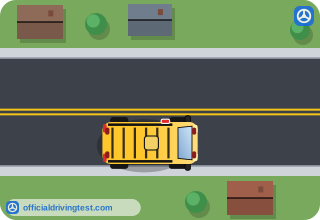
What signals does a stopped school bus use when it is loading or unloading children?
- Steady amber lights and a flashing white strobe
- Flashing amber lights and a raised flag
- Alternate flashing red lights and a stop signal arm
- Alternate flashing white lights and a horn
Show answer
Correct answer: Alternate flashing red lights and a stop signal arm
When the school bus is stopped, the alternate flashing red lights and the stop signal arm are activated.
Source: Missouri Driver Guide (Revised August 2026), page 23 · Open this page in the manual (Manual page 23)
-
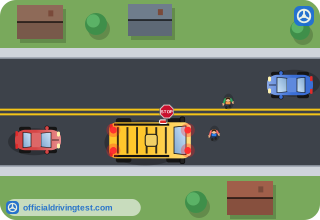
On a two-lane road, which traffic must stop before reaching a school bus whose red lights and stop arm are activated?
- Only following traffic
- Oncoming and following traffic
- Only oncoming traffic
- Only traffic in the lane next to the bus
Show answer
Correct answer: Oncoming and following traffic
Oncoming and following traffic must stop before they reach the bus when its signals are activated, including on a two-lane road.
Source: Missouri Driver Guide (Revised August 2026), page 23 · Open this page in the manual (Manual page 23)
-
Which situation lets you drive past a stopped school bus without stopping?
- Traveling the opposite direction on a two-lane road with no median
- Following the bus on a highway that has four or more lanes of traffic
- Following the bus on a one-way street with two lanes of traffic
- Traveling the opposite direction on a highway with four or more lanes
Show answer
Correct answer: Traveling the opposite direction on a highway with four or more lanes
You do not have to stop when you are traveling the opposite direction of a school bus on a highway containing four or more lanes of traffic.
Source: Missouri Driver Guide (Revised August 2026), page 24 · Open this page in the manual (Manual page 24)
-
On which kind of road do you not have to stop when traveling the opposite direction of a stopped school bus?
- A two-lane road with a solid double yellow center line
- A one-way street that has two lanes of traffic
- A road with two lanes and a wide paved shoulder
- A highway with each direction on a totally separate road
Show answer
Correct answer: A highway with each direction on a totally separate road
You do not have to stop when traveling the opposite direction of a school bus on a highway divided by a median where the directions are on totally separate roads.
Source: Missouri Driver Guide (Revised August 2026), page 24 · Open this page in the manual (Manual page 24)
-
When do you not have to stop for a school bus stopped in a loading zone at a school?
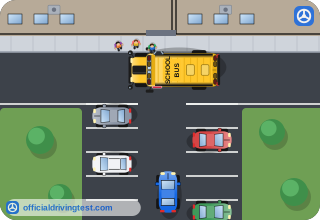
- When the bus has been stopped less than five minutes
- When students are not permitted to cross the roadway
- When fewer than five students are getting off
- When a crossing guard is present
Show answer
Correct answer: When students are not permitted to cross the roadway
You do not have to stop when a school bus is stopped in a loading zone at a school where students are not permitted to cross the roadway.
Source: Missouri Driver Guide (Revised August 2026), page 24 · Open this page in the manual (Manual page 24)
-
A school bus may not take on or discharge passengers on a highway of four or more lanes if it requires them to cross more than how many lanes of traffic?
- One lane
- Three lanes
- Two lanes
- Four lanes
Show answer
Correct answer: Two lanes
No school bus driver shall load or discharge passengers on a highway of four or more lanes in a way that requires them to cross more than two lanes of traffic.
Source: Missouri Driver Guide (Revised August 2026), page 24 · Open this page in the manual (Manual page 24)
-
After stopping for a school bus that is unloading children, what must you do?
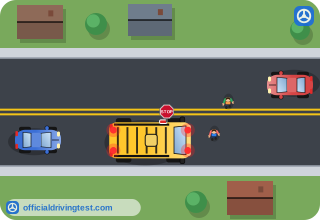
- Stay stopped until the bus moves or its driver signals you
- Proceed as soon as the first child reaches the sidewalk
- Go around the bus once the children are across the road
- Proceed after counting to ten if no child is in sight
Show answer
Correct answer: Stay stopped until the bus moves or its driver signals you
You must remain stopped until the bus moves or the bus driver signals for you to proceed, and then proceed with caution.
Source: Missouri Driver Guide (Revised August 2026), page 24 · Open this page in the manual (Manual page 24)
-
After stopping for a school bus that is unloading children, what should you watch for?
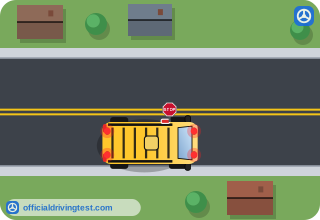
- School children walking along the side of the road
- Drivers behind you who want to pass the bus
- Crossing guards who direct traffic around the bus
- Bus drivers who want to merge back into traffic
Show answer
Correct answer: School children walking along the side of the road
After stopping for an unloading school bus, you should watch for school children walking along the side of the road.
Source: Missouri Driver Guide (Revised August 2026), page 24 · Open this page in the manual (Manual page 24)
-
How does the manual describe motorcycles from the point of view of other motorists?
- They are often overlooked by motorists.
- They are rarely overlooked because of their loud engines.
- They are easy to see from a long way off.
- They are always seen by drivers using mirrors.
Show answer
Correct answer: They are often overlooked by motorists.
The manual says motorcycles are often overlooked by motorists.
Source: Missouri Driver Guide (Revised August 2026), page 28 · Open this page in the manual (Manual page 28)
-
What does the manual say about judging the speed or distance of a motorcycle?
- It is easy because motorcycles keep a steady pace.
- It is only difficult at night.
- It is not always easy to do.
- It is only difficult on the interstate.
Show answer
Correct answer: It is not always easy to do.
The manual states that it is not always easy to judge the speed or distance of a motorcycle.
Source: Missouri Driver Guide (Revised August 2026), page 28 · Open this page in the manual (Manual page 28)
-
When you drive on a residential street with parked cars where motorcycles may be present, how should you travel?
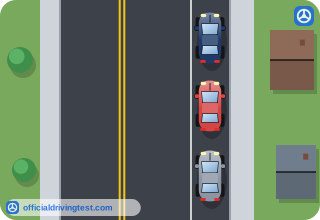
- Above the speed limit so you clear the parked cars quickly
- At or below the speed limit, depending on sight distance
- At the speed limit only, never below it
- At any speed that fits the traffic flow
Show answer
Correct answer: At or below the speed limit, depending on sight distance
The manual says to travel at or below the speed limit on such streets, depending on sight distance.
Source: Missouri Driver Guide (Revised August 2026), page 28 · Open this page in the manual (Manual page 28)
-
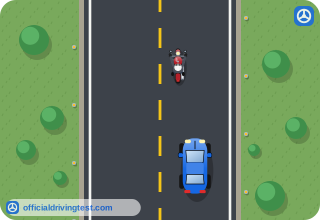
Which condition makes motorcyclists change speed and lane position, so that you should be ready to react?
- Smooth, dry, straight pavement
- Light traffic on a clear afternoon
- Newly painted lane lines
- Diagonal railroad tracks
Show answer
Correct answer: Diagonal railroad tracks
Motorcyclists change speed and lane position on bad road conditions such as manhole covers, diagonal railroad tracks, road debris or strong winds.
Source: Missouri Driver Guide (Revised August 2026), page 28 · Open this page in the manual (Manual page 28)
-
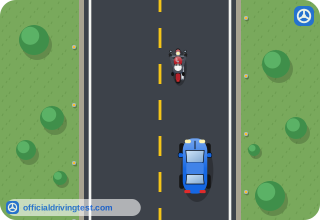
How much of a lane does a motorcyclist need for safety?
- The entire lane
- Half of the lane
- Two-thirds of the lane
- Only the center of the lane
Show answer
Correct answer: The entire lane
The manual says you should not share a lane with a motorcycle because the motorcyclist needs the entire lane for safety reasons.
Source: Missouri Driver Guide (Revised August 2026), page 28 · Open this page in the manual (Manual page 28)
-
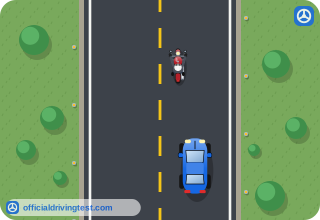
When you pass a motorcycle, how much room should you give it?
- Half a lane width
- Only as much as is left after you squeeze past
- A full lane width
- The width of the adjoining shoulder
Show answer
Correct answer: A full lane width
The manual tells drivers to give motorcycles a full lane width and not to squeeze past.
Source: Missouri Driver Guide (Revised August 2026), page 28 · Open this page in the manual (Manual page 28)
-
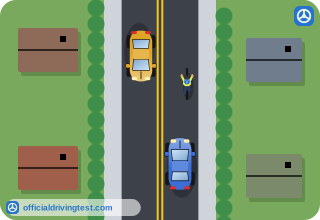
What should you do before passing a cyclist in a lane that is too narrow to share?
- Squeeze past while staying close to the lane line
- Wait for a clear stretch of road
- Sound your horn and pass at once
- Follow closely until the cyclist moves onto the sidewalk
Show answer
Correct answer: Wait for a clear stretch of road
The manual says to wait for a clear stretch of road before passing a cyclist in a lane too narrow to share.
Source: Missouri Driver Guide (Revised August 2026), page 28 · Open this page in the manual (Manual page 28)
-
According to the safety tips for motorcycle riders, what does the law require a motorcycle rider to wear?
- Bright colored clothing
- A reflective vest
- Gloves
- A helmet
Show answer
Correct answer: A helmet
The manual says the law requires motorcycle riders to wear a helmet.
Source: Missouri Driver Guide (Revised August 2026), page 28 · Open this page in the manual (Manual page 28)
-
What should a motorcycle rider do to make sure motorists see him or her?
- Wear bright colored clothes and stay out of blind spots
- Ride in the center of the lane between vehicles
- Keep the headlight off in daylight
- Ride close behind large vehicles
Show answer
Correct answer: Wear bright colored clothes and stay out of blind spots
The manual advises bright colored clothes, staying out of a vehicle's blind spots, and proper lights and reflectors after dark.
Source: Missouri Driver Guide (Revised August 2026), page 28 · Open this page in the manual (Manual page 28)
-
How much clearance should a motorcycle rider leave when passing to the left of a parked or moving vehicle?
- One to two feet
- Six to eight feet
- Three to four feet
- Ten to twelve feet
Show answer
Correct answer: Three to four feet
The manual says to leave three to four feet to avoid suddenly opened car doors or to allow for a vehicle to swerve.
Source: Missouri Driver Guide (Revised August 2026), page 28 · Open this page in the manual (Manual page 28)
-
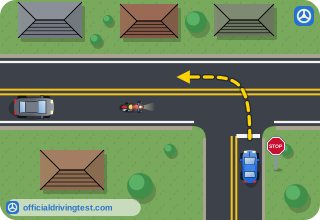
Why should a motorcycle rider be extra careful at intersections?
- Motorcycles are exempt from stop signs at intersections
- Drivers may not see the rider, or may think the rider is slower
- Motorcycle riders always have the right-of-way at intersections
- Motorcycles are allowed to turn only at intersections
Show answer
Correct answer: Drivers may not see the rider, or may think the rider is slower
The manual warns that drivers may not see a motorcycle approaching an intersection or may believe it is moving slower, so riders should not assume their right-of-way.
Source: Missouri Driver Guide (Revised August 2026), page 28 · Open this page in the manual (Manual page 28)
-
When should a motorcycle rider signal?
- Only when turning left at an intersection
- Only after beginning a lane change or turn
- Only after dark, when lights are needed
- Before slowing down, changing lanes or turning
Show answer
Correct answer: Before slowing down, changing lanes or turning
The manual says to signal before you slow down, change lanes or turn.
Source: Missouri Driver Guide (Revised August 2026), page 28 · Open this page in the manual (Manual page 28)
-
What does the manual advise a motorcycle rider to do as a courtesy to other traffic and to increase personal safety?
- Keep a steady line and be predictable
- Change lane position often so drivers notice you
- Match the lane position of the nearest car
- Ride on the lane line
Show answer
Correct answer: Keep a steady line and be predictable
The manual recommends keeping a steady line and being predictable.
Source: Missouri Driver Guide (Revised August 2026), page 28 · Open this page in the manual (Manual page 28)
-
Up to how much may a typical tractor-trailer combination weigh, according to the manual?
- 40,000 pounds
- 80,000 pounds
- 60,000 pounds
- 100,000 pounds
Show answer
Correct answer: 80,000 pounds
The manual says a typical tractor-trailer combination may weigh up to 80,000 pounds.
Source: Missouri Driver Guide (Revised August 2026), page 29 · Open this page in the manual (Manual page 29)
-
Depending on the trailer length, the total length of a typical tractor-trailer combination may exceed how many feet?
- 50 feet
- 60 feet
- 120 feet
- 90 feet
Show answer
Correct answer: 90 feet
The manual says the total length of the combination may exceed 90 feet.
Source: Missouri Driver Guide (Revised August 2026), page 29 · Open this page in the manual (Manual page 29)
-
On the busiest intercity routes, double or triple-trailer combinations may sometimes exceed what length?
- 100 feet
- 60 feet
- 75 feet
- 150 feet
Show answer
Correct answer: 100 feet
The manual says double or triple-trailer combinations are sometimes more than 100 feet long.
Source: Missouri Driver Guide (Revised August 2026), page 29 · Open this page in the manual (Manual page 29)
-
How does a semi-trailer combination accelerate at a traffic light, according to the manual?
- Faster than a car, because it has two or three times the power
- At the same rate as a car
- Slowly, and it may have to go through ten gears to reach the speed limit
- Quickly, because it needs only three gears
Show answer
Correct answer: Slowly, and it may have to go through ten gears to reach the speed limit
The manual notes that a semi-trailer combination accelerates slowly and may have to go through ten gears to reach the speed limit.
Source: Missouri Driver Guide (Revised August 2026), page 29 · Open this page in the manual (Manual page 29)
-
A truck engine must move how many times more weight than a car engine, according to the manual?
- 2 or 3 times more
- 30 or 40 times more
- 5 or 10 times more
- 100 times more
Show answer
Correct answer: 30 or 40 times more
With up to 70,000 pounds of trailer and cargo behind it, a truck engine must move 30 or 40 times more weight than a car engine.
Source: Missouri Driver Guide (Revised August 2026), page 29 · Open this page in the manual (Manual page 29)
-
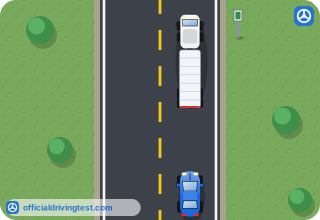
What should you NOT do when a large vehicle is coming along a roadway?
- Stay in your lane behind it
- Observe its turn signals
- Leave it a cushion of safety
- Enter the roadway in front of it
Show answer
Correct answer: Enter the roadway in front of it
The manual says not to enter a roadway in front of a large vehicle.
Source: Missouri Driver Guide (Revised August 2026), page 29 · Open this page in the manual (Manual page 29)
-
If you are driving behind a truck or a bus and cannot see the driver in his or her rearview mirrors, what does that mean?
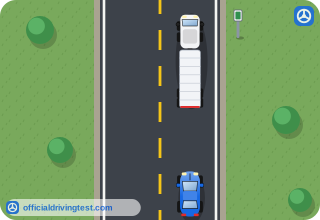
- The driver of that vehicle cannot see you
- The driver can see you in the side mirrors
- The driver will slow down for you
- The driver is about to stop
Show answer
Correct answer: The driver of that vehicle cannot see you
The manual says that if you cannot see a truck or bus driver in his or her mirrors, that driver cannot see you.
Source: Missouri Driver Guide (Revised August 2026), page 29 · Open this page in the manual (Manual page 29)
-
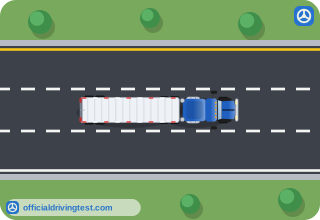
What are the blind spots on each side, in the rear and in the front of a truck or bus called?
- The Safe Zone
- The Gap Zone
- The No-Zone
- The Cushion
Show answer
Correct answer: The No-Zone
The manual calls these blind spots where an automobile cannot be seen the No-Zone.
Source: Missouri Driver Guide (Revised August 2026), page 29 · Open this page in the manual (Manual page 29)
-
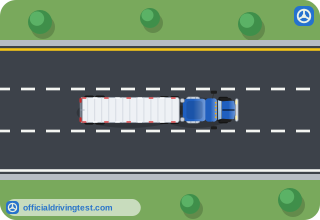
When may you drive in the No-Zone of a large vehicle?
- Whenever traffic is light
- Only when absolutely necessary
- Whenever you have signaled first
- Whenever the truck is traveling below the speed limit
Show answer
Correct answer: Only when absolutely necessary
The manual says not to drive in the No-Zone except when absolutely necessary.
Source: Missouri Driver Guide (Revised August 2026), page 29 · Open this page in the manual (Manual page 29)
-
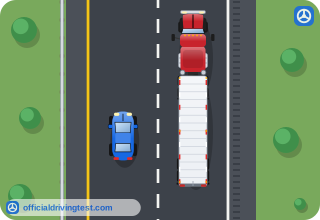
After you pass a truck, what must you be able to see before reentering the lane?
- The truck's rear wheels in your side mirror
- The truck's headlights in front of you
- Nothing, if you signal first
- The cab of the truck in your rearview mirror
Show answer
Correct answer: The cab of the truck in your rearview mirror
The manual says to make sure you can see the cab of the truck in your rearview mirror before reentering the lane.
Source: Missouri Driver Guide (Revised August 2026), page 29 · Open this page in the manual (Manual page 29)
-
What should you do once you have passed a truck and are in front of it?
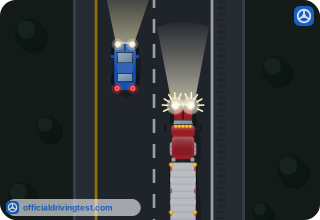
- Maintain your speed and signal when reentering the lane
- Slow down at once to leave the truck room
- Brake lightly to warn the truck driver
- Move back to the lane you left without signaling
Show answer
Correct answer: Maintain your speed and signal when reentering the lane
The manual says to maintain your speed, signal when reentering the lane, and not slow down once in front of the truck.
Source: Missouri Driver Guide (Revised August 2026), page 29 · Open this page in the manual (Manual page 29)