Missouri: Seat belts and child safety Practice Test
Missouri’s seat belt law and the child restraint and booster seat rules.
Independent educational site · not affiliated with any government agency or DMV
Ready? Test yourself
- Instant feedback with an explanation
- Every answer cites its source in the manual
- Your best score is saved on this device
Questions are original and based on the official manual "Missouri Driver Guide" (Revised August 2026), Missouri Department of Revenue.
All 16 questions in this practice test
Take the test above first, then use this list to study. Tap “Show answer” to see the correct answer and explanation.
Show the questions and answersHide the questions
-
Who must wear seat belts when you drive on an instruction permit?
- The driver and all passengers
- Only the driver
- Only passengers under 18 years old
- Only the supervising driver
Show answer
Correct answer: The driver and all passengers
Seat belts must be worn by the driver and all passengers.
Source: Missouri Driver Guide (Revised August 2026), page 15 · Open this page in the manual (Manual page 15)
-
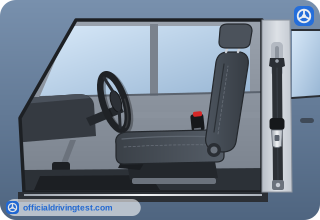
How should the lap belt of a seat belt be worn?
- Low and snug across the hips
- Loose across the stomach
- High and snug across the ribs
- Folded under the thighs
Show answer
Correct answer: Low and snug across the hips
Seat belts should be worn with the lap belt low and snug across the hips and the shoulder belt across the chest.
Source: Missouri Driver Guide (Revised August 2026), page 55 · Open this page in the manual (Manual page 55)
-
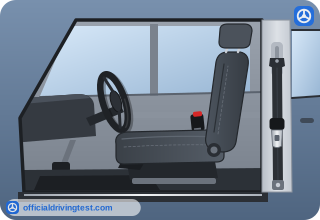
Where should a shoulder belt be positioned?
- Under the arm, tucked against the ribs for comfort
- Behind the back, held there by the lap belt
- Across the chest, never under the arm or behind the back
- Across the stomach, just above the lap belt
Show answer
Correct answer: Across the chest, never under the arm or behind the back
A shoulder belt goes across the chest. It should never be placed under the arm or behind the back.
Source: Missouri Driver Guide (Revised August 2026), page 55 · Open this page in the manual (Manual page 55)
-
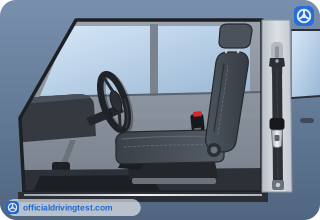
If a vehicle has a two-part seat belt system, what should the driver wear?
- Only the lap belt
- Both the lap belt and the shoulder belt
- Only the shoulder belt
- Either belt, whichever is more comfortable
Show answer
Correct answer: Both the lap belt and the shoulder belt
With a two-part seat belt system, be sure to wear both the lap belt and the shoulder belt.
Source: Missouri Driver Guide (Revised August 2026), page 55 · Open this page in the manual (Manual page 55)
-
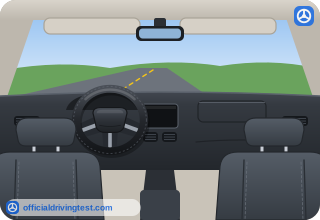
Why should seat belts be worn even if the vehicle has air bags?
- Air bags only work when a seat belt is not fastened by the occupants
- Air bags protect only the front-seat passengers and not the driver
- Air bags stop working once the vehicle is above low speeds
- Air bags do not protect you in a side or rear hit or a rollover
Show answer
Correct answer: Air bags do not protect you in a side or rear hit or a rollover
Air bags protect against hitting the steering wheel, dashboard or windshield, but not if you are hit from the side or rear or if the vehicle rolls over.
Source: Missouri Driver Guide (Revised August 2026), page 55 · Open this page in the manual (Manual page 55)
-
What distance does the National Highway Traffic Safety Administration recommend between the center of a driver’s breastbone and the center of the steering wheel?
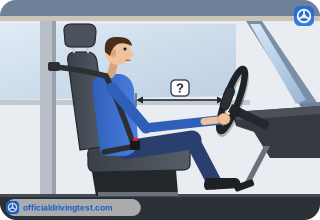
- At least four inches
- At least six inches
- At least ten inches
- At least fifteen inches
Show answer
Correct answer: At least ten inches
A deploying air bag can seriously injure an occupant, so drivers are advised to sit with at least ten inches between breastbone and steering wheel.
Source: Missouri Driver Guide (Revised August 2026), page 55 · Open this page in the manual (Manual page 55)
-
Children of what age and younger should always ride properly restrained in a rear seat?
- 12 and under
- 8 and under
- 10 and under
- 14 and under
Show answer
Correct answer: 12 and under
The manual says children 12 and under should always ride properly restrained in a rear seat.
Source: Missouri Driver Guide (Revised August 2026), page 55 · Open this page in the manual (Manual page 55)
-
Where should a rear-facing infant restraint never be placed?
- In the rear seat of a vehicle that has side air bags only
- In the middle of the rear seat, buckled in with a lap belt
- In any seat of a vehicle that has a driver-side air bag
- In the front seat of a vehicle with a front passenger air bag
Show answer
Correct answer: In the front seat of a vehicle with a front passenger air bag
A rear-facing infant restraint must never be put in the front seat of a vehicle with a front passenger air bag.
Source: Missouri Driver Guide (Revised August 2026), page 55 · Open this page in the manual (Manual page 55)
-
Who must be properly restrained when riding with an intermediate driver license holder?
- Only front-seat passengers
- All passengers
- Only passengers under age 18
- Only passengers who are not family members
Show answer
Correct answer: All passengers
Missouri law requires seat belts for the operator and front seat occupants, but ALL passengers accompanying an intermediate license holder must be properly restrained.
Source: Missouri Driver Guide (Revised August 2026), page 55 · Open this page in the manual (Manual page 55)
-
The child passenger restraint law applies to children in any motor vehicle except which of these?
- A public carrier for hire or a school bus
- A pickup truck or a sport utility vehicle
- A vehicle with front and side air bags
- A vehicle driven by the child’s parent
Show answer
Correct answer: A public carrier for hire or a school bus
The law applies to any motor vehicle other than a public carrier for hire or school bus.
Source: Missouri Driver Guide (Revised August 2026), page 55 · Open this page in the manual (Manual page 55)
-
A child is less than four years old. How must the child be secured?
- By a vehicle safety belt alone, as long as the child weighs 40 pounds or more
- In a booster seat only, and only if the child weighs under 40 pounds
- In an appropriate child passenger restraint system, whatever the child’s weight
- By a vehicle safety belt, as long as the child sits in a rear seat
Show answer
Correct answer: In an appropriate child passenger restraint system, whatever the child’s weight
Children less than four years old must be in an appropriate child passenger restraint system regardless of weight.
Source: Missouri Driver Guide (Revised August 2026), page 55 · Open this page in the manual (Manual page 55)
-
A child weighs less than 40 pounds. How must the child be secured?
- By a vehicle safety belt once the child is three years old or older
- In an appropriate child passenger restraint system, whatever the child’s age
- In a booster seat only, and only if the child is under four years old
- By a vehicle safety belt, as long as the child sits in a rear seat
Show answer
Correct answer: In an appropriate child passenger restraint system, whatever the child’s age
Children weighing less than 40 pounds must be in an appropriate child passenger restraint system regardless of age.
Source: Missouri Driver Guide (Revised August 2026), page 55 · Open this page in the manual (Manual page 55)
-
A child is five years old, weighs 50 pounds and is 4’0” tall. How must the child be secured?
- By a vehicle safety belt only, since the child is over four years old
- By a lap belt alone with the shoulder belt removed, in the rear seat
- By no restraint at all, as long as the child sits in a rear seat
- In a child passenger restraint system or booster seat appropriate for that child
Show answer
Correct answer: In a child passenger restraint system or booster seat appropriate for that child
Children at least four but less than eight years old who weigh at least 40 and less than 80 pounds and are under 4’9” must be in a child restraint system or booster seat.
Source: Missouri Driver Guide (Revised August 2026), page 56 · Open this page in the manual (Manual page 56)
-
A child is at least eight years old and weighs at least 80 pounds. How must the child be secured?
- By a rear-facing infant restraint placed in the rear seat
- By a child passenger restraint system only, never a booster
- By a vehicle safety belt or a booster seat appropriate for that child
- By no restraint at all, as long as the child sits in a rear seat
Show answer
Correct answer: By a vehicle safety belt or a booster seat appropriate for that child
Children at least eight years old, at least 80 pounds, or more than 4’9” tall must use a vehicle safety belt or booster seat appropriate for that child.
Source: Missouri Driver Guide (Revised August 2026), page 56 · Open this page in the manual (Manual page 56)
-
What reduces the likelihood of serious injury in a deer-vehicle crash?

- Everyone wearing seat belts and children in child safety seats
- Driving with the windows fully open to hear the deer
- Sounding the horn continuously just before the impact
- Carrying fewer passengers in the vehicle than usual
Show answer
Correct answer: Everyone wearing seat belts and children in child safety seats
To reduce the likelihood of serious injury in a crash, be sure all vehicle occupants wear seat belts and children are properly restrained in child safety seats.
Source: Missouri Driver Guide (Revised August 2026), page 59 · Open this page in the manual (Manual page 59)
-
A passenger car made after what date must have two sets of seat belts in the front seat?
- June 30, 1964
- June 30, 1954
- June 30, 1974
- June 30, 1984
Show answer
Correct answer: June 30, 1964
A passenger car made after June 30, 1964 must have two sets of seat belts in the front seat.
Source: Missouri Driver Guide (Revised August 2026), page 84 · Open this page in the manual (Manual page 84)