Missouri: Highway driving
Entering and leaving the highway, lane use, interchanges, the diverging diamond and what to do after a breakdown. Split into 2 shorter tests so you're not stuck in one long quiz.
Independent educational site · not affiliated with any government agency or DMV
All 33 Highway driving questions with answers
Choose a part above to take a practice test, or study every question and answer here.
Show the questions and answersHide the questions
-
On a highway with a total of two lanes, one in each direction, which lane do you drive in?
- The left-hand lane
- Whichever lane is less crowded
- The right-hand lane
- The paved shoulder
Show answer
Correct answer: The right-hand lane
On a two-lane highway you drive in the right hand lane.
Source: Missouri Driver Guide (Revised August 2026), page 37 · Open this page in the manual (Manual page 37)
-
When may you cross the center line for passing on a two-lane highway?
- When there are no oncoming vehicles and no solid yellow line
- Whenever the vehicle ahead is going slower than the posted limit
- When you see no oncoming vehicles, even if the line is solid yellow
- When you are approaching a curve and need to pass quickly
Show answer
Correct answer: When there are no oncoming vehicles and no solid yellow line
You may cross the center line for passing only when there are no oncoming vehicles and no solid yellow line.
Source: Missouri Driver Guide (Revised August 2026), page 37 · Open this page in the manual (Manual page 37)
-
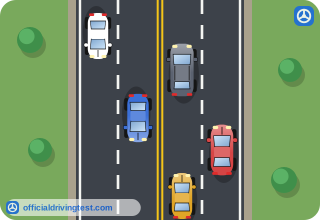
On a highway with four or more lanes in total, you should always keep to the right unless you are doing which of these?
- Getting a better view of road signs
- Staying away from vehicles on the shoulder
- Matching the speed of traffic in the left lane
- Passing slower traffic
Show answer
Correct answer: Passing slower traffic
On highways with four or more lanes, keep to the right unless passing slower traffic, letting another driver enter safely, or getting ready for a legal left turn.
Source: Missouri Driver Guide (Revised August 2026), page 37 · Open this page in the manual (Manual page 37)
-
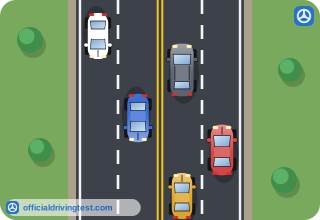
On a highway with four or more lanes in total, you should always keep to the right unless you are doing which of these?
- Driving below the posted speed limit
- Getting ready to make a legal left turn
- Following a large truck for a long distance
- Driving at night on a clear road
Show answer
Correct answer: Getting ready to make a legal left turn
Getting ready to make a legal left turn is one of the reasons to leave the right side on a multi-lane highway.
Source: Missouri Driver Guide (Revised August 2026), page 37 · Open this page in the manual (Manual page 37)
-
On a highway with four or more lanes in total, you should always keep to the right unless you are doing which of these?
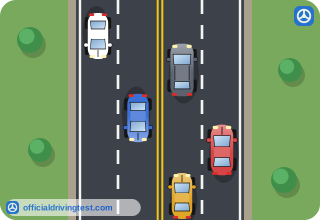
- Letting another driver have room to enter safely
- Avoiding the lane next to the paved shoulder
- Looking for a place to turn around safely
- Keeping up with the fastest traffic you see
Show answer
Correct answer: Letting another driver have room to enter safely
Letting another driver have room to enter safely is one of the reasons to leave the right side on a multi-lane highway.
Source: Missouri Driver Guide (Revised August 2026), page 37 · Open this page in the manual (Manual page 37)
-
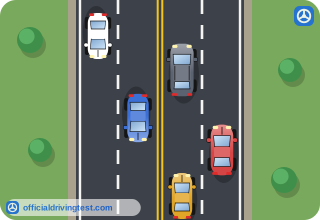
On a multi-lane highway, you should use the left lane only to do what?
- Drive at the speed limit
- Wait for traffic to clear
- Make a right turn
- Pass another vehicle
Show answer
Correct answer: Pass another vehicle
The manual says to use the left lane only to pass another vehicle.
Source: Missouri Driver Guide (Revised August 2026), page 37 · Open this page in the manual (Manual page 37)
-
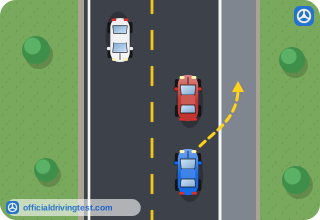
What does the manual say about using the shoulder or unpaved part of the highway to pass?
- Never use it to pass
- You may use it when no vehicles are behind you
- You may use it on a four-lane highway only
- You may use a paved shoulder when the left lane is blocked
Show answer
Correct answer: Never use it to pass
You must never use the shoulder or unpaved part of the highway to pass.
Source: Missouri Driver Guide (Revised August 2026), page 37 · Open this page in the manual (Manual page 37)
-
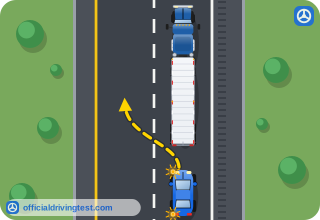
Before you pass a vehicle in front of you, what must you make sure of?
- That the vehicle ahead has signaled
- That the vehicle ahead is below the speed limit
- That there is a vehicle behind you
- That you are in a safe passing zone
Show answer
Correct answer: That you are in a safe passing zone
Before passing the vehicle in front of you, you make sure you are in a safe passing zone.
Source: Missouri Driver Guide (Revised August 2026), page 37 · Open this page in the manual (Manual page 37)
-
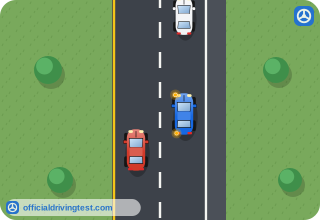
On a four-lane highway, how do you check the left lane for traffic before passing?
- Use your right mirror and look quickly over your right shoulder
- Use left and inside rearview mirrors and briefly look over your left shoulder
- Use only your inside mirror and wait until the vehicle ahead has moved over
- Sound your horn and watch the vehicle ahead for a signal
Show answer
Correct answer: Use left and inside rearview mirrors and briefly look over your left shoulder
You check the left lane using your left and inside rearview mirrors and briefly looking over your left shoulder.
Source: Missouri Driver Guide (Revised August 2026), page 37 · Open this page in the manual (Manual page 37)
-
Why is looking over your left shoulder important before passing?
- It allows you to check for blind spots
- It shows whether the vehicle behind is tailgating you
- It lets you see the speed of the vehicle ahead
- It lets oncoming drivers see that you intend to pass
Show answer
Correct answer: It allows you to check for blind spots
Looking over your left shoulder lets you check your blind spots.
Source: Missouri Driver Guide (Revised August 2026), page 37 · Open this page in the manual (Manual page 37)
-
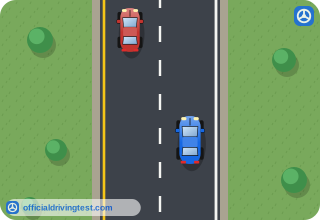
What are blind spots?
- Areas where other drivers cannot see your headlights
- Places on the road hidden by hills or curves
- The spaces you cannot see with your rearview mirrors
- Parts of the road where signs are missing
Show answer
Correct answer: The spaces you cannot see with your rearview mirrors
Blind spots are the spaces you cannot see with your rearview mirrors.
Source: Missouri Driver Guide (Revised August 2026), page 37 · Open this page in the manual (Manual page 37)
-
If you are driving on either side and slightly to the rear of another vehicle, what should you do?
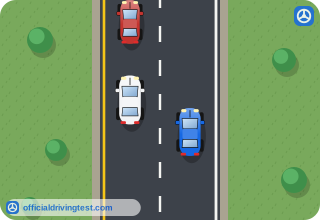
- Stay where you are and tap your horn so the driver sees you
- Speed up or drop back so the other driver can see you better
- Move closer to the vehicle so the other driver notices you
- Stay there and flash your headlights to get attention
Show answer
Correct answer: Speed up or drop back so the other driver can see you better
You should either speed up or drop back so the other driver can see your vehicle more easily.
Source: Missouri Driver Guide (Revised August 2026), page 37 · Open this page in the manual (Manual page 37)
-
When passing another vehicle, how should you get through the other driver’s blind spot?
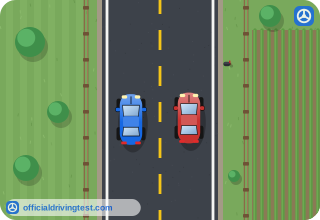
- Slowly, matching the other vehicle’s speed so you stay visible
- By staying alongside until the other driver signals
- At whatever speed lets you watch the other driver
- As quickly as you can without exceeding the speed limit
Show answer
Correct answer: As quickly as you can without exceeding the speed limit
You get through the other driver’s blind spot as quickly as you can without exceeding the speed limit, because the longer you stay there, the longer you are in danger of a collision.
Source: Missouri Driver Guide (Revised August 2026), page 37 · Open this page in the manual (Manual page 37)
-
If the way is clear when passing, what should you do before changing lanes?
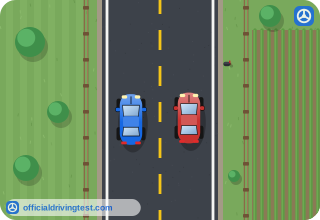
- Sound your horn to warn the other driver
- Flash your high beams at the other driver
- Signal that you are changing lanes
- Speed up before signaling the lane change
Show answer
Correct answer: Signal that you are changing lanes
If the way is clear, you signal that you are changing lanes and pass quickly and smoothly.
Source: Missouri Driver Guide (Revised August 2026), page 38 · Open this page in the manual (Manual page 38)
-
When may you turn back into the right lane after passing another vehicle?
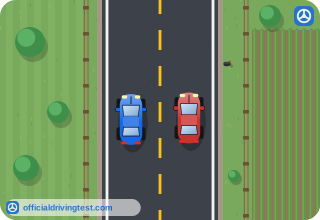
- As soon as you are ahead of the other vehicle’s front bumper
- When you see the passed vehicle in your rearview mirror
- After you have counted three seconds past the vehicle
- When the driver you passed flashes headlights to say you are clear
Show answer
Correct answer: When you see the passed vehicle in your rearview mirror
You do not turn back into the right lane until you see the passed vehicle in your rearview mirror.
Source: Missouri Driver Guide (Revised August 2026), page 38 · Open this page in the manual (Manual page 38)
-
When returning to the right lane after passing, over which shoulder do you look to check your blind spot?
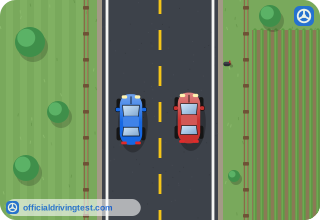
- Your left shoulder
- Neither, because mirrors are enough
- Both shoulders at once
- Your right shoulder
Show answer
Correct answer: Your right shoulder
You look over your right shoulder to check your blind spot, and you signal.
Source: Missouri Driver Guide (Revised August 2026), page 38 · Open this page in the manual (Manual page 38)
-
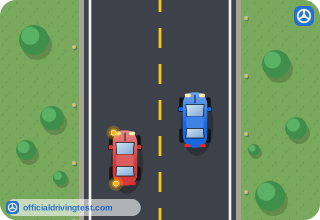
If another vehicle begins to pass you, what should you do?
- Move onto the shoulder to give room
- Slow down and flash your lights
- Stay in your lane and do not increase your speed
- Speed up so the other driver passes quickly
Show answer
Correct answer: Stay in your lane and do not increase your speed
You stay in your lane and do not increase your speed when another vehicle begins to pass you.
Source: Missouri Driver Guide (Revised August 2026), page 38 · Open this page in the manual (Manual page 38)
-
If many vehicles are passing you in the right lane of a multi-lane roadway, what does that probably mean?
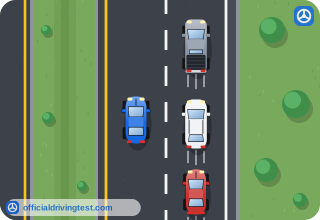
- You are going slower than the rest of the traffic
- The left lane is reserved for passing only
- Other drivers are exceeding the speed limit
- You are driving too close to the shoulder
Show answer
Correct answer: You are going slower than the rest of the traffic
If many vehicles pass you in the right lane, you are probably going slower than the rest of the traffic.
Source: Missouri Driver Guide (Revised August 2026), page 38 · Open this page in the manual (Manual page 38)
-
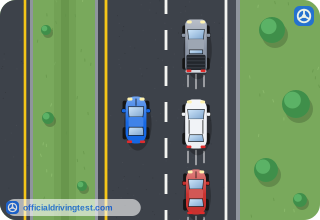
When many vehicles are passing you in the right lane of a multi-lane roadway, and you will not be turning left soon, what should you do?
- Stay in the left lane and keep your speed
- Speed up to keep pace with the passing vehicles
- Move onto the shoulder until traffic thins
- Move into the right lane when the way is clear
Show answer
Correct answer: Move into the right lane when the way is clear
Unless you will be turning left soon, you should move into the right lane when the way is clear.
Source: Missouri Driver Guide (Revised August 2026), page 38 · Open this page in the manual (Manual page 38)
-
Instead of stopping on the highway itself, where can you stop?
- On the median
- At rest stops or service areas
- Beside the entrance ramp
- In the right lane with flashers on
Show answer
Correct answer: At rest stops or service areas
You should never stop on the highway itself; many highways have rest stops and service areas.
Source: Missouri Driver Guide (Revised August 2026), page 39 · Open this page in the manual (Manual page 39)
-
What does it mean when a highway has controlled access?
- You can enter only at intersections with traffic signals
- You can enter or leave only where there are entrance or exit ramps
- Only vehicles with permits may use the highway
- Traffic is limited to one lane in each direction
Show answer
Correct answer: You can enter or leave only where there are entrance or exit ramps
On a controlled access highway you can enter or leave only where there are entrance or exit ramps.
Source: Missouri Driver Guide (Revised August 2026), page 39 · Open this page in the manual (Manual page 39)
-
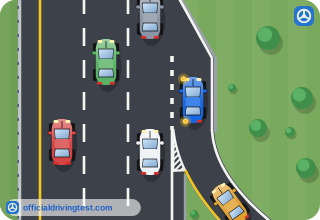
What is the purpose of the acceleration lane at the end of an entrance ramp?
- To stop and wait for an opening in highway traffic
- To slow down before joining the traffic
- To pass slower vehicles on the ramp
- To increase your speed to match the vehicles on the highway
Show answer
Correct answer: To increase your speed to match the vehicles on the highway
You use the ramp and acceleration lane to increase your speed to match the speed of the vehicles on the highway.
Source: Missouri Driver Guide (Revised August 2026), page 39 · Open this page in the manual (Manual page 39)
-
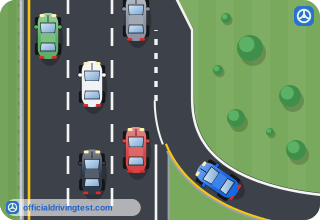
While you are speeding up on an entrance ramp and see an opening in the highway traffic, what should you do?
- Flash your headlights and let the highway traffic yield
- Stop at the end of the acceleration lane and wait
- Switch on your turn signal and pull smoothly into the traffic
- Move into the traffic quickly without signaling
Show answer
Correct answer: Switch on your turn signal and pull smoothly into the traffic
You switch on your turn signal and pull smoothly into the traffic.
Source: Missouri Driver Guide (Revised August 2026), page 39 · Open this page in the manual (Manual page 39)
-
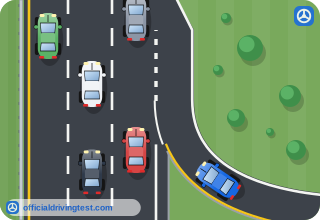
When may you stop at the end of an acceleration lane?
- When traffic is very heavy and you have to stop
- Whenever you cannot see an opening right away
- Whenever the highway traffic is above the speed limit
- Whenever you want to check your mirrors one more time
Show answer
Correct answer: When traffic is very heavy and you have to stop
You do not stop at the end of an acceleration lane unless traffic is very heavy and you have to stop.
Source: Missouri Driver Guide (Revised August 2026), page 39 · Open this page in the manual (Manual page 39)
-
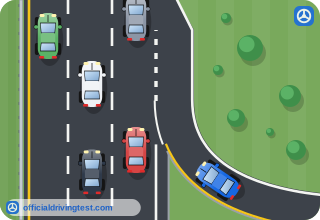
Drivers already on the highway should give you room to enter. If they do not, what must you do?
- Speed up and merge ahead of the nearest vehicle
- Honk and take the space you need to enter
- Merge at the speed of the ramp and let them adjust
- Yield the right-of-way to them, even if you must stop
Show answer
Correct answer: Yield the right-of-way to them, even if you must stop
You must yield the right-of-way to the drivers on the highway, even if that means stopping at the end of an acceleration lane.
Source: Missouri Driver Guide (Revised August 2026), page 39 · Open this page in the manual (Manual page 39)
-
What is at the beginning of most exit ramps?
- An acceleration lane
- A deceleration lane
- A merge lane
- A passing lane
Show answer
Correct answer: A deceleration lane
At the beginning of most exit ramps is a deceleration lane.
Source: Missouri Driver Guide (Revised August 2026), page 39 · Open this page in the manual (Manual page 39)
-
When should you be in the proper lane to leave the highway?
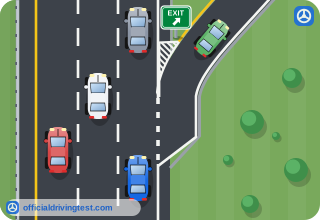
- Well in advance of the deceleration lane
- As you enter the deceleration lane
- Once you reach the exit ramp
- Just before the end of the ramp
Show answer
Correct answer: Well in advance of the deceleration lane
You make sure you are in the proper lane to leave the highway well in advance of the deceleration lane.
Source: Missouri Driver Guide (Revised August 2026), page 39 · Open this page in the manual (Manual page 39)
-
What should you do in the deceleration lane and on the exit ramp?
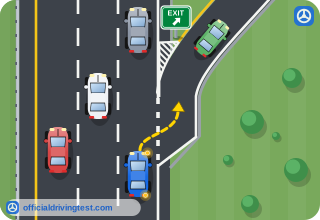
- Speed up to pass traffic
- Stop and check your mirrors
- Slow down
- Wait for traffic to clear
Show answer
Correct answer: Slow down
You use the deceleration lane and the exit ramp to slow down when leaving the highway.
Source: Missouri Driver Guide (Revised August 2026), page 39 · Open this page in the manual (Manual page 39)
-
Which sign must you be sure to obey on an exit ramp?
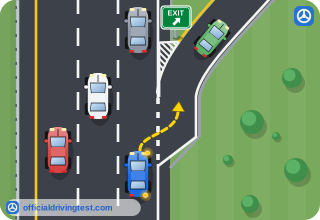
- The weight-limit sign
- The speed advisory sign
- The route marker
- The mile marker
Show answer
Correct answer: The speed advisory sign
You must be sure to obey the speed advisory sign on the exit ramp.
Source: Missouri Driver Guide (Revised August 2026), page 39 · Open this page in the manual (Manual page 39)
-
At the end of an exit ramp, what should you be ready to do?
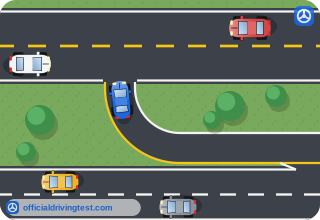
- Speed up
- Make a U-turn
- Merge without slowing
- Stop or yield
Show answer
Correct answer: Stop or yield
You should be ready to stop or yield at the end of the ramp.
Source: Missouri Driver Guide (Revised August 2026), page 39 · Open this page in the manual (Manual page 39)
-
If you miss your exit on a highway, what should you do?
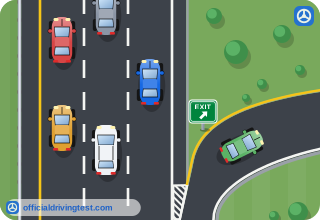
- Back up carefully on the shoulder to the missed exit
- Turn around at the nearest opening in the median strip
- Get off at the next exit and come back to the one you missed
- Stop and wait for a gap in traffic to make a U-turn
Show answer
Correct answer: Get off at the next exit and come back to the one you missed
You do not stop, back up, or turn around on the highway; you get off at the next exit and come back to the exit you missed.
Source: Missouri Driver Guide (Revised August 2026), page 39 · Open this page in the manual (Manual page 39)
-
When driving through a Diverging Diamond Interchange (DDI), where do you travel for a short distance?
- On the left side of the roadway
- On the shoulder of the roadway
- On the right side of the roadway only
- In the center turn lane
Show answer
Correct answer: On the left side of the roadway
When driving through a DDI, you will travel on the left side of the roadway for a short distance.
Source: Missouri Driver Guide (Revised August 2026), page 40 · Open this page in the manual (Manual page 40)
-
What can help you determine where you need to go on an interchange?
- Painted arrows on the shoulder
- Mile markers
- The shape of the ramps
- Directional signs
Show answer
Correct answer: Directional signs
There are directional signs on all interchanges that can help you determine where you need to go.
Source: Missouri Driver Guide (Revised August 2026), page 40 · Open this page in the manual (Manual page 40)