Mississippi: Right-of-way, turning and passing — Part 5 Practice Test
Who yields at intersections and four-way stops, driveways, turning step by step, multiple turn lanes, one-way streets, passing and being passed. — Part 5
Independent educational site · not affiliated with any government agency or DMV
Ready? Test yourself
- Instant feedback with an explanation
- Every answer cites its source in the manual
- Your best score is saved on this device
Questions are original and based on the official manual "Mississippi Driver's License Manual" (Revised December 2024), Mississippi Department of Public Safety, Driver Service Bureau.
All 17 questions in this practice test
Take the test above first, then use this list to study. Tap “Show answer” to see the correct answer and explanation.
Show the questions and answersHide the questions
-
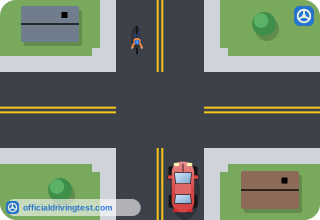
How does the manual say you must yield to bicycles?
- Only when they are in a marked bike lane
- Only when the cyclist signals first
- Exactly as you would to any other vehicle
- By waving them ahead before you stop
Show answer
Correct answer: Exactly as you would to any other vehicle
The manual says you must yield to bicycles exactly as you would to any other vehicle.
Source: Mississippi Driver's License Manual (Revised December 2024), page 55 · Open this page in the manual (Manual page 55)
-
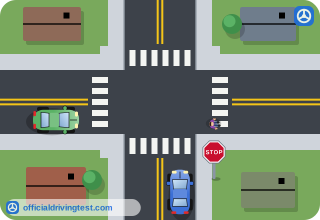
At an intersection with a stop sign or signal, where must you bring your vehicle to a complete stop?
- Past the crosswalk, inside the intersection
- At the crosswalk
- At the middle of the intersection
- At the far edge of the intersection
Show answer
Correct answer: At the crosswalk
At a stop sign or signal you must bring your vehicle to a complete stop at the crosswalk.
Source: Mississippi Driver's License Manual (Revised December 2024), page 56 · Open this page in the manual (Manual page 56)
-
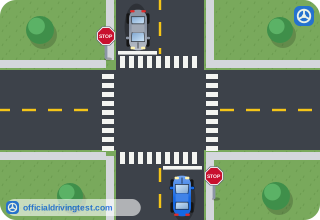
At an intersection with a stop sign or signal, after your complete stop, to whom must you yield the right-of-way?
- Only vehicles that are traveling straight ahead
- Only pedestrians who are in a marked crosswalk
- Only vehicles larger than yours
- Any vehicle or pedestrian in the intersection
Show answer
Correct answer: Any vehicle or pedestrian in the intersection
You must yield the right-of-way to any vehicle or pedestrian in the intersection and may proceed only when your way is completely clear.
Source: Mississippi Driver's License Manual (Revised December 2024), page 56 · Open this page in the manual (Manual page 56)
-
At a four-way stop, which vehicle has the right-of-way when the vehicles arrive at different times?
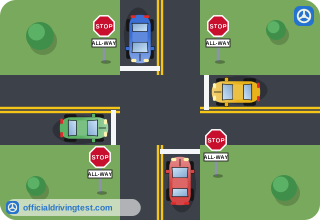
- The first vehicle to arrive
- The largest vehicle
- The vehicle on the left
- The vehicle that is traveling fastest
Show answer
Correct answer: The first vehicle to arrive
At a four-way stop the first vehicle to arrive has the right-of-way.
Source: Mississippi Driver's License Manual (Revised December 2024), page 56 · Open this page in the manual (Manual page 56)
-
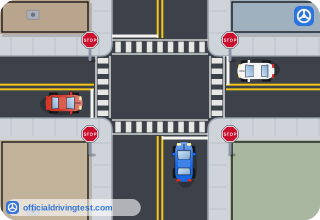
At a four-way stop, if several vehicles arrive at the same time, which vehicle has the right of way?
- The vehicle on the left
- The vehicle that signals first
- The vehicle on the right
- The largest vehicle
Show answer
Correct answer: The vehicle on the right
When multiple vehicles arrive at a four-way stop at the same time, the vehicle on the right has the right of way.
Source: Mississippi Driver's License Manual (Revised December 2024), page 56 · Open this page in the manual (Manual page 56)
-
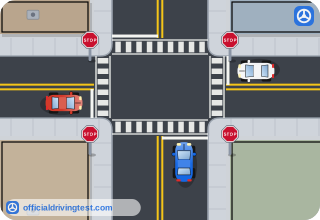
What does the manual warn you not to do in order to "stop first" at a four-way stop?
- Look at the other drivers
- Slam on your brakes
- Use your turn signal
- Yield to the driver on your right
Show answer
Correct answer: Slam on your brakes
The manual says not to slam on your brakes to “stop first” and to yield to the driver on the right.
Source: Mississippi Driver's License Manual (Revised December 2024), page 56 · Open this page in the manual (Manual page 56)
-
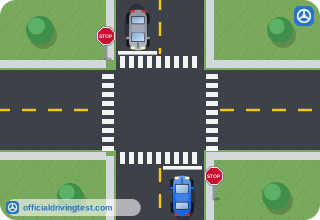
At a two-way stop, which traffic has the right of way?
- The traffic on the wider road, whether it has a stop sign or not
- Whichever vehicle at a stop sign is turning right
- The traffic that has the stop signs
- The cross-traffic with no stop signs
Show answer
Correct answer: The cross-traffic with no stop signs
At a two-way stop, the cross-traffic with no stop signs has the right of way, and vehicles at the stop signs wait until the way is clear.
Source: Mississippi Driver's License Manual (Revised December 2024), page 56 · Open this page in the manual (Manual page 56)
-
At a two-way stop, if two vehicles arrive at the stop signs at the same time, which has the right of way?
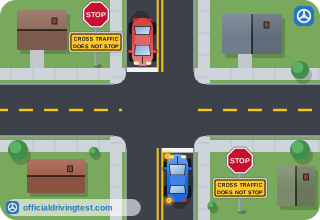
- The vehicle intending to travel straight across
- The vehicle intending to turn across the traffic lane
- The vehicle with its turn signal on
- The larger of the two vehicles
Show answer
Correct answer: The vehicle intending to travel straight across
When two vehicles arrive at the same time at a two-way stop, the vehicle intending to travel straight across has the right of way.
Source: Mississippi Driver's License Manual (Revised December 2024), page 56 · Open this page in the manual (Manual page 56)
-
Even when no stop sign is present, what must you do when entering a street or highway from a driveway?
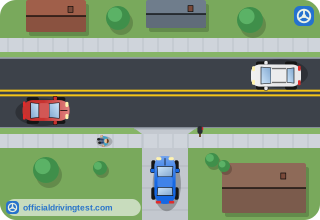
- Slow down and enter ahead of oncoming traffic
- Sound your horn and pull out slowly
- Stop and yield to oncoming traffic
- Merge into traffic without stopping
Show answer
Correct answer: Stop and yield to oncoming traffic
When entering a street or highway from a driveway or other entrance point, you must stop and yield to oncoming traffic even without a stop sign.
Source: Mississippi Driver's License Manual (Revised December 2024), page 57 · Open this page in the manual (Manual page 57)
-
At a highway intersection with no traffic signs or signals, what should you do?
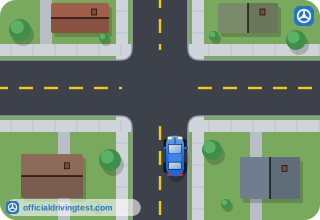
- Go first if you are on the wider road
- Yield to approaching traffic
- Sound your horn and keep your speed
- Speed up to clear it before others arrive
Show answer
Correct answer: Yield to approaching traffic
At an unmarked intersection you yield to approaching traffic, then proceed only when it is safe.
Source: Mississippi Driver's License Manual (Revised December 2024), page 57 · Open this page in the manual (Manual page 57)
-
In which direction do vehicles travel around a roundabout or traffic circle?

- Clockwise
- Straight across the center island
- Toward the nearest exit only
- Counterclockwise
Show answer
Correct answer: Counterclockwise
Vehicles travel counterclockwise around the raised center island of a roundabout.
Source: Mississippi Driver's License Manual (Revised December 2024), page 57 · Open this page in the manual (Manual page 57)
-
At a roundabout or traffic circle, which traffic yields the right of way?

- Traffic entering the roundabout
- Traffic already circulating in the roundabout
- Traffic exiting the roundabout
- The smaller vehicle
Show answer
Correct answer: Traffic entering the roundabout
Entering traffic yields the right of way to circulating traffic in a roundabout.
Source: Mississippi Driver's License Manual (Revised December 2024), page 57 · Open this page in the manual (Manual page 57)
-
What does the manual say to do as you approach a roundabout or traffic circle to enter it?

- Speed up to merge ahead of circulating traffic
- Signal and enter at your current speed
- Slow down
- Sound your horn and enter
Show answer
Correct answer: Slow down
The manual lists slowing down to enter the roundabout or traffic circle as the first step.
Source: Mississippi Driver's License Manual (Revised December 2024), page 57 · Open this page in the manual (Manual page 57)
-
When you reach the appropriate exit of a roundabout, what does the manual say to do?
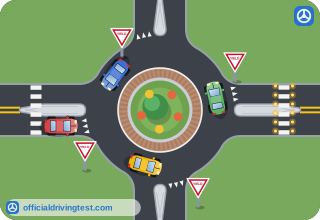
- Stop and wait for traffic to pass the exit
- Signal your intent and exit
- Turn on your hazard lights and slow to a crawl
- Sound your horn and exit
Show answer
Correct answer: Signal your intent and exit
The manual says to proceed to the appropriate exit, signal intent, and exit.
Source: Mississippi Driver's License Manual (Revised December 2024), page 57 · Open this page in the manual (Manual page 57)
-
What does the manual say about yielding the right of way to funeral processions?
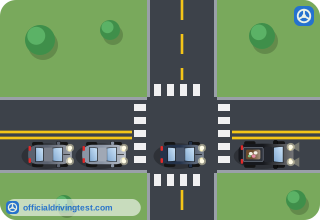
- It is required by law only on divided highways
- It is required by law in every situation
- It is not required by law, but common courtesy is to yield
- It is required by law only when a police escort leads the procession
Show answer
Correct answer: It is not required by law, but common courtesy is to yield
The manual says that although it is not required by law, common courtesy is to yield the right of way to funeral processions.
Source: Mississippi Driver's License Manual (Revised December 2024), page 59 · Open this page in the manual (Manual page 59)
-
What is true of the right of way for a driver leaving a parking space?
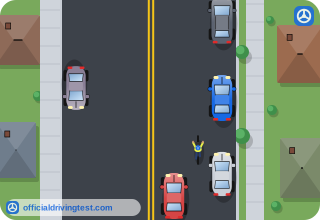
- The driver always has it
- The driver has it if signaling first
- The driver has it when leaving a parallel space
- The driver does not have it
Show answer
Correct answer: The driver does not have it
The manual says the driver leaving a parking space does not have the right of way and must yield to oncoming traffic.
Source: Mississippi Driver's License Manual (Revised December 2024), page 61 · Open this page in the manual (Manual page 61)
-
When leaving a parking space, what must you do about oncoming traffic?
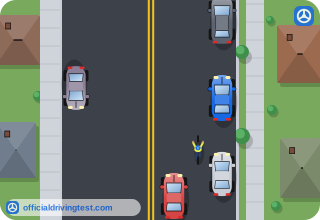
- Sound your horn and pull out
- Pull out first if you have signaled
- Speed up to merge with it
- Yield to it
Show answer
Correct answer: Yield to it
The manual says you must yield to any oncoming traffic when leaving a parking space.
Source: Mississippi Driver's License Manual (Revised December 2024), page 61 · Open this page in the manual (Manual page 61)