Mississippi: Emergency vehicles, work zones and traffic stops
Yielding to emergency vehicles, Mississippi’s move-over rule, work zones and what to do when pulled over by law enforcement. Split into 2 shorter tests so you're not stuck in one long quiz.
Independent educational site · not affiliated with any government agency or DMV
Choose a part
Emergency vehicles, work zones and traffic stops — Part 1
Questions in this part include: “What do work zone signs warn you about?”
StartEmergency vehicles, work zones and traffic stops — Part 2
Questions in this part include: “Which documents will the officer typically ask for during a traffic stop?”
StartAll 32 Emergency vehicles, work zones and traffic stops questions with answers
Choose a part above to take a practice test, or study every question and answer here.
Show the questions and answersHide the questions
-
What do work zone signs warn you about?
- That a railroad crossing is located just ahead
- That the road ahead is slippery when it is wet
- That a school zone begins at the next block
- That people are working on or near the roadway
Show answer
Correct answer: That people are working on or near the roadway
Work zone signs alert you to work zones ahead and warn that people are working on or near the roadway.
Source: Mississippi Driver's License Manual (Revised December 2024), page 33 · Open this page in the manual (Manual page 33)
-
An orange diamond-shaped sign shows a black figure holding a flag. What does it warn you about?
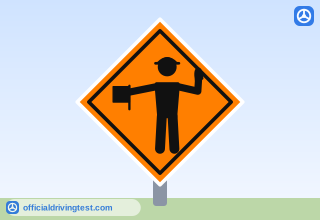
- Workers are ahead
- One lane of road is ahead
- A flagger is ahead
- A detour is ahead
Show answer
Correct answer: A flagger is ahead
A flagger ahead is the warning shown by the orange diamond with a figure holding a flag.
Source: Mississippi Driver's License Manual (Revised December 2024), page 33 · Open this page in the manual (Manual page 33)
-
An orange diamond-shaped sign shows a black figure digging with a shovel. What does it warn you about?
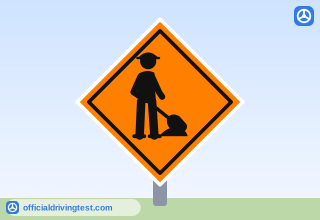
- A flagger is ahead
- Workers are ahead
- Road construction is ahead
- The road is closed
Show answer
Correct answer: Workers are ahead
The orange diamond with a figure shoveling warns that workers are ahead.
Source: Mississippi Driver's License Manual (Revised December 2024), page 33 · Open this page in the manual (Manual page 33)
-
In a work zone, a person may control traffic with a sign or flag to tell you which direction to travel or to slow down or stop. What must you do?
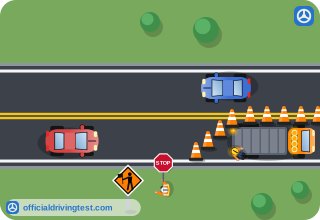
- Follow only the posted road signs
- Follow them only if they are a police officer
- Use your own judgment about when to stop
- Follow their instructions
Show answer
Correct answer: Follow their instructions
The manual says that when traffic is controlled by a person with a sign or flag, you must follow their instructions.
Source: Mississippi Driver's License Manual (Revised December 2024), page 33 · Open this page in the manual (Manual page 33)
-
What are barriers such as drums, cones and tubes (panels) used for in work zones?
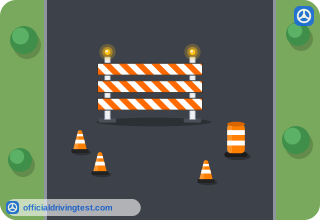
- To keep traffic out of hazardous work zones
- To mark where parking is allowed
- To show where the speed limit changes
- To separate lanes on a divided highway
Show answer
Correct answer: To keep traffic out of hazardous work zones
Barriers such as drums, cones and tubes keep traffic out of hazardous work zones.
Source: Mississippi Driver's License Manual (Revised December 2024), page 33 · Open this page in the manual (Manual page 33)
-
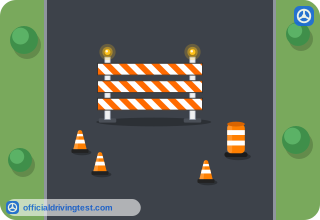
Besides keeping traffic out of hazardous work zones, what else may work zone barriers be used for?
- To mark the end of a no-passing zone on a two-lane road
- To keep drivers from entering closed roads or dangerous areas
- To show the location of a school crossing near the work site
- To slow traffic at railroad crossings near the work zone
Show answer
Correct answer: To keep drivers from entering closed roads or dangerous areas
Barriers may be used to keep drivers from entering closed roads or other areas where it is dangerous to drive.
Source: Mississippi Driver's License Manual (Revised December 2024), page 33 · Open this page in the manual (Manual page 33)
-
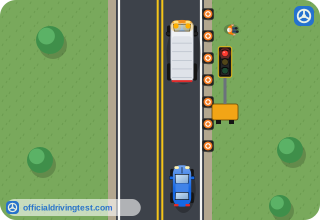
If you see a work zone warning sign showing a traffic signal symbol, where should you stop at the temporary signal?
- At the first orange cone
- Directly beside the signal
- Before the previous road sign
- At the white line, if present
Show answer
Correct answer: At the white line, if present
The manual says temporary traffic signals may be used in work zones and you should stop at the white line, if present.
Source: Mississippi Driver's License Manual (Revised December 2024), page 33 · Open this page in the manual (Manual page 33)
-
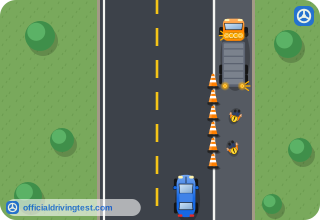
What does the manual tell you to do in work zones so that you give construction workers a "brake"?
- Reduce your speed and be prepared to stop suddenly
- Keep your speed and change lanes early to avoid them
- Stop completely at the first work zone sign you see
- Use your horn to warn the workers as you approach
Show answer
Correct answer: Reduce your speed and be prepared to stop suddenly
The manual says to reduce your speed in work zones and be prepared to stop suddenly.
Source: Mississippi Driver's License Manual (Revised December 2024), page 33 · Open this page in the manual (Manual page 33)
-
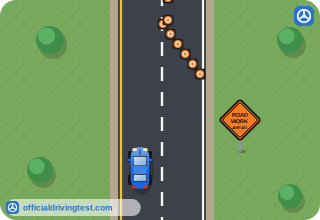
What does the manual say about following other vehicles in work zones?
- Follow closely to keep traffic moving
- Follow closely when traffic is slow
- Do not tailgate
- Follow closely only at night
Show answer
Correct answer: Do not tailgate
The manual says not to tailgate in work zones.
Source: Mississippi Driver's License Manual (Revised December 2024), page 33 · Open this page in the manual (Manual page 33)
-
How does the manual describe the right of way of an ambulance, fire engine, or police car flashing red or blue lights or signaling with a bell or siren?
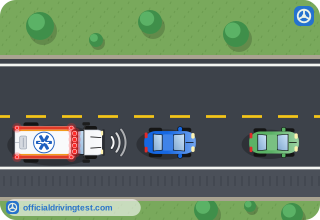
- It has the right of way only at intersections
- It has the right of way only on four-lane highways
- It always has the right of way on any street in any traffic situation
- It has the right of way only when traffic ahead has stopped
Show answer
Correct answer: It always has the right of way on any street in any traffic situation
The manual says such a vehicle always has the right of way on any street in any traffic situation.
Source: Mississippi Driver's License Manual (Revised December 2024), page 67 · Open this page in the manual (Manual page 67)
-
When an emergency vehicle is approaching, where should you pull your vehicle over, if possible, until it has passed?
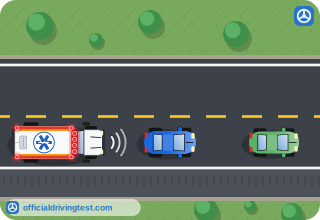
- To the extreme left side of the road
- To the extreme right shoulder of the road
- Into the center of the road
- Into the nearest lane, with your hazard lights on
Show answer
Correct answer: To the extreme right shoulder of the road
The manual says to pull over to the extreme right shoulder of the road, if possible, until the emergency vehicle has passed.
Source: Mississippi Driver's License Manual (Revised December 2024), page 67 · Open this page in the manual (Manual page 67)
-
If you are at an intersection when an emergency vehicle approaches, what does the manual say to do?
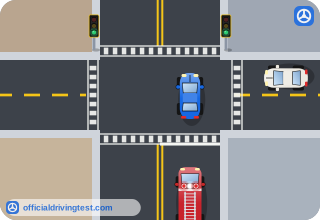
- Stop in the middle of the intersection until it passes
- Pull over to the extreme left shoulder at once
- Stop immediately and wait for the light to change
- Proceed through it, then pull over to the extreme right shoulder
Show answer
Correct answer: Proceed through it, then pull over to the extreme right shoulder
The manual says to proceed through the intersection and pull over to the extreme right shoulder.
Source: Mississippi Driver's License Manual (Revised December 2024), page 67 · Open this page in the manual (Manual page 67)
-
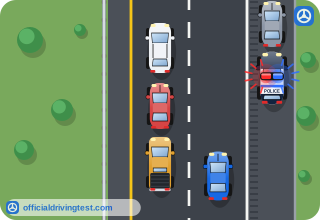
An emergency vehicle with lights or siren activated is parked along the side of a four-lane highway. What should you do if it is safe?
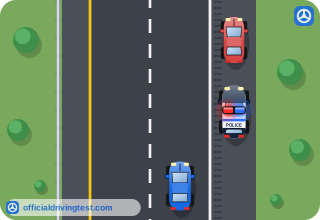
- Merge into the lane away from the emergency vehicle
- Drive past in the lane next to it at the same speed
- Stop in your lane behind it
- Move onto the shoulder beside it
Show answer
Correct answer: Merge into the lane away from the emergency vehicle
The manual says to merge into the lane away from the emergency vehicle if it is safe to do so.
Source: Mississippi Driver's License Manual (Revised December 2024), page 67 · Open this page in the manual (Manual page 67)
-
An emergency vehicle with lights or siren activated is parked along the side of a four-lane highway and merging into an adjacent lane is not safe. What should you do?
- Keep your speed and sound your horn
- Stop immediately in your lane
- Slow down and prepare to stop if necessary
- Speed up to pass it quickly
Show answer
Correct answer: Slow down and prepare to stop if necessary
The manual says that if merging into an adjacent lane is not safe, you should slow down and prepare to stop if necessary, because you must yield right of way.
Source: Mississippi Driver's License Manual (Revised December 2024), page 67 · Open this page in the manual (Manual page 67)
-
According to the manual, when are law enforcement officers responsible for conducting traffic stops?
- Only when they have seen a vehicle exceed the speed limit
- With reasonable suspicion of a traffic or criminal violation
- Only when a driver has already been involved in a crash
- Only when they have a signed warrant from a judge
Show answer
Correct answer: With reasonable suspicion of a traffic or criminal violation
The manual says officers conduct traffic stops when they have reasonable suspicion of a traffic violation or a criminal violation.
Source: Mississippi Driver's License Manual (Revised December 2024), page 67 · Open this page in the manual (Manual page 67)
-
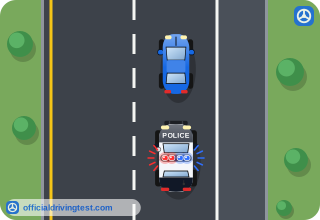
When you see emergency lights behind you, what should you do with your turn signal and position?
- Stop at once in the lane you are in and wait
- Speed up to reach a well-lit area before stopping
- Flash your headlights and continue to the next exit
- Signal and pull to the side when it is safe
Show answer
Correct answer: Signal and pull to the side when it is safe
The manual says to activate your turn signal and pull off or to the side of the roadway as soon as it is safe to do so.
Source: Mississippi Driver's License Manual (Revised December 2024), page 67 · Open this page in the manual (Manual page 67)
-
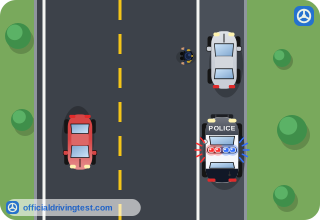
During a traffic stop, what should you do with the engine and any audio devices?
- Turn off both
- Leave both on so you can hear the officer
- Turn off the engine but leave the audio devices on
- Turn off the audio devices but leave the engine running
Show answer
Correct answer: Turn off both
The manual says to turn off the engine and any audio devices when stopped by an officer.
Source: Mississippi Driver's License Manual (Revised December 2024), page 67 · Open this page in the manual (Manual page 67)
-
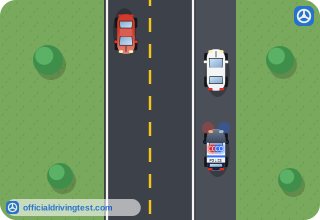
During a traffic stop, what should you do about staying in or leaving your vehicle?
- Get out and walk back to the officer’s patrol vehicle
- Get out and stand beside your own vehicle
- Stay in it unless the officer directs you to exit
- Move to the passenger seat and wait there
Show answer
Correct answer: Stay in it unless the officer directs you to exit
The manual says to stay in your vehicle unless the officer directs you to exit.
Source: Mississippi Driver's License Manual (Revised December 2024), page 67 · Open this page in the manual (Manual page 67)
-
If you are pulled over at night, what does the manual say to do to help visibility?
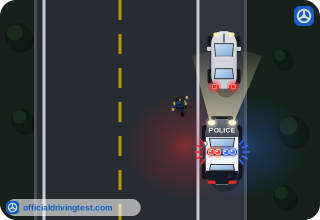
- Turn on your high beams
- Turn on your interior lights
- Turn off all of your lights
- Turn on your emergency flashers only
Show answer
Correct answer: Turn on your interior lights
The manual says to turn on your interior lights if you are pulled over at night to assist with visibility.
Source: Mississippi Driver's License Manual (Revised December 2024), page 67 · Open this page in the manual (Manual page 67)
-
During a traffic stop, where should you keep your hands?
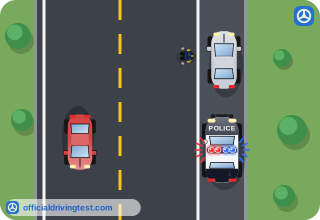
- On your lap or in your pockets
- Out of the window of the vehicle
- On the dashboard, away from the officer
- On the steering wheel or in a visible location
Show answer
Correct answer: On the steering wheel or in a visible location
The manual says to keep your hands on the steering wheel or in a visible location so they are easily observable.
Source: Mississippi Driver's License Manual (Revised December 2024), page 67 · Open this page in the manual (Manual page 67)
-
During a traffic stop, which instructions should you follow?
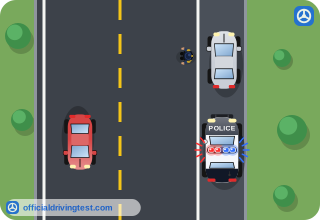
- All instructions the officer gives you or your passengers
- Only the instructions given directly to the driver
- Only the instructions you agree with
- Only the instructions given in writing
Show answer
Correct answer: All instructions the officer gives you or your passengers
The manual says to follow all instructions the officer gives you or your passengers.
Source: Mississippi Driver's License Manual (Revised December 2024), page 67 · Open this page in the manual (Manual page 67)
-
When an officer approaches your vehicle during a traffic stop, what should you do about the window?
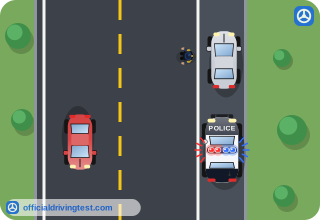
- Keep all windows closed and wave to the officer
- Lower every window in the vehicle at once
- Lower the window on the side the officer approaches
- Open the door so the officer can speak to you
Show answer
Correct answer: Lower the window on the side the officer approaches
The manual says the officer may approach either side of the vehicle and to lower the corresponding window so that you can better communicate.
Source: Mississippi Driver's License Manual (Revised December 2024), page 68 · Open this page in the manual (Manual page 68)
-
If you have a weapon in the vehicle when an officer approaches, when should you let the officer know?
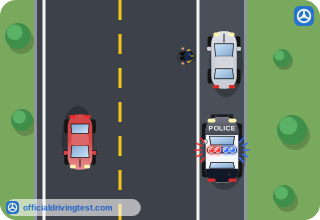
- Only if the officer asks to search the vehicle
- Upon first contact
- After handing over your documents
- Only if the officer asks you to exit
Show answer
Correct answer: Upon first contact
The manual says to let the officer know if you have a weapon in the vehicle upon first contact.
Source: Mississippi Driver's License Manual (Revised December 2024), page 68 · Open this page in the manual (Manual page 68)
-
When should you reach for your driver’s license or vehicle documents during a traffic stop?
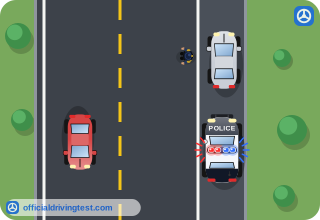
- As soon as you stop the vehicle
- As soon as you lower the window
- As soon as the officer reaches the vehicle
- After you wait for the officer’s instructions
Show answer
Correct answer: After you wait for the officer’s instructions
The manual says to wait for the officer’s instructions before reaching for your driver’s license or vehicle documents.
Source: Mississippi Driver's License Manual (Revised December 2024), page 68 · Open this page in the manual (Manual page 68)
-
Which documents will the officer typically ask for during a traffic stop?
- Your driver’s license, proof of insurance, and vehicle registration
- Your driver’s license, birth certificate, and vehicle title
- Your proof of insurance, tag receipt, and repair records
- Your vehicle registration, work schedule, and trip log
Show answer
Correct answer: Your driver’s license, proof of insurance, and vehicle registration
The manual says the officer will typically ask for your driver’s license, proof of insurance, and vehicle registration.
Source: Mississippi Driver's License Manual (Revised December 2024), page 68 · Open this page in the manual (Manual page 68)
-
If the documents the officer asks for are out of your reach, what should you do?
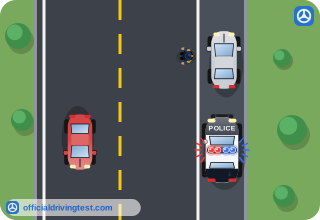
- Reach for them quickly while the officer watches you
- Ask a passenger to hand them out of the window
- Tell the officer where they are, then wait for acknowledgment
- Step out of the vehicle to get them from the trunk
Show answer
Correct answer: Tell the officer where they are, then wait for acknowledgment
The manual says to tell the officer where the documents are and wait for the officer’s acknowledgment before reaching to retrieve them.
Source: Mississippi Driver's License Manual (Revised December 2024), page 68 · Open this page in the manual (Manual page 68)
-
If an officer who is not in uniform stops you and does not show law enforcement credentials, what may you do?
- Drive away without stopping
- Ask to see them
- Refuse to give any information
- Wait until another officer arrives
Show answer
Correct answer: Ask to see them
The manual says an officer who is not in uniform will typically show credentials, and if not, you may ask to see them.
Source: Mississippi Driver's License Manual (Revised December 2024), page 68 · Open this page in the manual (Manual page 68)
-
If the officer asks you to exit the vehicle, what should you do?
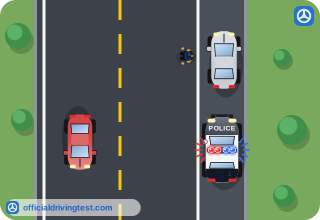
- Stay in the vehicle with the engine running
- Exit quickly and walk to the officer’s vehicle
- Exit and stand at the rear of your own vehicle
- Keep your hands visible, exit, and stand where directed
Show answer
Correct answer: Keep your hands visible, exit, and stand where directed
The manual says to keep your hands visible, exit the vehicle, and stand in the location the officer directs.
Source: Mississippi Driver's License Manual (Revised December 2024), page 68 · Open this page in the manual (Manual page 68)
-
What may you do if the officer does not explain the action being taken during a traffic stop?
- Ask the officer to explain it
- Leave the scene and call later
- Ask a passenger to explain it
- Wait until a court date to find out
Show answer
Correct answer: Ask the officer to explain it
The manual says the officer will typically explain the action being taken, and if not, you may ask them to do so.
Source: Mississippi Driver's License Manual (Revised December 2024), page 68 · Open this page in the manual (Manual page 68)
-
If you disagree with the officer’s decision or course of action during a stop, what does the manual say to do?
- Argue your case until the officer changes the decision
- Refuse to sign any ticket the officer writes
- Do not argue; you may contest the decision in court
- Drive to the agency’s office to protest right away
Show answer
Correct answer: Do not argue; you may contest the decision in court
The manual says not to prolong the contact by arguing; you may seek to contest the decision in court through established legal channels.
Source: Mississippi Driver's License Manual (Revised December 2024), page 68 · Open this page in the manual (Manual page 68)
-
What does the manual say about your acceptance and signature on a traffic ticket?
- It is an admission of guilt
- It is not an admission of guilt
- It ends your right to contest the ticket
- It means you agree to pay at the scene
Show answer
Correct answer: It is not an admission of guilt
The manual states that your acceptance and signature on a traffic ticket is not an admission of guilt.
Source: Mississippi Driver's License Manual (Revised December 2024), page 68 · Open this page in the manual (Manual page 68)
-
If you believe an officer acted inappropriately during a stop, what may you do?
- Call the driver service bureau and request a refund
- Follow the officer back to the station at once
- Wait a year before you contact anyone about it
- Contact the officer’s agency and ask for a supervisor
Show answer
Correct answer: Contact the officer’s agency and ask for a supervisor
The manual says you may call or contact the officer’s agency and request to speak to a supervisor, and that this is best done as soon as possible after the stop.
Source: Mississippi Driver's License Manual (Revised December 2024), page 68 · Open this page in the manual (Manual page 68)