Mississippi: Emergencies — Part 2 Practice Test
Questions in this part include: “Which information must you give to all other parties involved in an accident?” · “What should you use in daylight hours, in the same positions as night flares, when your truck is disabled?”
Independent educational site · not affiliated with any government agency or DMV
Ready? Test yourself
- Instant feedback with an explanation
- Every answer cites its source in the manual
- Your best score is saved on this device
Questions are original and based on the official manual "Mississippi Driver's License Manual" (Revised December 2024), Mississippi Department of Public Safety, Driver Service Bureau.
All 16 questions in this practice test
Take the test above first, then use this list to study. Tap “Show answer” to see the correct answer and explanation.
Show the questions and answersHide the questions
-
If you are involved in an accident, what must you do first?
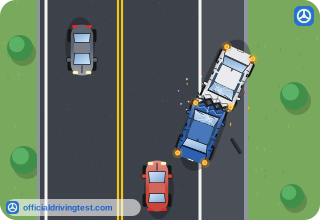
- Stop at once and help anyone who has been injured
- Move the vehicle out of sight and call your insurer
- Leave the scene if you were not at fault
- Wait for the officer without speaking to the other driver
Show answer
Correct answer: Stop at once and help anyone who has been injured
The manual says to stop at once and help anyone who has been injured.
Source: Mississippi Driver's License Manual (Revised December 2024), page 66 · Open this page in the manual (Manual page 66)
-
Which information must you give to all other parties involved in an accident?
- Your name, address, Social Security number, and employer
- Your name, license plate number, and bank account number
- Your address, insurance premium, and credit card number
- Your name, address, license plate number, and insurance information
Show answer
Correct answer: Your name, address, license plate number, and insurance information
The manual says to give all other parties your name, address, license plate number, and insurance information, and to get the same from them for your own protection.
Source: Mississippi Driver's License Manual (Revised December 2024), page 66 · Open this page in the manual (Manual page 66)
-
If you are injured so badly after an accident that you cannot make an immediate report, who else may make it?
- Only a law enforcement officer
- Any one of your passengers
- Only the other driver
- Only your insurance company
Show answer
Correct answer: Any one of your passengers
The manual says that if you are injured too badly to report immediately, any one of your passengers may do so.
Source: Mississippi Driver's License Manual (Revised December 2024), page 66 · Open this page in the manual (Manual page 66)
-
How does the manual describe the accident reports made to law enforcement?
- They are open to the public
- They are shared with your employer
- They are posted online
- They are confidential
Show answer
Correct answer: They are confidential
The manual states that these accident reports are confidential.
Source: Mississippi Driver's License Manual (Revised December 2024), page 66 · Open this page in the manual (Manual page 66)
-
What do you dial on a cellular phone to be connected toll free to a Mississippi Highway Patrol dispatcher to report an emergency traffic situation on an interstate or highway?
- *HP (*47)
- *MS (*67)
- *DL (*35)
- *MHP (*647)
Show answer
Correct answer: *HP (*47)
The manual says to dial *HP (*47) on a cellular phone, to state your emergency and give the location, and to report only actual emergencies.
Source: Mississippi Driver's License Manual (Revised December 2024), page 66 · Open this page in the manual (Manual page 66)
-
If you are involved in an accident or your car breaks down on the interstate, where should you move your vehicle?
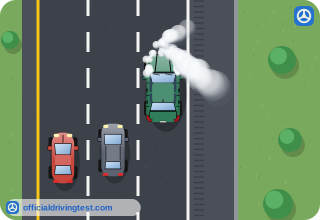
- Onto the left shoulder next to the median, as far from traffic as you can
- Off the pavement onto the extreme right shoulder or as far right as is practical
- Onto the nearest exit ramp, even if you must stop and back up to reach it
- Into the right lane, staying in it with your emergency flashers turned on
Show answer
Correct answer: Off the pavement onto the extreme right shoulder or as far right as is practical
After an accident or breakdown you move off the pavement onto the extreme right shoulder or as far to the right as is practical.
Source: Mississippi Driver's License Manual (Revised December 2024), page 70 · Open this page in the manual (Manual page 70)
-
If you are involved in an accident or break down at night, what should you do with your lights?
- Turn off all of your lights to avoid being hit
- Switch to your parking lights only and raise the hood
- Turn off your headlights but leave the flashers on
- Leave your lights on and use your emergency flashers
Show answer
Correct answer: Leave your lights on and use your emergency flashers
At night you leave your lights on and use your emergency flashers.
Source: Mississippi Driver's License Manual (Revised December 2024), page 70 · Open this page in the manual (Manual page 70)
-
If you are stranded on the interstate, what should you do?
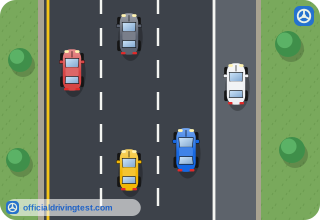
- Stay inside your vehicle, lock the doors, and wait for reliable help
- Get out and stand beside your vehicle so that others can see you
- Hitchhike to the nearest exit and call for help from there
- Get out and wave down passing drivers in the main flow of traffic
Show answer
Correct answer: Stay inside your vehicle, lock the doors, and wait for reliable help
A stranded driver stays inside the vehicle with the doors locked and waits for reliable help, and never stands beside the vehicle or hitchhikes.
Source: Mississippi Driver's License Manual (Revised December 2024), page 70 · Open this page in the manual (Manual page 70)
-
If you operate a bus or truck at night, what is the least number of flares, fuses, electric flares, or reflectors you must carry?
- One
- Two
- Four
- Three
Show answer
Correct answer: Three
At night a bus or truck must carry at least three flares, fuses, electric flares, or reflectors.
Source: Mississippi Driver's License Manual (Revised December 2024), page 84 · Open this page in the manual (Manual page 84)
-
If your truck becomes disabled, about how far ahead of your location should you place the first warning device?
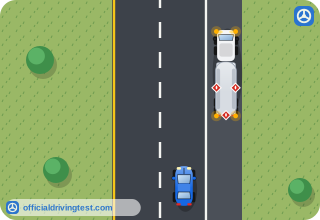
- About one hundred feet
- About fifty feet
- About two hundred feet
- About five hundred feet
Show answer
Correct answer: About one hundred feet
One warning device goes approximately one hundred feet ahead, a second one hundred feet to the rear, and a third at the roadway side of the vehicle.
Source: Mississippi Driver's License Manual (Revised December 2024), page 84 · Open this page in the manual (Manual page 84)
-
When a truck is disabled, where should the third warning device be placed, after one ahead and one to the rear?
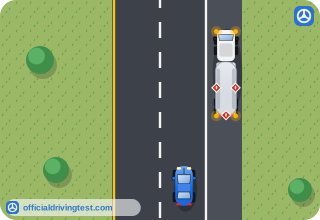
- Two hundred feet behind the vehicle
- On the roof of the cab
- At the roadway side of the vehicle
- At the nearest intersection
Show answer
Correct answer: At the roadway side of the vehicle
The third warning device goes at the roadway side of the vehicle, in addition to those one hundred feet ahead and one hundred feet to the rear.
Source: Mississippi Driver's License Manual (Revised December 2024), page 84 · Open this page in the manual (Manual page 84)
-
What should you use in daylight hours, in the same positions as night flares, when your truck is disabled?
- White flags
- Red flags
- Orange traffic cones
- Hazard lights alone
Show answer
Correct answer: Red flags
In daylight hours you should use red flags in the same positions as the night warning devices.
Source: Mississippi Driver's License Manual (Revised December 2024), page 84 · Open this page in the manual (Manual page 84)
-
After an accident involving a truck carrying gasoline, oil, or explosives, whom should you keep away?
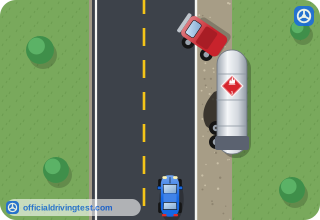
- Only the other driver
- Only people in vehicles
- Only children
- People, especially smokers
Show answer
Correct answer: People, especially smokers
In case of an accident, you should keep people, especially smokers, away from the truck.
Source: Mississippi Driver's License Manual (Revised December 2024), page 87 · Open this page in the manual (Manual page 87)
-
On the Natchez Trace Parkway, to whom should you report accidents, fires, or other emergencies?
- The nearest county sheriff's office
- The nearest Ranger
- The nearest driver license station
- The nearest hospital emergency room
Show answer
Correct answer: The nearest Ranger
All accidents, fires, and other emergencies on the Parkway should be reported to the nearest Ranger.
Source: Mississippi Driver's License Manual (Revised December 2024), page 90 · Open this page in the manual (Manual page 90)
-
If you cannot find the telephone number for help on the Natchez Trace Parkway, what does the manual say to do?
- Dial "0" for the operator and ask to be connected to the nearest Natchez Trace Park Ranger
- Wait at the roadside until a Park Ranger happens to drive by and stops to help you
- Drive off the Parkway and ask for help at the next driver license station you find
- Call the Superintendent's office in Tupelo and leave a message describing the problem
Show answer
Correct answer: Dial "0" for the operator and ask to be connected to the nearest Natchez Trace Park Ranger
A driver who cannot locate the number dials "0" for the operator and asks to be connected to the nearest Natchez Trace Park Ranger.
Source: Mississippi Driver's License Manual (Revised December 2024), page 90 · Open this page in the manual (Manual page 90)
-
When you ask the operator to connect you to a Natchez Trace Park Ranger, what should you be sure to give?
- Your driver's license number and vehicle registration papers
- Your full name, home address and the name of your insurance company
- Your approximate location and a description of the circumstances
- The number of passengers and the make and model of your vehicle
Show answer
Correct answer: Your approximate location and a description of the circumstances
The caller should give an approximate location and describe the circumstances.
Source: Mississippi Driver's License Manual (Revised December 2024), page 90 · Open this page in the manual (Manual page 90)