Mississippi: Emergencies — Part 1 Practice Test
Questions in this part include: “According to the manual, when are road conditions the slickest and most dangerous in rainy weather?” · “When you must walk to seek help, what type of road does the manual say you must NEVER cross?”
Independent educational site · not affiliated with any government agency or DMV
Ready? Test yourself
- Instant feedback with an explanation
- Every answer cites its source in the manual
- Your best score is saved on this device
Questions are original and based on the official manual "Mississippi Driver's License Manual" (Revised December 2024), Mississippi Department of Public Safety, Driver Service Bureau.
All 16 questions in this practice test
Take the test above first, then use this list to study. Tap “Show answer” to see the correct answer and explanation.
Show the questions and answersHide the questions
-
What does the manual say about a vehicle that breaks down?
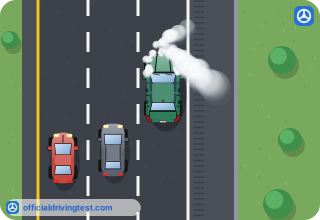
- You will not be arrested, but should move it out of the way quickly
- You must leave it where it stopped until an officer arrives
- You may be arrested if you cannot move it at once
- You should leave it in place until it is repaired
Show answer
Correct answer: You will not be arrested, but should move it out of the way quickly
If your vehicle breaks down you will not be arrested, but you should move it out of the way as quickly as possible.
Source: Mississippi Driver's License Manual (Revised December 2024), page 60 · Open this page in the manual (Manual page 60)
-
According to the manual, when are road conditions the slickest and most dangerous in rainy weather?
- In the opening minutes of rain or drizzle
- After several hours of steady rain
- In the minutes right after the rain stops
- Only during a heavy downpour
Show answer
Correct answer: In the opening minutes of rain or drizzle
The first water to hit the road loosens dirt and grease that coat it with a slick film, so the opening minutes of rain or drizzle are the slickest and most dangerous.
Source: Mississippi Driver's License Manual (Revised December 2024), page 65 · Open this page in the manual (Manual page 65)
-
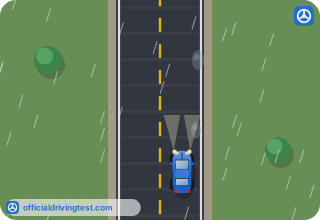
What does the first water to hit a dry road loosen, which then coats the road with a dangerously slick film?
- Loose gravel from the shoulder
- Paint from the lane markings
- Accumulated dirt and grease
- Oil from the engines of passing cars
Show answer
Correct answer: Accumulated dirt and grease
The first water to hit the road loosens accumulated dirt and grease, forming a mixture that quickly coats the road with a slick film.
Source: Mississippi Driver's License Manual (Revised December 2024), page 65 · Open this page in the manual (Manual page 65)
-
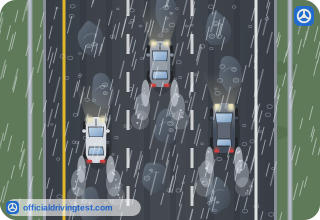
What can high speeds on a road with water on it cause your vehicle to do?
- Overheat its tires
- Hydroplane out of control
- Lock its brakes permanently
- Stall its engine
Show answer
Correct answer: Hydroplane out of control
The manual says that high speeds when there is water on the roadway can cause a vehicle to hydroplane out of control.
Source: Mississippi Driver's License Manual (Revised December 2024), page 65 · Open this page in the manual (Manual page 65)
-
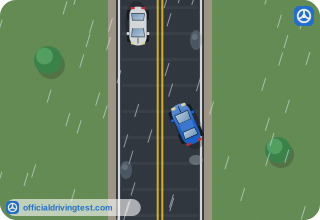
According to the manual, what causes most automobile skids?
- Worn windshield wipers that leave the glass streaked
- Turning the steering wheel too slowly on a curve
- Driving with the headlights on during the daytime
- Driving too fast for the weather and road conditions
Show answer
Correct answer: Driving too fast for the weather and road conditions
Most automobile skids are caused by driving too fast for the weather and road conditions.
Source: Mississippi Driver's License Manual (Revised December 2024), page 65 · Open this page in the manual (Manual page 65)
-
Hydroplaning occurs when which part of the vehicle starts to ride up on pooled water?
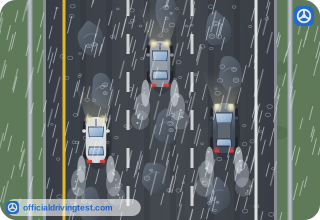
- The steering tires
- The rear bumper
- The brake drums
- The exhaust system
Show answer
Correct answer: The steering tires
Hydroplaning occurs when the steering tires start to ride up on pooled water, similar to the action of water skis.
Source: Mississippi Driver's License Manual (Revised December 2024), page 65 · Open this page in the manual (Manual page 65)
-
What is the best way to avoid traction loss from hydroplaning?
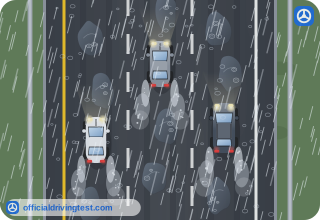
- Brake firmly as soon as you see a puddle ahead
- Follow closely behind the vehicle in front of you
- Slow down when it rains or the road is wet
- Drive through puddles in a lower gear at speed
Show answer
Correct answer: Slow down when it rains or the road is wet
The manual says the best way to avoid traction loss from hydroplaning is to slow down in the rain or when the road is wet with pooled water or puddles.
Source: Mississippi Driver's License Manual (Revised December 2024), page 65 · Open this page in the manual (Manual page 65)
-
If you see a flooded roadway, what should you do?
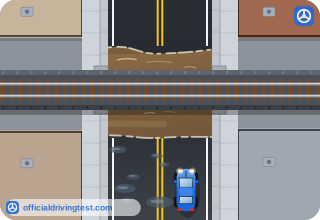
- Drive through it slowly in a low gear
- Find another route to get to your destination
- Follow the vehicle ahead through the water
- Stop and wait in the water until it drains
Show answer
Correct answer: Find another route to get to your destination
The manual says not to drive through large bodies of standing water on a road, and to find another route if the roadway is flooded.
Source: Mississippi Driver's License Manual (Revised December 2024), page 65 · Open this page in the manual (Manual page 65)
-
If your vehicle starts to skid, in which direction should you turn the wheel, if you can do so without running off the road or hitting something?
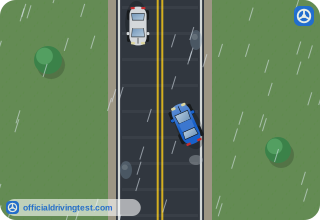
- Away from the direction of the skid
- Straight ahead and hold it there
- Back and forth in short quick turns
- In the direction of the skid
Show answer
Correct answer: In the direction of the skid
The manual says to turn the wheel in the direction of the skid, but only if you can do so without running off the road or hitting something.
Source: Mississippi Driver's License Manual (Revised December 2024), page 65 · Open this page in the manual (Manual page 65)
-
What effect does braking suddenly have when your vehicle is skidding?
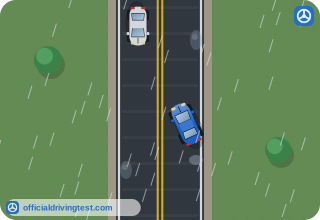
- It increases the skid
- It ends the skid sooner
- It has no effect on the skid
- It straightens the vehicle
Show answer
Correct answer: It increases the skid
The manual reminds drivers that braking suddenly will increase the skid.
Source: Mississippi Driver's License Manual (Revised December 2024), page 65 · Open this page in the manual (Manual page 65)
-
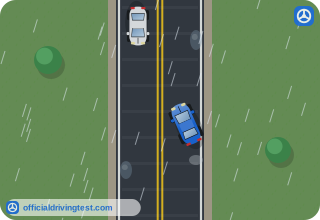
Which of these should you never use when you are trying to stop a skid?
- The steering wheel
- The horn
- The clutch
- The turn signal
Show answer
Correct answer: The clutch
The manual states: never use the clutch when you are trying to stop a skid.
Source: Mississippi Driver's License Manual (Revised December 2024), page 65 · Open this page in the manual (Manual page 65)
-
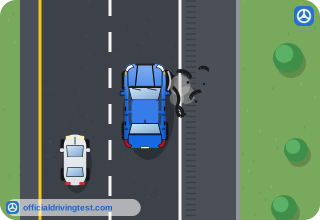
What should you do with the brakes if you have a flat tire or blowout?
- Apply the brakes suddenly and firmly to stop quickly
- Release the accelerator, then brake slowly and cautiously
- Keep your foot on the accelerator and brake lightly
- Pump the brakes rapidly until the vehicle has stopped
Show answer
Correct answer: Release the accelerator, then brake slowly and cautiously
After a flat tire or blowout, do not apply the brakes suddenly: take your foot off the accelerator, then brake slowly and cautiously.
Source: Mississippi Driver's License Manual (Revised December 2024), page 65 · Open this page in the manual (Manual page 65)
-
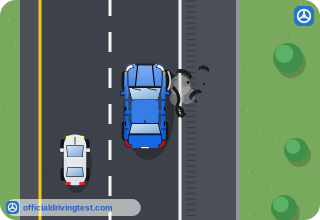
After a flat tire or blowout, what may you do if you have plenty of stopping distance?
- Shift into a lower gear and accelerate
- Apply the parking brake at once
- Turn off the engine immediately
- Allow the vehicle to stop by itself
Show answer
Correct answer: Allow the vehicle to stop by itself
The manual says that if you have plenty of stopping distance after a blowout, you can allow the vehicle to stop by itself.
Source: Mississippi Driver's License Manual (Revised December 2024), page 65 · Open this page in the manual (Manual page 65)
-
If you run off the pavement, how should you use the brakes before returning to the roadway?
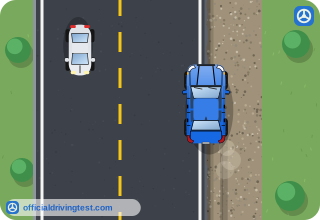
- Lightly
- Firmly
- Not at all
- Repeatedly and rapidly
Show answer
Correct answer: Lightly
The manual says that if you run off the pavement, use the brakes lightly before returning to the roadway.
Source: Mississippi Driver's License Manual (Revised December 2024), page 65 · Open this page in the manual (Manual page 65)
-
If your car becomes disabled on a road, where should you pull over?
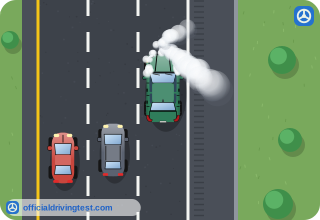
- To the extreme left shoulder
- Into the left lane next to the median
- To the extreme right shoulder
- Onto the nearest cross street only
Show answer
Correct answer: To the extreme right shoulder
The manual says that if your car becomes disabled you should pull over to the extreme right shoulder.
Source: Mississippi Driver's License Manual (Revised December 2024), page 65 · Open this page in the manual (Manual page 65)
-
When you must walk to seek help, what type of road does the manual say you must NEVER cross?
- Any four-lane highway
- Any county road
- Any road without a shoulder
- Any interstate
Show answer
Correct answer: Any interstate
The manual says to be extremely careful crossing any highway and never to cross any interstate.
Source: Mississippi Driver's License Manual (Revised December 2024), page 65 · Open this page in the manual (Manual page 65)