Minnesota: Vehicle equipment and controls — Part 5 Practice Test
Questions in this part include: “What color must the tail lamps on a trailer be?” · “A trailer must be equipped with brakes when its gross vehicle weight is at least what?”
Independent educational site · not affiliated with any government agency or DMV
Ready? Test yourself
- Instant feedback with an explanation
- Every answer cites its source in the manual
- Your best score is saved on this device
Questions are original and based on the official manual "Minnesota Driver’s Manual" (June 2026), Minnesota Driver and Vehicle Services.
All 19 questions in this practice test
Take the test above first, then use this list to study. Tap “Show answer” to see the correct answer and explanation.
Show the questions and answersHide the questions
-
What color must the tail lamps on a trailer be?
- White
- Amber
- Blue
- Red
Show answer
Correct answer: Red
The trailer requirements call for two red tail lamps.
Source: Minnesota Driver’s Manual (June 2026), page 80
-
What color must a trailer’s rear license plate lamp be?
- Red
- White
- Amber
- Green
Show answer
Correct answer: White
The trailer requirements call for one white rear license plate lamp.
Source: Minnesota Driver’s Manual (June 2026), page 80
-
How many red reflectors must a trailer have?
- One
- Three
- Four
- Two
Show answer
Correct answer: Two
The trailer requirements list two red reflectors.
Source: Minnesota Driver’s Manual (June 2026), page 80
-
When must trailer stop and turn signals be used?
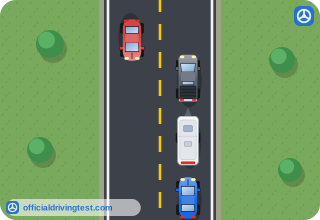
- At night and whenever the towing vehicle’s signals cannot be seen by other drivers
- Only when the trailer is loaded with more than 3,000 pounds of weight
- Only on roads where the posted speed limit is above 35 mph
- At night only, because daytime drivers can see the towing vehicle
Show answer
Correct answer: At night and whenever the towing vehicle’s signals cannot be seen by other drivers
Trailer stop and turn signals must be used for night driving and whenever the towing vehicle’s stop and turn signals are not visible to other drivers.
Source: Minnesota Driver’s Manual (June 2026), page 80
-
The width of a trailer may not extend beyond which part of the towing vehicle?
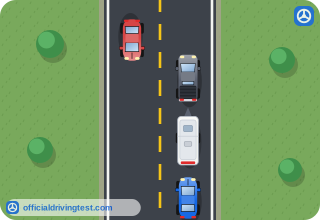
- The outer edges of its tires
- Its side body panels
- Its exterior rearview mirrors
- Its headlights
Show answer
Correct answer: Its exterior rearview mirrors
The manual says a trailer’s width may not extend beyond the exterior rearview mirrors of the towing vehicle.
Source: Minnesota Driver’s Manual (June 2026), page 80
-
The 102-inch width limit for self-propelled recreational vehicles does not include attachments that do not extend beyond what?
- The vehicle’s rear bumper
- The vehicle’s side body panels or tires
- The vehicle’s tires
- The vehicle’s exterior rearview mirrors
Show answer
Correct answer: The vehicle’s exterior rearview mirrors
The 102-inch (8 feet, 6 inches) width limit does not include attachments that do not extend beyond a self-propelled recreational vehicle’s exterior rearview mirrors.
Source: Minnesota Driver’s Manual (June 2026), page 80
-
What is the length limit for Type A, B or C motor homes?
- 45 feet
- 35 feet
- 50 feet
- 30 feet
Show answer
Correct answer: 45 feet
Type A, B or C motor homes may not be longer than 45 feet.
Source: Minnesota Driver’s Manual (June 2026), page 80
-
What is the general length limit for single-unit vehicles?
- 30 feet
- 35 feet
- 40 feet
- 50 feet
Show answer
Correct answer: 40 feet
The manual gives 40 feet as the general length limit for single-unit vehicles.
Source: Minnesota Driver’s Manual (June 2026), page 80
-
A trailer must be equipped with brakes when its gross vehicle weight is at least what?
- 1,000 pounds
- 3,000 pounds
- 2,000 pounds
- 5,000 pounds
Show answer
Correct answer: 3,000 pounds
All trailers with a gross vehicle weight of 3,000 pounds or more must have brakes.
Source: Minnesota Driver’s Manual (June 2026), page 80
-
What must all recreational trailers have that is clearly visible?
- A plate with current registration
- A sticker showing the trailer’s towing rating
- A decal showing the trailer’s maximum speed
- A tag listing the owner’s license number
Show answer
Correct answer: A plate with current registration
All recreational trailers must have a clearly visible plate with current registration.
Source: Minnesota Driver’s Manual (June 2026), page 80
-
How must a trailer’s safety chain be attached?
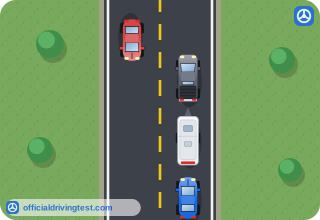
- Fastened to the trailer only while it is moving on a freeway
- Attached to the towing vehicle and left loose on the trailer
- Permanently attached to the trailer and fastened to the towing vehicle
- Attached to the trailer only when it carries a heavy load
Show answer
Correct answer: Permanently attached to the trailer and fastened to the towing vehicle
A safety chain must be permanently attached to the trailer and fastened to the vehicle used for towing.
Source: Minnesota Driver’s Manual (June 2026), page 80
-
What is a recreational vehicle combination?
- Any passenger car that pulls a small utility trailer for hauling
- A pickup truck or recreational truck-tractor attached to a camper trailer
- A motor home that is longer than 45 feet and has no trailer
- A truck that carries a camper in its bed without a trailer
Show answer
Correct answer: A pickup truck or recreational truck-tractor attached to a camper trailer
A recreational vehicle combination is a pickup truck or recreational truck-tractor attached to a camper trailer, which can also have a trailer hitched to it.
Source: Minnesota Driver’s Manual (June 2026), page 80
-
What must be true of the towing rating of the pickup or recreational truck-tractor in a recreational vehicle combination?
- It must be at least twice the weight of the camper trailer alone
- It must be equal to or greater than the total weight of all vehicles towed
- It must be posted on a plate that is visible from the driver’s seat
- It must be less than the weight of the first trailer being towed
Show answer
Correct answer: It must be equal to or greater than the total weight of all vehicles towed
The towing rating of the pickup or recreational truck-tractor must be equal to or greater than the total weight of all vehicles being towed.
Source: Minnesota Driver’s Manual (June 2026), page 80
-
What is the maximum length of a recreational vehicle combination?
- 50 feet
- 60 feet
- 80 feet
- 70 feet
Show answer
Correct answer: 70 feet
A recreational vehicle combination may not be more than 70 feet in length.
Source: Minnesota Driver’s Manual (June 2026), page 80
-
When may a recreational vehicle combination not be driven in the Twin Cities Metro Area?
- Monday through Friday from 6 to 9 a.m. and 4 to 7 p.m.
- Monday through Friday from 7 to 9 a.m. and 3 to 6 p.m.
- Every day of the week from 6 to 9 a.m. and 4 to 7 p.m.
- Saturday and Sunday from 6 to 9 a.m. and 4 to 7 p.m.
Show answer
Correct answer: Monday through Friday from 6 to 9 a.m. and 4 to 7 p.m.
A recreational vehicle combination may not be driven in the Twin Cities Metro Area from Monday through Friday during the hours of 6 to 9 a.m. and 4 to 7 p.m.
Source: Minnesota Driver’s Manual (June 2026), page 80
-
When towing extra weight, which part of your vehicle needs extra attention because the engine overheats more easily?
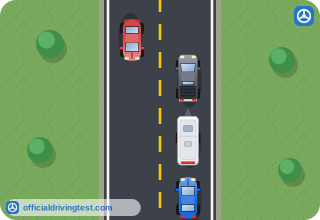
- The cooling system
- The charging system
- The windshield washer system
- The fuel system
Show answer
Correct answer: The cooling system
The manual says to pay extra attention to the cooling system when towing extra weight, since the engine overheats more easily in warm weather, at high speeds and in hilly areas.
Source: Minnesota Driver’s Manual (June 2026), page 80
-
What should your windshield wiper fluid contain for winter driving?
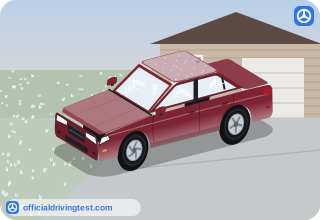
- Antifreeze
- Motor oil
- Sand
- Salt
Show answer
Correct answer: Antifreeze
Winter driving safety advice is to make sure the windshield wiper fluid contains antifreeze.
Source: Minnesota Driver’s Manual (June 2026), page 81
-
Which headlight setting should you use in heavy rain or fog to reduce glare?
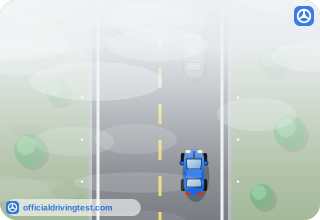
- High beam
- Parking lights only
- Hazard warning lights only
- Low beam
Show answer
Correct answer: Low beam
In heavy rain or fog, headlights should be kept on low beam to reduce glare.
Source: Minnesota Driver’s Manual (June 2026), page 83
-
What can you use to warn others when approaching curves on narrow roads or where brush and trees block your view?
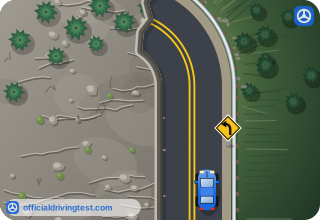
- Your windshield washers
- Your horn
- Your hazard warning lights
- Your parking brake
Show answer
Correct answer: Your horn
You can use your horn to warn other drivers or pedestrians that you are on the road.
Source: Minnesota Driver’s Manual (June 2026), page 83