Minnesota: Vehicle equipment and controls — Part 4 Practice Test
Questions in this part include: “You must use your headlights any time you cannot clearly see the road ahead for at least what distance?” · “How far may a passenger vehicle’s load extend beyond the line of the fenders on the left side?”
Independent educational site · not affiliated with any government agency or DMV
Ready? Test yourself
- Instant feedback with an explanation
- Every answer cites its source in the manual
- Your best score is saved on this device
Questions are original and based on the official manual "Minnesota Driver’s Manual" (June 2026), Minnesota Driver and Vehicle Services.
All 19 questions in this practice test
Take the test above first, then use this list to study. Tap “Show answer” to see the correct answer and explanation.
Show the questions and answersHide the questions
-
You must use your headlights any time you cannot clearly see the road ahead for at least what distance?
- 200 feet
- 350 feet
- 500 feet
- 1,000 feet
Show answer
Correct answer: 500 feet
Headlights must be used any time you cannot clearly see the road ahead for at least 500 feet.
Source: Minnesota Driver’s Manual (June 2026), page 73
-
Which of these weather conditions does the manual list as one in which you must use your headlights?
- Strong wind
- Hail
- High heat
- Cloudy but dry weather
Show answer
Correct answer: Hail
Headlights must be used in rain, snow, hail, sleet or fog.
Source: Minnesota Driver’s Manual (June 2026), page 73
-
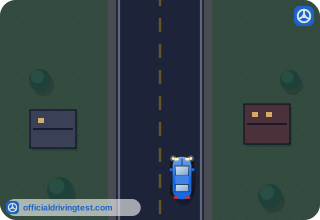
Within what distance should you be able to stop your vehicle when driving at night?
- The distance to the next intersection or stop sign
- The distance you can see in your rearview mirror
- The distance shown on the nearest speed limit sign
- The distance your headlights illuminate the road
Show answer
Correct answer: The distance your headlights illuminate the road
The manual says you should be able to stop within the distance your headlights illuminate the road.
Source: Minnesota Driver’s Manual (June 2026), page 73
-
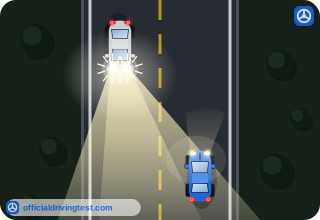
What should you do if you are blinded by glare from oncoming headlights?
- Flash your high beams until the other driver dims theirs
- Speed up so you pass the oncoming vehicle quickly
- Use the white line along the edge of the road as a reference
- Look straight into the lights to keep your bearings
Show answer
Correct answer: Use the white line along the edge of the road as a reference
If you are blinded by glare, the manual says to use the white line along the edge of the road as a reference.
Source: Minnesota Driver’s Manual (June 2026), page 73
-
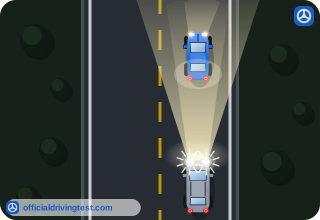
What can you do about glare from the headlights of a vehicle behind you?
- Turn on your high beams to warn the driver behind
- Use a “day-night” mirror or adjust your regular mirror
- Brake suddenly to make the driver behind pass
- Turn off your headlights until it passes
Show answer
Correct answer: Use a “day-night” mirror or adjust your regular mirror
For glare caused by headlights from behind, the manual says to use a day-night mirror or adjust your regular mirror.
Source: Minnesota Driver’s Manual (June 2026), page 73
-
It is illegal to drive a vehicle occupied by more than how many people in the front seat?
- Three
- Two
- Four
- Five
Show answer
Correct answer: Three
It is illegal to drive a vehicle packed with a load or occupied by more than three people in the front seat because they obstruct your view or control.
Source: Minnesota Driver’s Manual (June 2026), page 79
-
How far may a load stick out in front of the front wheels or bumper of a motor vehicle?
- No more than one foot
- No more than two feet
- No more than three feet
- No more than four feet
Show answer
Correct answer: No more than three feet
A load must not stick out more than three feet in front of the front wheels or bumper of any motor vehicle.
Source: Minnesota Driver’s Manual (June 2026), page 79
-
A load extending how far from the rear of a vehicle requires a flag?
- One foot or more
- Four feet or more
- Two feet or more
- Six feet or more
Show answer
Correct answer: Four feet or more
If a load extends four feet or more from the rear of any vehicle, a flag must be attached to the end of the load.
Source: Minnesota Driver’s Manual (June 2026), page 79
-
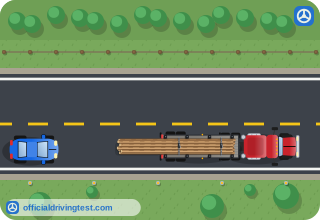
What color flag must be attached to a load that extends four feet or more from the rear of a vehicle?
- White, blue or green
- Black, white or green
- Red, white or blue
- Red, yellow or orange
Show answer
Correct answer: Red, yellow or orange
The flag attached to the end of such a load must be red, yellow or orange.
Source: Minnesota Driver’s Manual (June 2026), page 79
-
How large must the flag on a rear-projecting load be, at the smallest?
- 16 inches square
- 6 inches square
- 12 inches square
- 24 inches square
Show answer
Correct answer: 16 inches square
The flag must be at least 16 inches square.
Source: Minnesota Driver’s Manual (June 2026), page 79
-
At night, a red lantern or lamp on the end of a projecting load must be visible from at least what distance?
- 100 feet
- 200 feet
- 500 feet
- 1,000 feet
Show answer
Correct answer: 500 feet
At night a red lantern or lamp visible from a distance of at least 500 feet must be attached to the end of the load.
Source: Minnesota Driver’s Manual (June 2026), page 79
-
How far may a passenger vehicle’s load extend beyond the line of the fenders on the left side?
- Six inches
- Not at all
- One foot
- Three feet
Show answer
Correct answer: Not at all
Passenger vehicles may not carry loads that extend beyond the line of the fenders on the left side.
Source: Minnesota Driver’s Manual (June 2026), page 79
-
How far may a passenger vehicle’s load extend beyond the fender line on the right side?
- No more than 12 inches
- Not at all
- No more than three feet
- No more than six inches
Show answer
Correct answer: No more than six inches
Passenger vehicles may not carry loads that extend more than six inches beyond the fender line on the right side.
Source: Minnesota Driver’s Manual (June 2026), page 79
-
When a trailer is loaded, how much of its weight should be balanced on the hitch?
- 1 to 5 percent
- 25 to 30 percent
- 10 to 15 percent
- 50 percent
Show answer
Correct answer: 10 to 15 percent
The manual says 10 to 15 percent of the trailer’s weight should be balanced on the hitch.
Source: Minnesota Driver’s Manual (June 2026), page 79
-
When a trailer is correctly loaded, how should its floor sit?
- Tilted down toward the hitch
- Level
- Tilted up toward the hitch
- Lower at the rear than at the front
Show answer
Correct answer: Level
When a trailer is correctly loaded, its floor should be level.
Source: Minnesota Driver’s Manual (June 2026), page 79
-
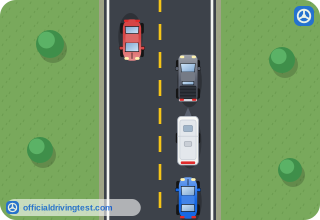
When pulling a trailer, what should you check after the first few miles and again at all rest stops?
- The engine oil and coolant
- Only the trailer tires
- The brake fluid and fuel level
- The hitch, tires, lights and load
Show answer
Correct answer: The hitch, tires, lights and load
After the first few miles you should stop and check the hitch, tires, lights and load, and repeat this at all rest stops.
Source: Minnesota Driver’s Manual (June 2026), page 79
-
What is the maximum width allowed for a trailer?
- 8 feet 6 inches
- 7 feet 6 inches
- 9 feet 6 inches
- 8 feet
Show answer
Correct answer: 8 feet 6 inches
The trailer requirements give a maximum width of 8 feet 6 inches.
Source: Minnesota Driver’s Manual (June 2026), page 80
-
What is the maximum height allowed for a trailer?
- 11 feet 6 inches
- 12 feet
- 13 feet 6 inches
- 14 feet 6 inches
Show answer
Correct answer: 13 feet 6 inches
The trailer requirements list a maximum height of 13 feet 6 inches.
Source: Minnesota Driver’s Manual (June 2026), page 80
-
What is the maximum length allowed for a trailer?
- 35 feet
- 45 feet
- 50 feet
- 30 feet
Show answer
Correct answer: 45 feet
The trailer requirements list a maximum length of 45 feet.
Source: Minnesota Driver’s Manual (June 2026), page 80