Minnesota: Vehicle equipment and controls — Part 3 Practice Test
Questions in this part include: “Which of these is a fuel efficient technique listed in the manual?” · “When can you use hand and arm signals in addition to or instead of turn signals?”
Independent educational site · not affiliated with any government agency or DMV
Ready? Test yourself
- Instant feedback with an explanation
- Every answer cites its source in the manual
- Your best score is saved on this device
Questions are original and based on the official manual "Minnesota Driver’s Manual" (June 2026), Minnesota Driver and Vehicle Services.
All 19 questions in this practice test
Take the test above first, then use this list to study. Tap “Show answer” to see the correct answer and explanation.
Show the questions and answersHide the questions
-
Which of these is a fuel efficient technique listed in the manual?
- Make several short trips instead of one long one
- Plan and combine errands into one trip
- Accelerate quickly to reach speed
- Keep extra heavy items in the vehicle for traction
Show answer
Correct answer: Plan and combine errands into one trip
The manual lists planning and combining errands into one trip as a way to drive efficiently.
Source: Minnesota Driver’s Manual (June 2026), page 25
-
Which of these helps your car use less fuel?
- Using the lowest available grade of motor oil
- Tuning your engine only when it stalls
- Letting the tires run slightly under-inflated
- Keeping tires properly inflated
Show answer
Correct answer: Keeping tires properly inflated
The manual lists keeping tires properly inflated among the ways to keep your car in good condition for fuel efficiency.
Source: Minnesota Driver’s Manual (June 2026), page 25
-
According to the manual, what should you do on the highway to drive efficiently?
- Use cruise control
- Drive slightly above the speed limit
- Use the lowest gear
- Brake often to keep pace
Show answer
Correct answer: Use cruise control
The manual lists using cruise control on the highway as a fuel efficient technique.
Source: Minnesota Driver’s Manual (June 2026), page 25
-
How many feet before you turn must you activate your signal?
- At least 25 feet
- At least 100 feet
- At least 50 feet
- At least 200 feet
Show answer
Correct answer: At least 100 feet
The manual says to activate your signal at least 100 feet before turning.
Source: Minnesota Driver’s Manual (June 2026), page 27
-
When can you use hand and arm signals in addition to or instead of turn signals?
- During daylight hours
- Only at night
- Only on freeways
- Only on gravel or dirt roads
Show answer
Correct answer: During daylight hours
During daylight hours you can use hand and arm signals in addition to or instead of turn signals.
Source: Minnesota Driver’s Manual (June 2026), page 27
-
In which situation must you not use hand signals?
- When you are turning left in daylight on a city street
- When you are driving slowly through heavy city traffic in daylight hours
- When you drive a vehicle that blocks other drivers from seeing your hand signals
- When your turn signals work and it is daylight
Show answer
Correct answer: When you drive a vehicle that blocks other drivers from seeing your hand signals
Do not use hand signals at night or when driving a vehicle that blocks other drivers from seeing them.
Source: Minnesota Driver’s Manual (June 2026), page 27
-
Which arm position is the hand signal for a left turn?
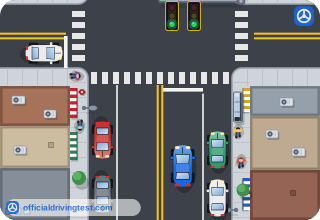
- The arm bent at the elbow with the forearm pointing up
- The arm extended straight out to the left side of the vehicle
- The arm hanging straight down with the hand open
- The arm extended straight out the front of the vehicle
Show answer
Correct answer: The arm extended straight out to the left side of the vehicle
The hand and arm signal for a left turn is the arm extended straight out to the left side of the vehicle.
Source: Minnesota Driver’s Manual (June 2026), page 27
-
Which arm position is the hand signal for a right turn?
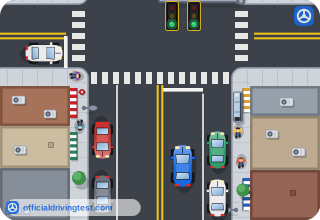
- The arm extended straight out to the left side of the vehicle
- The arm hanging straight down with the hand open
- The arm bent with the hand held over the roof of the vehicle
- The arm bent at the elbow with the forearm pointing up
Show answer
Correct answer: The arm bent at the elbow with the forearm pointing up
The hand and arm signal for a right turn is the arm bent at the elbow with the forearm pointing up.
Source: Minnesota Driver’s Manual (June 2026), page 27
-
Which arm position is the hand signal for stop?
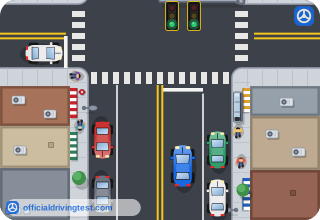
- The arm extended straight out to the left side of the vehicle
- The arm bent at the elbow with the forearm pointing up
- The arm bent at the elbow with the forearm pointing down
- The arm waving up and down outside the window
Show answer
Correct answer: The arm bent at the elbow with the forearm pointing down
To signal a stop, hold your left arm out and bend it at the elbow so your forearm points toward the ground.
Source: Minnesota Driver’s Manual (June 2026), page 27
-
Backing up on public roads can result in what charge?
- Failure to yield
- Leaving the scene of a crash
- Improper lane use
- Reckless or careless driving
Show answer
Correct answer: Reckless or careless driving
Backing up on public roads can result in a charge of reckless or careless driving.
Source: Minnesota Driver’s Manual (June 2026), page 34
-
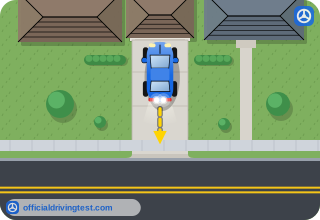
If you must back out of a driveway onto a public road, what should you do?
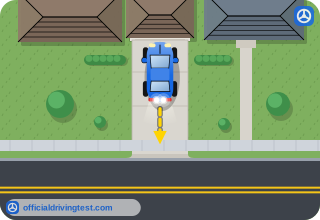
- Back across all of the lanes into the farthest lane
- Back into the nearest lane and drive forward from there
- Back out quickly to keep traffic moving
- Back onto the shoulder and wait for a gap
Show answer
Correct answer: Back into the nearest lane and drive forward from there
If you must back out of a driveway, back into the nearest lane and drive forward from there.
Source: Minnesota Driver’s Manual (June 2026), page 34
-
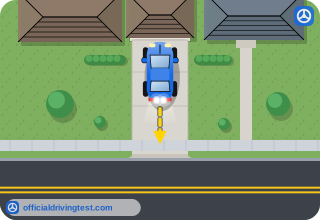
Before you back up, what should you do?
- Sound your horn twice and then back up
- Walk around your vehicle to make sure nothing is behind it
- Turn on your hazard lights and roll down your windows
- Roll down all of your windows
Show answer
Correct answer: Walk around your vehicle to make sure nothing is behind it
The manual says to walk around your vehicle before backing up to make sure nothing is behind it.
Source: Minnesota Driver’s Manual (June 2026), page 35
-
While backing up, how should you check for hazards?
- Rely on your back-up camera if your vehicle has one installed
- Watch only your side mirrors
- Look straight ahead and use your horn
- Keep looking out the rear window, not only at mirrors or a camera
Show answer
Correct answer: Keep looking out the rear window, not only at mirrors or a camera
You should continue looking out the rear window while backing up and not rely solely on your mirrors or back-up camera.
Source: Minnesota Driver’s Manual (June 2026), page 35
-
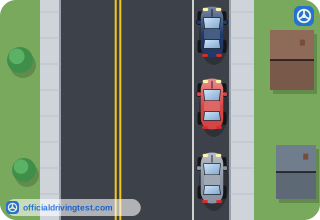
When you are stopped or parked on the side of a road, what must you do before opening any door?
- Turn on your hazard lights and wait for a gap in traffic
- Sound your horn once
- Check that it is safe and will not interfere with traffic
- Wait ten seconds
Show answer
Correct answer: Check that it is safe and will not interfere with traffic
Do not open any doors until you have checked to make sure it is safe and will not interfere with other traffic.
Source: Minnesota Driver’s Manual (June 2026), page 35
-
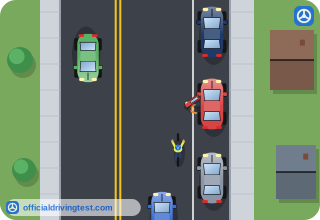
How long may you leave a door on the side closest to moving traffic open?
- Up to one minute while your hazard lights are flashing
- No longer than necessary to load or unload passengers
- As long as your hazard lights are on
- As long as the vehicle is in park
Show answer
Correct answer: No longer than necessary to load or unload passengers
A door on the side closest to moving traffic must not be left open longer than necessary to load or unload passengers.
Source: Minnesota Driver’s Manual (June 2026), page 35
-
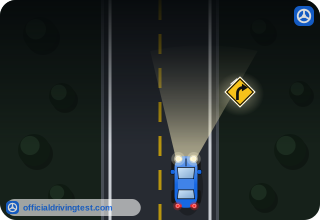
Which of these does the manual list as a step to help you reach your destination safely when driving at night?
- Keep your high beams on in all traffic
- Drive faster to spend less time in the dark
- Make sure your vehicle lights are working
- Tint your windshield to reduce glare
Show answer
Correct answer: Make sure your vehicle lights are working
The night driving list includes studying maps beforehand, making sure vehicle lights work, and ensuring the windshield is clean and free of defects.
Source: Minnesota Driver’s Manual (June 2026), page 73
-
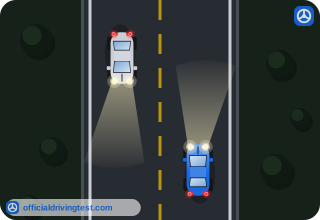
Within what distance of an oncoming vehicle must your headlights remain on low beam?
- 500 feet
- 1,000 feet
- 350 feet
- 200 feet
Show answer
Correct answer: 1,000 feet
When you are within 1,000 feet of an oncoming vehicle, your headlights must remain on low beam.
Source: Minnesota Driver’s Manual (June 2026), page 73
-
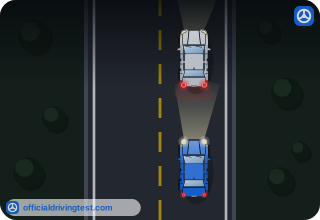
When following another vehicle, at what distance or closer must your headlights stay on low beam?
- 100 feet or less
- 350 feet or less
- 500 feet or less
- 200 feet or less
Show answer
Correct answer: 200 feet or less
Headlights must remain on low beam when following another vehicle at a distance of 200 feet or less.
Source: Minnesota Driver’s Manual (June 2026), page 73
-
When must your headlights be turned on?
- At sunset, and used until sunrise
- Only when it is completely dark
- Only when other drivers have theirs on
- One hour after sunset until one hour before sunrise
Show answer
Correct answer: At sunset, and used until sunrise
The manual says headlights must be turned on at sunset and used until sunrise.
Source: Minnesota Driver’s Manual (June 2026), page 73