Minnesota: Vehicle equipment and controls — Part 2 Practice Test
Questions in this part include: “How much pressure can tires lose in a month?” · “Window tint applied to side or rear windows after Aug. 1, 1985, must show what?”
Independent educational site · not affiliated with any government agency or DMV
Ready? Test yourself
- Instant feedback with an explanation
- Every answer cites its source in the manual
- Your best score is saved on this device
Questions are original and based on the official manual "Minnesota Driver’s Manual" (June 2026), Minnesota Driver and Vehicle Services.
All 20 questions in this practice test
Take the test above first, then use this list to study. Tap “Show answer” to see the correct answer and explanation.
Show the questions and answersHide the questions
-
How much pressure can tires lose in a month?
- Up to 5 PSI
- Up to 1 PSI
- Up to 10 PSI
- Up to 15 PSI
Show answer
Correct answer: Up to 1 PSI
Tires can lose up to 1 PSI of pressure every month, so check pressure often.
Source: Minnesota Driver’s Manual (June 2026), page 24
-
Where can you find your vehicle’s recommended tire pressure?
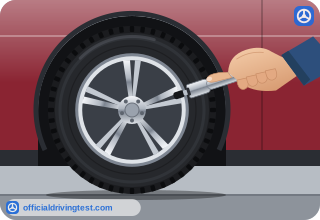
- On the tire’s sidewall, next to the tire size markings
- On the inside of the fuel filler cover or on the hood
- On the vehicle’s registration card or on its title
- On a sticker inside the driver’s door or in the owner’s manual
Show answer
Correct answer: On a sticker inside the driver’s door or in the owner’s manual
The recommended tire pressure is on a sticker inside the driver’s door or in the owner’s manual.
Source: Minnesota Driver’s Manual (June 2026), page 24
-
When should you check your tire pressure?
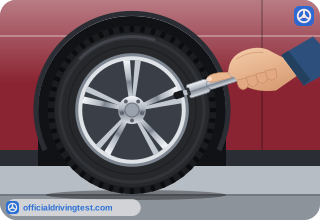
- Before driving or at least three hours after driving
- Right after a long drive, when tires are warm
- Only after a tire looks flat
- Just before each oil change
Show answer
Correct answer: Before driving or at least three hours after driving
Check tire pressure before driving or at least three hours after driving.
Source: Minnesota Driver’s Manual (June 2026), page 24
-
When you check tire pressure, what should you compare the measured PSI to?
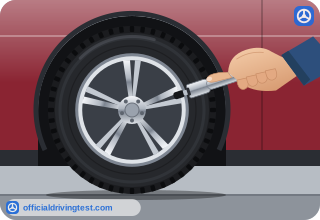
- The PSI shown on the tire’s sidewall near the tire size
- The PSI shown on the spare tire stored in the trunk
- The PSI on the driver’s door sticker or in the owner’s manual
- The PSI you measured the last time you checked it
Show answer
Correct answer: The PSI on the driver’s door sticker or in the owner’s manual
Compare the measured PSI to the PSI on the sticker or in the owner’s manual, not the PSI on the tire’s sidewall.
Source: Minnesota Driver’s Manual (June 2026), page 24
-
A tire is illegal if its tread is less than how deep?
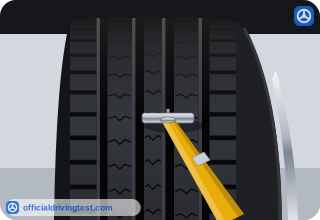
- One-quarter inch
- One-sixteenth inch
- One-half inch
- One-eighth inch
Show answer
Correct answer: One-sixteenth inch
A tire is illegal if the tread is less than one-sixteenth inch deep.
Source: Minnesota Driver’s Manual (June 2026), page 24
-
In the penny test for tire wear, your tires are legal and safe if the tread covers what?
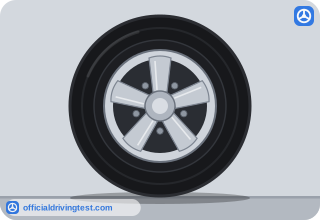
- None of Lincoln’s head
- Only Lincoln’s chin
- Lincoln’s whole body
- Any part of Lincoln’s head
Show answer
Correct answer: Any part of Lincoln’s head
If any part of Lincoln’s head is covered by the tread, your tires are legal and safe.
Source: Minnesota Driver’s Manual (June 2026), page 24
-
On which road surface do tires have less traction?
- Gravel or dirt roads
- Concrete roads
- Asphalt roads
- Paved roads
Show answer
Correct answer: Gravel or dirt roads
Tires have less traction on gravel or dirt roads than on concrete or asphalt.
Source: Minnesota Driver’s Manual (June 2026), page 24
-
What does the manual say you should always carry about tires?
- A second set of tires stored in the trunk
- A tire patch kit instead of a spare tire
- A good spare tire, with its pressure checked often
- A spare tire only when you take long trips
Show answer
Correct answer: A good spare tire, with its pressure checked often
Always carry a good spare tire and check its pressure often.
Source: Minnesota Driver’s Manual (June 2026), page 24
-
What does the manual say about hanging objects in your vehicle?
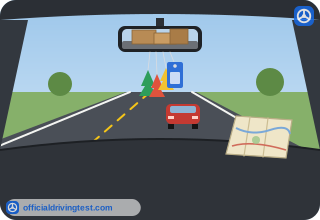
- You may hang small objects from the rearview mirror
- Do not hang objects between the driver and the windshield
- You may hang objects if they are lightweight
- Hanging objects is allowed only on the passenger side
Show answer
Correct answer: Do not hang objects between the driver and the windshield
Do not hang objects between the driver and the windshield.
Source: Minnesota Driver’s Manual (June 2026), page 24
-
Which of these can be placed on a windshield under state law?
- A reflective sun film
- A hanging air freshener
- Any sticker the owner chooses
- An EZpass device
Show answer
Correct answer: An EZpass device
Labels and stickers allowed by state law, such as state and national park stickers, safety inspection stickers and EZpass devices, can be placed on your windshield.
Source: Minnesota Driver’s Manual (June 2026), page 24
-
Where can a global positioning or other navigation system be mounted?
- Near the bottom part of the windshield
- Near the top part of the windshield
- In the center of the windshield
- On the driver’s side window glass
Show answer
Correct answer: Near the bottom part of the windshield
Global positioning and other navigation systems can be mounted near the bottom part of the windshield.
Source: Minnesota Driver’s Manual (June 2026), page 24
-
Where can driver feedback and safety-monitoring equipment be mounted?
- Anywhere on the windshield, if it is small enough to fit
- On the driver’s side window glass, next to the mirror
- Immediately behind, slightly above or below the rearview mirror
- On the dashboard directly in front of the driver’s seat
Show answer
Correct answer: Immediately behind, slightly above or below the rearview mirror
It can be mounted immediately behind, slightly above or slightly below the rearview mirror.
Source: Minnesota Driver’s Manual (June 2026), page 24
-
What can a windshield not be made of, covered by or treated with?
- Laminated safety glass that meets all state safety standards
- Materials that make it more reflective or reduce light passing through it
- Materials that prevent cracks from spreading across the glass
- Materials that block ultraviolet rays coming from the sun
Show answer
Correct answer: Materials that make it more reflective or reduce light passing through it
Windshields cannot be made of, covered by or treated with materials that make the glass more reflective or reduce the amount of light passing through it.
Source: Minnesota Driver’s Manual (June 2026), page 24
-
Window tint applied to side or rear windows after Aug. 1, 1985, must show what?
- The name of the installer who applied it to the vehicle
- The date it was installed on the vehicle by the shop
- The darkness grade of the film and the shop’s name
- The percentage of light transmitted and reflected
Show answer
Correct answer: The percentage of light transmitted and reflected
Any window tint applied after Aug. 1, 1985, must show the percentage of light transmitted and reflected.
Source: Minnesota Driver’s Manual (June 2026), page 24
-
Tint that transmits less than what percentage of available light is restricted to certain windows and vehicles?
- 50 percent
- 20 percent
- 35 percent
- 75 percent
Show answer
Correct answer: 50 percent
Tint that transmits less than 50 percent of available light can only be used on certain windows of certain vehicles.
Source: Minnesota Driver’s Manual (June 2026), page 24
-
Tint that reflects more than what percentage of available light is restricted to certain windows and vehicles?
- 10 percent
- 35 percent
- 20 percent
- 50 percent
Show answer
Correct answer: 20 percent
Tint that reflects more than 20 percent of available light can only be used on certain windows of certain vehicles.
Source: Minnesota Driver’s Manual (June 2026), page 24
-
Dark tint (transmitting under 50 percent or reflecting over 20 percent) can be used on which window of a pickup truck?
- The rear and side windows
- The rear window only
- The front side windows only
- The windshield
Show answer
Correct answer: The rear window only
Such tint can be used only on the rear window of a pickup truck, or the rear and side windows of a van, limousine or funeral home vehicle.
Source: Minnesota Driver’s Manual (June 2026), page 24
-
What must a vehicle with a glass windshield have?
- Tinted glass
- A windshield sun visor
- A rain-sensing camera
- Working windshield wipers
Show answer
Correct answer: Working windshield wipers
A vehicle with a glass windshield must have working windshield wipers.
Source: Minnesota Driver’s Manual (June 2026), page 24
-
Why are window defrosters necessary?
- To keep windows and the windshield clear of steam and frost
- To keep the tires from freezing to the road in winter
- To warm the engine faster on cold winter mornings
- To melt snow and ice on the roof of the vehicle
Show answer
Correct answer: To keep windows and the windshield clear of steam and frost
Window defrosters are necessary to keep windows and the windshield clear of steam and frost.
Source: Minnesota Driver’s Manual (June 2026), page 24
-
What must passenger vehicles have to prevent water, dirt and other material from being thrown into the air by the tires?
- Mud flaps on the rear only
- A rear spoiler
- Fenders or other wheel guards
- Studded tires
Show answer
Correct answer: Fenders or other wheel guards
Passenger vehicles must have fenders or other wheel guards to prevent water, dirt and other material from being thrown by the tires.
Source: Minnesota Driver’s Manual (June 2026), page 24