Minnesota: Pavement markings Practice Test
Yellow and white lines, passing and no-passing lines, stop lines, crosswalks, lane arrows, bicycle lanes and carpool lane markings.
Independent educational site · not affiliated with any government agency or DMV
Ready? Test yourself
- Instant feedback with an explanation
- Every answer cites its source in the manual
- Your best score is saved on this device
Questions are original and based on the official manual "Minnesota Driver’s Manual" (June 2026), Minnesota Driver and Vehicle Services.
All 23 questions in this practice test
Take the test above first, then use this list to study. Tap “Show answer” to see the correct answer and explanation.
Show the questions and answersHide the questions
-
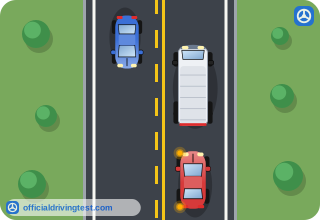
What does a solid yellow line on your side of the center line mean?
- Passing is allowed only when no vehicle is in sight
- Passing is not allowed
- Passing is allowed only for slow vehicles
- Passing is allowed only on the right
Show answer
Correct answer: Passing is not allowed
Do not pass where there is a solid yellow line on your side of the center line.
Source: Minnesota Driver’s Manual (June 2026), page 34
-
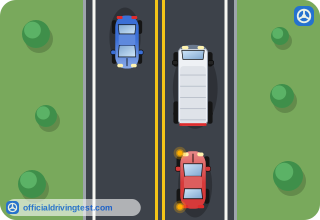
What do double solid yellow lines mean?
- Passing is allowed in either direction when it is safe
- Passing is allowed only for vehicles going faster than 55 mph
- No passing is allowed in either direction
- Passing is allowed only on the right
Show answer
Correct answer: No passing is allowed in either direction
Double solid yellow lines mean no passing is allowed in either direction.
Source: Minnesota Driver’s Manual (June 2026), page 34
-
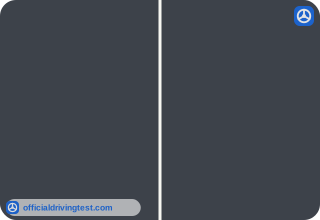
What do white lines separate?
- Traffic that is moving in opposite directions
- Passing zones from no-passing zones
- Carpool lanes from the roadway shoulder
- Lanes of traffic traveling in the same direction
Show answer
Correct answer: Lanes of traffic traveling in the same direction
White lines separate lanes of traffic traveling in the same direction.
Source: Minnesota Driver’s Manual (June 2026), page 69
-
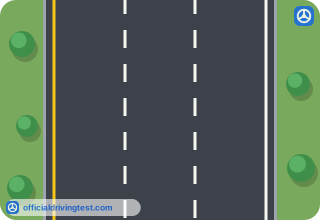
What do white dashes mean?
- You can change lanes where this marking is present
- You must not change lanes where this marking is present
- This area is for bicycle traffic only
- Passing is permitted only here
Show answer
Correct answer: You can change lanes where this marking is present
White dashes mean you can change lanes where the marking is present.
Source: Minnesota Driver’s Manual (June 2026), page 69
-
What do shorter and thicker white dashes indicate?
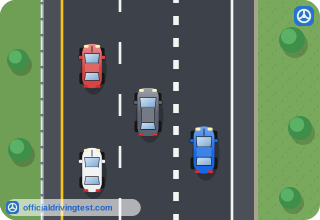
- A bicycle lane begins
- Passing is permitted
- The lane is ending
- A crosswalk is ahead
Show answer
Correct answer: The lane is ending
Shorter and thicker white dashes indicate that the lane is ending.
Source: Minnesota Driver’s Manual (June 2026), page 69
-
What does a solid white line mean for changing lanes?
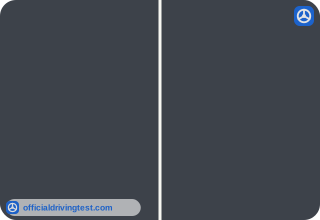
- You may change lanes only to pass
- You should not change lanes
- Lane changes are required here
- You may change lanes freely when no one is near
Show answer
Correct answer: You should not change lanes
A solid white line means you should not change lanes.
Source: Minnesota Driver’s Manual (June 2026), page 69
-
Which of these do solid white lines mark?
- The center of a two-way road
- No-passing zones
- Reversible lanes
- Stop lines at intersections
Show answer
Correct answer: Stop lines at intersections
Solid white lines also mark crosswalks, stop lines at intersections, parking stalls and the edges of a roadway.
Source: Minnesota Driver’s Manual (June 2026), page 69
-
What must you do where there are double solid white lines?
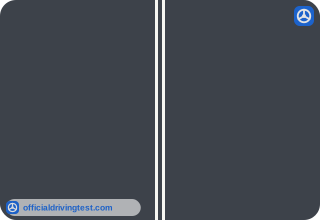
- Not change lanes
- Pass only on the left
- Slow down and merge
- Stop before crossing
Show answer
Correct answer: Not change lanes
Double solid white lines mean you must not change lanes.
Source: Minnesota Driver’s Manual (June 2026), page 69
-
What does a solid white line with a bicycle symbol mean?
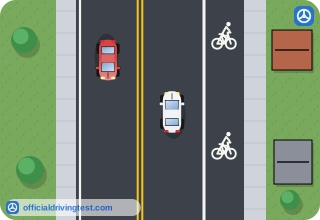
- Bicycles may park in this area
- Bicycles may share the area with slow-moving vehicles
- The area is for bicycle or electric-assist bicycle traffic only
- Motor vehicles may use it as a passing lane
Show answer
Correct answer: The area is for bicycle or electric-assist bicycle traffic only
A solid white line with bicycle insignia marks an area for bicycle or electric-assist bicycle traffic only.
Source: Minnesota Driver’s Manual (June 2026), page 69
-
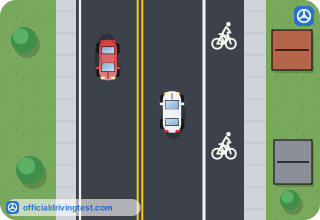
You are on a bicycle in an area marked with a solid white line and a bicycle symbol. Which way must you travel?
- Against adjacent traffic
- In the same direction as adjacent traffic
- In either direction when no cars are close
- On the left edge, facing oncoming traffic
Show answer
Correct answer: In the same direction as adjacent traffic
On a bicycle in an area marked with a solid white line and bicycle insignia, you must travel in the same direction as adjacent traffic.
Source: Minnesota Driver’s Manual (June 2026), page 69
-
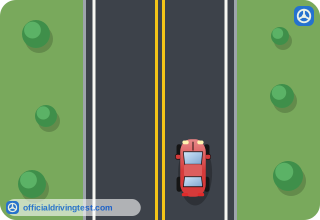
What do yellow lines separate?
- Lanes of traffic traveling in the same direction
- A bicycle lane from the roadway
- Parking stalls from travel lanes
- Traffic moving in opposite directions
Show answer
Correct answer: Traffic moving in opposite directions
Yellow lines separate traffic moving in opposite directions.
Source: Minnesota Driver’s Manual (June 2026), page 69
-
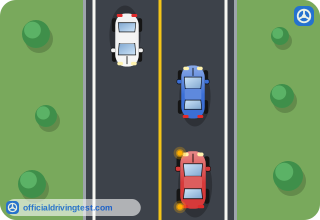
What does a solid yellow line mean?
- You must not pass
- You may pass only when the road ahead is clear
- You may pass only on a straight section of road
- You may pass only on the left side
Show answer
Correct answer: You must not pass
A solid yellow line means you must not pass, and passing in a no-passing zone is illegal.
Source: Minnesota Driver’s Manual (June 2026), page 69
-
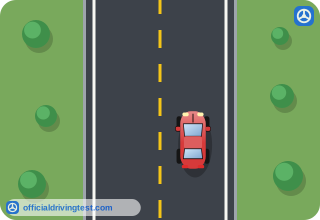
What do yellow dashes mean?
- You must not pass
- You must change lanes
- You may pass
- Only emergency vehicles may pass
Show answer
Correct answer: You may pass
Yellow dashes mean you may pass.
Source: Minnesota Driver’s Manual (June 2026), page 69
-
A solid yellow line is on one side of the roadway and a line of dashes is on the other side. Which marking must you obey?
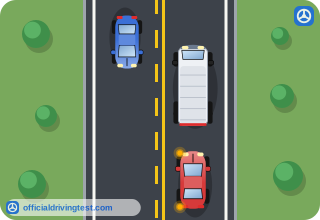
- The solid line, in both directions
- The marking in your lane of traffic
- The dashes, in both directions
- The marking in the oncoming lane
Show answer
Correct answer: The marking in your lane of traffic
With mixed lines, you must obey the marking in your lane of traffic.
Source: Minnesota Driver’s Manual (June 2026), page 69
-
What do double solid yellow lines mean?
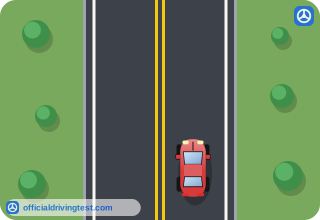
- You may pass if no oncoming traffic is visible
- You may pass on the side with the better view
- Only vehicles on one side of the lines must not pass
- You must not pass, whichever side you are driving on
Show answer
Correct answer: You must not pass, whichever side you are driving on
Double solid yellow lines mean you must not pass, regardless of which side of the line you are driving.
Source: Minnesota Driver’s Manual (June 2026), page 69
-
What must you do if your vehicle is in a lane marked with a white turn arrow, sometimes with the word “only”?
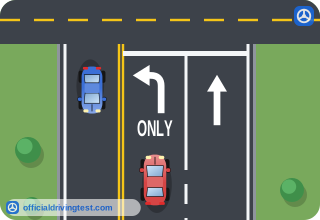
- Turn
- Go straight if no traffic is near
- Change lanes before the intersection
- Turn only if the light is green
Show answer
Correct answer: Turn
White arrows, sometimes with the word “only,” show that drivers must stay within the lane while turning, and if your vehicle is in this type of lane, you must turn.
Source: Minnesota Driver’s Manual (June 2026), page 71
-
Why are turn lanes separated from through traffic lanes by solid white lines?
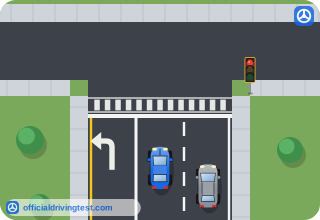
- To mark where parking is allowed near the intersection
- To show where bicycles may cross the lane
- To discourage drivers from changing lanes near an intersection
- To separate traffic traveling in opposite directions
Show answer
Correct answer: To discourage drivers from changing lanes near an intersection
Turn lanes are separated from through traffic lanes by solid white lines to discourage drivers from changing lanes near an intersection.
Source: Minnesota Driver’s Manual (June 2026), page 71
-
How is a center lane designated for left turns marked?
- By double solid white lines on each side
- By parallel solid and dashed yellow lines
- By dashed double yellow lines
- By a diamond symbol
Show answer
Correct answer: By parallel solid and dashed yellow lines
A center lane designated for left turns is marked by parallel solid and dashed yellow lines, sometimes with white arrows on the pavement.
Source: Minnesota Driver’s Manual (June 2026), page 71
-
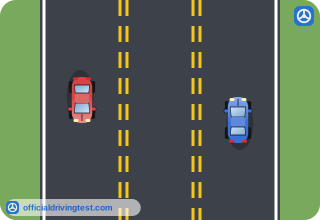
What are reversible lanes meant to do?
- Help keep traffic flowing during rush-hour periods
- Give slower vehicles a place to pull off the road
- Reserve a lane for vehicles with two or more occupants
- Provide extra parking during rush hour
Show answer
Correct answer: Help keep traffic flowing during rush-hour periods
Reversible lanes help keep traffic flowing during rush-hour periods.
Source: Minnesota Driver’s Manual (June 2026), page 71
-
What kind of lines separate reversible lanes?
- Solid double white lines
- A single solid yellow line
- Dashed double yellow lines
- Dashed white lines
Show answer
Correct answer: Dashed double yellow lines
Reversible lanes are separated by dashed double yellow lines.
Source: Minnesota Driver’s Manual (June 2026), page 71
-
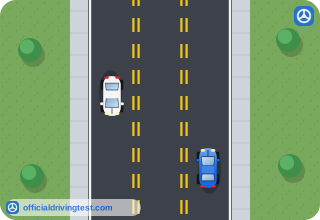
When may you cross the lines that separate reversible lanes?
- Whenever no other vehicle is in the lane you want to enter
- Only if an overhead signal has a green arrow or a sign permits it
- Only if you are passing slower traffic
- Only if you signal during rush-hour periods
Show answer
Correct answer: Only if an overhead signal has a green arrow or a sign permits it
You may cross these lines only if the overhead signal above the lane you wish to enter has a green arrow, or if a sign permits you to do so.
Source: Minnesota Driver’s Manual (June 2026), page 71
-
How are carpool lanes marked?
- By a diamond symbol or “Carpool Only” signs
- By a bicycle symbol or “Bike Only” signs
- By a white arrow or “Turn Only” signs
- By a green X or “Local Traffic” signs
Show answer
Correct answer: By a diamond symbol or “Carpool Only” signs
Carpool lanes are marked by a diamond symbol or with “Carpool Only” signs.
Source: Minnesota Driver’s Manual (June 2026), page 71
-
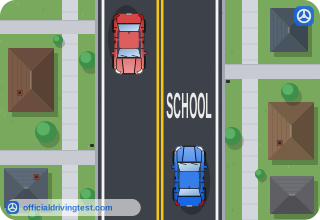
What may pavement messages such as “School Zone Ahead” be used for?
- To mark where parking is prohibited
- To warn you of certain conditions
- To show the posted speed limit for the next mile
- To identify lanes reserved for school buses
Show answer
Correct answer: To warn you of certain conditions
Pavement messages may be used to warn you of certain conditions, such as “School Zone Ahead.”
Source: Minnesota Driver’s Manual (June 2026), page 71