Minnesota: Parking rules Practice Test
Where you may not park, parking on hills, parallel parking, highway parking and leaving your vehicle safely.
Independent educational site · not affiliated with any government agency or DMV
Ready? Test yourself
- Instant feedback with an explanation
- Every answer cites its source in the manual
- Your best score is saved on this device
Questions are original and based on the official manual "Minnesota Driver’s Manual" (June 2026), Minnesota Driver and Vehicle Services.
All 23 questions in this practice test
Take the test above first, then use this list to study. Tap “Show answer” to see the correct answer and explanation.
Show the questions and answersHide the questions
-
When you parallel park, your vehicle’s wheels closest to the side of the road should be no more than how far from the curb?
- 12 inches
- 6 inches
- 24 inches
- 36 inches
Show answer
Correct answer: 12 inches
When you parallel park, the wheels closest to the side of the road should be no more than 12 inches from the curb.
Source: Minnesota Driver’s Manual (June 2026), page 35
-
Parking is not allowed within what distance of a crosswalk at an intersection?
- 5 feet
- 10 feet
- 20 feet
- 40 feet
Show answer
Correct answer: 20 feet
Parking is not allowed within 20 feet of a crosswalk at an intersection.
Source: Minnesota Driver’s Manual (June 2026), page 35
-
Parking is not allowed within what distance of any flashing light, stop sign or traffic control signal on the side of a public road?
- 10 feet
- 15 feet
- 100 feet
- 30 feet
Show answer
Correct answer: 30 feet
Parking is not allowed within 30 feet of any flashing light, stop sign or traffic control signal on the side of a public road.
Source: Minnesota Driver’s Manual (June 2026), page 35
-
Parking is not allowed within what distance of the nearest rail of a railroad crossing?
- 10 feet
- 50 feet
- 25 feet
- 200 feet
Show answer
Correct answer: 50 feet
Parking is not allowed within 50 feet of the nearest rail of a railroad crossing.
Source: Minnesota Driver’s Manual (June 2026), page 35
-
Parking is not allowed within what distance of a fire hydrant?
- 5 feet
- 15 feet
- 10 feet
- 25 feet
Show answer
Correct answer: 10 feet
Parking is not allowed within 10 feet of a fire hydrant.
Source: Minnesota Driver’s Manual (June 2026), page 35
-
What is it called when you park on the traffic side of a vehicle that is parked at a curb?
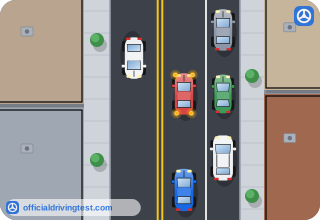
- Double parking
- Angle parking
- Shoulder parking
- Blocking parking
Show answer
Correct answer: Double parking
Parking on the traffic side of any vehicle parked at a curb or at the edge of a highway is known as double parking, and it is not allowed.
Source: Minnesota Driver’s Manual (June 2026), page 35
-
Parking is not allowed beside a curb painted what color?
- Yellow
- White
- Blue
- Green
Show answer
Correct answer: Yellow
Parking is not allowed beside a curb that is painted yellow or where No Parking signs are posted.
Source: Minnesota Driver’s Manual (June 2026), page 35
-
When the front of your parked vehicle points downhill, which way should the front wheels be turned?
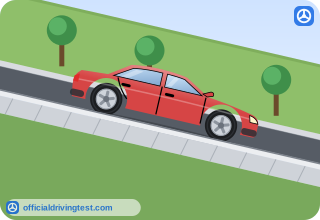
- Away from the curb or shoulder of the road
- Straight ahead, with the wheels not turned
- Toward the center of the road
- Toward the curb or shoulder of the road
Show answer
Correct answer: Toward the curb or shoulder of the road
When parked facing downhill, wheels should be turned toward the curb or shoulder of the road.
Source: Minnesota Driver’s Manual (June 2026), page 36
-
When the front of your parked vehicle points uphill and there is a curb, which way should the front wheels be turned?
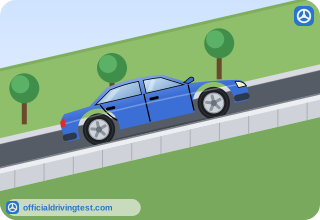
- It does not matter which way
- Straight ahead
- Away from the curb
- Left only on one-way streets
Show answer
Correct answer: Away from the curb
When parked facing uphill with a curb, wheels should be turned away from the curb.
Source: Minnesota Driver’s Manual (June 2026), page 36
-
When the front of your parked vehicle points uphill and there is no curb, which way should the front wheels be turned?
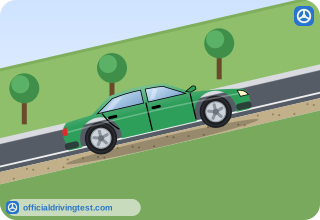
- Toward the shoulder of the road
- Toward the center of the road
- Straight ahead
- Away from the shoulder of the road
Show answer
Correct answer: Toward the shoulder of the road
When parked facing uphill with no curb, wheels should be turned toward the shoulder of the road.
Source: Minnesota Driver’s Manual (June 2026), page 36
-
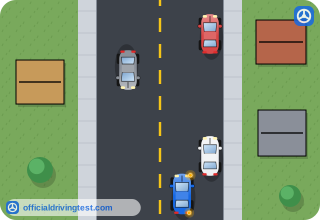
When parallel parking, how far from the car ahead should you stop, even with it?
- About six inches
- About three feet away from it
- About five feet
- About one and a half feet
Show answer
Correct answer: About one and a half feet
The first parallel parking step is to stop even with the car ahead and about one and a half feet away from it.
Source: Minnesota Driver’s Manual (June 2026), page 36
-
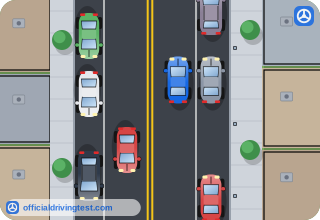
In parallel parking, after you stop even with the car ahead, what do you do next?
- Turn the wheel sharply to the left and pull forward
- Turn the wheel sharply to the right and back up slowly
- Straighten the wheels and back up quickly
- Turn the wheel to the right and pull forward into the space
Show answer
Correct answer: Turn the wheel sharply to the right and back up slowly
The second parallel parking step is to turn the wheel to the right sharply and back up slowly.
Source: Minnesota Driver’s Manual (June 2026), page 36
-
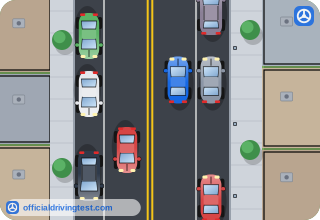
In parallel parking, when your vehicle is clear of the car ahead, what do you do while continuing to back up slowly?
- Straighten the front wheels and stop
- Turn the wheel sharply to the left
- Turn the wheel halfway to the right
- Hold the wheel steady and speed up
Show answer
Correct answer: Turn the wheel sharply to the left
When clear of the car ahead, turn the wheel sharply to the left and continue to back up slowly.
Source: Minnesota Driver’s Manual (June 2026), page 36
-
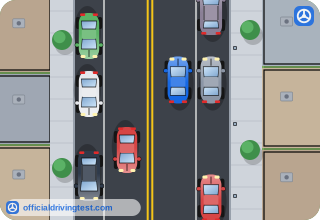
In the last step of parallel parking, where do you pull your vehicle after turning the wheel sharply to the right?
- Against the bumper of the car behind
- As close as possible to the car ahead
- Into the middle of the traffic lane
- Toward the curb, in the center of the space
Show answer
Correct answer: Toward the curb, in the center of the space
The last step is to turn the wheel sharply to the right and pull toward the curb in the center of the space.
Source: Minnesota Driver’s Manual (June 2026), page 36
-
If you park on a state highway or freeway, where must you move your vehicle?
- Away from the main part of the road
- Into the left lane next to the median
- As close to the traffic lane as possible
- Into the nearest lane of traffic
Show answer
Correct answer: Away from the main part of the road
If you are parking on state highways or freeways, you must move your vehicle away from the main part of the road.
Source: Minnesota Driver’s Manual (June 2026), page 37
-
If your vehicle cannot be moved off the main part of a state highway or freeway, what should you use?
- Your horn every few minutes to warn other drivers
- Your brake lights only
- Visible markers or signals to prevent damage and harm to other drivers
- Your high beams pointed at oncoming traffic to warn drivers
Show answer
Correct answer: Visible markers or signals to prevent damage and harm to other drivers
If your vehicle cannot be moved, use visible markers or signals to prevent damage and harm to other drivers.
Source: Minnesota Driver’s Manual (June 2026), page 37
-
What lights must be illuminated on a vehicle parked on the highway at night?
- Both headlights on high beam and one white rear light
- One red front light and one white taillight
- Only the dome light and the brake lights
- At least one white or amber front light and one red taillight
Show answer
Correct answer: At least one white or amber front light and one red taillight
If you park on the highway at night, you must have at least one white or amber front light and one red taillight illuminated on your vehicle.
Source: Minnesota Driver’s Manual (June 2026), page 37
-
The lights on a vehicle parked on the highway at night must be visible from at least what distance?
- 100 feet
- 500 feet
- 200 feet
- 300 feet
Show answer
Correct answer: 500 feet
Both required lights on a vehicle parked on the highway at night must be visible from at least 500 feet.
Source: Minnesota Driver’s Manual (June 2026), page 37
-
How should you set the headlights on a vehicle parked on the highway at night?
- High beam
- Flashing
- Low beam
- Off
Show answer
Correct answer: Low beam
Headlights on parked vehicles should be set to low beam.
Source: Minnesota Driver’s Manual (June 2026), page 37
-
Who may use parking spaces that have blue handicapped parking signs?
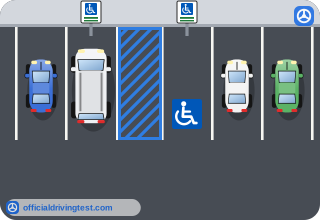
- Any vehicle whose driver stays inside the vehicle at all times
- Any vehicle with a driver age 65 or older
- Vehicles with disability license plates or a disability parking permit
- Any vehicle parked for a short time only
Show answer
Correct answer: Vehicles with disability license plates or a disability parking permit
Spaces with blue handicapped parking signs are reserved for vehicles with disability license plates or a disability parking permit.
Source: Minnesota Driver’s Manual (June 2026), page 59
-
If designated disability parking spaces are occupied or unavailable, what may a driver with a valid disability parking permit or plates do?
- Park in a loading zone for as long as needed
- Park at an angle and occupy two standard parking spaces
- Park on the sidewalk next to the entrance
- Park in a no-parking zone for up to one full hour
Show answer
Correct answer: Park at an angle and occupy two standard parking spaces
With a valid disability parking permit or plates, you may park at an angle and occupy two standard parking spaces when designated spaces are occupied or unavailable.
Source: Minnesota Driver’s Manual (June 2026), page 59
-
What may city officials declare when a significant amount of snow accumulates?
- A road closure
- A snow emergency
- A parking holiday
- A speed restriction
Show answer
Correct answer: A snow emergency
City officials may declare a snow emergency, and certain parking rules may then go into effect while snow is removed from streets.
Source: Minnesota Driver’s Manual (June 2026), page 81
-
Why should you obey snow emergency parking rules?
- To keep your insurance rates from going up
- To avoid losing your parking permit
- To avoid points on your driving record
- To avoid towing and fines
Show answer
Correct answer: To avoid towing and fines
The manual says to obey snow emergency parking rules to avoid towing and fines.
Source: Minnesota Driver’s Manual (June 2026), page 81