Minnesota: Exam Simulator
40 random questions from every topic, like a mini exam.
Independent educational site · not affiliated with any government agency or DMV
Ready? Test yourself
40 questions (the state does not publish how many its test has); pass mark 80%, as on the real test.
- Instant feedback with an explanation
- Every answer cites its source in the manual
- Your best score is saved on this device
Questions are original and based on the official manual "Minnesota Driver’s Manual" (June 2026), Minnesota Driver and Vehicle Services.
Sample questions
The exam simulator picks 40 random questions from every topic each time you start. Here are a few examples.
Show the questions and answersHide the questions
-
Under Minnesota law, what is it to obstruct the work of a DVS employee?
- A warning-only offense
- A crime
- A parking-type violation
- An office rule, not a law
Show answer
Correct answer: A crime
It is a crime to obstruct the work of a Driver and Vehicle Services (DVS) employee.
Source: Minnesota Driver’s Manual (June 2026), page 2
-
At least how many separate brake systems must all cars and trucks have?
- One
- Three
- Four
- Two
Show answer
Correct answer: Two
All cars and trucks must have at least two separate brake systems, like the foot brake and the parking/emergency brake.
Source: Minnesota Driver’s Manual (June 2026), page 22
-
What does a solid yellow line on your side of the center line mean?
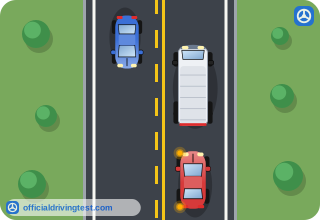
- Passing is allowed only when no vehicle is in sight
- Passing is not allowed
- Passing is allowed only for slow vehicles
- Passing is allowed only on the right
Show answer
Correct answer: Passing is not allowed
Do not pass where there is a solid yellow line on your side of the center line.
Source: Minnesota Driver’s Manual (June 2026), page 34
-
What are ramp meters?
- Gauges on freeway exits that measure the speed of leaving traffic
- Signs that show the distance to the next freeway entrance
- Signal lights on freeway entrance ramps that help control merging traffic
- Lights on freeway exits that tell drivers when a lane is closed
Show answer
Correct answer: Signal lights on freeway entrance ramps that help control merging traffic
Ramp meters are signal lights on freeway entrance ramps that help control the flow of merging traffic.
Source: Minnesota Driver’s Manual (June 2026), page 68
-
When you parallel park, your vehicle’s wheels closest to the side of the road should be no more than how far from the curb?
- 12 inches
- 6 inches
- 24 inches
- 36 inches
Show answer
Correct answer: 12 inches
When you parallel park, the wheels closest to the side of the road should be no more than 12 inches from the curb.
Source: Minnesota Driver’s Manual (June 2026), page 35
-
What does the color red mean on a regulatory sign?
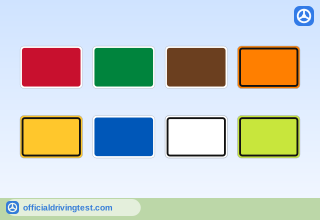
- Prohibits and commands
- Warns of possible hazards
- Describes services for motorists
- Indicates historic sites
Show answer
Correct answer: Prohibits and commands
Red on regulatory signs prohibits and commands.
Source: Minnesota Driver’s Manual (June 2026), page 56
-
What may happen if you do not obey a regulatory sign?
- You must attend a driver improvement class
- You will lose your driving privileges immediately
- Nothing, because regulatory signs are only advice
- You may receive a traffic citation and a fine
Show answer
Correct answer: You may receive a traffic citation and a fine
Regulatory signs must be obeyed, and drivers who do not obey them may receive a traffic citation and a fine.
Source: Minnesota Driver’s Manual (June 2026), page 57
-
You are stopped at a red traffic light and want to go straight through. What must be true before you proceed?
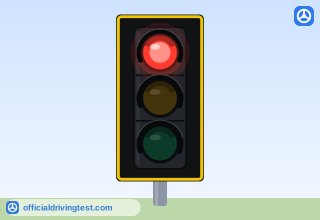
- The light has turned yellow for cross traffic
- Cross traffic has slowed down or stopped
- The light is green and your path is clear
- At least five seconds have passed
Show answer
Correct answer: The light is green and your path is clear
At a red light you wait until the light turns green and your path is clear before proceeding.
Source: Minnesota Driver’s Manual (June 2026), page 41
-
On a wide road, the rule that you must drive on the right side does not apply when the road has how many marked lanes?
- Three
- Two
- Four
- Five
Show answer
Correct answer: Three
The manual lists a road with three marked lanes as an exception to driving on the right side of a wide road.
Source: Minnesota Driver’s Manual (June 2026), page 26
-
Why are most vehicle-train collisions deadly for the driver?
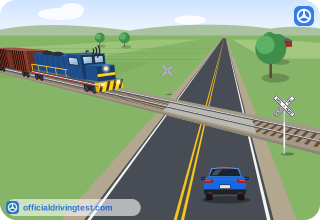
- Because of the size and weight of a train
- Because trains cannot be seen at night
- Because trains travel faster than 100 mph
- Because crossing gates do not work in cold weather
Show answer
Correct answer: Because of the size and weight of a train
Because of the size and weight of a train, most vehicle-train collisions are deadly for the driver.
Source: Minnesota Driver’s Manual (June 2026), page 53