Minnesota: Emergencies and winter driving — Part 4 Practice Test
Questions in this part include: “How much water will reach the bottom of most passenger cars, causing loss of control or possible stalling?” · “How much moving water can carry away most vehicles, including SUVs and pickup trucks?”
Independent educational site · not affiliated with any government agency or DMV
Ready? Test yourself
- Instant feedback with an explanation
- Every answer cites its source in the manual
- Your best score is saved on this device
Questions are original and based on the official manual "Minnesota Driver’s Manual" (June 2026), Minnesota Driver and Vehicle Services.
All 17 questions in this practice test
Take the test above first, then use this list to study. Tap “Show answer” to see the correct answer and explanation.
Show the questions and answersHide the questions
-
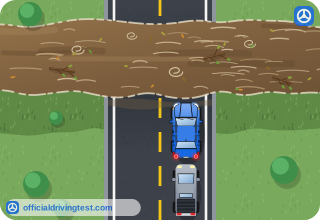
What should you do if you see a flooded roadway ahead?
- Drive through slowly in a low gear
- Turn around and find another route
- Follow the car ahead through the water
- Wait in the road until the water goes down
Show answer
Correct answer: Turn around and find another route
Do not drive through flooded areas; if you see a flooded roadway ahead, turn around and find another route.
Source: Minnesota Driver’s Manual (June 2026), page 85
-
How much water will reach the bottom of most passenger cars, causing loss of control or possible stalling?
- 6 inches
- 3 inches
- 12 inches
- 18 inches
Show answer
Correct answer: 6 inches
6 inches of water will reach the bottom of most passenger cars, causing loss of control or possible stalling.
Source: Minnesota Driver’s Manual (June 2026), page 85
-
How much moving water can carry away most vehicles, including SUVs and pickup trucks?
- 1 foot
- 3 feet
- 2 feet
- 4 feet
Show answer
Correct answer: 2 feet
2 feet of moving water can carry away most vehicles, including SUVs and pickup trucks.
Source: Minnesota Driver’s Manual (June 2026), page 85
-
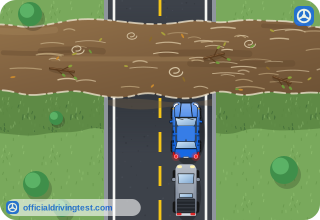
Why should you not attempt to cross a flooded road even if the water appears shallow?
- Shallow water always hides large objects that can puncture the tires
- Water can hide dips or damage roadways by washing away the surface
- Shallow water makes the road surface too slippery to stop on
- Shallow water floods the exhaust system and stops the engine at once
Show answer
Correct answer: Water can hide dips or damage roadways by washing away the surface
Even if the water appears shallow, water can hide dips or damage roadways by washing away the surface.
Source: Minnesota Driver’s Manual (June 2026), page 85
-
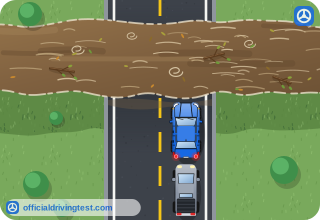
If there is no other route around a flooded road, what should you do?
- Drive across slowly in the middle of the road
- Park in the water and wait for help
- Wait where you are until the water reaches the road
- Proceed to higher ground and wait for the waters to subside
Show answer
Correct answer: Proceed to higher ground and wait for the waters to subside
If there is no other route, proceed to higher ground and wait for the waters to subside.
Source: Minnesota Driver’s Manual (June 2026), page 85
-
For how long will most vehicles float on the surface of the water?
- 5 to 10 seconds
- 30 to 60 seconds
- 2 to 3 minutes
- 10 to 15 minutes
Show answer
Correct answer: 30 to 60 seconds
Most vehicles will float on the surface of the water for 30 to 60 seconds.
Source: Minnesota Driver’s Manual (June 2026), page 85
-
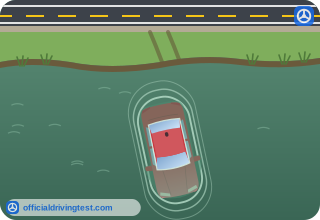
If your vehicle enters deep water, what should you do?
- Stay inside and call for help until the vehicle stops floating
- Wait for the vehicle to fill with water before trying the doors
- Roll up the windows and stay in the car until help arrives
- Get out immediately, through an open window if possible
Show answer
Correct answer: Get out immediately, through an open window if possible
If your vehicle enters deep water, get out of the vehicle immediately, and if possible exit through open windows before the water reaches the window level.
Source: Minnesota Driver’s Manual (June 2026), page 85
-
When can the doors of a submerged vehicle be opened?
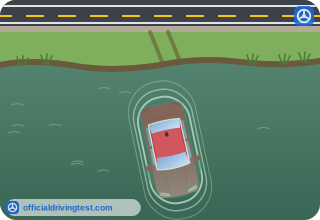
- When the water pressure inside equals the pressure outside
- As soon as the vehicle starts to sink
- Only after the windows have been rolled up
- When the front end of the car has stopped sinking
Show answer
Correct answer: When the water pressure inside equals the pressure outside
Vehicle doors cannot be opened until the water pressure inside the car is equal to that outside.
Source: Minnesota Driver’s Manual (June 2026), page 85
-
Which end of a vehicle sinks first when it is submerged, and what may the rear passenger compartment provide?
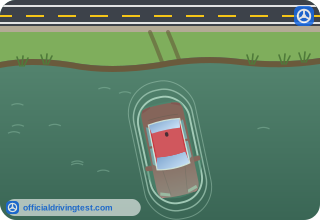
- The rear end, because of the weight of the trunk, and an air pocket
- The front end, because of the weight of the engine, and a dry exit
- The front end, because of the weight of the engine, and an air pocket
- The rear end, because of the weight of the trunk, and a dry exit
Show answer
Correct answer: The front end, because of the weight of the engine, and an air pocket
The weight of the engine causes the front end of the car to sink first, and the rear passenger compartment may provide an air pocket while you plan your escape.
Source: Minnesota Driver’s Manual (June 2026), page 85
-
If you see smoke rising from beneath the hood of your vehicle, what should you do?
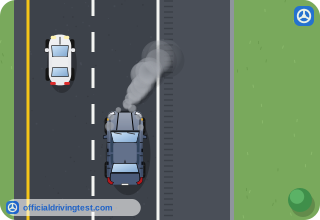
- Open the hood to see where the smoke is coming from
- Keep driving to the nearest service station
- Pour water on the engine to cool it down
- Pull off the road, turn off the ignition and get out
Show answer
Correct answer: Pull off the road, turn off the ignition and get out
If you notice smoke rising from beneath the hood, pull off the road, turn off the ignition and exit the vehicle immediately.
Source: Minnesota Driver’s Manual (June 2026), page 85
-
Why should you not use water to put out a vehicle fire?
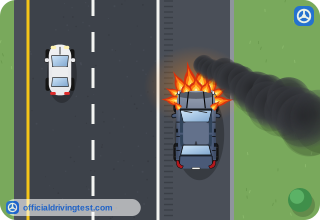
- It will actually spread the blaze
- It will damage the vehicle’s electrical system
- It will not reach the source of the fire
- It will make the smoke more dangerous to breathe
Show answer
Correct answer: It will actually spread the blaze
The manual says not to use water to put out the fire because this will actually spread the blaze.
Source: Minnesota Driver’s Manual (June 2026), page 85
-
When your engine becomes hot, what should you do first?
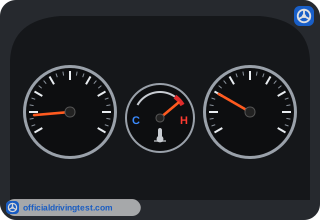
- Pull over and open the radiator cap
- Turn the heater off and turn the air conditioning up high
- Turn off unnecessary equipment, such as the air conditioning
- Pour cold water on the engine
Show answer
Correct answer: Turn off unnecessary equipment, such as the air conditioning
When your engine becomes hot, turn off any unnecessary vehicle equipment, such as the air conditioning; if the temperature is still too high, turning on the heater helps draw hot air away.
Source: Minnesota Driver’s Manual (June 2026), page 85
-
What should you do if the engine temperature suddenly increases or steam rises from the engine?
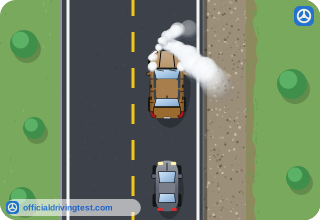
- Turn on the heater and keep driving to the next exit
- Pull over, stop and turn off the ignition immediately
- Open the hood while you keep the engine running
- Turn on the air conditioning and slow down
Show answer
Correct answer: Pull over, stop and turn off the ignition immediately
If the engine temperature suddenly increases or steam rises from the engine, pull over to the side of the road, stop the vehicle and turn off the ignition immediately.
Source: Minnesota Driver’s Manual (June 2026), page 85
-
If your headlights suddenly go out, what might give you enough light to guide you off the road?
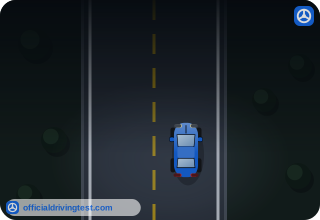
- Parking lights, hazard lights or turn signals
- The interior dome light and the glove box light
- The high beams
- The fog lights
Show answer
Correct answer: Parking lights, hazard lights or turn signals
If your headlights go out, try your parking lights, hazard warning lights or turn signals; one of them may give you enough light to guide you off the road.
Source: Minnesota Driver’s Manual (June 2026), page 86
-
If all your lights fail on a dark, deserted road, what should you do?
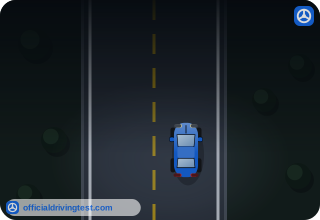
- Stop right where you are in the lane
- Pull onto the shoulder at once and keep driving slowly
- Slow down and keep on the pavement until you can reach the shoulder
- Speed up to reach a lighted area as soon as you possibly can
Show answer
Correct answer: Slow down and keep on the pavement until you can reach the shoulder
If all lights fail on a dark, deserted road, slow down and keep your vehicle on the pavement until you can move safely onto the shoulder.
Source: Minnesota Driver’s Manual (June 2026), page 86
-
If your windshield wipers suddenly fail in heavy rain or snow, what should you do?
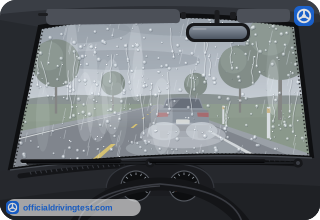
- Brake suddenly to stop in the lane of traffic
- Slow down and activate your hazard warning lights
- Speed up to leave the storm behind
- Turn on your high beams and continue
Show answer
Correct answer: Slow down and activate your hazard warning lights
If your wipers fail in heavy rain or snow, slow down and activate your hazard warning lights, and do not brake suddenly if other vehicles are behind you.
Source: Minnesota Driver’s Manual (June 2026), page 86
-
If the hood of your vehicle suddenly opens and blocks your view, how might you be able to see the road?
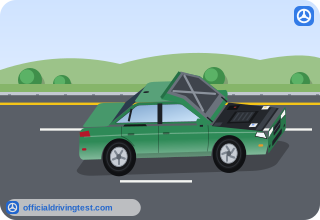
- By opening the door and leaning out of the vehicle
- By turning on the windshield wipers
- By slowing to a stop in your lane
- Through the space between the hood and the dashboard
Show answer
Correct answer: Through the space between the hood and the dashboard
You may be able to see through the space between the hood and the dashboard; if not, roll down the window and lean over to look past the side of the hood.
Source: Minnesota Driver’s Manual (June 2026), page 86