Minnesota: Emergencies and winter driving — Part 2 Practice Test
Questions in this part include: “If you are involved in a crash that results in injury, what should you do?” · “Which of these is among the items recommended for a winter survival kit?”
Independent educational site · not affiliated with any government agency or DMV
Ready? Test yourself
- Instant feedback with an explanation
- Every answer cites its source in the manual
- Your best score is saved on this device
Questions are original and based on the official manual "Minnesota Driver’s Manual" (June 2026), Minnesota Driver and Vehicle Services.
All 17 questions in this practice test
Take the test above first, then use this list to study. Tap “Show answer” to see the correct answer and explanation.
Show the questions and answersHide the questions
-
If you are involved in a crash that results in injury, what should you do?
- Leave the scene once you have called your insurance company
- Drive to the nearest law enforcement agency to report it
- Wait for a passing driver to report the crash for you
- Stay where you are and, if able, call 911 or law enforcement
Show answer
Correct answer: Stay where you are and, if able, call 911 or law enforcement
The manual says to stay where you are after an injury crash and, if you are able, call 911 or the nearest law enforcement agency.
Source: Minnesota Driver’s Manual (June 2026), page 78
-
If a crash results only in property damage, when should you step out of your vehicle?
- After you have moved to a safe location away from traffic
- Immediately, so you can inspect the damage to each vehicle
- Only after law enforcement has arrived at the scene
- Only after you have photographed the other vehicle
Show answer
Correct answer: After you have moved to a safe location away from traffic
For a property-damage-only crash you move to a safe location, and you do not step out of your vehicle until you are away from traffic.
Source: Minnesota Driver’s Manual (June 2026), page 78
-
After a crash, which of these should you write down?
- The posted speed limit at the scene of the crash
- The names of every passenger in the other vehicles
- The license plate numbers of other vehicles involved
- The interior color of every vehicle involved
Show answer
Correct answer: The license plate numbers of other vehicles involved
The manual says to write down the license plate numbers of other vehicles involved in the crash.
Source: Minnesota Driver’s Manual (June 2026), page 78
-
Which of these is among the items recommended for a winter survival kit?
- A portable gas stove for cooking
- A red flag for your vehicle’s antenna
- A can of spare gasoline and a funnel
- Spare brake fluid
Show answer
Correct answer: A red flag for your vehicle’s antenna
Recommended winter survival kit items include a red flag for your vehicle’s antenna, along with a shovel, blanket, flares and more.
Source: Minnesota Driver’s Manual (June 2026), page 81
-
If you become stranded while traveling in cold weather, what should you do?
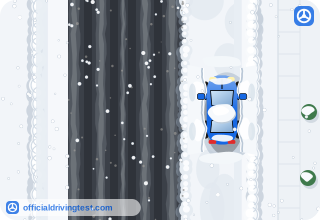
- Stay with your vehicle
- Walk to the nearest building
- Follow the road to find help
- Walk along the highway to flag down a driver
Show answer
Correct answer: Stay with your vehicle
The manual says to stay with your vehicle because most deaths occur when people leave, become lost and suffer prolonged exposure to the cold.
Source: Minnesota Driver’s Manual (June 2026), page 82
-
If you become stranded while traveling in cold weather, what should you attach to your radio antenna or door handle?
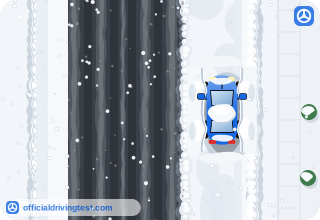
- A bright orange cloth
- A reflective vest
- A red flag
- A blue light
Show answer
Correct answer: A red flag
One of the steps for a stranded driver is to attach a red flag to the radio antenna or door handle.
Source: Minnesota Driver’s Manual (June 2026), page 82
-
While stranded and running the engine for warmth, what should you keep clear of snow and debris?
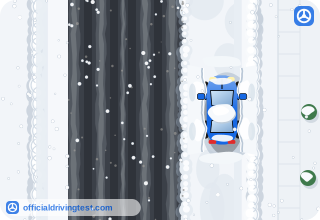
- The tail lamps
- The exhaust pipe
- The windshield wipers
- The hood latch
Show answer
Correct answer: The exhaust pipe
A stranded driver should keep the exhaust pipe clear of snow and debris.
Source: Minnesota Driver’s Manual (June 2026), page 82
-
When stranded, how long is it recommended to run the engine each hour to charge the battery and warm the interior?
- About 30 minutes
- About 45 minutes
- About 2 minutes
- About 10 minutes
Show answer
Correct answer: About 10 minutes
Running the engine for about 10 minutes each hour to charge the battery and warm the interior is recommended.
Source: Minnesota Driver’s Manual (June 2026), page 82
-
Why should you leave at least one window partially open when stranded in cold weather with the engine idling?
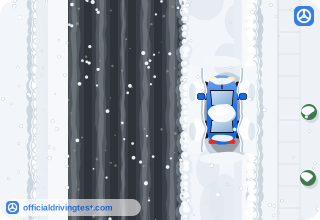
- To keep the windshield from fogging so rescuers can see inside
- To let in fresh air because occupants can suffer carbon monoxide poisoning
- To let the cold air keep everyone awake while waiting
- To let heat escape so the engine does not overheat
Show answer
Correct answer: To let in fresh air because occupants can suffer carbon monoxide poisoning
Occupants of an idling vehicle can suffer carbon monoxide poisoning if ventilation is not adequate, so leave at least one window partially open.
Source: Minnesota Driver’s Manual (June 2026), page 82
-
When stranded in cold weather, how many people in the vehicle should remain awake at all times?
- Every passenger
- Only the driver
- Two people
- At least one
Show answer
Correct answer: At least one
At least one person in the vehicle should remain awake at all times.
Source: Minnesota Driver’s Manual (June 2026), page 82
-
What causes a vehicle to skid?
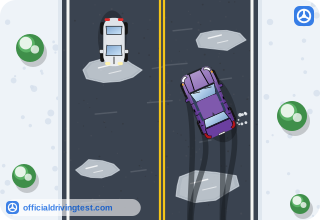
- The engine runs at too high a speed
- The tires lose their grip on the road surface
- The brake fluid becomes too cold
- The steering wheel is held too tightly
Show answer
Correct answer: The tires lose their grip on the road surface
A vehicle skids when its tires lose their grip on the road surface.
Source: Minnesota Driver’s Manual (June 2026), page 82
-
What should you do if your vehicle skids?
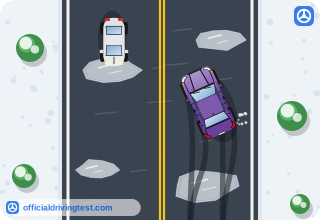
- Stay calm, take your foot off the accelerator and brake until you can turn in the desired direction
- Slam on the brakes and hold the steering wheel firmly in the direction in which the vehicle skids
- Press the accelerator to pull out of the skid and steer back toward the lane
- Stay calm and shift into neutral while steering sharply away from the skid
Show answer
Correct answer: Stay calm, take your foot off the accelerator and brake until you can turn in the desired direction
If your vehicle skids, stay calm, do not slam on the brakes, take your foot off the accelerator and brake until you can turn in the desired direction.
Source: Minnesota Driver’s Manual (June 2026), page 82
-
If your vehicle has anti-lock brakes, how should you brake when you need to stop quickly?
- Pump the brake pedal as you would regular brakes
- Tap the brake pedal lightly and let go several times
- Press down on the brake pedal and continue to steer
- Press the pedal once and take both hands off the wheel
Show answer
Correct answer: Press down on the brake pedal and continue to steer
With anti-lock brakes, do not pump them; press down on the brake pedal and continue to steer the vehicle until you regain control.
Source: Minnesota Driver’s Manual (June 2026), page 83
-
What happens when your tires hydroplane?
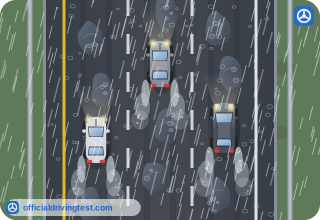
- They lose some grip but you can still brake and turn normally
- They heat up and the tire treads grip the water more firmly
- They lose all contact with the road and you cannot brake or steer
- They grip the road better because water cools the tread
Show answer
Correct answer: They lose all contact with the road and you cannot brake or steer
When tires hydroplane they lose all contact with the road, so you are unable to brake, accelerate or change direction.
Source: Minnesota Driver’s Manual (June 2026), page 83
-
What should you do if your tires begin to hydroplane?
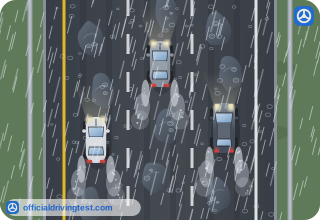
- Brake hard right away
- Turn the steering wheel sharply
- Shift into neutral and accelerate
- Take your foot off the gas pedal
Show answer
Correct answer: Take your foot off the gas pedal
If your tires begin to hydroplane, take your foot off the gas pedal.
Source: Minnesota Driver’s Manual (June 2026), page 83
-
What are possible warning signs before a blowout?
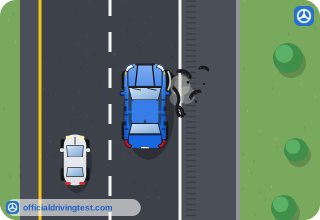
- A burning smell and thin smoke rising from beneath the hood
- A brake pedal that sinks slowly when you press it
- A thumping sound or the steering wheel pulling to the right or left
- A warning light that stays on after the engine starts
Show answer
Correct answer: A thumping sound or the steering wheel pulling to the right or left
Before a blowout you may hear a thumping sound or notice the steering wheel pulling to the right or left.
Source: Minnesota Driver’s Manual (June 2026), page 83
-
What should you do if you experience a blowout?
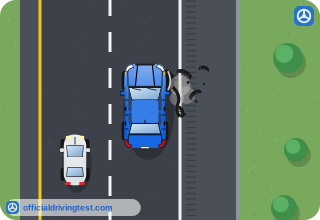
- Brake hard right away and steer toward the nearest shoulder to stop quickly
- Hold the steering wheel tightly, steer straight and slowly ease off the accelerator
- Turn the steering wheel sharply toward the shoulder and shift into neutral
- Release the steering wheel so the vehicle can straighten out by itself
Show answer
Correct answer: Hold the steering wheel tightly, steer straight and slowly ease off the accelerator
After a blowout, hold the steering wheel tightly, steer straight ahead and slowly ease your foot off the accelerator.
Source: Minnesota Driver’s Manual (June 2026), page 83