Minnesota: Emergencies and winter driving — Part 1 Practice Test
Questions in this part include: “If someone is injured or killed in a crash, what should you do?” · “After a crash, if asked, what insurance information must you give to the investigating law enforcement officer?”
Independent educational site · not affiliated with any government agency or DMV
Ready? Test yourself
- Instant feedback with an explanation
- Every answer cites its source in the manual
- Your best score is saved on this device
Questions are original and based on the official manual "Minnesota Driver’s Manual" (June 2026), Minnesota Driver and Vehicle Services.
All 17 questions in this practice test
Take the test above first, then use this list to study. Tap “Show answer” to see the correct answer and explanation.
Show the questions and answersHide the questions
-
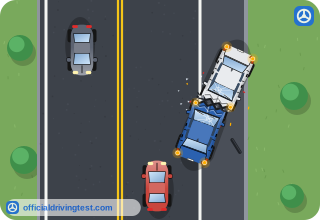
If you are in a crash and able to, why should you turn off the ignition?
- To save the battery
- To keep the airbags from inflating again
- To reduce the risk of fire
- To stop the vehicle from being towed
Show answer
Correct answer: To reduce the risk of fire
After a crash, if you are able, turn off the ignition to reduce the risk of fire.
Source: Minnesota Driver’s Manual (June 2026), page 39
-
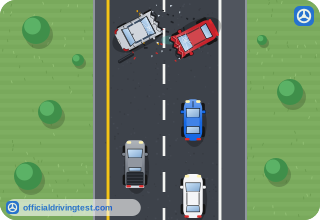
After a crash, what should you use to warn other drivers of danger?
- Your horn and your high beams flashing at traffic
- Emergency warning lights, flares or a flashlight
- Your parking brake
- Your windshield wipers
Show answer
Correct answer: Emergency warning lights, flares or a flashlight
To protect yourself and the crash scene, use emergency warning lights, flares or a flashlight to warn other drivers of danger.
Source: Minnesota Driver’s Manual (June 2026), page 39
-
If someone is injured or killed in a crash, what should you do?
- Call the Driver and Vehicle Services office within 24 hours
- Wait for another driver to call
- Call your insurance agent first
- Call the nearest law enforcement agency or 911 as quickly as possible
Show answer
Correct answer: Call the nearest law enforcement agency or 911 as quickly as possible
If someone is injured or killed, call the nearest law enforcement agency or 911 as quickly as possible.
Source: Minnesota Driver’s Manual (June 2026), page 39
-
What does the manual say you are required by law to do for crash victims?
- Move them to the shoulder
- Give them a ride to a hospital
- Provide reasonable assistance
- Wait with them until their family arrives
Show answer
Correct answer: Provide reasonable assistance
You are required by law to provide reasonable assistance to crash victims.
Source: Minnesota Driver’s Manual (June 2026), page 39
-
After a crash, what information must you give to other drivers and any law enforcement officer at the scene?
- Your name, address, date of birth and vehicle registration number
- Your name, address, phone number and vehicle color
- Your name, address, Social Security number and vehicle title
- Your name, address, employer and insurance policy number
Show answer
Correct answer: Your name, address, date of birth and vehicle registration number
After a crash, provide your name, address, date of birth and vehicle registration number to other drivers and any law enforcement officer at the scene.
Source: Minnesota Driver’s Manual (June 2026), page 39
-
After a crash, to whom must you show your driver’s license?
- Only a law enforcement officer who is at the scene
- Only the other driver
- Only your insurance agent
- Anyone who asks for it and any law enforcement officer
Show answer
Correct answer: Anyone who asks for it and any law enforcement officer
Show your driver’s license to anyone who asks for it and to any law enforcement officer.
Source: Minnesota Driver’s Manual (June 2026), page 39
-
After a crash, if asked, what insurance information must you give to the investigating law enforcement officer?
- The name of your insurance carrier and the amount of your coverage
- The name and address of your insurance carrier and the name of your agent
- Your policy number and the date you bought it
- The amount of coverage and your monthly premium
Show answer
Correct answer: The name and address of your insurance carrier and the name of your agent
If asked, give the name and address of your insurance carrier and the name of your agent to the investigating law enforcement officer.
Source: Minnesota Driver’s Manual (June 2026), page 39
-
If you do not have your insurance information with you after a crash, within what time must you provide it?
- 24 hours
- 72 hours
- 48 hours
- 7 days
Show answer
Correct answer: 72 hours
If you do not have your insurance information with you, you must provide it within 72 hours.
Source: Minnesota Driver’s Manual (June 2026), page 39
-
If a crash results only in property damage, what does the manual say about notifying law enforcement?
- You must call 911 immediately
- You must report to a police station within 24 hours
- You must report to DVS within 10 days
- You do not need to notify law enforcement
Show answer
Correct answer: You do not need to notify law enforcement
If the crash only results in property damage, you do not need to notify law enforcement.
Source: Minnesota Driver’s Manual (June 2026), page 39
-
If you damage property other than a vehicle in a crash, what should you do?
- Inform the property owner
- Drive away if the damage is minor
- Report it only to your insurance agent
- Wait for a deputy registrar
Show answer
Correct answer: Inform the property owner
If you damage property other than a vehicle, inform the property owner.
Source: Minnesota Driver’s Manual (June 2026), page 39
-
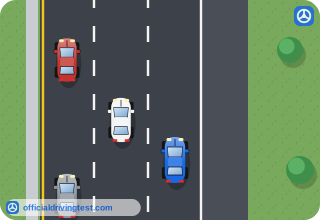
When is it legal to stop or park a vehicle on an interstate freeway?
- When traffic is heavy
- When you need to check a map
- When you stop briefly to let a passenger out
- Only in an emergency
Show answer
Correct answer: Only in an emergency
It is illegal to stop or park on an interstate freeway except in an emergency.
Source: Minnesota Driver’s Manual (June 2026), page 77
-
What does the manual say about running out of fuel on an interstate freeway?
- It is not considered an emergency, and you could be cited
- It is an emergency, so you may stop on the shoulder and wait
- It is an emergency only if you have passengers with you
- It is an emergency only if it happens at night
Show answer
Correct answer: It is not considered an emergency, and you could be cited
Running out of fuel is not considered an emergency, and you could receive a citation.
Source: Minnesota Driver’s Manual (June 2026), page 77
-
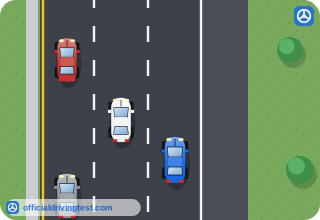
If you must stop on the freeway because of an emergency, where should you park?
- In the right lane, as close to the shoulder as possible
- In the acceleration lane of the next entry ramp
- On the shoulder, as far from the main roadway as possible
- In the left lane next to the median
Show answer
Correct answer: On the shoulder, as far from the main roadway as possible
The manual says to park on the shoulder, as far from the main roadway as possible.
Source: Minnesota Driver’s Manual (June 2026), page 77
-
What can you do to signal that your vehicle has stopped on the freeway in an emergency?
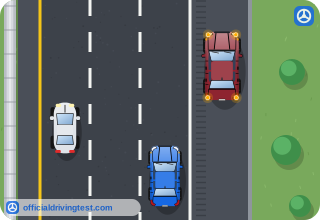
- Tie a red cloth to the rear bumper or the trunk lid
- Tie a white cloth to the radio antenna or a door handle
- Hang a dark cloth from the rear window or a mirror
- Place a traffic cone on the road behind your car
Show answer
Correct answer: Tie a white cloth to the radio antenna or a door handle
The manual says to open the trunk and raise the hood, or tie a white cloth to the radio antenna or a door handle.
Source: Minnesota Driver’s Manual (June 2026), page 77
-
If you have flares or reflectors during an emergency stop on a freeway, how far behind your vehicle should you place them?
- From 10 to 50 feet
- From 50 to 100 feet
- From 500 to 1,000 feet
- From 100 to 500 feet
Show answer
Correct answer: From 100 to 500 feet
The manual says to place flares or reflectors from 100 to 500 feet behind your vehicle on the right edge of the main road.
Source: Minnesota Driver’s Manual (June 2026), page 77
-
After stopping on the freeway because of an emergency, what should you do if possible?
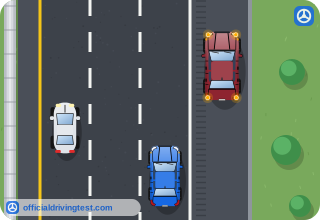
- Stay with your vehicle
- Walk to the next exit
- Flag down passing drivers
- Wait in a traffic lane
Show answer
Correct answer: Stay with your vehicle
The manual says to stay with your vehicle, if possible.
Source: Minnesota Driver’s Manual (June 2026), page 77
-
If you must leave your vehicle after an emergency stop on a freeway, what must you not do?
- Walk on the right shoulder as far from traffic as you can
- Move a safe distance away from the vehicle on the shoulder
- Walk on the area of the highway reserved for vehicle traffic
- Stay on the shoulder, away from traffic, until help arrives
Show answer
Correct answer: Walk on the area of the highway reserved for vehicle traffic
The manual says that walking on the area of the highway reserved for vehicle traffic is illegal and extremely dangerous.
Source: Minnesota Driver’s Manual (June 2026), page 77