Michigan: Sharing the road — Part 1 Practice Test
Questions in this part include: “Which best describes a 'slow-moving vehicle' under Michigan law?” · “Under Michigan law, which of the following is part of the legal definition of a moped?”
Independent educational site · not affiliated with any government agency or DMV
Ready? Test yourself
- Instant feedback with an explanation
- Every answer cites its source in the manual
- Your best score is saved on this device
Questions are original and based on the official manual "What Every Driver Must Know" (October 2025), Michigan Secretary of State.
Did you know?
- In 1927, the Ford Motor Company produced its fifteen millionth Model T.
- In 1939, the 3-M Corporation introduced reflective sheeting for roadside signs.
- In 1942, the Willow Run and Detroit Industrial Expressway, the nation's first four-lane divided highway, was completed. Nearly 42,000 Detroit-area motorists used it daily to commute to the Ypsilanti bomber factory.
More background reading from the manual →
All 20 questions in this practice test
Take the test above first, then use this list to study. Tap “Show answer” to see the correct answer and explanation.
Show the questions and answersHide the questions
-
A passenger vehicle traveling 55 mph can stop in about 130 feet. About how far does a commercial vehicle need to stop from the same speed?
- About 130 feet
- About 200 feet
- About 400 feet
- About 600 feet
Show answer
Correct answer: About 400 feet
A commercial vehicle traveling 55 mph needs about 400 feet to stop, compared to about 130 feet for a passenger vehicle at the same speed.
Source: What Every Driver Must Know (October 2025), page 53 · Open this page in the manual (Manual page 53)
-
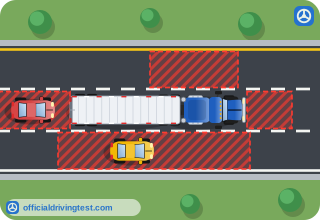
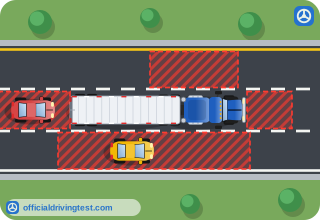
Why do large trucks have blind spots called 'no zones'?
- Because their small mirrors are rarely adjusted correctly
- Because other motorists there are not visible to the truck driver
- Because trucks are not permitted to enter those road zones
- Because those areas are reserved truck parking spots
Show answer
Correct answer: Because other motorists there are not visible to the truck driver
Large commercial vehicles have blind spots, called 'no zones', where the truck driver cannot see other vehicles, increasing crash risk if you linger there.
Source: What Every Driver Must Know (October 2025), page 53 · Open this page in the manual (Manual page 53)
-
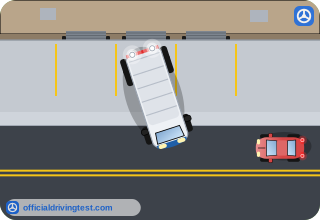
Why should you never cross behind a commercial vehicle that is backing up?
- It is against the law to be near a parked truck
- The wide trailer can completely hide your vehicle from the driver's view
- Backing trucks are always guided by a spotter, so you must wait for a signal
- It drains the truck's air brakes
Show answer
Correct answer: The wide trailer can completely hide your vehicle from the driver's view
Most trailers are wide enough to hide a car from view, so the truck driver may not see you if you cross behind while it is backing up.
Source: What Every Driver Must Know (October 2025), page 53 · Open this page in the manual (Manual page 53)
-
Which best describes a 'slow-moving vehicle' under Michigan law?
- Any vehicle traveling below the posted speed limit
- A vehicle that cannot travel faster than 25 mph
- A vehicle with a flashing yellow light on its roof only
- Any bicycle or moped sharing the roadway
Show answer
Correct answer: A vehicle that cannot travel faster than 25 mph
Slow-moving vehicles, such as farm equipment or horse-drawn buggies, cannot travel faster than 25 mph and display an orange triangle on the back.
Source: What Every Driver Must Know (October 2025), page 54 · Open this page in the manual (Manual page 54)
-
Under Michigan law, which of the following is part of the legal definition of a moped?
- An engine of at least 125 cc with no maximum speed limit
- A requirement that the rider be at least 21 years old
- An engine of 100 cc or less and a top speed of 30 mph or less
- At least four wheels and a manual gear-shifting system
Show answer
Correct answer: An engine of 100 cc or less and a top speed of 30 mph or less
Michigan law defines a moped as having two or three wheels, an engine no greater than 100 cc, and a top speed no greater than 30 mph on level ground.
Source: What Every Driver Must Know (October 2025), page 56 · Open this page in the manual (Manual page 56)
-
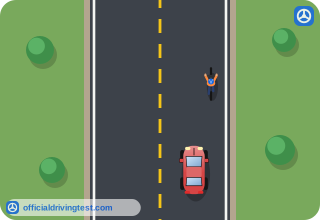
What does the manual say about passing a motorcyclist, scooter operator, moped rider or bicyclist?
- You may never pass them under any circumstance
- You must always honk before passing them
- You may only pass them on divided highways
- Pass like any other vehicle, using an adjacent lane
Show answer
Correct answer: Pass like any other vehicle, using an adjacent lane
The manual instructs drivers to give these riders room and pass them as they would any other vehicle, by moving into an adjacent lane when safe and legal.
Source: What Every Driver Must Know (October 2025), page 55 · Open this page in the manual (Manual page 55)
-
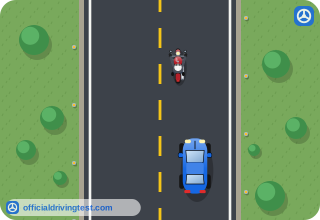
What is the minimum following distance the manual recommends behind a motorcyclist, scooter operator or bicyclist?
- 1 second
- 3 to 4 seconds
- 10 seconds
- One car length, regardless of speed
Show answer
Correct answer: 3 to 4 seconds
Because tailgating is illegal, the manual recommends leaving at least 3 to 4 seconds of travel space behind a motorcyclist, scooter operator or bicyclist.
Source: What Every Driver Must Know (October 2025), page 55 · Open this page in the manual (Manual page 55)
-
How much space does Michigan law require when passing a bicyclist?
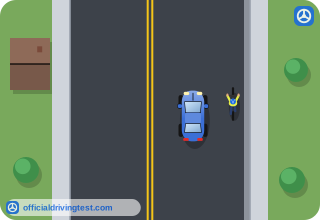
- At least 1 foot
- At least 3 feet
- At least 10 feet
- No specific distance is required
Show answer
Correct answer: At least 3 feet
Michigan law requires leaving at least 3 feet of space between your vehicle and a bicyclist when passing; some cities require even more.
Source: What Every Driver Must Know (October 2025), page 57 · Open this page in the manual (Manual page 57)
-
For visibility and safety at night, what should you do when following a truck or bus?
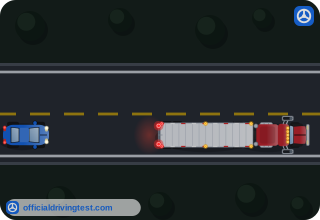
- Use your low beams
- Use your high beams
- Flash your headlights repeatedly
- Turn off your headlights
Show answer
Correct answer: Use your low beams
The manual instructs drivers to use low beams when following a truck or bus at night.
Source: What Every Driver Must Know (October 2025), page 53 · Open this page in the manual (Manual page 53)
-
Why should you avoid following a commercial vehicle too closely ("drafting")?
- It only matters in snow, rain or other slippery road conditions
- It raises the chance of a rear-end collision and limits your view ahead
- It voids your auto insurance coverage for that trip
- The commercial driver will report you to police
Show answer
Correct answer: It raises the chance of a rear-end collision and limits your view ahead
Following too closely limits what you can see ahead and greatly increases rear-end collision risk.
Source: What Every Driver Must Know (October 2025), page 53 · Open this page in the manual (Manual page 53)
-
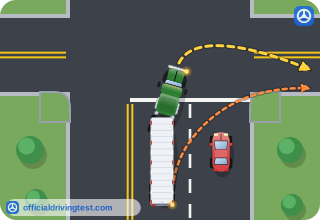
Why do commercial vehicles often swing wide to the left before making a right turn?
- To signal a lane change
- To warm up the engine
- Because they need extra room to safely complete the turn
- Because their turn signal is only on the left side
Show answer
Correct answer: Because they need extra room to safely complete the turn
Commercial vehicles need room to make right turns and may swing wide left first; stopping past the white line can block their turn.
Source: What Every Driver Must Know (October 2025), page 53 · Open this page in the manual (Manual page 53)
-
When you are merging onto the freeway and commercial vehicles may not be able to move over, what should you do?
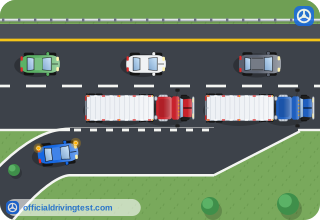
- Stop on the freeway
- Cut in front of a truck and force it to slow down
- Flash your high beams at the trucks
- Match the flow of traffic closely, pick your spot, and go
Show answer
Correct answer: Match the flow of traffic closely, pick your spot, and go
The manual says that when merging onto the freeway, commercial vehicles may not be able to move over, so match the flow of traffic as closely as possible, pick your spot and go.
Source: What Every Driver Must Know (October 2025), page 54 · Open this page in the manual (Manual page 54)
-
When passing a commercial vehicle, you should:
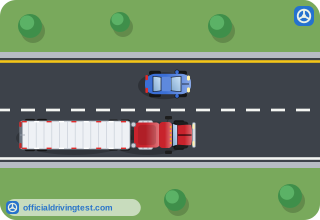
- Signal well in advance and never cut it off
- Cut in quickly to save time
- Pass without signaling since trucks expect it
- Tap your brakes to warn the driver
Show answer
Correct answer: Signal well in advance and never cut it off
Signal intended lane changes well in advance and never cut off a commercial vehicle or force it to slow or stop suddenly.
Source: What Every Driver Must Know (October 2025), page 54 · Open this page in the manual (Manual page 54)
-
Before pulling back into your lane after passing a commercial vehicle, you should:
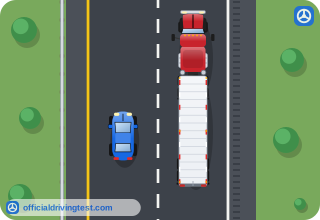
- Wait for the truck driver to flash headlights
- See the truck's entire cab in your rearview mirror
- Signal for two seconds only
- Slow to the truck's speed first
Show answer
Correct answer: See the truck's entire cab in your rearview mirror
As you pass, be sure you can see the entire cab of the truck in your rearview mirror before pulling back into the lane.
Source: What Every Driver Must Know (October 2025), page 54 · Open this page in the manual (Manual page 54)
-
Why should you keep both hands on the steering wheel when passing a commercial vehicle?
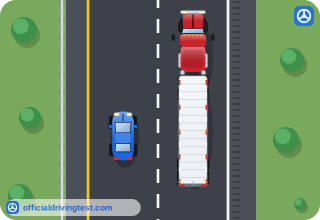
- It's required only for trucks by law
- Because commercial vehicles have no mirrors
- Commercial vehicles create strong air flow and draft
- To operate the horn and signal simultaneously
Show answer
Correct answer: Commercial vehicles create strong air flow and draft
Commercial vehicles create strong airflow and draft at highway speeds, so keep both hands on the wheel while passing.
Source: What Every Driver Must Know (October 2025), page 54 · Open this page in the manual (Manual page 54)
-
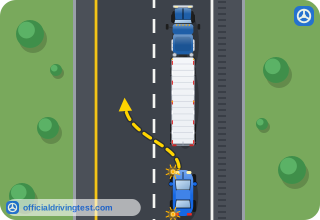
Before attempting to pass a commercial vehicle, especially one pulling a trailer, you should:
- Pass on the right for a better view
- Honk to alert the driver
- Assume it will always continue straight
- Observe its turn signals, since the trailer may swing out before turning
Show answer
Correct answer: Observe its turn signals, since the trailer may swing out before turning
Observe a commercial vehicle's turn signals before passing; drivers pulling trailers often must swing out before turning.
Source: What Every Driver Must Know (October 2025), page 54 · Open this page in the manual (Manual page 54)
-
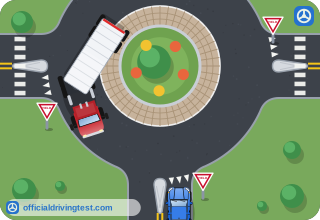
What should you avoid doing when a truck is in a roundabout with you?
- Yielding to it
- Passing or driving next to it
- Signaling your exit
- Following at a normal distance
Show answer
Correct answer: Passing or driving next to it
Avoid passing or driving next to trucks in roundabouts.
Source: What Every Driver Must Know (October 2025), page 54 · Open this page in the manual (Manual page 54)
-
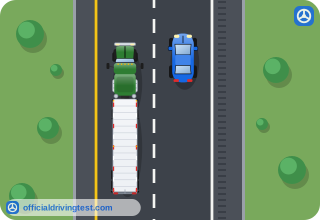
If a truck or bus is passing you, especially in bad weather, you should:
- Turn on your high beams
- Move onto the shoulder
- Slow down and start your wipers
- Speed up to get away from it
Show answer
Correct answer: Slow down and start your wipers
Slow down if a truck or bus is passing you and start your wipers before it passes, since spray can reduce visibility.
Source: What Every Driver Must Know (October 2025), page 54 · Open this page in the manual (Manual page 54)
-
According to the manual, which of these are NOT considered slow-moving vehicles?
- Tractors pulling trailers or wagons
- Amish buggies
- Combines and other farm machinery
- "Four-wheelers" and golf carts
Show answer
Correct answer: "Four-wheelers" and golf carts
"Four-wheelers" and golf carts are specifically not considered slow-moving vehicles.
Source: What Every Driver Must Know (October 2025), page 54 · Open this page in the manual (Manual page 54)
-
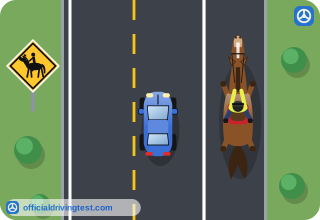
When following a horse and rider or horse-drawn buggy, you should reduce your speed to about ___ and keep a distance of at least ___.
- 5-10 mph / 5 feet
- 40 mph / 100 feet
- 15-20 mph / 20 feet
- 30-35 mph / 50 feet
Show answer
Correct answer: 15-20 mph / 20 feet
Reduce your speed to 15-20 mph and maintain at least 20 feet of distance so as not to spook the horse.
Source: What Every Driver Must Know (October 2025), page 54 · Open this page in the manual (Manual page 54)