Massachusetts: Signals and vehicle controls — Part 3 Practice Test
Questions in this part include: “When you are driving on a roadway, what are other drivers expected to assume you will do unless you show otherwise?” · “How is the hand signal for slowing or stopping made?”
Independent educational site · not affiliated with any government agency or DMV
Ready? Test yourself
- Instant feedback with an explanation
- Every answer cites its source in the manual
- Your best score is saved on this device
Questions are original and based on the official manual "Massachusetts Driver's Manual" (Revised April 2026), Massachusetts Registry of Motor Vehicles.
All 17 questions in this practice test
Take the test above first, then use this list to study. Tap “Show answer” to see the correct answer and explanation.
Show the questions and answersHide the questions
-
A driver coming toward you does not change from high beams to low beams after you flick your headlights. What should you do?
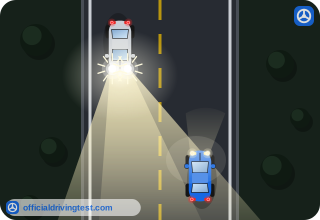
- Turn on your own high beams to match the other driver
- Stay to the right and do not turn on your high beams
- Slow down and stop in your lane until they pass
- Move toward the center line to give them room
Show answer
Correct answer: Stay to the right and do not turn on your high beams
If the oncoming driver does not change to low beams, stay to the right and do not turn on your high beams.
Source: Massachusetts Driver's Manual (Revised April 2026), page 46 · Open this page in the manual (Manual page 46)
-
In fog, which headlights should you use to reduce glare?
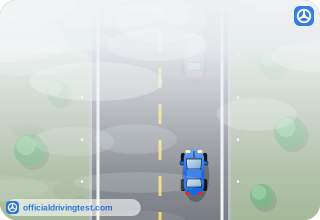
- High beam headlights
- Parking lights only
- Low beam headlights
- No headlights
Show answer
Correct answer: Low beam headlights
In fog, use your low beam headlights to reduce glare.
Source: Massachusetts Driver's Manual (Revised April 2026), page 47 · Open this page in the manual (Manual page 47)
-
What does the manual say about turn signals when driving in rain or fog?
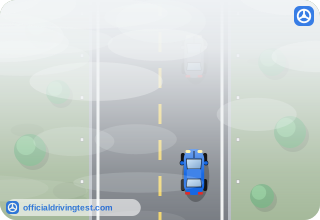
- Always use your turn signals
- Use them only on highways
- Skip them when roads are empty
- Use them only at night
Show answer
Correct answer: Always use your turn signals
The manual says to always use your turn signals when driving in rain or fog.
Source: Massachusetts Driver's Manual (Revised April 2026), page 47 · Open this page in the manual (Manual page 47)
-
When you are driving on a roadway, what are other drivers expected to assume you will do unless you show otherwise?
- Slow down at the next intersection
- Drive straight ahead
- Move into the right lane
- Pull over to the side of the road
Show answer
Correct answer: Drive straight ahead
The manual says you are expected to drive straight ahead unless you show otherwise, which is why you must signal.
Source: Massachusetts Driver's Manual (Revised April 2026), page 93 · Open this page in the manual (Manual page 93)
-
What do your signals do?
- Give you the right-of-way over pedestrians and other motorists
- Allow you to turn without first checking the traffic around you
- Show other drivers the speed at which you are traveling now
- Alert other road users to what you are doing and give them time to react
Show answer
Correct answer: Alert other road users to what you are doing and give them time to react
Signals alert pedestrians and motorists of what you are doing and give them time to react.
Source: Massachusetts Driver's Manual (Revised April 2026), page 93 · Open this page in the manual (Manual page 93)
-
What must you use if the electronic signals on your vehicle are not working?
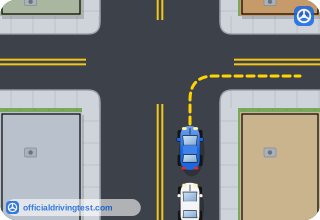
- The three hand signals, made through the driver's side window
- Your horn, sounded once before each move you make
- Your hazard lights, turned on before each move you make
- Your headlights, flashed before each move you make
Show answer
Correct answer: The three hand signals, made through the driver's side window
If the electronic signals are not working, you must use the three hand signals, which should be made through the driver's side window.
Source: Massachusetts Driver's Manual (Revised April 2026), page 93 · Open this page in the manual (Manual page 93)
-
According to the manual, what must you know to pass the road test?
- The location of every RMV Service Center
- The speed limit on each type of road
- The hand signals
- The name of each part of the engine
Show answer
Correct answer: The hand signals
The manual says you must know the hand signals to pass the road test.
Source: Massachusetts Driver's Manual (Revised April 2026), page 93 · Open this page in the manual (Manual page 93)
-
How is the hand signal for a left turn made?
- The arm is bent upward at the elbow
- The arm is held straight out to the side
- The arm is held down at an angle
- The arm is held straight up
Show answer
Correct answer: The arm is held straight out to the side
The left-turn hand signal is shown with the driver's arm extended straight out the driver's side window.
Source: Massachusetts Driver's Manual (Revised April 2026), page 93 · Open this page in the manual (Manual page 93)
-
How is the hand signal for a right turn made?
- The arm is held straight out to the side
- The arm is held down at an angle
- The arm is waved up and down
- The arm is bent upward at the elbow
Show answer
Correct answer: The arm is bent upward at the elbow
The right-turn hand signal is shown with the forearm raised upward from the elbow.
Source: Massachusetts Driver's Manual (Revised April 2026), page 93 · Open this page in the manual (Manual page 93)
-
How is the hand signal for slowing or stopping made?
- The arm is held down at an angle
- The arm is held straight out to the side
- The arm is bent upward at the elbow
- The arm is held straight up
Show answer
Correct answer: The arm is held down at an angle
The slow-or-stop hand signal is shown with the arm angled downward.
Source: Massachusetts Driver's Manual (Revised April 2026), page 93 · Open this page in the manual (Manual page 93)
-
Once you have completed your move, what must you do with your signal?
- Leave it on for another 100 feet
- Leave it on until you change lanes again
- Turn it off
- Flash it twice to thank other drivers
Show answer
Correct answer: Turn it off
Once you have completed your move, you must turn your signal off.
Source: Massachusetts Driver's Manual (Revised April 2026), page 93 · Open this page in the manual (Manual page 93)
-
Before you merge, join traffic from a stopped position, or change lanes, what is the first step?
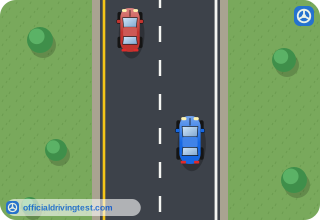
- Signal your intent to move
- Check your mirrors and your blind spot
- Make your move
- Sound your horn to warn nearby drivers
Show answer
Correct answer: Check your mirrors and your blind spot
The manual lists three steps: check your mirrors and blind spot, signal your intent, then make your move.
Source: Massachusetts Driver's Manual (Revised April 2026), page 93 · Open this page in the manual (Manual page 93)
-
When you check your blind spot before a move, which side do you check?
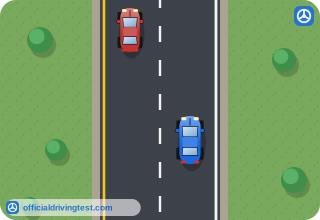
- The side away from the direction you are turning
- Always the left side, whichever way you are turning
- Always the right side, whichever way you are turning
- The side you are moving or turning toward
Show answer
Correct answer: The side you are moving or turning toward
You must check the blind spot on the side you are moving or turning toward.
Source: Massachusetts Driver's Manual (Revised April 2026), page 93 · Open this page in the manual (Manual page 93)
-
Which arm may bicyclists use to signal?
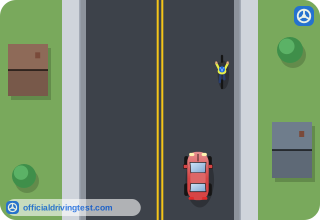
- Either arm
- Only the left arm
- Only the right arm
- Neither arm; they use a hand-held light
Show answer
Correct answer: Either arm
The manual says bicyclists may use either arm to signal.
Source: Massachusetts Driver's Manual (Revised April 2026), page 93 · Open this page in the manual (Manual page 93)
-
Which of these is against Massachusetts law?
- Parking between the white lines of a marked parking space
- Waiting for vehicles in the travel lane to pass before you pull away from the curb
- Bypassing or cutting out a motor vehicle's muffler system
- Using a crosswalk when one is available to cross the road
Show answer
Correct answer: Bypassing or cutting out a motor vehicle's muffler system
The manual says it is illegal to bypass or cut out a motor vehicle's muffler system.
Source: Massachusetts Driver's Manual (Revised April 2026), page 112 · Open this page in the manual (Manual page 112)
-
Where must you return used motor oil, transmission fluid, and other hazardous materials?
- To any licensed repair garage
- To the nearest town dump
- To the place you bought them
- To a Registry of Motor Vehicles office
Show answer
Correct answer: To the place you bought them
The manual says you must return used motor oil, transmission fluid, and other hazardous materials to the place you bought them.
Source: Massachusetts Driver's Manual (Revised April 2026), page 112 · Open this page in the manual (Manual page 112)
-
Who is responsible for disposing of used motor oil and other hazardous materials you return?
- The garage or store that sold it to you
- You, the person who bought it and returned it
- Your city or town, through its local dump
- The company that originally made the oil
Show answer
Correct answer: The garage or store that sold it to you
The manual says the garage or store that sold the materials to you is responsible for disposing of them.
Source: Massachusetts Driver's Manual (Revised April 2026), page 112 · Open this page in the manual (Manual page 112)