Massachusetts: Signals and vehicle controls — Part 2 Practice Test
Questions in this part include: “For which purpose should you use your horn?” · “What does the manual say about Advanced Driver Assistance Systems (ADAS)?”
Independent educational site · not affiliated with any government agency or DMV
Ready? Test yourself
- Instant feedback with an explanation
- Every answer cites its source in the manual
- Your best score is saved on this device
Questions are original and based on the official manual "Massachusetts Driver's Manual" (Revised April 2026), Massachusetts Registry of Motor Vehicles.
All 18 questions in this practice test
Take the test above first, then use this list to study. Tap “Show answer” to see the correct answer and explanation.
Show the questions and answersHide the questions
-
For which purpose should you use your horn?
- To warn pedestrians or other drivers of possible trouble
- To show anger or complain about another driver’s mistake on the road
- To get a slower driver to move faster
- To get vehicles moving in a traffic jam
Show answer
Correct answer: To warn pedestrians or other drivers of possible trouble
The manual says to use your horn to warn pedestrians or other drivers of possible trouble and to avoid crashes.
Source: Massachusetts Driver's Manual (Revised April 2026), page 45 · Open this page in the manual (Manual page 45)
-
You are stopped in a traffic jam. Which is the manual’s advice about your horn?
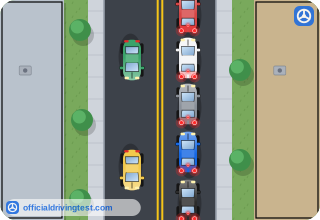
- Tap it to get vehicles moving
- Use it to hurry the car ahead
- Use it every few seconds to show the cars ahead you are ready
- Do not use it to try to get other vehicles moving
Show answer
Correct answer: Do not use it to try to get other vehicles moving
The manual lists trying to get other vehicles moving in a traffic jam as something you should not use your horn for.
Source: Massachusetts Driver's Manual (Revised April 2026), page 45 · Open this page in the manual (Manual page 45)
-
When must you use your headlights and taillights?
- From sunset until sunrise only
- From one-half hour after sunset until one-half hour before sunrise
- From one hour after sunset until one hour before sunrise, every day
- Only when it is completely dark
Show answer
Correct answer: From one-half hour after sunset until one-half hour before sunrise
You must use headlights and taillights from one-half hour after sunset until one-half hour before sunrise.
Source: Massachusetts Driver's Manual (Revised April 2026), page 45 · Open this page in the manual (Manual page 45)
-
You must use your headlights and taillights when you cannot clearly see people or vehicles how far ahead due to insufficient light or weather conditions?
- 500 feet
- 100 feet
- 250 feet
- 1,000 feet
Show answer
Correct answer: 500 feet
You must use headlights and taillights when you cannot clearly see people or vehicles 500 feet ahead because of poor light or weather.
Source: Massachusetts Driver's Manual (Revised April 2026), page 45 · Open this page in the manual (Manual page 45)
-
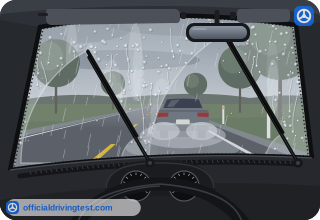
What does the law require you to use whenever you use your windshield wipers?
- Daytime running lights alone
- Parking lights only
- Headlights and taillights
- Fog lights only
Show answer
Correct answer: Headlights and taillights
The law requires headlights and taillights whenever you use your windshield wipers, and daytime running lights are not sufficient.
Source: Massachusetts Driver's Manual (Revised April 2026), page 47 · Open this page in the manual (Manual page 47)
-
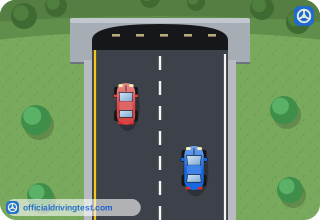
What must you do with your lights while driving through a tunnel?
- Use only your parking lights
- Use your headlights and taillights
- Turn them off to avoid glare
- Use them only if the tunnel is long
Show answer
Correct answer: Use your headlights and taillights
The manual says you must use your headlights and taillights while driving through a tunnel.
Source: Massachusetts Driver's Manual (Revised April 2026), page 45 · Open this page in the manual (Manual page 45)
-
Which is a reason the manual gives for using your headlights and taillights?
- To tell another driver to speed up
- To show another driver may go first
- To warn another driver behind you that you are about to stop
- To alert another driver to turn on their headlights
Show answer
Correct answer: To alert another driver to turn on their headlights
One of the times you must use headlights and taillights is to alert another driver to turn on their headlights.
Source: Massachusetts Driver's Manual (Revised April 2026), page 45 · Open this page in the manual (Manual page 45)
-
What does the manual say about Advanced Driver Assistance Systems (ADAS)?
- They can make driving safer, but only if used correctly
- They make driving safe without any effort or attention from the driver
- They do not need to be learned before use
- They are required on every vehicle
Show answer
Correct answer: They can make driving safer, but only if used correctly
ADAS can make driving safer, but only if used correctly.
Source: Massachusetts Driver's Manual (Revised April 2026), page 46 · Open this page in the manual (Manual page 46)
-
How does the manual say to start learning about your vehicle’s Advanced Driver Assistance Systems?
- Ask another driver to explain them
- Read the owner’s manual
- Test them on a busy road
- Wait until a warning light appears
Show answer
Correct answer: Read the owner’s manual
The manual says to read the owner’s manual to start learning about your vehicle’s systems.
Source: Massachusetts Driver's Manual (Revised April 2026), page 46 · Open this page in the manual (Manual page 46)
-
What does the manual say is still the most important safety feature in your car?
- The antilock brakes
- The driver assistance systems
- The airbags
- The driver
Show answer
Correct answer: The driver
The manual reminds you that the driver is still the most important safety feature in your car.
Source: Massachusetts Driver's Manual (Revised April 2026), page 46 · Open this page in the manual (Manual page 46)
-
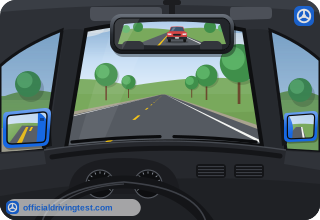
What does putting your inside rearview mirror in the "night" position do?
- Shows more of the road ahead of your vehicle
- Dims your own headlights for oncoming traffic
- Reduces the glare from headlights behind you
- Widens your view of the blind spots
Show answer
Correct answer: Reduces the glare from headlights behind you
The "night" position of the inside rearview mirror reduces the glare from headlights behind you.
Source: Massachusetts Driver's Manual (Revised April 2026), page 46 · Open this page in the manual (Manual page 46)
-
At night, what should you do with the lights inside your vehicle?
- Keep them off
- Keep them on for visibility
- Turn them on when passing
- Dim them halfway
Show answer
Correct answer: Keep them off
The manual says to keep inside lights off when driving at night.
Source: Massachusetts Driver's Manual (Revised April 2026), page 46 · Open this page in the manual (Manual page 46)
-
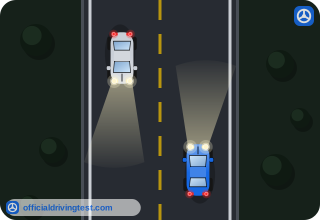
If another driver flashes headlights at you at night, what may be the reason?
- Your brake lights or turn signal may be broken
- Your headlights may be off or your high beams may be on
- The other driver may be asking you to speed up and pass them
- Your windshield wipers may be left on
Show answer
Correct answer: Your headlights may be off or your high beams may be on
If another driver flashes headlights at you, your headlights may be off or your high beams may be on.
Source: Massachusetts Driver's Manual (Revised April 2026), page 46 · Open this page in the manual (Manual page 46)
-
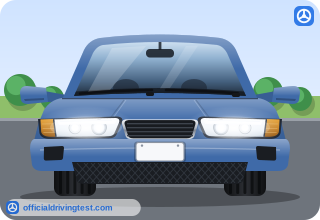
How far ahead do high beam headlights normally let you see?
- About 350 feet
- About 100 feet
- About 200 feet
- About 500 feet
Show answer
Correct answer: About 350 feet
High beam headlights normally let you see about 350 feet ahead.
Source: Massachusetts Driver's Manual (Revised April 2026), page 46 · Open this page in the manual (Manual page 46)
-
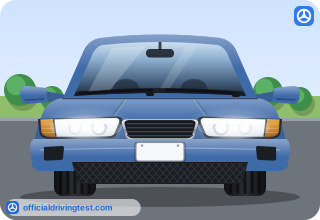
How far ahead do low beam headlights normally let you see?
- About 50 feet
- About 200 feet
- About 100 feet
- About 350 feet
Show answer
Correct answer: About 100 feet
Low beam headlights normally let you see about 100 feet ahead.
Source: Massachusetts Driver's Manual (Revised April 2026), page 46 · Open this page in the manual (Manual page 46)
-
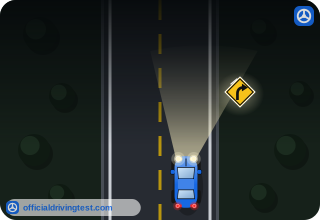
When should you use high beams?
- Whenever you drive after sunset
- Only in dark areas where you cannot see the road surface ahead
- Whenever another vehicle is far ahead
- On any road with no streetlights, even when other vehicles are near
Show answer
Correct answer: Only in dark areas where you cannot see the road surface ahead
Use high beams only in dark areas where you cannot see the road surface ahead.
Source: Massachusetts Driver's Manual (Revised April 2026), page 46 · Open this page in the manual (Manual page 46)
-
You must lower your high beams to low beam when you are within how far of an oncoming vehicle?
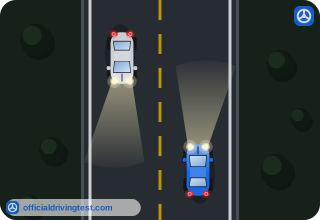
- 100 feet
- 200 feet
- 1,000 feet
- 500 feet
Show answer
Correct answer: 500 feet
You must lower your high beams to low beam when within 500 feet of an oncoming vehicle.
Source: Massachusetts Driver's Manual (Revised April 2026), page 46 · Open this page in the manual (Manual page 46)
-
You must lower your high beams to low beam when you are within how far of a vehicle traveling ahead of you?
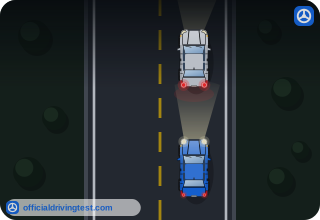
- 100 feet
- 350 feet
- 500 feet
- 200 feet
Show answer
Correct answer: 200 feet
You must lower your high beams to low beam when within 200 feet of a vehicle traveling ahead of you.
Source: Massachusetts Driver's Manual (Revised April 2026), page 46 · Open this page in the manual (Manual page 46)