Massachusetts: Sharing the road — Part 4 Practice Test
Vulnerable road users and the four-foot passing rule, bicycles and bicycle lanes, motorcycles, mopeds, scooters, trucks and buses, school buses, farm vehicles, animals and funeral processions. — Part 4
Independent educational site · not affiliated with any government agency or DMV
Ready? Test yourself
- Instant feedback with an explanation
- Every answer cites its source in the manual
- Your best score is saved on this device
Questions are original and based on the official manual "Massachusetts Driver's Manual" (Revised April 2026), Massachusetts Registry of Motor Vehicles.
All 34 questions in this practice test
Take the test above first, then use this list to study. Tap “Show answer” to see the correct answer and explanation.
Show the questions and answersHide the questions
-
How close may you drive to a trolley passenger step when the trolley is letting passengers on or off?
- No closer than four feet
- No closer than twelve feet
- No closer than eight feet
- No closer than twenty feet
Show answer
Correct answer: No closer than eight feet
State law says you must not drive closer than eight feet of a trolley passenger step when the trolley is letting passengers on or off.
Source: Massachusetts Driver's Manual (Revised April 2026), page 107 · Open this page in the manual (Manual page 107)
-
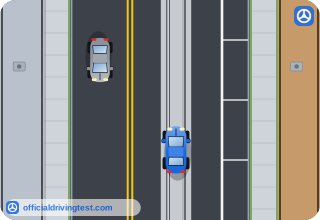
Before crossing any tracks, what should you look for?
- Stop lines painted between the rails
- Oncoming trolleys
- Trolley passenger steps
- A green signal for trolleys
Show answer
Correct answer: Oncoming trolleys
The manual says to look for oncoming trolleys before crossing any tracks.
Source: Massachusetts Driver's Manual (Revised April 2026), page 107 · Open this page in the manual (Manual page 107)
-
If a trolley is approaching, what must you not do?
- Stop at a safe distance
- Look for oncoming trolleys
- Keep a safe distance from it
- Turn in front of it
Show answer
Correct answer: Turn in front of it
The manual says not to turn in front of a trolley if one is approaching.
Source: Massachusetts Driver's Manual (Revised April 2026), page 107 · Open this page in the manual (Manual page 107)
-
Why can't a trolley driver swerve to avoid you?
- A trolley's path is limited to the tracks
- Trolleys are too wide for the roadway
- Trolley drivers are not allowed to brake suddenly
- Trolleys always travel faster than other traffic
Show answer
Correct answer: A trolley's path is limited to the tracks
The manual says a trolley's path is limited to the tracks, so a trolley driver cannot swerve to avoid you.
Source: Massachusetts Driver's Manual (Revised April 2026), page 107 · Open this page in the manual (Manual page 107)
-
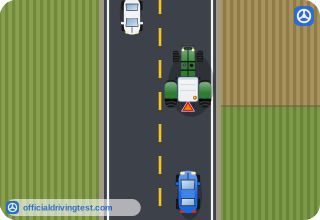
How can you recognize slow-moving vehicles such as farm vehicles and construction rigs?
- They have blue flashing lights mounted on the roof
- They have yellow flags attached to the front bumper
- They usually have orange warning signs attached to the back
- They have green reflective strips along the sides
Show answer
Correct answer: They usually have orange warning signs attached to the back
The manual says most farm vehicles, construction rigs and other slow-moving vehicles have orange warning signs attached to the back.
Source: Massachusetts Driver's Manual (Revised April 2026), page 107 · Open this page in the manual (Manual page 107)
-
If you approach a slow-moving vehicle such as a farm vehicle, what should you do?
- Keep your speed and pass quickly
- Reduce your speed and use caution
- Follow closely behind it
- Flash your headlights to warn it
Show answer
Correct answer: Reduce your speed and use caution
The manual says to reduce your speed and use caution if you approach a slow-moving vehicle.
Source: Massachusetts Driver's Manual (Revised April 2026), page 107 · Open this page in the manual (Manual page 107)
-
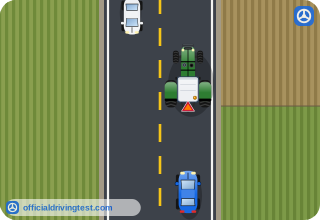
How does the manual say to treat slow-moving vehicles?
- Like emergency vehicles on a call
- Like school buses with flashing lights
- Like large trucks that need extra room
- Similar to bicyclists and pedestrians
Show answer
Correct answer: Similar to bicyclists and pedestrians
The manual says to treat slow-moving vehicles similar to bicyclists and pedestrians and to leave plenty of space around them if you plan to pass.
Source: Massachusetts Driver's Manual (Revised April 2026), page 107 · Open this page in the manual (Manual page 107)
-
What is a funeral procession, according to the manual?
- Two or more vehicles, including a lead or escort vehicle, with the body or cremated remains
- Three or more vehicles, including a lead vehicle, traveling at night with the body
- Five or more vehicles, including a police vehicle, traveling together with the body
- Four or more vehicles, with a hearse in front, traveling on a public way
Show answer
Correct answer: Two or more vehicles, including a lead or escort vehicle, with the body or cremated remains
The manual defines a funeral procession as two or more vehicles, including a lead or escort vehicle, traveling during daylight hours with the body or cremated remains of a deceased person.
Source: Massachusetts Driver's Manual (Revised April 2026), page 107 · Open this page in the manual (Manual page 107)
-
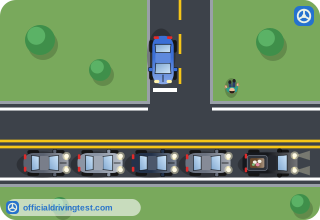
A funeral procession has the right-of-way at intersections, but it must yield to which of these?
- Vehicles waiting at a stop sign
- Any vehicle approaching from the procession's right
- Emergency vehicles with flashing lights or sirens
- Vehicles that have a green light
Show answer
Correct answer: Emergency vehicles with flashing lights or sirens
The manual says funeral processions must yield to emergency vehicles with flashing lights or sirens or when directed by law enforcement.
Source: Massachusetts Driver's Manual (Revised April 2026), page 107 · Open this page in the manual (Manual page 107)
-
If the lead vehicle in a funeral procession legally drives through an intersection, what may the other procession vehicles do?
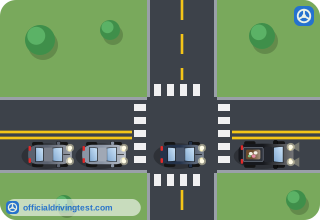
- Stop for any stop sign or red light that appears
- Drive through too, even if the light changes
- Wait for the lead vehicle to return and signal them
- Proceed only if their hazard lights are on
Show answer
Correct answer: Drive through too, even if the light changes
The manual says all vehicles in the procession may also drive through the intersection, even if a traffic light changes or there is a stop sign.
Source: Massachusetts Driver's Manual (Revised April 2026), page 107 · Open this page in the manual (Manual page 107)
-
If you are driving as part of a funeral procession, how closely may you follow the vehicle ahead?
- No closer than four seconds
- At least one car length
- At least 100 feet
- As closely as is safe
Show answer
Correct answer: As closely as is safe
The manual says you may follow the vehicle ahead as closely as is safe.
Source: Massachusetts Driver's Manual (Revised April 2026), page 107 · Open this page in the manual (Manual page 107)
-
On a highway with a speed limit of 55 MPH or higher, what is the fastest a funeral procession vehicle may drive?
- 55 MPH
- 45 MPH
- 65 MPH
- 70 MPH
Show answer
Correct answer: 55 MPH
The manual says a vehicle in a funeral procession must not drive faster than 55 MPH on a highway with a speed limit of 55 MPH or higher.
Source: Massachusetts Driver's Manual (Revised April 2026), page 108 · Open this page in the manual (Manual page 108)
-
On a public way other than a highway with a limit of 55 MPH or higher, how much slower than the speed limit may a funeral procession vehicle go?
- No more than 10 MPH slower
- No more than 15 MPH slower
- No more than 5 MPH slower
- No more than 20 MPH slower
Show answer
Correct answer: No more than 5 MPH slower
The manual says a vehicle in a funeral procession must not go more than 5 MPH slower than the speed limit on any other public way.
Source: Massachusetts Driver's Manual (Revised April 2026), page 108 · Open this page in the manual (Manual page 108)
-
Which lights must a vehicle in a funeral procession have turned on?
- Parking lights only
- Headlights and taillights
- Fog lights and parking lights
- High beams and parking lights
Show answer
Correct answer: Headlights and taillights
The manual says vehicles in a funeral procession must have their headlights and taillights turned on.
Source: Massachusetts Driver's Manual (Revised April 2026), page 108 · Open this page in the manual (Manual page 108)
-
Which vehicles in a funeral procession must have their hazard lights on?
- Every vehicle in the procession
- Only the first vehicle
- Only the last vehicle
- The first and last vehicles
Show answer
Correct answer: The first and last vehicles
The manual says hazard lights must be on if you are the first or last vehicle in the procession.
Source: Massachusetts Driver's Manual (Revised April 2026), page 108 · Open this page in the manual (Manual page 108)
-
When may a vehicle that is not part of a funeral procession drive between procession vehicles?
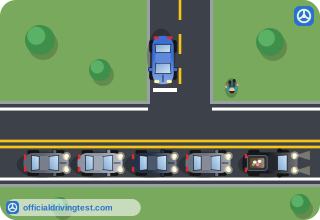
- When directed by law enforcement
- When it has a green light
- When the procession is moving slowly
- When its driver signals first
Show answer
Correct answer: When directed by law enforcement
The manual says you may not drive between procession vehicles unless directed by law enforcement or you are operating an emergency vehicle with siren and flashing lights turned on.
Source: Massachusetts Driver's Manual (Revised April 2026), page 108 · Open this page in the manual (Manual page 108)
-
On a multiple lane highway, you may not pass a funeral procession on its right unless the procession is in which lane?
- The far right lane
- The center lane
- The far left lane
- Any lane
Show answer
Correct answer: The far left lane
The manual says you may not pass a procession on a multiple lane highway on the procession's right, unless the procession is in the far left lane.
Source: Massachusetts Driver's Manual (Revised April 2026), page 108 · Open this page in the manual (Manual page 108)
-
You have a green light while a funeral procession is passing through a red light. What must you do?
- Cross, because you have the green light and the right-of-way
- Not cross unless you can do so without crossing the procession's path
- Cross only after sounding your horn to warn the procession
- Cross behind the last vehicle only if no police are present
Show answer
Correct answer: Not cross unless you can do so without crossing the procession's path
The manual says you may not cross an intersection, even with a green light, while a procession is passing through a red light, unless you can do so without crossing the path of the procession.
Source: Massachusetts Driver's Manual (Revised April 2026), page 108 · Open this page in the manual (Manual page 108)
-
A vehicle owned by a funeral home may display a flashing light of which color during a funeral procession?
- Blue
- Amber
- Green
- Purple
Show answer
Correct answer: Purple
The manual says a funeral home vehicle may display a flashing purple light, but no other color, during a funeral procession.
Source: Massachusetts Driver's Manual (Revised April 2026), page 108 · Open this page in the manual (Manual page 108)
-
Whose right-of-way must you always give when you meet an animal that someone is leading, riding, or driving?
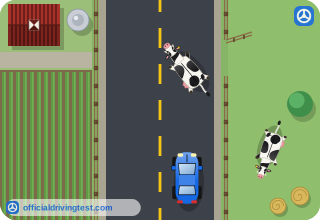
- Your own
- The vehicle that arrived first
- The larger one
- The animal's
Show answer
Correct answer: The animal's
The manual says to always give the right-of-way to an animal that someone is leading, riding, or driving.
Source: Massachusetts Driver's Manual (Revised April 2026), page 108 · Open this page in the manual (Manual page 108)
-
When you get near an animal or a horse-drawn vehicle, what is the first thing the manual says to do?
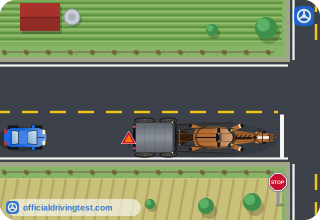
- Slow down
- Honk your horn
- Speed up to pass
- Flash your high beams
Show answer
Correct answer: Slow down
The manual says that when you get near an animal or horse-drawn vehicle you should slow down.
Source: Massachusetts Driver's Manual (Revised April 2026), page 108 · Open this page in the manual (Manual page 108)
-
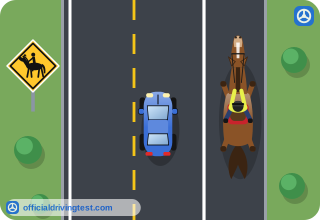
You are passing an animal on the road in Massachusetts and it looks scared. What must you do?
- Pull your vehicle to the side and stop
- Speed up to get past it quickly
- Honk your horn to move it out of the way
- Keep going slowly and flash your headlights
Show answer
Correct answer: Pull your vehicle to the side and stop
The manual says that if the animal you are passing looks scared, you must pull your vehicle to the side and stop.
Source: Massachusetts Driver's Manual (Revised April 2026), page 109 · Open this page in the manual (Manual page 109)
-
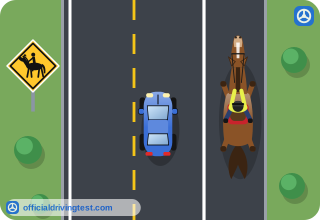
What does the manual say about your horn when you pass an animal or a horse-drawn vehicle?
- Honk once so it hears you coming
- Honk only if it is coming toward you
- Do not honk it or make a loud noise
- Honk twice and then slow down
Show answer
Correct answer: Do not honk it or make a loud noise
Animals are easily scared, so the manual says not to honk your horn or make a loud noise when passing one.
Source: Massachusetts Driver's Manual (Revised April 2026), page 109 · Open this page in the manual (Manual page 109)
-
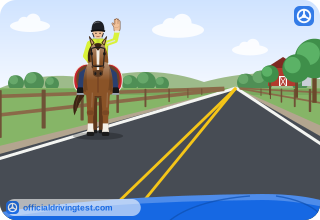
A rider or driver of an animal signals you to stop. What must you do?
- Slow down and keep going
- You must stop
- Pass carefully on the left
- Move to the shoulder and continue
Show answer
Correct answer: You must stop
The manual says you must stop if a rider or driver signals you to do so.
Source: Massachusetts Driver's Manual (Revised April 2026), page 109 · Open this page in the manual (Manual page 109)
-
Which animals does the Massachusetts law on passing animals apply to?
- Only horses pulling a wagon or carriage
- Only animals that someone is riding
- Only horses and ponies
- Horses, cows, and any other draft animals
Show answer
Correct answer: Horses, cows, and any other draft animals
The manual states that the law applies to horses, cows, and any other draft animals.
Source: Massachusetts Driver's Manual (Revised April 2026), page 109 · Open this page in the manual (Manual page 109)
-
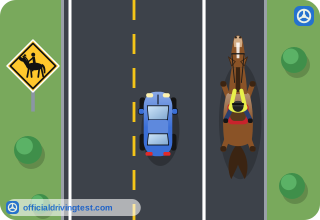
What should you do when you pass an animal that is traveling in the same direction as you?
- Pass as close as you can to save time on the road
- Pass at the highest speed allowed so you are by it quickly
- Pass quickly and sound your horn to warn the rider
- Allow plenty of room and drive at a reasonable speed
Show answer
Correct answer: Allow plenty of room and drive at a reasonable speed
The manual says to allow plenty of room for passing safely and to drive at a reasonable speed.
Source: Massachusetts Driver's Manual (Revised April 2026), page 109 · Open this page in the manual (Manual page 109)
-
Why should you take extra care when passing hay rides in rural areas?
- They usually travel faster than other traffic
- They are usually animal drawn and full of passengers
- They usually have no warning signs on them
- They usually stop suddenly in the middle of the road
Show answer
Correct answer: They are usually animal drawn and full of passengers
The manual says hay rides are usually animal drawn and full of passengers, so take extra care when passing them.
Source: Massachusetts Driver's Manual (Revised April 2026), page 109 · Open this page in the manual (Manual page 109)
-
Which of these does Massachusetts law prohibit while you drive?
- Returning used motor oil to the store that sold it to you
- Throwing anything out of your window while driving
- Parking between the white lines of a marked parking space
- Waiting for vehicles in the travel lane to pass before you pull away from the curb
Show answer
Correct answer: Throwing anything out of your window while driving
The manual says it is illegal to throw anything out of your window while driving.
Source: Massachusetts Driver's Manual (Revised April 2026), page 111 · Open this page in the manual (Manual page 111)
-
Which action is listed as illegal in the manual's miscellaneous rules of the road?
- Parking between the white lines of a marked parking space
- Staying at least four feet away from a bicycle while passing it
- Using a crosswalk when one is available to cross the road
- Throwing garbage or glass onto a roadway or onto public or private land
Show answer
Correct answer: Throwing garbage or glass onto a roadway or onto public or private land
The manual says it is illegal to throw garbage or glass onto a roadway or onto public or private land.
Source: Massachusetts Driver's Manual (Revised April 2026), page 111 · Open this page in the manual (Manual page 111)
-
Which of these is it illegal to do?
- Throwing lighted cigarettes or anything that can cause a fire near a forest or open field
- Returning used motor oil to the store that sold it to you
- Waiting for vehicles in the travel lane to pass before you pull away from the curb
- Staying at least four feet away from a bicycle while passing it
Show answer
Correct answer: Throwing lighted cigarettes or anything that can cause a fire near a forest or open field
The manual says it is illegal to throw lighted cigarettes or anything that can cause a fire near a forest or open field.
Source: Massachusetts Driver's Manual (Revised April 2026), page 112 · Open this page in the manual (Manual page 112)
-
Where may bicyclists not ride in Massachusetts?
- Limited access or express state highways where signs prohibit bicycles
- Any road that has a marked bike lane running beside it
- Any street that is located inside of a business district
- Any road with more than one lane in each direction of travel
Show answer
Correct answer: Limited access or express state highways where signs prohibit bicycles
Bicyclists may use all public ways except limited access or express state highways where signs specifically prohibiting bicycles have been posted.
Source: Massachusetts Driver's Manual (Revised April 2026), page 112 · Open this page in the manual (Manual page 112)
-
Which traffic laws must bicyclists obey when they ride on public ways?
- Only the traffic laws that apply to pedestrians on the road
- Only the traffic laws for streets that have no bike lanes
- The same basic traffic laws that apply to motor vehicle operators
- Special bicycle rules that are used in place of vehicle laws
Show answer
Correct answer: The same basic traffic laws that apply to motor vehicle operators
The manual says bicyclists must obey the same basic traffic laws and regulations that apply to motor vehicle operators.
Source: Massachusetts Driver's Manual (Revised April 2026), page 112 · Open this page in the manual (Manual page 112)
-
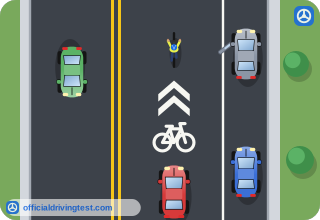
Except on posted limited access or express state highways, where may a bicyclist use the full lane?
- Only on streets that have no bike lane running beside them
- Only on streets with a posted speed limit of 25 mph or less
- Anywhere, anytime, and on any street, even if there is a bike lane
- Only when there is no motor vehicle driving behind the bicyclist
Show answer
Correct answer: Anywhere, anytime, and on any street, even if there is a bike lane
The manual says a bicyclist can use the full lane anywhere, anytime, and on any street, even if there is a bike lane, except where bicycles are banned by posted signs on limited access or express state highways.
Source: Massachusetts Driver's Manual (Revised April 2026), page 112 · Open this page in the manual (Manual page 112)
-
In which direction must bicyclists ride?
- With traffic, unless signs or markings indicate otherwise
- Against traffic, so they can see approaching vehicles
- In either direction on streets with a bike lane
- Toward the nearest pedestrian traffic they can see
Show answer
Correct answer: With traffic, unless signs or markings indicate otherwise
The manual says you must bike in the same direction as traffic unless otherwise indicated by signs or markings.
Source: Massachusetts Driver's Manual (Revised April 2026), page 113 · Open this page in the manual (Manual page 113)